

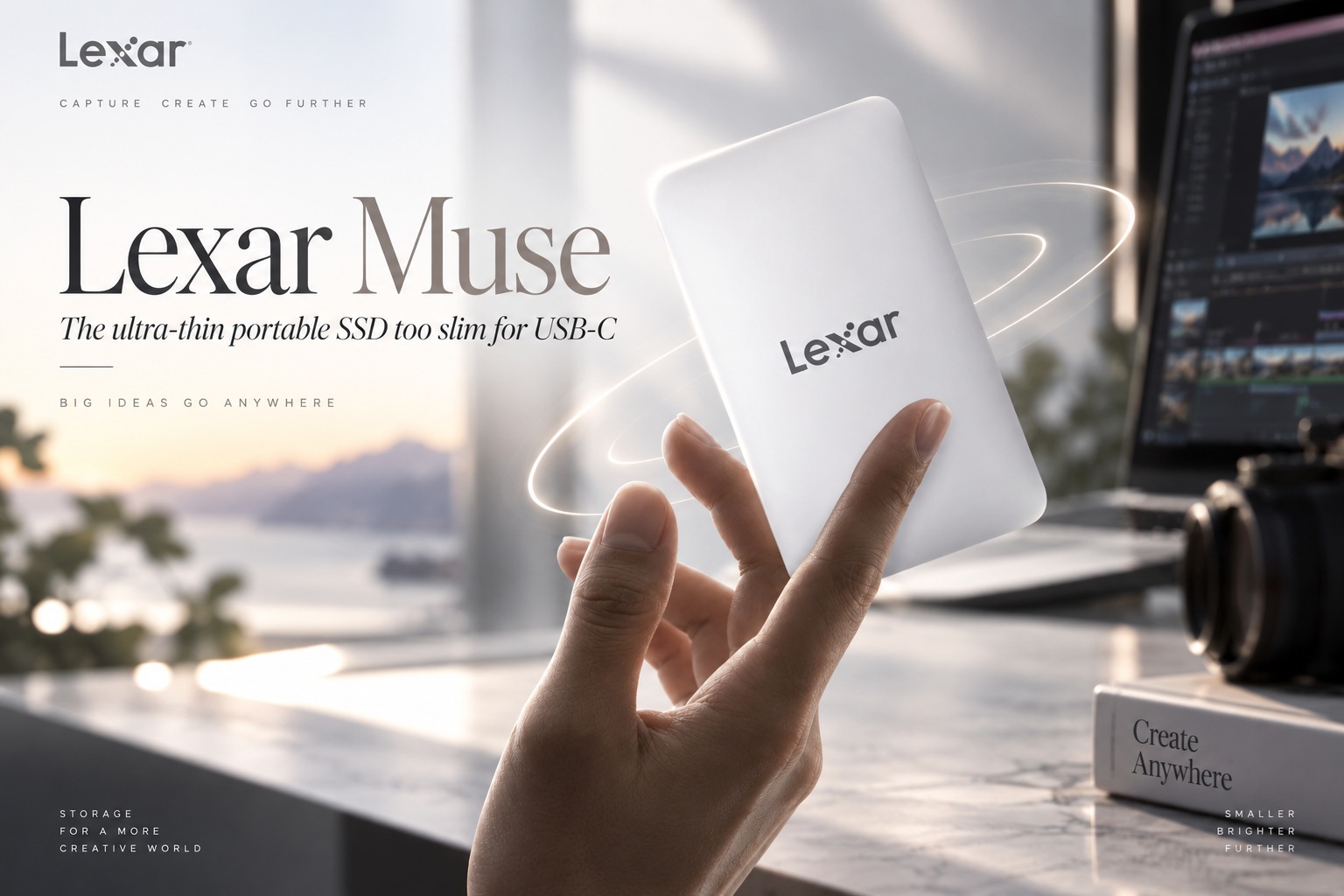
Portable SSDs have been getting smaller for years, but Lexar is taking that trend to an unusual extreme with the new Muse, a portable solid-state drive the company claims is the thinnest in the world. At its thickest point, the drive measures just 3.8mm, tapering down to around 1mm at the edges.
That ultra-slim design creates an interesting problem: there simply is not enough physical space to fit a conventional USB-C port into the drive itself. Lexar's solution is a proprietary magnetic connection called PogoPin, paired with its own SnapLink Magnetic Cable. It is an unconventional compromise, but one that allows the Muse to remain exceptionally thin while still delivering the performance expected from a modern portable SSD.
Thin Enough That USB-C No Longer Fits
Most portable SSDs use a standard USB-C socket because it is compact, widely supported and convenient. The Muse takes portability far enough that even USB-C becomes too bulky for the enclosure.
Instead, the drive uses Lexar's PogoPin magnetic data connection. Despite the name, it does not look exactly like the exposed pogo-pin arrangements commonly seen on accessories and docking stations. The connector is designed to snap magnetically into place with Lexar's proprietary SnapLink cable.
The other end of that cable remains standard USB-C, which means the Muse can still connect to normal USB-C devices. The difference is that losing or damaging the proprietary cable could be considerably more inconvenient than replacing an ordinary USB-C cable.
Performance Is Still Impressively Fast
Despite the unusual connector and extremely thin enclosure, Lexar has not sacrificed much in terms of transfer speed. The Muse is rated for sequential read speeds of up to 1,050MB/s and write speeds of up to 1,000MB/s.
Those figures put it comfortably into the territory of high-speed portable SSDs designed for moving large video files, photos and project data. For most users, that is more than enough performance for backups, media storage and transferring large files between devices.
The more interesting use case, however, is direct recording from a smartphone.
Lexar Is Clearly Thinking About iPhone Video Creators
Lexar specifically highlights support for recording Apple ProRes 4K video at up to 120 frames per second directly to the drive on compatible iPhones. That tells us a lot about who the Muse is really being designed for.
Modern iPhones can produce extremely large video files when recording in high-quality ProRes formats. Internal storage disappears quickly, particularly when shooting at high frame rates, making external SSDs increasingly useful for creators who record professionally on their phones.
By making the Muse extremely thin and lightweight, Lexar is effectively trying to turn external storage into something that feels like part of the phone rather than another peripheral hanging from it.
The MagSafe-Style Mounting Makes the Idea More Practical
Lexar has also shown the Muse being used inside a slim magnetic sleeve that resembles an Apple MagSafe Wallet. The enclosure can attach magnetically to the back of a compatible phone or MagSafe-equipped case.
That approach makes much more sense than leaving a portable SSD dangling from a cable while recording video. The drive stays attached to the back of the smartphone while the short SnapLink cable connects it to the USB-C port.
For video creators, this could result in a remarkably compact recording setup. Instead of mounting a conventional SSD somewhere on a phone cage, the storage essentially becomes another flat accessory attached behind the device.
Technically Universal, but Clearly Designed With iPhone in Mind
Because the SnapLink cable ends in USB-C, the Muse should technically be capable of connecting to other compatible devices. Laptops, Android phones and tablets could potentially use it as ordinary external storage.
However, Lexar's emphasis on ProRes recording and its MagSafe-style form factor strongly suggests that iPhone 15 and newer models are the primary audience. Apple's move to USB-C opened the door to much easier external recording, and professional mobile-video workflows have rapidly grown around that capability.
The Muse seems designed specifically to take advantage of that trend.
Proprietary Connectivity Is the Main Trade-Off
The most obvious downside is the proprietary cable. Standard USB-C portable SSDs have a simple advantage: if the cable disappears, almost any suitable replacement can get the drive working again.
With the Muse, the connection at the SSD itself is unique. Users will therefore need to keep track of the SnapLink cable or purchase another compatible one if Lexar offers replacements separately.
For a product built around extreme thinness, that compromise is understandable. A conventional USB-C socket would simply require a thicker enclosure. But it does create an additional dependency that buyers should consider before choosing the Muse over a more traditional portable SSD.
Magnetic Connections Could Make Everyday Use Easier
There is also an upside to the proprietary design. A magnetic connector can be much easier to attach and remove than plugging a small connector into a thin enclosure.
For smartphone recording, that may be particularly convenient. The drive can remain secured magnetically behind the phone, while its data cable snaps into place without placing excessive mechanical strain on the SSD itself.
The magnetic design could also make accidental cable pulls less damaging if the connection simply detaches rather than dragging the storage device or phone with it.
How durable and reliable the connection proves in everyday use will ultimately depend on the final hardware.
512GB and 1TB Capacities Are Planned
Lexar plans to offer the Muse in 512GB and 1TB capacities when availability begins sometime in the fourth quarter of 2026.
Those capacities make sense for the intended mobile-video audience. A 512GB model should provide a substantial increase over built-in smartphone storage, while the 1TB version gives users more breathing room for longer ProRes recording sessions.
It would have been interesting to see a 2TB option as well, particularly for professional creators, although Lexar could potentially expand the range later if demand justifies it.
Pricing Will Be an Important Part of the Story
Lexar has not yet announced pricing, and that could determine how attractive the Muse ultimately becomes. Portable SSDs have become highly competitive, with conventional USB-C models offering large capacities and strong performance at increasingly affordable prices.
The Muse will likely command some premium because of its unusually thin design, magnetic mounting system and specialised cable. The question is how large that premium will be.
For someone simply looking for external storage, there may be cheaper and more flexible options. For an iPhone videographer who values minimal size and a clean recording setup, paying extra could be easier to justify.
The Five-Year Warranty Is Reassuring
Lexar's global product information mentions a five-year warranty, which is a welcome detail for something intended to store valuable photos and video footage.
Portable SSDs used for professional recording can experience significantly more write activity than drives used occasionally for backups. Having longer warranty coverage provides additional confidence, particularly for creators who intend to use the drive regularly in the field.
Regional warranty conditions may still differ, so buyers will need to check the terms offered in their particular market.
Availability Begins in Q4 2026
Lexar says the Muse will begin rolling out globally in Q4 2026, although availability, specifications and pricing may vary depending on the region.
There is currently no confirmation regarding Malaysian availability or local pricing. That means users interested in the drive will have to wait for Lexar's regional announcements closer to launch.
The same uncertainty applies to accessories such as replacement SnapLink cables and the magnetic mounting sleeve, which could become important parts of the overall ecosystem.
Portable Storage Is Becoming More Like a Smartphone Accessory
The Muse also illustrates a broader change happening in portable storage. External SSDs used to be primarily laptop accessories: small boxes connected when users needed to copy or back up files.
Smartphone photography and video production are changing that relationship. As phones capture higher-resolution content and support professional formats, external storage increasingly needs to be small enough to remain attached while the device is actually being used.
That creates demand for completely different designs. Weight, thickness, cable management and mounting become almost as important as raw read and write performance.
The Muse appears to be designed around exactly that kind of workflow.
Final Thoughts
The Lexar Muse is an interesting example of what happens when a manufacturer prioritises thinness so aggressively that even USB-C becomes too large. At only 3.8mm at its thickest point and around 1mm along the edges, it is remarkably slim for a portable SSD.
Its proprietary PogoPin connection and SnapLink Magnetic Cable are the obvious compromises, but the design also allows Lexar to create an unusually clean mobile-storage solution. With speeds of up to 1,050MB/s reads and 1,000MB/s writes, along with support for direct 4K 120fps ProRes recording on compatible iPhones, performance has not been forgotten.
The Muse probably makes the most sense for iPhone creators who want large external storage without attaching a conventional SSD brick to their phone. For everyone else, the proprietary cable may make a normal USB-C drive more practical.
Still, as smartphones increasingly become serious cameras and production devices, the Muse shows an interesting direction for portable storage: less like an external drive you carry around, and more like an accessory that becomes part of the phone itself.











Comments 0