

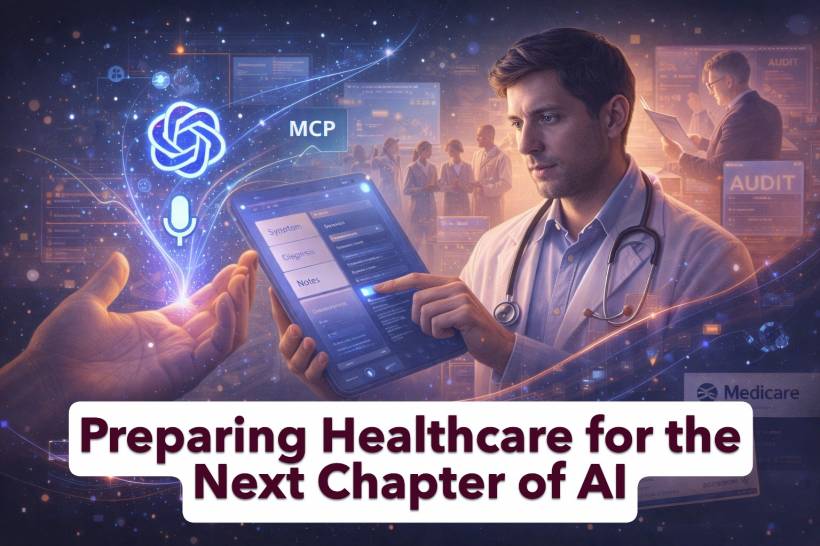
Artificial intelligence in healthcare is moving beyond experimentation and into a more mature, collaborative phase. According to David Lareau, president and CEO of Medicomp Systems, the next stage of AI adoption will be less about massive, standalone systems and more about how different tools work together seamlessly inside clinical workflows. At the center of this shift is a growing focus on interoperability, voice-driven interaction, and practical AI models that solve very specific problems.
From Isolated Systems to Collaborative AI
One of the most important developments shaping this next phase is the rise of the model context protocol (MCP). Rather than acting as yet another AI product, MCP functions as a common language that allows large language models, AI agents, and clinical systems to communicate with trusted knowledge sources in a standardized way.
For healthcare organizations, this represents a meaningful change. Instead of forcing new AI tools to be deeply embedded inside electronic health record systems, MCP allows targeted AI agents to plug in through well-defined interfaces. This opens the door for collaboration across vendors and gives developers more freedom to focus on purpose-built solutions rather than heavyweight integrations.
Cleaner Documentation and More Focused AI
Lareau also sees documentation quality becoming a major priority for both providers and payers. As AI-generated content becomes more common, the expectation for accuracy, completeness, and clinical relevance rises alongside it. Health systems are increasingly looking for tools that help ensure documentation is not only fast to produce, but also reliable enough to support reimbursement and patient care.
At the same time, there is a noticeable shift away from large, one-size-fits-all AI platforms. Many organizations still rely on monolithic systems, but that approach is starting to show its limits. Smaller, domain-specific AI models are gaining attention because they can be tailored to precise clinical tasks, making them easier to manage and easier to trust.

Voice-Driven Interaction Gains Momentum
One area seeing early and sustained momentum is voice-based interaction. Ambient listening tools and voice commands are already helping clinicians reduce documentation burden and spend more time with patients. What is changing now is how these tools connect to enterprise systems.
By using standardized APIs supported by MCP, voice-enabled applications can integrate more cleanly without custom development for each deployment. This flexibility allows health systems to mix and match best-of-breed tools while still maintaining consistent workflows. The end goal is a more natural interaction model where clinicians can rely on AI support at the point of care without friction.
A recurring theme in this evolution is choice. No single vendor can meet every clinical, operational, and financial need, especially as AI capabilities continue to diversify. Health systems want the ability to adopt specialized solutions for focused use cases while ensuring those tools fit into their broader ecosystem.
Standardized connection frameworks like MCP help make this possible by creating predictable ways for AI capabilities to interact with core platforms. Over time, this could significantly accelerate innovation while reducing the integration burden that often slows adoption.
Beyond workflow improvements, regulatory pressure is also shaping AI priorities. As Medicare audits become more rigorous, organizations are paying closer attention to whether documented diagnoses accurately reflect patient conditions and ongoing management. Increased enrollment in Medicare Advantage plans has only intensified this scrutiny.
While tools like ambient listening have improved data capture, they also raise expectations around validation. Health systems now face greater responsibility to confirm that AI-assisted documentation aligns with clinical reality. Failing to do so can introduce compliance risks and financial exposure.
To address this, Lareau expects wider adoption of tools that can review encounters and patient charts to verify that diagnoses are supported by appropriate clinical evidence. These tools can assist clinicians in real time and enable organizations to conduct broader reviews across populations.
Payers are also expected to use similar validation technologies before submitting data to Medicare, creating shared incentives across the healthcare ecosystem. This push aligns closely with ongoing changes to the CMS Hierarchical Condition Category model, which increasingly demands specificity and stronger clinical justification in coding.
As the transition to updated models completes in 2026, technologies that highlight documentation gaps and confirm accuracy will become essential rather than optional.
Finally, cost and infrastructure realities are driving renewed interest in smaller AI models. Large language models can be powerful, but they come with high computing demands and escalating token costs when deployed at scale across thousands of users.
Smaller, domain-specific models offer a more practical alternative. They can run efficiently on standard CPUs, operate within a health system's own secure environment, and reduce reliance on expensive hardware. This approach helps organizations control costs while maintaining tighter oversight of sensitive clinical data.
Taken together, these trends point toward a more grounded and sustainable approach to AI in healthcare. Collaboration over isolation, validation over volume, and precision over scale are becoming the guiding principles. Rather than chasing the biggest model or the flashiest feature, health systems are preparing for an AI ecosystem that quietly supports clinicians, protects data integrity, and improves patient outcomes where it matters most.











Comments 0