

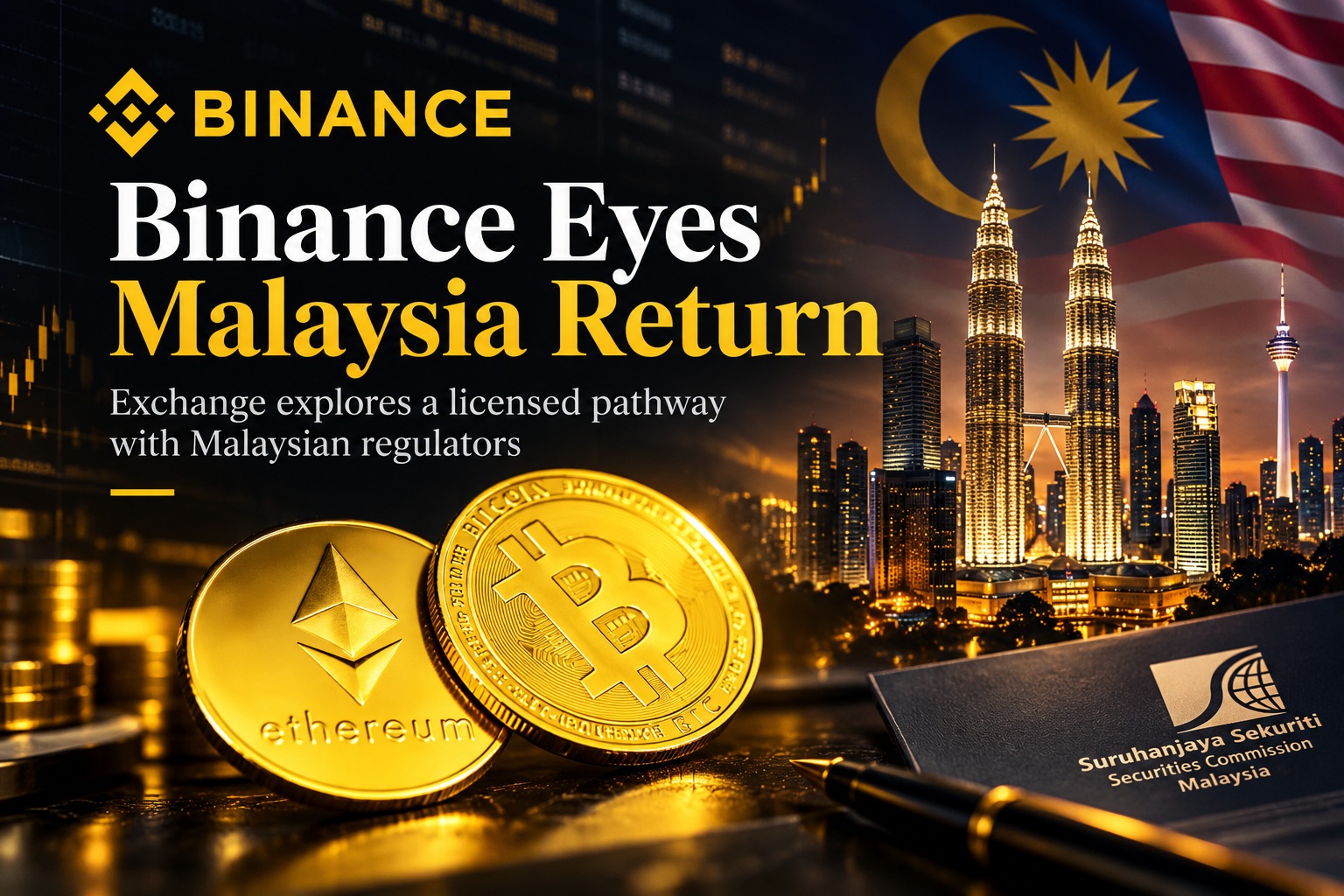
Binance is reportedly exploring a possible return to Malaysia through a properly licensed operation, more than five years after the cryptocurrency exchange was ordered to stop operating locally. The company has confirmed that it has been engaging with both the Securities Commission Malaysia (SC) and Bank Negara Malaysia (BNM) about establishing a regulated business presence in the country.
According to Binance, discussions with the two Malaysian regulators have been taking place jointly for around 10 months. The company has not disclosed exactly which licence it hopes to obtain, saying discussions are still focused on determining whether a licensed operating model is viable and how such a business could be structured.
Binance Wants A Regulated Path Back Into Malaysia
The discussions suggest Binance is attempting to find a formal regulatory route for offering cryptocurrency-related products and services to Malaysian customers. Rather than simply reopening access under its existing international platform, the company appears to be examining how a locally compliant operation could function.
That could potentially involve restrictions or operational requirements different from those applied to Binance globally. Malaysian regulators would also need to determine whether the proposed structure satisfies the country's rules governing digital assets, payments and financial services.
For now, however, Binance has not revealed what products it would offer if a licence is eventually granted.
The Exchange Was Ordered To Stop Operating In Malaysia In 2021
Binance previously faced enforcement action from the Securities Commission in July 2021. At the time, the regulator determined that the company was operating a digital asset exchange in Malaysia without the necessary authorisation.
The SC ordered Binance to stop providing services to Malaysian users and also required the company to cease local media and marketing activities. Restrictions were additionally imposed on Malaysian investors accessing the exchange's Telegram community.
The enforcement action effectively ended Binance's direct Malaysian operations at the time.
Binance Was Removed And Later Returned To The Investor Alert List
The company's regulatory status has continued to change in the years since that enforcement action. Binance was removed from the Securities Commission's Investor Alert List in 2024, a development that attracted attention because of its previous regulatory history in Malaysia.
However, the exchange was reportedly added back to the list earlier this month. No explanation for the latest change was provided in the information accompanying the report.
That renewed listing comes at the same time Binance is discussing a potential licensed business model with regulators, creating an unusual situation where regulatory engagement and continuing scrutiny are happening simultaneously.
The Exact Licence Binance Wants Remains Unknown
One of the biggest unanswered questions is what kind of licence Binance is pursuing. Cryptocurrency businesses can operate under several different regulatory frameworks depending on the services they provide.
Running a digital asset exchange, offering custody services and facilitating payment-related functions may involve different requirements. A peer-to-peer marketplace can raise another set of questions because transactions may occur directly between users rather than through a conventional exchange order book.
Binance has declined to specify which regulatory category it is targeting while discussions remain ongoing.
Bank Negara Malaysia Is Also Involved In The Discussions
The involvement of Bank Negara Malaysia is notable because the central bank's responsibilities differ from those of the Securities Commission. The SC primarily oversees Malaysia's capital markets and regulated digital asset exchanges, while BNM is responsible for areas including banking, payments and monetary policy.
Joint engagement with both regulators could therefore indicate that the proposed Binance structure touches several parts of Malaysia's financial regulatory environment.
However, without additional details from Binance or the regulators, it remains unclear how the responsibilities would ultimately be divided.
The Discussions Have Been Going On For Around 10 Months
Binance says it has been engaging the SC and BNM for approximately 10 months. That suggests the possibility of returning to Malaysia is not a recent reaction to the latest controversy surrounding the company.
Regulatory discussions involving financial services can take substantial time because authorities need to understand the proposed business model, technology, risk controls and consumer protections before granting approval.
A long discussion period also does not guarantee that a licence will eventually be issued.
For now, the talks simply indicate that Binance is exploring whether a compliant operating model can be established.
Binance's P2P Platform Is Also Under Scrutiny
The renewed regulatory discussions come while Binance's peer-to-peer trading platform faces separate questions in Malaysia.
Former finance minister and DAP chairman Lim Guan Eng reportedly wrote to the Securities Commission in September asking the regulator to examine whether Binance's P2P service was facilitating ringgit transactions through advertisements listed using other currency denominations.
His office later circulated the letter publicly on 31 October 2026.
The concern centres on whether marketplace listings could effectively function as substitutes for direct Malaysian ringgit trading even when they were technically placed under another currency.
A Papua New Guinea Kina Marketplace Was Disabled
Binance responded by saying it voluntarily disabled a specific marketplace involving the Papua New Guinea kina.
According to the exchange, that marketplace had been unofficially pegged to the Malaysian ringgit by users. Binance said the decision to disable it formed part of the company's ongoing engagement with the Securities Commission.
The move suggests Binance is adjusting parts of its P2P platform while discussing its regulatory position in Malaysia.
The company has maintained that this does not mean its wider platform is deliberately attempting to provide disguised ringgit trading.
Another Complaint Involved The Romanian Leu Marketplace
Binance also addressed a separate complaint involving an advertisement placed on its Romanian leu marketplace.
The exchange said the advertisement had been created by a non-Malaysian user and described the situation as an isolated incident. Binance rejected the idea that the listing represented a systematic attempt to offer ringgit-denominated trading through another currency category.
According to the company, no other marketplace products were designed to be pegged to the ringgit or serve as direct substitutes for Malaysia's currency.
Binance Says Users Can Still Try To Circumvent Marketplace Rules
The exchange acknowledged that no online marketplace can completely prevent users from attempting to work around platform rules.
Peer-to-peer systems allow individual participants to create advertisements and negotiate transactions, creating moderation challenges that are different from those found in centrally controlled markets.
Binance argues that isolated rule violations by individual users should not automatically be interpreted as evidence of an organised attempt by the platform itself to circumvent Malaysian regulations.
The effectiveness of Binance's enforcement controls will nevertheless remain important to regulators assessing whether a licensed operation should be allowed.
The P2P Issue Could Matter To Any Future Malaysian Licence
If Binance eventually obtains approval to operate in Malaysia, regulators will likely want confidence that the company can prevent unapproved ringgit activity from occurring through alternative routes.
A regulated cryptocurrency platform needs clear controls around how local currency enters and leaves the ecosystem. Authorities also need to understand who is facilitating transactions and whether those activities fall within the permissions granted under a licence.
The recent P2P concerns therefore arrive at a particularly sensitive point in Binance's discussions with Malaysian authorities.
How the exchange addresses those concerns could influence confidence in any proposed local operating model.
A Major Security Incident Has Added Another Complication
The regulatory discussions are also taking place shortly after Binance disclosed a significant security incident involving billions of dollars worth of digital assets.
The incident reportedly affected approximately US$6.3 billion, equivalent to around RM25.6 billion, in cryptocurrency assets.
Binance said its investigation found no evidence that wallet private keys had been leaked. The exchange also maintained that customers' funds remained safe despite the scale of the incident.
The security event nevertheless adds another issue regulators may consider when evaluating the company's risk controls.
Binance Says It Will Cover Losses
Following the incident, Binance pledged to cover losses using its Secure Asset Fund for Users, commonly known as SAFU, together with corporate reserves.
The SAFU mechanism was established to provide an emergency protection pool for users during significant platform security incidents.
Binance reportedly also worked with blockchain partners to freeze around US$3 billion, or approximately RM12.2 billion, worth of affected assets.
That cooperation shows one advantage of blockchain monitoring: assets can sometimes be traced and restricted when exchanges and ecosystem participants coordinate quickly.
No Private-Key Leak Was Found
Binance's statement that no wallet private keys were compromised is an important distinction.
Private keys provide direct control over cryptocurrency wallets, and their compromise can make recovery extremely difficult. A security incident involving other platform systems can still be serious, but exposure of private keys would potentially create much broader consequences.
The exchange has therefore emphasised that the breach did not involve a fundamental loss of control over the cryptographic keys protecting customer wallets.
Even so, a security incident of this scale naturally raises questions about platform security and operational risk.
Regulators Will Likely Examine More Than Just The Technology
A decision on whether Binance can return to Malaysia will likely involve much more than assessing its trading technology.
Regulators may need to examine governance, customer protection, anti-money-laundering controls, cybersecurity, market surveillance and how complaints are handled.
The P2P marketplace may also require particular attention because transactions can involve direct interaction between individual users.
Any licensed Malaysian operation would need to satisfy local requirements regardless of how Binance operates in other countries.
Binance Has Changed Significantly Since 2021
The company seeking regulatory approval today is operating in a very different global environment from when the Securities Commission ordered it to stop operating in Malaysia in 2021.
Cryptocurrency regulation has expanded substantially, and exchanges increasingly seek formal licences in individual countries rather than relying on globally accessible platforms with limited local presence.
Governments have also become more focused on customer protection, stablecoin regulation, anti-money-laundering controls and digital asset custody.
A Malaysian return would therefore likely look considerably more structured than Binance's earlier presence.
Local Licensing Could Restrict Which Services Are Offered
Even if Binance receives approval, Malaysian customers should not necessarily expect access to every product available on its international platform.
Regulated exchanges frequently operate different product sets according to local laws. Services such as derivatives, leveraged trading, staking or certain token offerings may be restricted depending on the jurisdiction.
A Malaysian Binance business could therefore function as a locally tailored version of the platform.
The final product offering would depend on whatever regulatory structure is eventually approved.
Malaysia Already Has A Regulated Digital Asset Framework
Binance would also be entering a market where other digital asset exchanges already operate under the Securities Commission's regulatory framework.
Any new entrant would therefore need to comply with standards that existing licensed operators are already expected to follow.
That includes requirements around customer onboarding, security and asset management.
A Binance licence could increase competition, but it would also place the company within the same regulatory boundaries as other locally approved platforms.
A Licence Could Significantly Change Binance's Malaysian Position
For Malaysian cryptocurrency users, a successful licensing process would represent a major reversal from the situation in 2021.
Instead of being an offshore exchange ordered to stop operating locally, Binance could potentially return as a formally regulated service working directly with Malaysian authorities.
That would provide the company with a clearer legal pathway for marketing and offering products to local users.
It could also provide customers with stronger local regulatory protections than relying on an overseas platform without Malaysian authorisation.
There Is Still No Guarantee A Licence Will Be Granted
Despite the ongoing discussions, nothing in the current information confirms that regulatory approval is imminent.
Exploratory discussions are a normal part of determining whether a proposed financial business can satisfy regulatory requirements.
The SC and BNM may request changes to Binance's proposed model, restrict certain products or ultimately decide that the structure does not meet their requirements.
Until an official licence is issued, Malaysian users should not interpret the discussions as confirmation that Binance has already been approved to resume local operations.
The Investor Alert List Status Adds Uncertainty
Binance's return to the Securities Commission's Investor Alert List also complicates perceptions around the ongoing discussions.
Being placed on the list while simultaneously engaging regulators over a possible licensed operation suggests there remains a clear distinction between Binance's current status and whatever future regulated business it hopes to establish.
The exchange's international services do not automatically become authorised simply because discussions are taking place.
A licence would need to be formally granted before that regulatory position changes.
P2P Controls Could Be A Key Test
The dispute surrounding currency-labelled P2P advertisements demonstrates how difficult it can be to enforce geographic restrictions on a global marketplace.
Even when a platform disables direct MYR support, users may attempt to communicate or structure trades in ways that effectively recreate ringgit transactions.
Binance will therefore need to show that it has mechanisms capable of identifying and removing attempts to circumvent local restrictions.
The voluntary shutdown of the Papua New Guinea kina marketplace appears to be one example of the company responding to those concerns.
Marketplace Moderation Is Difficult At Binance's Scale
Binance operates one of the world's largest cryptocurrency ecosystems, meaning enormous numbers of users can interact with its products.
Monitoring every P2P advertisement manually would be unrealistic. The platform therefore needs automated controls capable of detecting suspicious pricing, descriptions and currency relationships.
Bad actors will inevitably attempt to find ways around those systems.
The regulatory question is less about whether violations can ever happen and more about whether Binance responds effectively when they do.
The Security Incident Could Increase Regulatory Scrutiny
Cybersecurity will likely remain another major focus.
Cryptocurrency exchanges are particularly attractive targets because they can hold or facilitate access to enormous quantities of digital assets. A successful breach can have immediate financial consequences across multiple countries.
Binance's commitment to reimburse affected losses may protect customers financially, but regulators will still want to understand what went wrong and how similar incidents will be prevented.
A licensed Malaysian business would need credible security and incident-response controls.
SAFU Could Help Demonstrate Financial Resilience
The Secure Asset Fund for Users may become part of Binance's argument that it can absorb major security incidents without passing losses directly to customers.
Maintaining reserves specifically for emergencies can provide another layer of protection when technical controls fail.
However, reserve funds do not replace strong security.
The ideal outcome remains preventing attackers from accessing assets or systems in the first place.
Malaysia Could Be An Attractive Market For Binance
Malaysia has an active cryptocurrency community and an established regulatory structure for digital assets, making it an attractive market for major global exchanges.
A licensed operation could allow Binance to compete directly for Malaysian users rather than serving them indirectly through an international platform.
The company also brings significant global liquidity and a large selection of digital asset services.
Whether regulators consider those advantages sufficient will depend on Binance's ability to satisfy local compliance requirements.
Competition Could Benefit Malaysian Crypto Users
If Binance successfully enters the regulated market, increased competition could potentially benefit consumers.
Existing exchanges may respond with lower fees, additional features or improved services. Greater competition can also encourage innovation as platforms try to differentiate themselves.
However, competition only benefits the market when every participant follows comparable regulatory and consumer-protection standards.
A large international brand should not receive weaker requirements simply because of its scale.
Local Regulation Could Also Provide Greater Accountability
One advantage of a locally licensed business is clearer regulatory accountability.
Customers experiencing disputes would have a recognised Malaysian regulatory framework rather than dealing entirely with an offshore entity.
Regulators would also have greater oversight of how the company operates locally and how Malaysian customer assets are handled.
That could improve confidence among users who remain cautious about using international cryptocurrency exchanges.
The Discussions Mark A Significant Change From 2021
Perhaps the most interesting part of the story is simply that Binance and Malaysian regulators are talking about a possible legitimate return.
Five years ago, the relationship centred around enforcement action and an order to stop operating.
Now, Binance says it has spent approximately 10 months discussing how a licensed business could potentially work.
That does not erase the previous regulatory history, but it shows how both the cryptocurrency industry and regulatory landscape have evolved.
Final Thoughts
Binance's discussions with the Securities Commission Malaysia and Bank Negara Malaysia could eventually open the door for one of the world's largest cryptocurrency exchanges to establish a formally licensed presence in the country.
The company says it has spent around 10 months engaging both regulators to explore the viability and structure of a compliant Malaysian business, although it has not revealed which licence it is seeking or what products a future local operation might offer.
The discussions represent a significant change from July 2021, when the Securities Commission ordered Binance to stop operating in Malaysia because it was providing digital asset exchange services without authorisation.
However, the path back is far from straightforward. Binance continues to face questions around its P2P marketplace, including concerns that some users may have attempted to facilitate ringgit transactions through marketplaces listed under other currencies. The exchange says it has voluntarily disabled one such Papua New Guinea kina marketplace and describes a separate Romanian leu listing as an isolated case rather than a systematic effort to avoid Malaysian rules.
The talks also arrive shortly after a major security incident involving approximately US$6.3 billion in digital assets, although Binance says customer funds remain safe and no wallet private keys were leaked.
Whether Malaysia ultimately grants Binance a licence remains unknown. But after years outside the country's regulated digital asset market, the exchange is clearly trying to find a path back — this time through the front door rather than operating without local approval.











Comments 0