

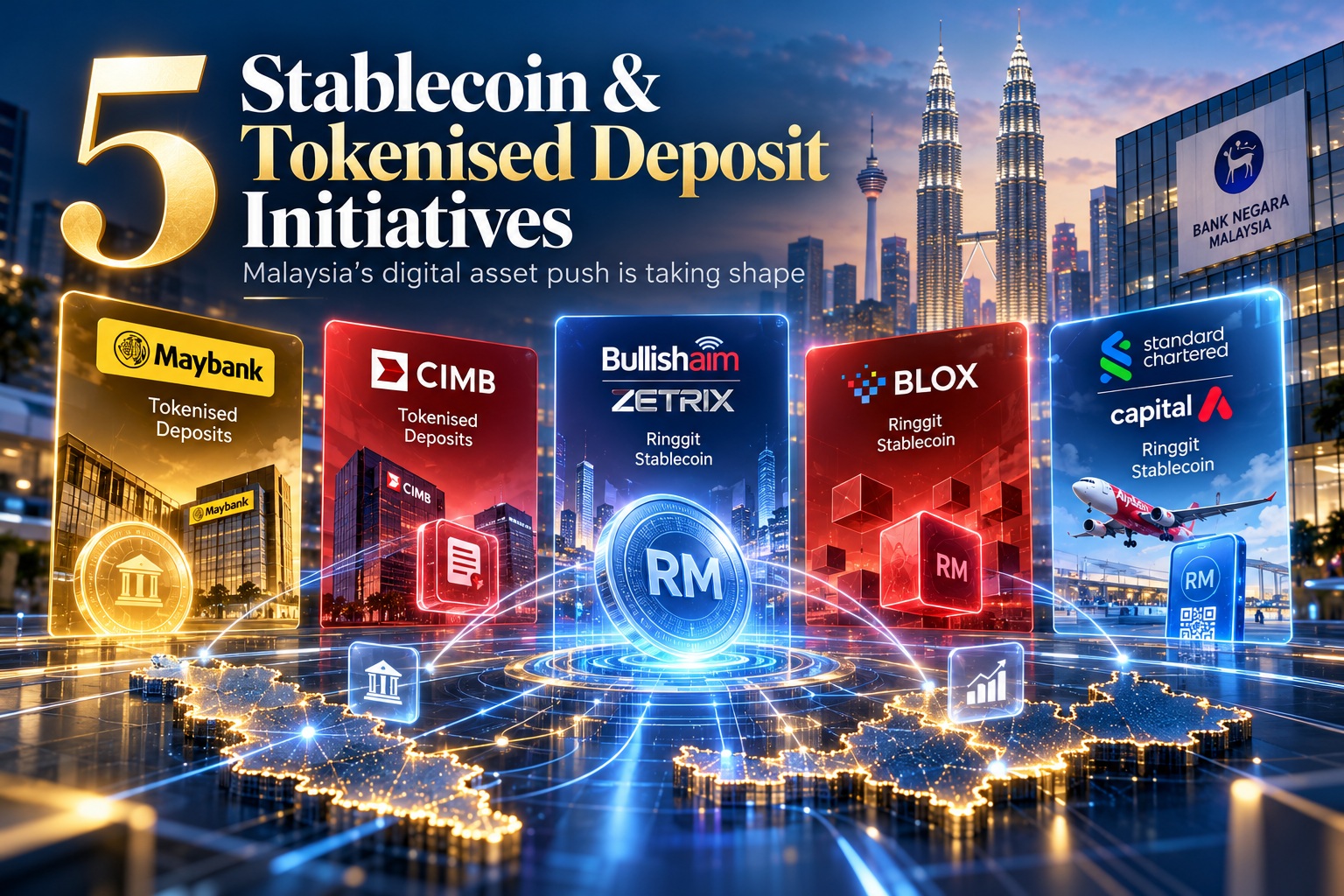
Malaysia's digital asset landscape is moving beyond policy discussions and into practical experimentation, with five ringgit stablecoin and tokenised deposit initiatives now progressing at different stages of development. The momentum follows the launch of Malaysia's Digital Asset Innovation Hub in June 2025 by Prime Minister Datuk Seri Anwar Ibrahim. The initiative was created to encourage experimentation in fintech and digital assets, including areas such as programmable money and ringgit-backed stablecoins.
Since then, banks, fintech companies and blockchain firms have begun testing different ways of representing money and financial assets digitally. Some projects remain controlled pilots, while others have already introduced ringgit-backed stablecoins into circulation.
Bank Negara Malaysia Is Supporting Several Institutional Pilots
In February 2026, Bank Negara Malaysia announced that three initiatives had been onboarded through the Digital Asset Innovation Hub involving Maybank, CIMB, Standard Chartered and Capital A.
These projects are intended to test practical uses for ringgit stablecoins and tokenised deposits, rather than limiting the technology to theoretical demonstrations.
The participating organisations are exploring areas such as securities settlement, foreign exchange, corporate payments and cross-border transactions.
The broader objective is to understand where blockchain-based money could offer advantages over conventional financial infrastructure while still operating within a regulated environment.
1. CIMB Tests Tokenised Deposits For Sukuk Settlement
CIMB became one of the first major Malaysian banks to demonstrate how tokenised deposits could potentially support capital market transactions.
In August 2026, the bank completed a pilot involving the settlement of tokenised sukuk using tokenised bank deposits inside a controlled environment.
The trial involved a RM1.68 billion issuance under CIMB Bank's RM10 billion Senior Sukuk Wakalah programme.
The sukuk carried tenors ranging from five to 15 years, demonstrating that the experiment was connected to a substantial institutional financing transaction rather than a small demonstration.
Twelve Institutional Investors Participated
A total of 12 institutional investors subscribed to the tokenised portion of the issuance.
The remaining RM300 million was issued through the conventional sukuk structure, allowing the transaction to include both traditional and tokenised settlement approaches.
This created an opportunity to examine how blockchain-based settlement could fit alongside established capital market infrastructure rather than replacing everything immediately.
The pilot therefore demonstrates how tokenisation could potentially be introduced gradually into existing financial markets.
The Sukuk Structure Itself Was Not Changed
One particularly important aspect of CIMB's pilot is that the tokenisation layer did not alter the underlying economic or Shariah structure of the sukuk.
The financial instrument remained fundamentally the same. Blockchain technology was instead introduced at the settlement layer.
This distinction matters because tokenisation does not necessarily require financial institutions to redesign the underlying product.
Existing financial instruments can potentially retain their legal and economic characteristics while using new technology for ownership recording or settlement.
CIMB Is Also Engaging The Securities Commission
CIMB has said it is working with the Securities Commission Malaysia as it develops tokenised capital market products.
Regulatory involvement is particularly important when blockchain technology is applied to securities because the digital representation does not remove the existing legal requirements surrounding the underlying product.
The involvement of both financial institutions and regulators suggests Malaysia is taking a controlled approach rather than allowing tokenised products to develop entirely outside the established capital market framework.
That could provide greater certainty if the technology eventually moves beyond pilot programmes.
2. Maybank Uses Tokenised Deposits For Cross-Border Payments
Maybank is exploring another potential use for tokenised money: cross-border payments and foreign exchange settlement.
In March 2026, the bank completed its first on-chain transaction involving the Malaysian ringgit and Singapore dollar corridor.
The transaction included tokenised deposits, an on-chain foreign exchange conversion and a cross-border payment from Malaysia to Singapore.
The pilot was conducted together with Yinson Holdings.
MYR Was Converted To SGD On-Chain
The process began by tokenising bank deposits. The Malaysian ringgit value was then converted into Singapore dollars directly through the blockchain-based system.
The resulting funds were transferred from Malaysia to Singapore using Maybank's permissioned blockchain infrastructure.
According to the pilot description, the cross-border transfer occurred in almost real time.
This illustrates one of the most frequently discussed potential benefits of tokenised deposits: reducing the time and complexity involved when moving value between different banking systems and currencies.
Cross-Border Payments Are A Major Area Of Interest
Traditional cross-border payments often involve several intermediaries before money reaches its final destination.
Banks may need to communicate through correspondent institutions, perform foreign exchange settlement and reconcile records across different systems.
Tokenised deposits could potentially reduce some of those steps by allowing regulated bank money to move across connected digital networks.
Maybank's MYR-SGD experiment therefore provides a practical example of how blockchain could be applied to a real corporate payment scenario.
Permissioned Blockchain Keeps The Network Controlled
Maybank's pilot used a permissioned blockchain, meaning access to the network is restricted rather than being completely open like many public cryptocurrency networks.
This approach is generally more suitable for banks because participating institutions can control who is allowed to interact with the system.
Regulatory requirements, customer identification and transaction oversight can therefore be incorporated more easily.
The result is blockchain technology being used without necessarily adopting the fully decentralised structure associated with cryptocurrencies such as Bitcoin.
3. Standard Chartered And Capital A Explore A Ringgit Stablecoin
A third initiative under the Digital Asset Innovation Hub involves Standard Chartered Malaysia and Capital A.
The organisations signed a letter of intent in December 2025 to explore the development of a ringgit-denominated stablecoin.
Under the proposed arrangement, Standard Chartered Malaysia would act as the issuer, while Capital A and its group of companies would develop and test practical applications for the digital currency.
These use cases could include enterprise operations and other institutional payment scenarios.
The Stablecoin Is Being Explored For Business Use
The initiative appears to focus heavily on institutional rather than consumer applications.
Gerard Ang, Standard Chartered Malaysia's Head of Financing & Securities Services, said during a panel at LIDAC 2026 that institutional users may find clearer value in the technology than ordinary consumers.
One area he highlighted was gross settlement, where individual transactions are settled separately rather than being offset against other payments.
Using blockchain-based money could potentially make this process more efficient when organisations need to move value directly between one another.
Cross-Border Settlement Is Another Potential Use Case
Standard Chartered also sees cross-border payments as one of the stronger arguments for stablecoin technology.
Current correspondent banking processes can involve multiple institutions, settlement delays and additional costs.
A regulated ringgit stablecoin could potentially create another method for businesses to transfer value across markets.
The real advantage would depend on whether the digital currency can integrate effectively with other regulated financial systems and currencies.
Consumers May Not See The Same Immediate Benefit
For ordinary consumers, existing payment systems already work relatively efficiently in many situations.
Malaysia has DuitNow, online banking, cards and increasingly interoperable QR payment systems.
That makes it harder for a ringgit stablecoin to demonstrate an obvious everyday advantage unless it offers something existing systems cannot provide.
Institutional settlement, programmable payments and cross-border transactions may therefore become the more compelling early use cases.
Private Companies Are Also Developing Ringgit Stablecoins
Not every project is being developed directly through Bank Negara Malaysia's innovation programme.
Two private-sector stablecoins have already emerged: MYRC, developed by BLOX, and JMYR, created through Bullish Aim and Zetrix.
Both attempt to represent Malaysian ringgit value digitally on blockchain infrastructure.
Their business models and development stages differ, but both illustrate the growing private-sector interest in ringgit-backed digital money.
4. BLOX Develops The MYRC Stablecoin
BLOX developed MYRC as a ringgit-backed stablecoin intended to explore blockchain-based settlement for tokenised assets and automated payment workflows.
According to CEO and co-founder Ethan Chung, the idea originated from examining how digital settlement infrastructure could support businesses and financial applications.
MYRC is designed to maintain a 1-to-1 relationship with the Malaysian ringgit, meaning one MYRC represents RM1.
Users can reportedly move between traditional fiat money and MYRC according to the supported services.
More Than RM1.8 Million MYRC Was Reportedly In Circulation
By the end of August 2026, BLOX's website indicated that more than RM1.8 million worth of MYRC was circulating.
That remains relatively small compared with Malaysia's conventional payment infrastructure, but the project is still at an early stage.
The figure nevertheless shows that the stablecoin has progressed beyond being merely a technical concept.
The larger question is whether businesses and institutions eventually find enough practical reasons to use it regularly.
BLOX Raised US$1 Million In Seed Funding
BLOX has also raised US$1 million in seed financing.
The investment was led by Kivo Technology, the technology investment arm of a Singapore-based venture fund.
BLOX plans to use the capital to expand MYRC, develop products aimed at businesses and institutions, and support broader company growth.
The funding provides the company with additional resources to move from early experimentation towards wider commercial adoption.
MYRC Is Positioned Around Payments And Tokenised Assets
The project appears to be focusing on situations where programmable digital money could offer practical benefits.
Tokenised assets need a reliable settlement mechanism if buyers and sellers are expected to transact entirely within blockchain-based systems.
A ringgit stablecoin can potentially perform that role by representing Malaysian currency directly on the same digital infrastructure.
Automated payments could also make use of programmable rules, allowing transactions to occur automatically when certain conditions are satisfied.
5. Bullish Aim And Zetrix Introduce JMYR
The fifth major initiative involves Bullish Aim Sdn Bhd and Zetrix.
A ringgit-backed stablecoin initially known as RMJDT went live on the Zetrix blockchain in Johor in December 2025.
The project was positioned as supporting Malaysia's broader Digital Asset National Policy and involved Bullish Aim, which is chaired and owned by Tunku Ismail Ibni Sultan Ibrahim, the Regent of Johor.
The stablecoin has since been renamed JMYR.
One JMYR Is Intended To Equal RM1
JMYR is designed to maintain a stable relationship with the Malaysian ringgit.
Each token is intended to equal RM1 and is described as being fully backed by cash and cash-equivalent assets.
This reserve structure is intended to provide confidence that token holders can treat JMYR as a digital representation of ringgit value rather than a speculative cryptocurrency whose price fluctuates significantly.
Stable reserve management will naturally be critical if the token is expected to gain wider use.
JMYR Is Targeting Individuals, Businesses And Developers
The project positions JMYR as a stablecoin that can serve multiple participants in the digital economy.
Individuals could potentially use it for payments, while businesses may adopt it for settlement or programmable transactions.
Developers could also integrate JMYR into blockchain applications requiring a ringgit-denominated unit of value.
This broad positioning suggests the project wants to build an ecosystem rather than focus on one narrow payment use case.
JMYR's Roadmap Begins With Malaysian Adoption
According to its roadmap, the next stage of JMYR development focuses primarily on Malaysia.
Phase 2 involves introducing wallet integrations, applications and merchant acceptance across the country.
This would help move the stablecoin beyond blockchain users and into more conventional commercial activity.
Merchant integration is particularly important because a digital currency has limited practical value if users have very few places where they can spend it.
ASEAN Cross-Border Settlement Comes Next
Phase 3 of the roadmap looks beyond Malaysia towards ASEAN cross-border settlement corridors.
This could allow JMYR to participate in regional transactions where businesses or financial institutions need to move ringgit-denominated value between countries.
Cross-border applications are one of the strongest recurring themes across Malaysia's digital money projects.
Maybank, Standard Chartered and JMYR are all exploring different versions of the same general problem: making international settlement faster and more efficient.
Tokenised Assets And Web3 Form The Final Stage
JMYR's fourth roadmap phase focuses on tokenised asset markets and the wider Web3 economy.
A stable digital currency could provide settlement liquidity for tokenised securities, property, commodities or other blockchain-based assets.
If these markets develop substantially, having a ringgit-denominated settlement asset could become useful.
However, this stage depends heavily on whether tokenised financial markets themselves achieve significant adoption.
Recent Zetrix Developments Create Additional Uncertainty
The JMYR project may face additional uncertainty because of recent developments involving Zetrix AI.
The Securities Commission Malaysia has reportedly visited Zetrix AI's headquarters in connection with an investigation.
Separately, the Malaysian government is pursuing legal action involving Zetrix AI and its subsidiary MyEG over approximately RM314 million in government revenue collections linked to the Road Transport Department.
Zetrix AI has acknowledged the amount owed, with no resolution timeline provided as of 8 October 2026.
The Investigation Does Not Automatically Determine JMYR's Future
These developments create uncertainty around Zetrix-related projects, but they do not automatically mean JMYR will stop operating.
Stablecoins can involve several organisations responsible for issuance, reserves, blockchain technology and business integration.
What happens next will depend on how the wider regulatory and corporate issues develop.
For now, JMYR remains one of the five notable ringgit digital money initiatives currently associated with Malaysia's expanding digital asset ecosystem.
More Projects Are Already Emerging Beyond The Main Five
The five initiatives are not the only digital money experiments currently being developed.
OCBC and Ant International have also launched a tokenised deposit solution supporting liquidity transfers and corporate treasury management between Malaysia and Singapore.
The service demonstrates how quickly activity around blockchain-based bank money is expanding.
Malaysia could therefore end up with several different approaches operating simultaneously rather than one single model becoming dominant immediately.
OCBC Uses Ant International's WhaleRTP Platform
The OCBC solution operates through Ant International's WhaleRTP platform.
WhaleRTP is designed to connect blockchain-based assets issued by different financial institutions.
This can potentially allow banks to move value between separate digital financial networks without requiring every participant to use exactly the same blockchain infrastructure.
Interoperability will be particularly important if tokenised deposits and stablecoins become widespread.
The System Supports Singapore And US Dollar Liquidity
The OCBC and Ant International system enables movement of Singapore dollar and US dollar liquidity across borders.
One advantage is that transactions can potentially take place beyond normal banking hours.
Traditional banking infrastructure often operates according to settlement windows and market opening hours.
Blockchain-based settlement can theoretically remain available continuously, giving corporate treasury teams greater flexibility in managing liquidity.
Blockchain Creates An Immutable Audit Trail
The system also creates a blockchain-based record of transactions.
Because blockchain records are designed to be difficult to alter retrospectively, this can provide an immutable audit trail for financial transfers.
That could help institutions with reconciliation and auditing, particularly when several entities participate in the transaction.
However, blockchain records still need to integrate accurately with each organisation's internal accounting and banking systems.
Stablecoins And Tokenised Deposits Are Not The Same Thing
Although the two terms frequently appear together, stablecoins and tokenised deposits represent different approaches.
A stablecoin is generally a digital token issued against underlying reserves and designed to maintain a stable value relative to a currency such as the ringgit.
A tokenised deposit, on the other hand, represents money already held as a bank deposit.
The distinction becomes important because the legal claim, issuer and regulatory treatment may differ considerably.
Tokenised Deposits Remain Closely Connected To Banks
Because tokenised deposits represent conventional bank deposits, they naturally remain connected to the financial institution holding the underlying money.
This can make them attractive for regulated institutional use because they fit more closely into the existing banking framework.
Banks can potentially add blockchain settlement capabilities without introducing a completely separate form of privately issued money.
The CIMB and Maybank pilots demonstrate how this approach could work in capital markets and cross-border payments.
Stablecoins Can Potentially Operate More Broadly
Stablecoins can be integrated across blockchain applications more easily because they exist as transferable digital tokens.
Developers can incorporate them into wallets, decentralised applications and tokenised asset platforms.
That flexibility creates more possibilities but also introduces questions around reserve management, redemption rights and regulation.
The success of projects such as MYRC and JMYR will therefore depend heavily on maintaining confidence that every token remains properly backed.
The Ringgit Stablecoin Question Is Really About Utility
Creating a token that equals RM1 is technically achievable. The bigger challenge is giving people and businesses a compelling reason to use it.
Existing Malaysian payment systems are already fast and convenient for domestic consumer payments.
A stablecoin therefore needs to solve problems conventional banking infrastructure handles less effectively.
Cross-border settlement, programmable payments and tokenised asset transactions appear to be the areas where the strongest potential value is currently being explored.
Domestic Payments May Be The Hardest Market
Convincing consumers to replace DuitNow or mobile banking with a stablecoin could prove difficult.
Existing payment systems already allow Malaysians to transfer money almost instantly and pay merchants through QR codes.
For a ringgit stablecoin to gain meaningful domestic adoption, it would likely need to offer additional functionality rather than simply duplicate those capabilities.
Programmability and integration with digital assets may provide that differentiation.
Programmable Money Could Enable New Workflows
Programmable money allows payment rules to be embedded directly into digital transactions.
A company could potentially configure a payment to execute automatically once goods arrive, a contract condition is satisfied or another verified event occurs.
This reduces the need for several manual approval and reconciliation steps.
The Digital Asset Innovation Hub's focus on programmable money suggests Malaysia wants to explore these possibilities alongside more conventional payment improvements.
Institutional Adoption May Come Before Consumer Adoption
Most of the strongest use cases currently involve organisations rather than individual consumers.
Banks want faster securities settlement. Corporations want efficient cross-border treasury transfers. Businesses may benefit from automated payments and tokenised asset settlement.
Consumers already have convenient alternatives for many everyday transactions.
The first meaningful adoption of digital ringgit technology may therefore happen quietly inside financial institutions before ordinary users encounter it directly.
Regulation Will Determine How Far These Projects Can Grow
Every initiative will eventually depend on Malaysia's regulatory framework.
Stablecoins involve questions around reserves, issuance and redemption, while tokenised securities remain subject to existing capital market requirements.
Banks also need to comply with financial regulations regardless of whether their transactions happen on a blockchain.
The Digital Asset Innovation Hub provides a controlled environment for experimenting with the technology before regulators decide how broader commercial deployment should work.
Interoperability Could Become The Biggest Challenge
If several banks and private companies issue different forms of tokenised money, those systems will eventually need ways to communicate.
A business should not need completely separate infrastructure for every bank-issued deposit token or stablecoin it encounters.
Platforms capable of connecting different digital assets could therefore become extremely important.
The OCBC and Ant International project already points towards this interoperability problem.
The Five Projects Are Testing Different Parts Of The Same Future
CIMB is exploring tokenised deposits for capital market settlement.
Maybank is testing them for cross-border payments and foreign exchange.
Standard Chartered and Capital A are examining institutional stablecoin applications.
BLOX is developing MYRC around business payments and tokenised assets, while JMYR has ambitions ranging from domestic merchant adoption to ASEAN settlement and Web3 markets.
These projects may compete in some areas, but they are also collectively testing where blockchain-based money actually provides meaningful value.
The Bigger Question Is Which Model Can Scale
The existence of five projects does not mean all five will eventually become widely used.
Some may remain experiments. Others may evolve into specialised infrastructure used primarily by banks or corporations.
One model could eventually dominate, or several could coexist for different purposes.
The deciding factor will not necessarily be which technology sounds most advanced. It will be which one solves an actual problem more effectively than the systems already available.
Final Thoughts
Malaysia's digital money ecosystem is moving rapidly from policy discussions into practical experimentation. Five major initiatives involving ringgit stablecoins and tokenised deposits are now progressing across banking, capital markets and private blockchain platforms.
CIMB has already used tokenised deposits to settle part of a RM1.68 billion sukuk issuance, while Maybank completed an almost real-time on-chain MYR-SGD transaction involving tokenised deposits and foreign exchange conversion.
Standard Chartered Malaysia and Capital A are exploring a ringgit stablecoin aimed at institutional use cases, particularly gross settlement and cross-border payments.
Meanwhile, BLOX's MYRC and the Bullish Aim-Zetrix JMYR project represent private-sector attempts to create ringgit-backed stablecoins for payments, programmable transactions and eventually tokenised asset markets.
Other developments are also emerging, including OCBC and Ant International's tokenised deposit solution for cross-border corporate treasury management.
The technology is therefore no longer limited to demonstrations of whether a ringgit can technically exist on a blockchain. The experiments are increasingly asking a more important question: where does digital ringgit actually work better than the financial infrastructure Malaysia already has?
The answer will determine whether stablecoins and tokenised deposits remain specialised pilots or eventually become an important part of Malaysia's banking and payments system.











Comments 0