

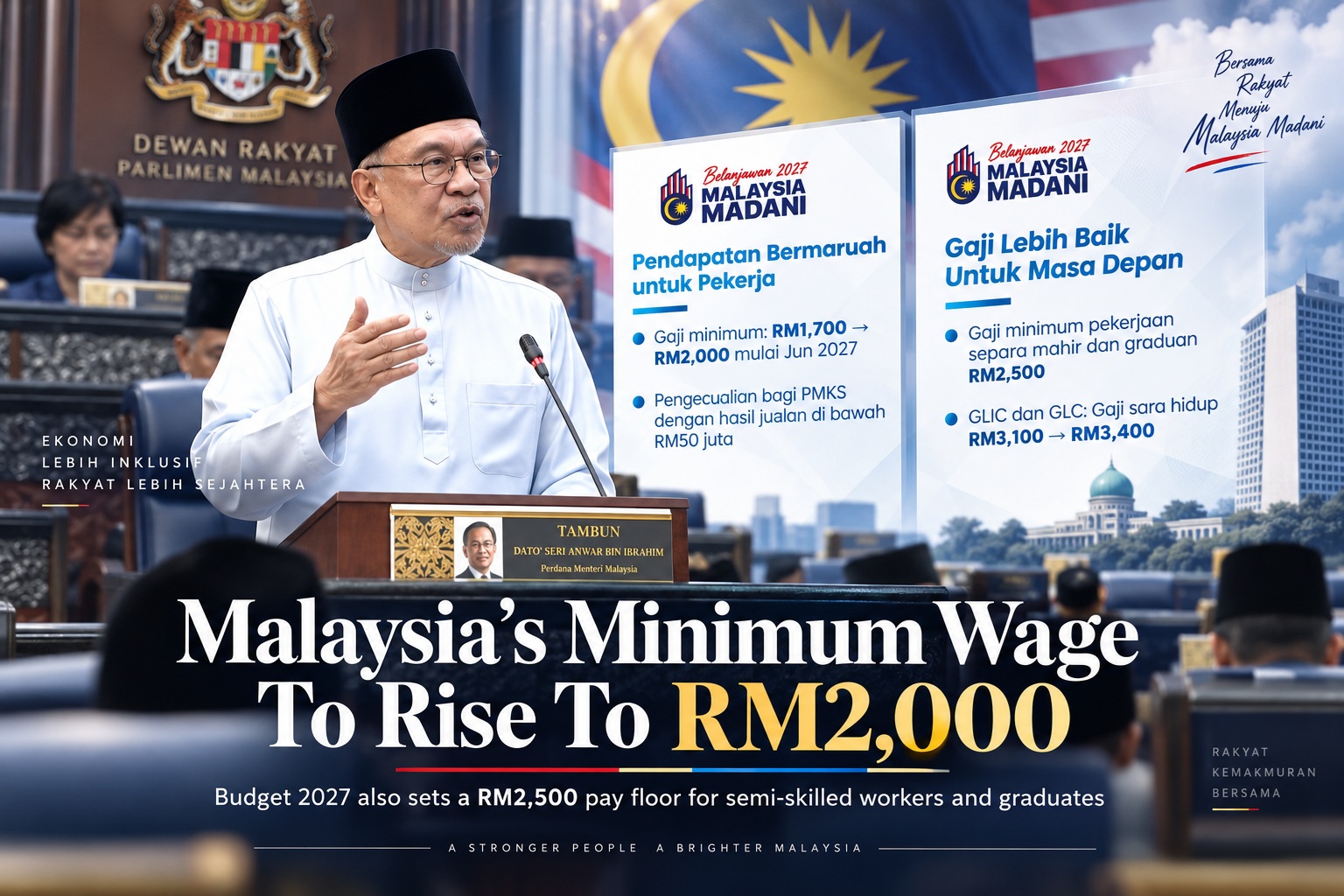
Malaysia's minimum wage will increase from RM1,700 to RM2,000 per month beginning in June 2027, following an announcement made during the tabling of Budget 2027. Prime Minister Datuk Seri Anwar Ibrahim said the adjustment is intended to narrow the gap between workers' productivity and wages as households continue facing higher living costs. More than four million workers are expected to be covered by the new minimum wage rate.
The government is also introducing broader changes to Malaysia's wage framework, including a proposed RM2,500 minimum monthly salary for semi-skilled workers and graduates. Separately, new conditions involving salary payments and tax deductions will apply to larger employers, while micro, small and medium enterprises, or MSMEs, will be exempted from those particular requirements.
Minimum Wage Increases From RM1,700 To RM2,000
The new RM2,000 minimum wage represents an increase of RM300 per month from the current RM1,700 rate. It will take effect in June 2027, giving employers several months to prepare for the change. Anwar said more than four million workers across Malaysia are expected to benefit once the new rate comes into force.
According to the Prime Minister, one of the underlying problems facing Malaysian workers is that wages have not kept pace with increases in productivity and the overall cost of living. When prices rise more quickly than household income, workers can experience declining purchasing power even if they remain employed. Raising the wage floor is intended to provide additional income protection for workers at the lower end of the salary scale.
Government Wants Wages To Better Reflect Productivity
Anwar said the gap between productivity and worker compensation needs to be reduced. Malaysia has continued developing higher-value industries and attracting investment, but the government believes wage growth needs to improve alongside those economic developments. Budget 2027 therefore places greater emphasis on increasing income rather than relying entirely on subsidies and other forms of cost-of-living assistance.
A higher minimum wage does not automatically address every income challenge, but it establishes a new floor beneath which eligible workers should not be paid. The government is also looking beyond entry-level wages by introducing measures targeting graduates and semi-skilled employees, whose qualifications may not always be reflected adequately in their salaries.
RM2,500 Minimum Salary For Graduates And Semi-Skilled Workers
Budget 2027 will introduce a minimum monthly salary of RM2,500 for semi-skilled workers and graduates. Anwar said the existing minimum wage primarily protects workers at the bottom of the income scale, while pay for more qualified workers can remain disproportionate to their education or skills. The new measure is therefore intended to address part of that imbalance.
This represents a broader shift from treating wage policy purely as minimum-wage protection. By creating a separate benchmark for graduates and semi-skilled employees, the government is signalling that educational qualifications and occupational skill levels should translate into higher starting salaries. Further implementation details will determine exactly which occupations and workers fall within the new framework.
GLICs And GLCs Raise Living Wage Benchmark To RM3,400
Government-linked investment companies and government-linked companies have also committed to increasing their living wage benchmark. The current RM3,100 monthly benchmark will rise to RM3,400, with approximately 230,000 workers expected to benefit from the change.
A living wage is different from a statutory minimum wage because it aims to provide workers with an income that more realistically reflects the cost of maintaining a reasonable standard of living. The government is using GLICs and GLCs as examples of employers that can move beyond the legal minimum. Anwar also welcomed similar initiatives introduced by major employers in sectors such as banking and oil and gas.
Private-Sector Employers Encouraged To Follow
The Prime Minister called on other private-sector companies to adopt more reasonable wage levels as well. While the statutory minimum wage sets the lowest permitted salary for affected workers, companies are encouraged to pay more when their financial position, workforce requirements and employee skill levels allow it.
Higher wages could also help employers attract and retain skilled workers, particularly in sectors facing talent shortages. Malaysia's longer-term challenge is therefore not simply raising the legal minimum every few years, but creating an economy where productivity improvements translate more consistently into better compensation.
MSME Exemption Applies To New Salary Payment Tax Rules
The MSME exemption announced under Budget 2027 relates to new conditions governing tax deductions on salary expenses. It should not be confused with an exemption from the RM2,000 minimum wage based on the information announced. The government is introducing the tax measure as part of efforts to reduce the employment of undocumented foreign workers.
For companies other than MSMEs, salary expenses will only qualify for the relevant tax deductions when wages are paid through bank accounts using payment methods permitted under the Employment Act. The measure creates a clearer transaction trail and makes salary payments easier for authorities to verify. MSMEs are exempted from this particular requirement.
Government Targets Undocumented Foreign Employment
Requiring larger employers to make salary payments through traceable banking channels is intended to strengthen oversight of employment practices. Cash-based arrangements can be more difficult for authorities to monitor and may make it easier for undocumented employment to remain outside formal payroll systems.
Linking tax deductions to recognised payment methods gives companies a financial incentive to maintain more transparent salary records. The government appears to be using taxation policy alongside employment regulations rather than relying solely on enforcement operations. Exempting MSMEs from the new condition also reduces additional administrative requirements for smaller businesses.
A Broader Reform Of Malaysia's Wage Structure
Taken together, the measures announced under Budget 2027 go beyond a single increase in the national minimum wage. The RM2,000 wage floor, RM2,500 benchmark for graduates and semi-skilled workers, and RM3,400 living wage commitment among GLICs and GLCs represent different levels of the government's attempt to improve worker incomes.
The changes also show greater attention being paid to wage progression rather than only employment numbers. Having a job is important, but the government is increasingly highlighting whether salaries are sufficient for workers to manage living costs and whether skilled employees are being compensated appropriately for their qualifications.
Final Thoughts
Malaysia's minimum wage will rise from RM1,700 to RM2,000 in June 2027, benefiting more than four million workers. Budget 2027 will also introduce a RM2,500 minimum monthly salary for graduates and semi-skilled workers, while GLICs and GLCs are raising their living wage benchmark from RM3,100 to RM3,400 for around 230,000 employees.
The wider objective is to reduce the gap between productivity, qualifications and actual wages while responding to rising living costs. At the same time, the government is tightening salary-payment requirements for larger employers as part of efforts to curb undocumented foreign employment, with MSMEs exempted from that specific tax-deduction condition.











Comments 0