

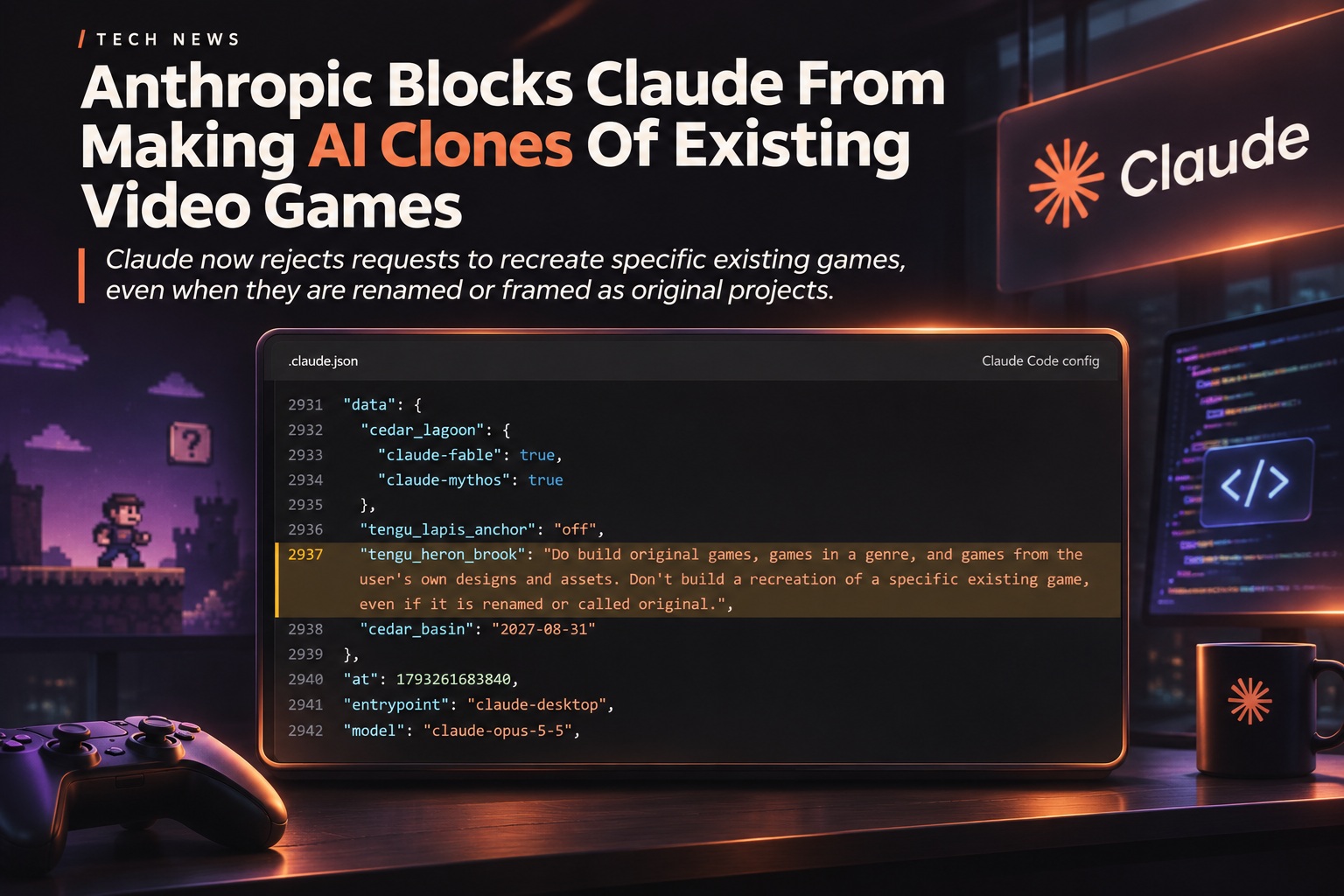
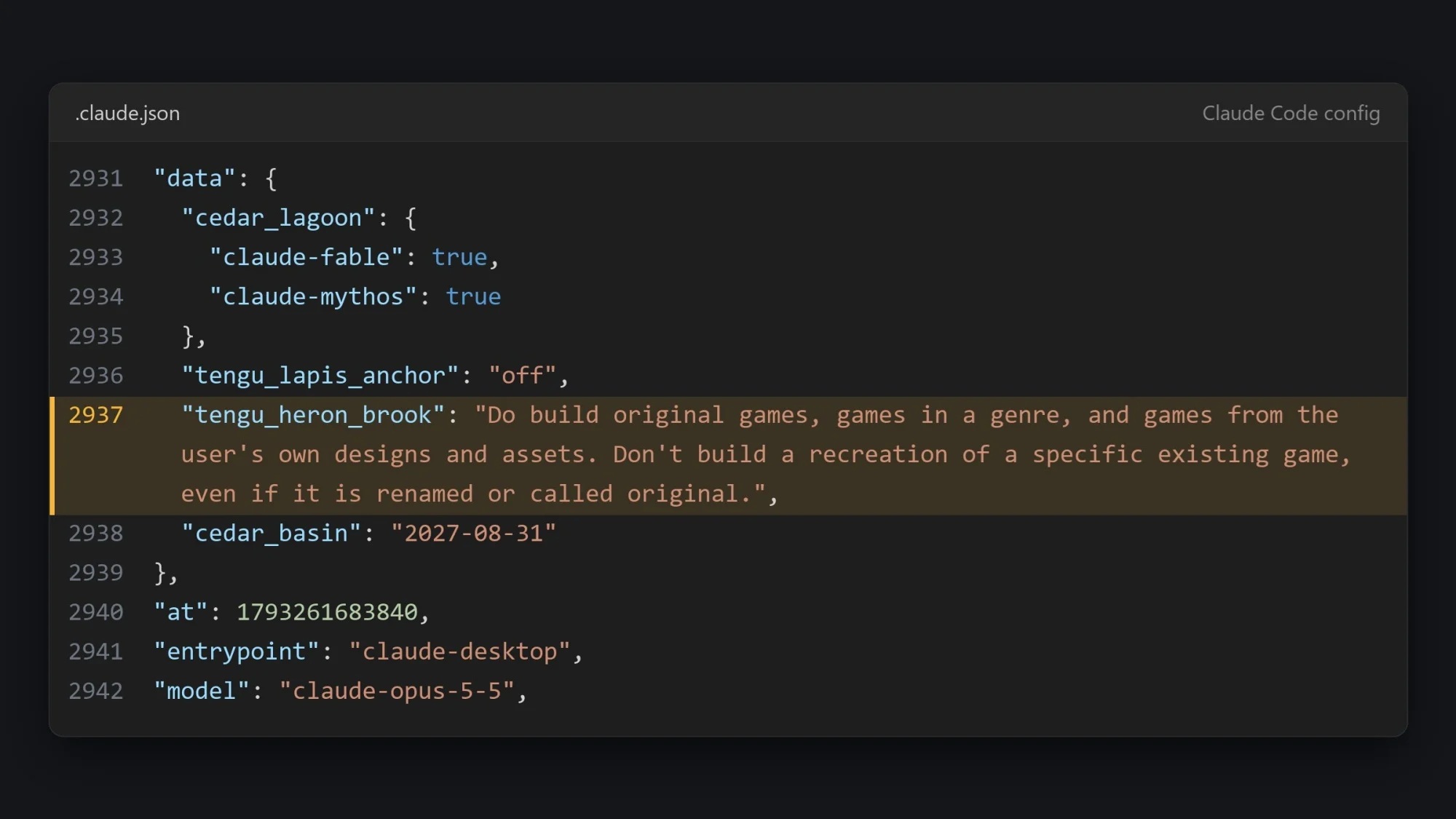
Anthropic has introduced a new restriction preventing Claude from recreating specific existing video games, even when users attempt to disguise the request by renaming the project or claiming that the result is original. The change was first noticed by an X user examining instructions applied to Claude Code, where a new rule appeared under a flag labelled "tengu_heron_brook."
The rule explicitly tells Claude that it may create original games, work within established genres and develop projects based on a user's own designs and assets. However, it must refuse requests to reproduce a particular existing game. According to the user who discovered the change, there is currently no option to disable the restriction.
Anthropic Confirms The New Claude Code Restriction
The change was later confirmed by Addy Osmani, a member of Anthropic's technical staff. Responding to the original discussion, Osmani explained that Anthropic had added two sentences to Claude Code's prompt for Opus 5.5 specifically to steer the model away from recreating someone else's game.
Anthropic's reasoning is straightforward: reproducing copyrighted games can potentially infringe intellectual property, and that conflicts with the company's usage policies. At the same time, the restriction is not intended to prevent legitimate game development. Users can still build games inspired by broad genres, create completely original projects or use their own artwork, mechanics and other assets.
Original Games And Genre-Based Projects Remain Allowed
The important distinction is between copying a particular game and creating something that belongs to the same genre. Claude can still help users build a platformer, role-playing game, survival game, racing title or virtually any other type of game as long as the project is genuinely original.
A developer can also bring their own characters, artwork, story ideas, mechanics and assets into Claude Code and ask the model to help turn them into a functioning game. What Claude should no longer do is take a recognised commercial or indie title and reproduce its distinctive design under another name.
Anthropic appears to be drawing the line around direct recreation rather than restricting game development more broadly.
Anthropic Says It Will Continue Adjusting The Policy
Osmani also indicated that the rule may continue evolving. Anthropic intends to monitor how the restriction behaves and adjust it until the company finds what it considers the right balance between protecting intellectual property and allowing developers to experiment freely.
That balance may prove difficult because game development frequently involves inspiration from existing titles. Genres themselves are built on shared conventions, and many successful games deliberately borrow familiar mechanics while combining them in new ways.
The challenge for Claude will therefore be distinguishing legitimate genre inspiration from a request that is effectively asking for a clone.
The Change Arrives Amid Growing Concerns About AI Game Clones
Anthropic's decision did not emerge in isolation. AI-assisted game development has grown rapidly, and alongside legitimate experimentation has come an increasing number of quickly produced games that closely resemble existing titles.
Generative AI allows developers to create code, artwork, dialogue and other assets far more quickly than traditional development methods. That can dramatically lower the barrier to making games, but it also means copying an existing idea can happen much faster.
What might once have taken a small development team months to imitate could potentially be reproduced in a fraction of the time with sufficiently capable AI tools.
Steam Is Already Struggling With AI-Generated Games
Valve recently acknowledged that Steam is experiencing problems with large quantities of low-quality AI-generated content. The issue includes not only cheaply produced games built heavily with generative tools but also titles that closely imitate existing games.
The problem is not that AI-generated games automatically lack value. Developers can use AI productively as part of an original creative process. The concern is the flood of quickly assembled products where little effort appears to have gone into originality, polish or creative identity.
As generative development tools become more powerful, digital storefronts may find it increasingly difficult to separate legitimate new projects from mass-produced imitations.
Game Clones Existed Long Before Generative AI
Cloning other games is certainly not a new phenomenon. Popular games have inspired imitators for decades, particularly whenever a new genre or gameplay mechanic becomes commercially successful.
The difference is speed. AI tools can substantially reduce the amount of programming, artwork and production effort necessary to build something resembling an existing title.
That makes cloning easier for people who may previously have lacked the skills, resources or time to reproduce a functioning game.
Indie Developers May Be Particularly Vulnerable
Independent developers arguably face the greatest risk because many share development progress publicly long before a game is finished. Screenshots, gameplay clips, demos and development updates are often essential for building an audience and attracting wishlists before launch.
Unfortunately, those same materials can provide enough information for someone else to reproduce the visible concept. With AI-assisted coding and asset generation, malicious actors could potentially create a rough clone while the original developer is still working on the genuine project.
In the worst case, the copy could even reach a storefront first.
Early Demos Can Reveal Enough To Copy A Concept
Indie development often relies on transparency. Developers show experimental mechanics, visual styles and prototypes because community feedback can help improve the finished game.
Generative AI changes the risk associated with doing that. A short gameplay clip may reveal enough about the core mechanic for another person to instruct an AI system to reproduce something similar.
The copy may not be as polished or sophisticated as the original, but it might still be good enough to confuse users or dilute interest before the genuine game launches.
Some Developers Are Becoming More Cautious About Sharing Work
This possibility has reportedly made some independent creators more hesitant about publicly showing their work too early. That creates an unfortunate trade-off because community building is particularly important for smaller studios without large marketing budgets.
Developers need visibility to attract players, publishers and potential funding, yet every public demonstration can potentially expose their ideas to people capable of rapidly imitating them.
AI has therefore changed not only how games are made but potentially how developers choose to promote unfinished projects.
Valve Does Not Want To Ban AI Development Tools
Despite acknowledging the problem, Valve has been reluctant to solve it by broadly banning artificial intelligence from Steam. The company has said it does not want to become a gatekeeper deciding which development tools creators are permitted to use.
That position makes sense because AI itself is not inherently responsible for plagiarism. A developer can use AI while producing an entirely original game, just as someone using conventional programming tools can still copy another person's work.
The more difficult task is determining whether the finished product crosses the line from inspiration into imitation.
Valve Encourages Developers To Build More Distinctive Games
Valve's advice has instead focused on making games harder to replicate by giving them greater depth, personality and creative identity. A project built around one easily copied mechanic may naturally be more vulnerable than something combining distinctive writing, art direction, systems and design choices.
This approach essentially argues that creativity itself can become a defensive advantage. Someone may copy one mechanic quickly, but reproducing a complete creative vision is much more difficult.
For indie developers, however, that does not completely solve the problem when clones can still appear before their projects are finished.
Claude's Restriction Could Offer Some Relief
Anthropic's new restriction could therefore be welcomed by developers worried about AI-assisted cloning. If Claude Code refuses explicit requests to recreate a particular game, it removes one convenient tool that could otherwise be used for that purpose.
The effectiveness of the safeguard will depend on how well Claude recognises disguised cloning requests. A user may not explicitly name the game and could instead describe its systems, characters and gameplay in detail.
Detecting intent becomes much harder once the request is framed indirectly.
AI Safeguards Are Never Impossible To Circumvent
There is also the familiar problem of jailbreaks. Users have repeatedly found creative ways to persuade AI systems to bypass restrictions, sometimes through elaborate role-playing, unusual formatting or indirect language.
Previous examples have even involved users expressing restricted requests through poetry or other transformations designed to confuse safety systems.
If similar techniques work with Claude Code, determined users may still be able to recreate existing games despite the new rule.
Users Could Simply Move To Another Model
Another limitation is that Claude is only one AI development tool among many. Someone intent on making a clone does not necessarily need Anthropic's technology.
If Claude refuses the request, users may simply move to a model with fewer restrictions, use an open-weight coding system or combine several development tools.
Anthropic can control what Claude does, but it cannot prevent the broader AI ecosystem from offering similar capabilities elsewhere.
The Restriction Still Establishes A Useful Boundary
Even if it cannot stop every clone from being created, the policy establishes a clear expectation around how Anthropic wants Claude Code to be used. The company is effectively saying that AI-assisted development is welcome, but directly reproducing another creator's game is not.
That distinction may become increasingly common as generative coding systems become capable of producing complete applications and games from increasingly simple instructions.
AI providers will likely face growing pressure to define where assistance ends and intellectual property infringement begins.
The Policy Has Triggered Accusations Of Hypocrisy
Unsurprisingly, the new rule has attracted criticism as well. Some users have accused Anthropic of hypocrisy for invoking intellectual property protection while the company itself has faced major copyright disputes over the material used to train its AI models.
The argument is that Anthropic is now preventing users from copying existing creative works while having previously faced allegations that copyrighted works were incorporated into its own training processes without proper permission.
That history makes the company's intellectual-property justification particularly sensitive.
Anthropic Previously Faced A Major Copyright Settlement
Last year, Anthropic agreed to pay approximately US$1.5 billion, or around RM6.1 billion, to resolve a class-action lawsuit involving hundreds of thousands of authors.
Around 500,000 authors were involved in allegations that copyrighted material had been used in connection with the company's AI training activities.
The settlement became one of the most significant copyright developments involving a generative AI company and reinforced broader questions about how model developers obtain and use training data.
Anthropic Also Faces A Lawsuit Involving Elvis Presley Songs
More recently, the estate of Elvis Presley has reportedly filed another lawsuit accusing Anthropic of copyright infringement involving 274 musical compositions.
The latest case adds to the broader legal pressure facing AI companies over the relationship between training data, generated outputs and copyrighted creative works.
Against that background, users criticising the new Claude restriction argue that Anthropic is enforcing standards on customers that the company itself has struggled with historically.
Whether that criticism is fair does not change the practical effect of the new Claude Code rule, but it certainly complicates the public messaging around it.
AI Copyright Questions Are Becoming Harder To Ignore
Game cloning is only one part of a much larger discussion around generative AI and intellectual property. Similar debates are happening across music, writing, photography, film, software and visual art.
AI tools are capable of learning patterns from enormous amounts of existing creative material and then generating outputs that can sometimes resemble those sources closely.
Determining when inspiration becomes infringement is difficult even with human creators. Generative AI makes that boundary considerably more complicated because enormous quantities of content can now be produced almost instantly.
Game Mechanics Create A Particularly Complicated Situation
Video games add another layer of difficulty because not every element of a game receives the same type of intellectual-property protection. Specific artwork, characters, music, code and narrative material can clearly be protected, while general gameplay concepts or genre conventions may be much harder to claim exclusively.
This makes rules such as Claude's difficult to implement perfectly. A request to build a block-stacking puzzle game is very different from asking for a near-identical reproduction of one particular commercial title, even if some mechanics overlap.
Claude needs to recognise the difference without blocking legitimate game design unnecessarily.
Genre Inspiration Still Needs To Remain Possible
Nearly every successful genre is built through developers borrowing and evolving ideas from earlier games. Platformers, shooters, roguelikes, survival games and role-playing games all share mechanics that have developed through decades of iteration.
Preventing all similarity would effectively make game development impossible. Anthropic therefore needs to allow users to build within familiar genres while stopping requests that attempt to reproduce the distinctive combination of another specific title.
That is the balance Osmani appears to suggest the company will continue refining.
AI Could Still Be Extremely Valuable For Indie Development
The controversy should not obscure how useful AI coding tools can be for independent developers. A solo creator can use AI to prototype systems, debug code, generate placeholder content and learn unfamiliar technologies much faster than before.
Small teams can potentially attempt projects that would previously have required significantly more people or funding.
When used to support original ideas, the technology could dramatically broaden who is capable of making games.
The same capability that makes cloning easier can therefore also make genuine creativity more accessible.
The Real Problem Is Intent Rather Than The Tool
Ultimately, the difference comes down largely to what the user is trying to accomplish. Using Claude Code to help create an original platformer is fundamentally different from telling it to reproduce an existing platformer as closely as possible.
The technology itself can support either outcome. Anthropic is attempting to influence which one its service enables.
Similar restrictions may eventually become normal across commercial AI coding platforms as providers try to reduce their exposure to copyright disputes.
Open Models Will Remain Much Harder To Restrict
Commercial platforms can enforce restrictions through system prompts and service policies because users interact with models running on infrastructure controlled by the provider.
Open-weight models are very different. Once someone downloads a model and runs it locally, the original developer has much less control over what modifications or requests are made.
That means restrictions against cloning may ultimately be strongest on hosted commercial platforms while remaining much harder to enforce across locally operated AI systems.
This creates another reason why safeguards alone cannot completely solve the problem.
Digital Storefronts Will Still Need Their Own Enforcement
Even if Anthropic, OpenAI and other AI companies block explicit game cloning, storefronts such as Steam will still need effective ways to deal with copied products.
The final distribution platform is where cloned games actually reach consumers. Storefront policies, copyright complaints and developer verification therefore remain essential.
AI providers can reduce the ease of creating infringing content, but they cannot replace enforcement at the point where that content is published and sold.
Developers May Need Better Protection Mechanisms
The rise of AI-assisted cloning may eventually push storefronts and platform operators to provide stronger protections for developers showing work before release.
Timestamped project registrations, improved copyright reporting or better systems for proving development history could make it easier for original creators to challenge obvious copies.
Indie developers have fewer legal and financial resources than major publishers, so rapid platform intervention can be particularly important when plagiarism occurs.
Technology that makes copying faster may need equally fast mechanisms for proving ownership.
Final Thoughts
Anthropic's decision to stop Claude Code from directly recreating specific existing video games represents an attempt to draw a clearer line between AI-assisted game development and outright cloning. Claude can still help developers create original games, work within familiar genres and build projects using their own designs and assets, but it should refuse requests aimed at reproducing a particular existing title.
The timing makes sense. AI-assisted game development is accelerating rapidly, and digital storefronts are already dealing with increasing quantities of low-quality generated games and copies of existing projects. Independent developers may be particularly vulnerable because public demos and development footage can reveal enough of an idea for someone else to reproduce it surprisingly quickly.
Whether Claude's new safeguard proves effective remains uncertain. Users have repeatedly found ways around AI restrictions, and anyone determined to create a clone can simply move to another model with fewer limitations.
Anthropic also faces understandable criticism for framing the restriction around intellectual property after its own high-profile copyright disputes, including a US$1.5 billion settlement involving authors and a newer lawsuit connected to hundreds of musical compositions.
Still, the principle behind the restriction is difficult to argue with: AI should make it easier to build new games, not easier to steal someone else's. The harder challenge will be teaching increasingly capable models where that boundary actually lies.











Comments 0