

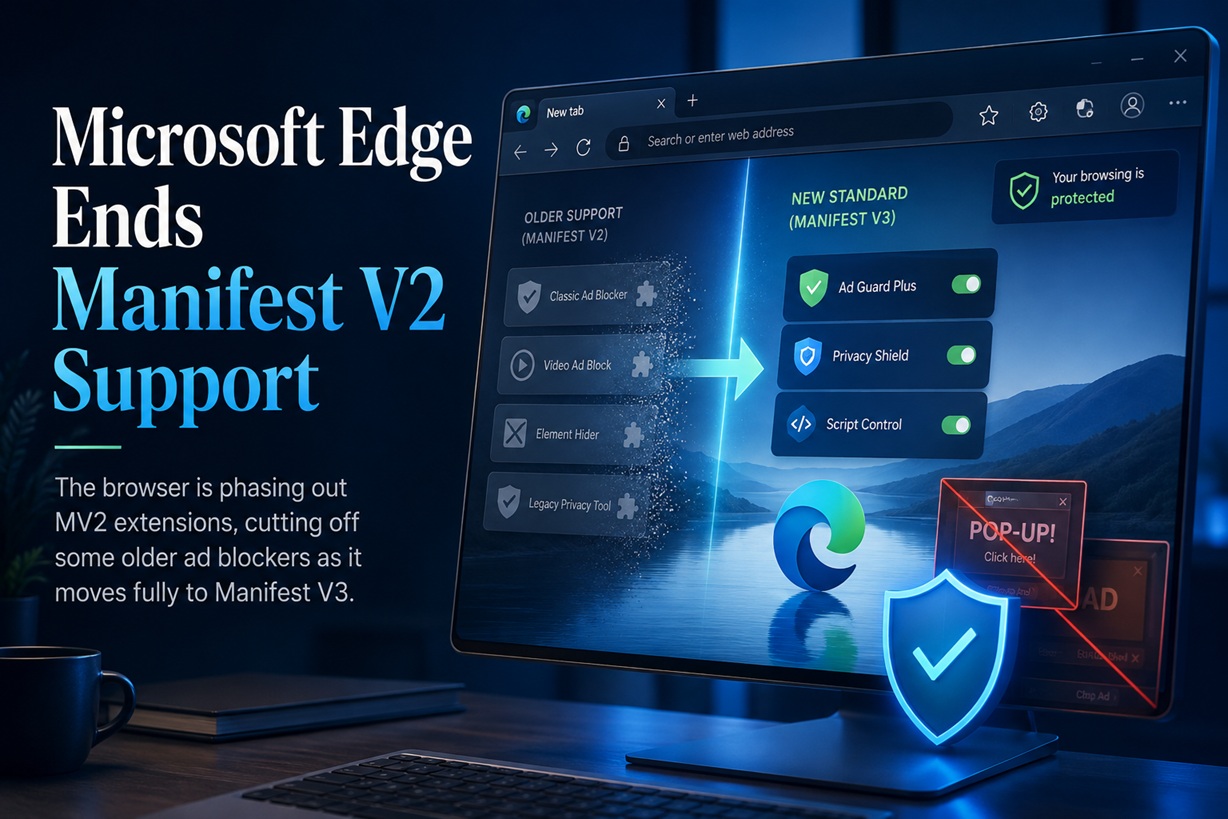
Microsoft is preparing to shut the door on Manifest V2 extensions in Edge, bringing its browser further in line with the direction Google has already taken with Chrome. On the surface, this is being framed as a routine extension-platform upgrade. Microsoft says most developers have already moved their extensions to Manifest V3, and that only a relatively small number of actively used Manifest V2 add-ons remain.
For everyday users, however, there is one part of this transition that matters a lot more than the rest: some of the most capable ad blockers still rely on Manifest V2. And once Microsoft finishes disabling MV2 support, those extensions will effectively stop working in Edge.
Manifest V2 Is Being Replaced By Manifest V3
Browser extensions are not simply little programs that can do whatever they want inside a browser. They operate through a set of APIs and permissions defined by something called an extension manifest. Manifest V2, or MV2, has been the foundation used by Chrome, Edge and other Chromium-based browsers for years. Manifest V3 changes a number of those rules. Google originally introduced MV3 partly to improve security, privacy and performance by restricting how much access extensions have to browser processes and network activity.
That sounds reasonable in theory.
The controversy comes from the fact that ad blockers are among the extensions that depend most heavily on network-level control. Traditional blockers such as the full version of uBlock Origin can inspect and modify network requests using mechanisms available under Manifest V2. Manifest V3 places tighter restrictions on how extensions can perform that work. As a result, ad blockers still exist under MV3, but they do not necessarily have exactly the same capabilities.
Microsoft Says Most Extensions Have Already Migrated
Microsoft argues that the migration is essentially complete for the majority of its extension ecosystem. According to figures published by the company, around 95% of the most popular Manifest V2 extensions in the Edge Add-ons store have already moved to Manifest V3. Microsoft says only 58 MV2 extensions with meaningful usage remain, and just three of those reportedly lack a publicly available MV3 replacement.
From Microsoft's perspective, that suggests the transition is no longer particularly disruptive. The company also says extensions across a wide range of categories—including password managers, VPN tools and ad blockers—have successfully transitioned without losing important customer functionality. That may be true for many extensions.
Ad blocking is where the argument becomes considerably more complicated.
uBlock Origin Is The Big Example
The original uBlock Origin is one of the clearest examples of what users potentially lose when Manifest V2 disappears. uBlock Origin has built a reputation as one of the most effective browser content blockers available. It can block conventional advertising, trackers, malicious domains and a wide range of unwanted browser requests while remaining relatively lightweight. Its developer has also created uBlock Origin Lite, which is compatible with Manifest V3.
The two versions, however, are not identical. The Lite edition is designed around the restrictions imposed by MV3, meaning some filtering capabilities and dynamic behaviour available in the original extension cannot be reproduced in exactly the same way. For casual browsing, many users may never notice the difference.
For people who rely heavily on advanced filter lists, custom rules or more aggressive blocking, the change can be much more noticeable.
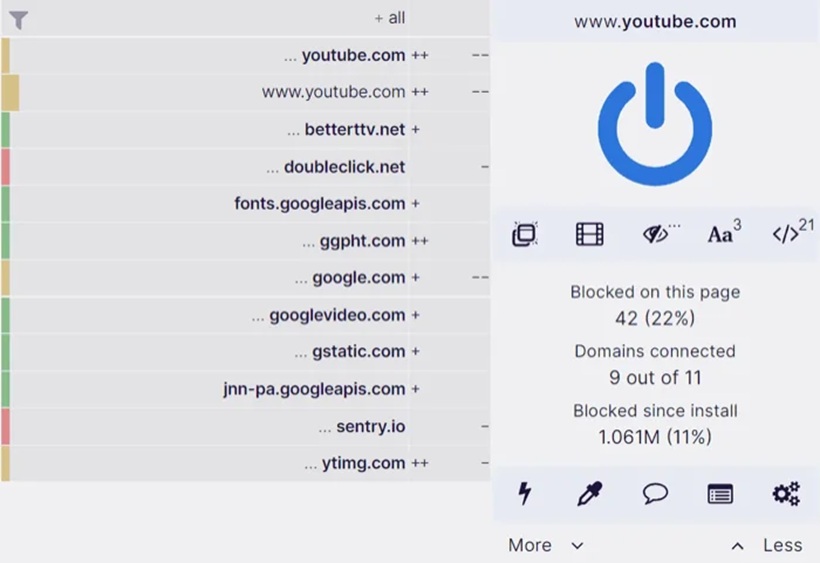
Why Manifest V3 Changes How Ad Blocking Works
The technical difference largely comes down to how extensions are allowed to interact with network requests. Under Manifest V2, extensions can use powerful APIs that let them examine browser traffic and make blocking decisions dynamically. Manifest V3 pushes extensions toward a more restricted system where filtering rules are declared in advance. This approach gives the browser greater control over what extensions can do and reduces the amount of code that can continuously monitor network requests. From a browser-security perspective, there are benefits.
A malicious extension with broad network access can potentially abuse those privileges. But those same privileges are also what allow advanced ad blockers to be extremely flexible. So the trade-off is obvious: MV3 reduces extension power in the name of security and predictability, but some legitimate tools lose capabilities at the same time.
Edge Will Disable MV2 Gradually
Microsoft is not switching everything off overnight. The retirement will happen progressively. Manifest V2 extensions will first begin disappearing from Edge Canary, Dev and Beta channels, where Microsoft usually introduces browser changes before they reach ordinary users. After that, the restrictions will move into the Stable version of Edge. Microsoft is aiming to complete the transition for regular consumer installations before the end of 2026.
Enterprise environments will receive additional time. Businesses often depend on specialised browser extensions for internal systems, workflows and security software, so Microsoft plans to continue supporting enterprise migration into early 2027. That staggered schedule should give developers and organisations some time to prepare. For ordinary home users, however, the practical outcome is clear: MV2 extensions are approaching the end of the road in Edge.
This Mirrors What Has Already Happened In Chrome
Microsoft's decision is hardly surprising because Edge itself is built on Chromium. Google has already been moving Chrome toward Manifest V3 and gradually disabling MV2 support. Maintaining a completely different extension architecture inside Edge would therefore require Microsoft to increasingly diverge from upstream Chromium development. That would add engineering overhead and potentially create compatibility problems with Chrome extensions. From Microsoft's point of view, following the broader Chromium ecosystem is the practical decision. From the user's perspective, however, this also means Edge inherits many of the same controversies surrounding Google's extension changes.
The Timing Is Interesting Because Other Browsers Are Going The Opposite Way
What makes Microsoft's announcement more noticeable is that some competing browsers are placing stronger emphasis on built-in blocking instead. DuckDuckGo, for example, recently announced plans to integrate YouTube ad blocking powered by uBlock Origin technology into its browser. Other privacy-focused browsers have similarly made blocking advertising and trackers a core part of their identity rather than leaving the job entirely to extensions. That creates two very different philosophies. Chrome and Edge are gradually restricting the extension capabilities used by traditional blockers. Privacy-focused browsers, meanwhile, are increasingly treating aggressive content blocking as a selling point.
For users who care heavily about ad blocking, the browser itself may therefore become more important than which extension they install.
Why Ad Blocking Is No Longer Just About Annoying Banners
Advertising on the web is often discussed as if the only issue were visual annoyance. That is not really the whole story anymore. Ads can involve tracking scripts, behavioural profiling, third-party network calls and occasionally malicious advertising campaigns. Malvertising has become particularly concerning because attackers can abuse advertising networks to redirect visitors toward fraudulent websites, fake software downloads or other malicious content. That is why security-conscious users sometimes treat ad blocking as another layer of browser protection rather than simply a cosmetic preference. An ad blocker obviously does not replace antivirus software, browser security features or common sense. But preventing unnecessary third-party content from loading in the first place can reduce exposure to certain threats.
Microsoft's Argument And Power Users' Concerns Can Both Be True
It is worth separating two things here. Microsoft may be completely correct that the overwhelming majority of Edge extensions have transitioned successfully to Manifest V3. For most users, the migration may happen without them noticing anything at all. At the same time, power users are also correct when they point out that Manifest V3 does not provide exactly the same filtering freedom as Manifest V2. Both statements can exist simultaneously. The average password manager, theme or productivity extension may work perfectly well under MV3. An advanced network-filtering tool is a different type of extension with considerably more demanding requirements. That is why uBlock Origin has become such a central part of the discussion. It demonstrates that the debate is not simply about whether an MV3 replacement exists.
The important question is whether that replacement can do everything the previous version could.
What Edge Users Will Need To Do
Users who currently depend on Manifest V2 extensions should start checking whether an MV3-compatible version or alternative exists. For many extensions, that transition will be simple. Users of uBlock Origin may eventually need to move to uBlock Origin Lite or another Manifest V3-compatible blocker if they want to remain with Edge. Another possibility is changing browsers. Browsers that continue supporting the capabilities needed by traditional extensions—or that provide their own built-in blocking systems—may become increasingly attractive to people who prioritise aggressive content filtering. How long those alternatives remain available will depend on each browser developer's own policies.
Final Thoughts
Microsoft ending Manifest V2 support in Edge was probably inevitable once Chromium itself moved firmly toward Manifest V3. For Microsoft, the numbers suggest the ecosystem is already mostly ready. For the average Edge user, the transition may indeed be almost invisible. But for serious ad-blocking users, losing access to the full version of uBlock Origin is difficult to dismiss as a minor change. uBlock Origin Lite remains available and should be perfectly adequate for many people, but the broader concern is not whether ads can still be blocked at all.
It is about how much control extensions are allowed to have over browser traffic. Manifest V3 gives browsers tighter control over extensions, which can improve security in some areas. The trade-off is that some legitimate extensions become less powerful. And with online advertising increasingly tied to tracking, intrusive scripts and even occasional malicious campaigns, reducing the capabilities of one of the web's most effective defensive tools is understandably going to remain controversial.











Comments 0