

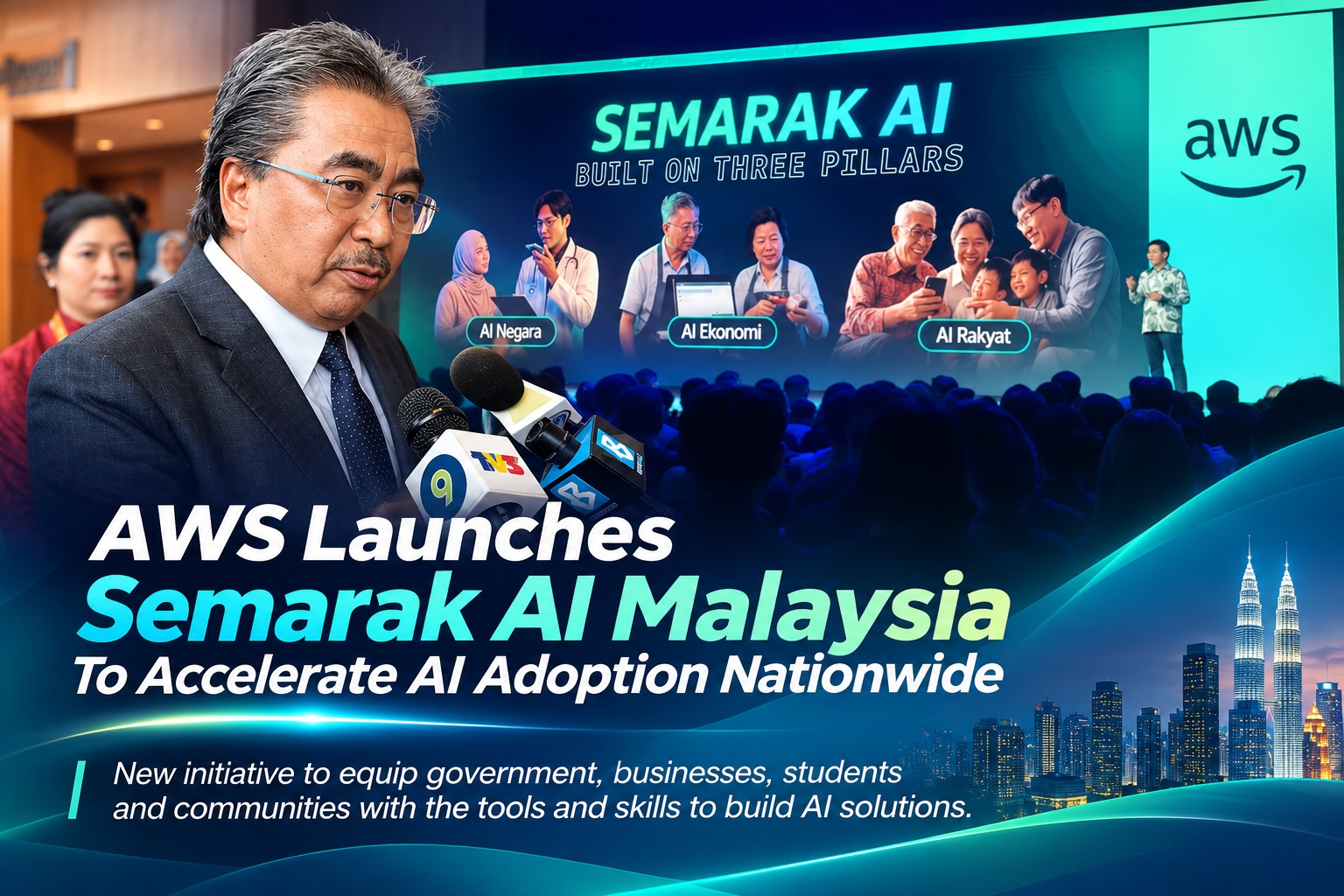
Amazon Web Services has officially introduced Semarak AI Malaysia, a new initiative aimed at helping Malaysians develop the knowledge, tools and practical experience needed to build artificial intelligence solutions. Announced during AWS Cloud and AI Day Kuala Lumpur, the programme targets a broad range of participants, including government officers, software developers, small and medium-sized enterprises, students, lecturers and local communities. Rather than focusing only on encouraging people to use existing AI services, AWS says the initiative is intended to help Malaysia develop the capability to create and implement its own AI-powered solutions.
Semarak AI Malaysia is built around three main pillars: AI Negara, AI Ekonomi and AI Rakyat. Each pillar focuses on a different part of the country's AI ecosystem, covering government transformation, business adoption and community-level skills development. Together, the programmes are intended to strengthen Malaysia's AI capabilities from the public sector all the way down to schools and local communities.
AI Negara Focuses On Government AI Adoption
The first pillar, AI Negara, concentrates on Malaysia's public sector and how artificial intelligence can be incorporated into government operations. One of the key initiatives under this pillar is the launch of GovHub, which was created by GovTech Malaysia together with the Digital Ministry. GovHub runs through the National Digital Department's AI-as-a-Service platform and uses AWS's Kiro technology as part of its development environment.
The objective is to provide government developers with access to AI-assisted tools that can help them build applications and digital services more efficiently. Instead of every ministry or agency developing separate AI capabilities from scratch, the AIaaS platform provides a common environment through which public-sector teams can access the technology.
GovHub Will Begin With 500 Developers
The first phase of GovHub will involve approximately 500 developers during 2026. AWS and its government partners intend to gradually expand participation over the coming years, with a target of reaching 4,000 developers by 2028. The phased approach allows the platform to begin with a smaller group before expanding more broadly across government.
Training thousands of public-sector developers could have a significant effect on how quickly government agencies are able to experiment with AI-enabled services. Developers who understand the tools can identify practical opportunities within their own departments rather than depending entirely on external vendors to introduce AI solutions.
AWS Kiro Will Support Government Development
Kiro plays an important role within GovHub as the AI-assisted development tool being made available through the government's AIaaS platform. By integrating AI directly into software development, government developers can potentially accelerate tasks such as generating code, building prototypes and working through technical problems.
The objective is not simply to introduce AI as another government application but to give technical teams tools they can use while developing new services. If public-sector developers become comfortable working with AI during everyday development, the technology can gradually become part of normal government digital transformation rather than remaining isolated inside specialised pilot projects.
445,000 Government Officers Will Gain Access To Amazon Quick
AI Negara extends far beyond software developers. AWS plans to make its Amazon Quick AI work assistant available to 445,000 government officers through the same AIaaS platform. This represents a much broader rollout intended to introduce AI capabilities directly into ordinary government work rather than limiting them to technical teams.
Quick is designed to assist with tasks such as analysing information, synthesising research and identifying patterns across large datasets. For public-sector employees dealing with large volumes of reports, statistics or administrative information, these capabilities could potentially reduce the amount of manual work required before useful conclusions can be drawn.
AI Could Help Government Officers Work With Large Amounts Of Information
Government departments routinely handle substantial quantities of documents, statistics and research material. Finding useful information inside those datasets can require considerable time, particularly when staff need to compare several sources or identify patterns manually. Tools such as Quick are intended to help employees process that material more efficiently.
The scale of the planned rollout is particularly notable. Providing access to hundreds of thousands of government officers means AWS and the Malaysian government are looking beyond isolated AI experiments and towards broader adoption across everyday public-sector workflows.
AI Negara Could Change How Government AI Projects Are Built
The combination of GovHub, Kiro and Quick creates two different approaches to public-sector AI adoption. Developers gain tools that can help them build AI-enabled applications, while non-technical government employees gain access to an assistant intended to support everyday knowledge work. This allows AI adoption to happen at both the development and user levels.
Whether the programmes ultimately improve government productivity will depend on how effectively the tools are integrated into real workflows. Providing access is only the first step; employees will also need appropriate training and clear understanding of where AI is useful and where human judgement remains essential.
AI Ekonomi Targets Malaysian Businesses
The second pillar, AI Ekonomi, focuses on helping Malaysian businesses adopt artificial intelligence and encouraging local software companies to build AI-enabled products. AWS is partnering with GD XCHANGE, the solutions arm of logistics company GDEX, together with technology distributor VSTECS, to create a programme aimed specifically at small and medium-sized enterprises.
SMEs frequently face greater barriers to AI adoption than large corporations because they may lack dedicated technical teams or the financial resources needed to experiment extensively. The programme is intended to lower those barriers by providing eligible companies with access to AWS AI tools after completing an assessment
.
Eligible SMEs Can Get Six Months Of Complimentary AI Tools
Businesses accepted into the programme can receive six months of complimentary access to Quick and Kiro. Before receiving access, companies will undergo an AI assessment intended to determine how the technology could fit into their operations. This should help participating SMEs identify practical use cases rather than simply receiving AI tools without knowing where they can provide value.
A business might discover opportunities in research, data analysis, software development or other internal processes depending on its operations. The assessment-led approach also recognises that AI adoption is not identical for every organisation and that different businesses will require different applications.
AWS Wants To Reach 10,000 SMEs By 2028
The SME initiative aims to onboard 10,000 Malaysian businesses by 2028. Reaching that number would expose a sizeable portion of the country's smaller companies to AI-assisted workflows and development tools. For many participating businesses, the programme could represent their first structured attempt at integrating generative AI into daily operations.
The six-month complimentary period also gives companies time to determine whether the tools deliver enough practical value to justify continued adoption. Rather than committing immediately to long-term AI spending, SMEs can experiment first and evaluate the results within their own businesses.
Helping SMEs Use AI Could Broaden Adoption Beyond Large Corporations
Much of the early AI investment around the world has been driven by large enterprises with substantial technology budgets. SMEs may understand the potential benefits but struggle to justify the initial cost or find staff with the required technical knowledge. Programmes providing structured access and guidance can help reduce that gap.
This becomes particularly important in Malaysia because SMEs form a significant part of the wider business landscape. If AI adoption remains concentrated only among major corporations, productivity improvements associated with the technology may not spread as widely across the economy.
Sarawak Gets Its Own Software Accelerator Programme
AI Ekonomi also includes a partnership between AWS and the Sarawak Digital Economy Corporation, or SDEC. Together, they are supporting the Sarawak SaaS Accelerator, known as SaSAR, which focuses on helping software companies develop AI-based products and connect those solutions with businesses interested in adopting artificial intelligence.
The programme addresses both sides of the market. Local software companies receive support to develop AI products, while businesses looking for AI solutions gain access to companies capable of building them. Creating stronger connections between local developers and potential customers could help more Malaysian AI products move from prototypes into commercial use.
SaSAR Could Help Build A Local AI Software Industry
Encouraging companies to build AI products locally is different from simply encouraging organisations to subscribe to international AI services. A stronger local software ecosystem gives Malaysian companies the opportunity to develop products specifically designed around domestic industries, languages and business requirements.
Those products could eventually be sold beyond Malaysia as well. If successful, initiatives such as SaSAR could help transform local software firms from consumers of international AI technology into companies capable of creating commercially competitive AI products themselves.
AI Ekonomi Is About More Than Productivity Tools
The broader goal of AI Ekonomi therefore appears to extend beyond helping businesses save time with AI assistants. It is also intended to develop companies capable of creating new AI-based products and services. That distinction becomes important when considering Malaysia's longer-term position in the technology economy.
Using foreign AI tools can improve productivity, but building valuable intellectual property locally creates a different type of economic opportunity. Malaysian software companies capable of developing successful AI products can create skilled jobs, generate export revenue and contribute more directly to the country's technology ecosystem.
AI Rakyat Brings AI Skills To Students And Communities
The third pillar, AI Rakyat, focuses on expanding AI knowledge beyond government and businesses into educational institutions and local communities. One major initiative under this pillar is the POLYCC Agentic AI League 2026, which involved more than 3,000 students and lecturers from polytechnics and community colleges.
Participants use AWS Kiro as the programme's primary coding tool, giving students practical experience working with AI-assisted software development. Rather than limiting AI education to theoretical discussions, the programme allows participants to build and experiment with technology directly.
More Than 3,000 Students And Lecturers Have Already Participated
The participation of more than 3,000 students and lecturers demonstrates the scale AWS is targeting at the education level. Introducing AI-assisted development through polytechnics and community colleges also expands access beyond conventional university computer science programmes. Students from a broader range of educational backgrounds can gain experience working with tools increasingly used in the technology industry.
Lecturer participation is equally important because educators need to understand the technology before they can teach students how to use it responsibly. Developing both sides simultaneously could make it easier for AI-related skills to become part of future technical education programmes.
Agentic AI Skills Are Becoming More Relevant
AI development is increasingly moving beyond simple chatbot interactions towards systems capable of performing multi-step tasks and assisting directly with technical work. Coding tools such as Kiro expose students to this changing relationship between developers and artificial intelligence.
Learning how to work effectively with AI-generated code may become increasingly valuable for future software professionals. At the same time, students need enough programming knowledge to understand, test and review what the AI produces rather than relying blindly on generated results.
AWS Has Also Adopted A Government School
Under AI Rakyat, AWS has adopted Sekolah Kebangsaan Datuk Keramat (1) through the Malaysian government's Sekolah Angkat MADANI programme. The initiative will involve upgrading the school's digital and STEM facilities while introducing additional technology-focused learning opportunities.
AWS also plans to train teachers so they can teach areas such as robotics and coding. Building teacher capability is important because equipment alone does not guarantee meaningful technology education; schools also need educators who feel comfortable using the tools and guiding students.
Students Will Learn Robotics And Coding
The school programme will introduce more hands-on exposure to technology, including robotics and coding activities. Practical learning can help students understand how digital systems actually work rather than interacting with technology only as consumers.
Early exposure may also influence future education choices. Students who discover an interest in programming, engineering or robotics while still in school may be more likely to pursue related courses later.
Drone Technology Is Part Of The Programme
Students will also participate in practical activities involving drone technology. Drones combine several areas of modern technology, including electronics, software, navigation, sensors and wireless communications, making them useful educational tools for demonstrating how different technical disciplines work together.
Hands-on activities can make STEM subjects feel much more tangible compared with purely classroom-based learning. They also give students exposure to technologies increasingly used in areas such as agriculture, surveying, logistics and infrastructure inspection.
Digital Safety Will Be Included As Well
AWS says the programme will include education around digital safety, which becomes increasingly important as younger students spend more time online and interact with AI-enabled services. Understanding privacy, online risks and responsible digital behaviour should develop alongside technical skills such as coding.
Teaching students how to build technology without teaching them how to use it safely would leave an important gap. Including digital safety therefore makes the programme broader than simply encouraging children to become programmers.
Semarak AI Malaysia Covers Several Levels Of Society
The structure of Semarak AI Malaysia is notable because the three pillars address very different groups. AI Negara focuses on government developers and public officers, AI Ekonomi targets SMEs and software businesses, while AI Rakyat reaches students, educators and communities.
This gives the initiative a much broader scope than a conventional corporate AI training programme. AWS is effectively trying to establish AI capabilities across several layers of Malaysia's digital economy simultaneously.
Malaysia Wants To Build AI Rather Than Simply Consume It
Investment, Trade and Industry Minister Datuk Seri Johari Abdul Ghani emphasised this distinction when discussing the programme. He said Malaysia needs a workforce and software industry capable of building AI technology rather than merely consuming it if the country wants to become a leader in the AI economy.
That argument highlights one of the biggest challenges facing countries during the current AI boom. Using tools developed elsewhere can improve productivity, but relying entirely on foreign technology leaves much of the highest-value development outside the country.
Building AI Skills Creates A Different Kind Of Economic Value
A workforce capable of developing AI systems gives Malaysia opportunities beyond simply adopting existing services. Local developers can create solutions tailored to Malaysian businesses, while software companies can potentially export those products into other markets.
Government agencies with internal AI skills can also become less dependent on external vendors for every new digital project. Building technical capability therefore creates longer-term strategic value that cannot be achieved through software subscriptions alone.
The Software Industry Will Play An Important Role
Malaysia's ability to benefit from AI will depend heavily on whether local software companies can transform the technology into useful products. Raw AI models are only part of the equation; businesses still need applications that integrate those capabilities into everyday workflows.
Programmes such as SaSAR can help strengthen this application layer by giving local companies opportunities to build products and connect with potential customers. The more successful those companies become, the more AI-related economic activity can remain within Malaysia.
Government Adoption Could Create Demand For Local Skills
AI Negara could also help stimulate wider demand for AI capabilities. As government departments begin using more AI-enabled systems, they may require developers, consultants, security specialists and software providers capable of supporting those deployments.
This can create opportunities beyond the government itself. A growing public-sector AI ecosystem may encourage more companies to invest in relevant skills because there is a clearer domestic market for those capabilities.
AI Training Needs To Go Beyond Prompting
For programmes such as Semarak AI Malaysia to have long-term value, training will need to cover more than simply teaching people how to ask an AI assistant questions. Developers need to understand how generated code works, businesses need to understand where AI genuinely improves workflows and government employees need to understand how to evaluate AI-generated information critically.
Responsible usage also requires awareness of privacy, security and accuracy limitations. AI becomes considerably more valuable when users understand both what it can do and where human judgement still needs to take over.
The Initiative Builds On AWS's RM29.2 Billion Commitment
Johari said Semarak AI Malaysia builds on AWS's existing RM29.2 billion commitment to support Malaysia's digital ambitions. That investment provides a much larger backdrop to the new programme, connecting AI skills development with AWS's broader infrastructure and cloud presence in the country.
Physical infrastructure and human capability need to develop together if Malaysia wants to capture more value from AI. Data centres provide the computing foundation, while developers, businesses and public-sector employees determine what ultimately gets built on top of that infrastructure.
Cloud Infrastructure Alone Is Not Enough
Building data centres does not automatically create a strong AI economy. Without developers and businesses capable of turning computing capacity into useful products, much of the economic value could remain concentrated elsewhere.
Semarak AI Malaysia appears intended to address that gap by developing both infrastructure users and software creators. The combination could help ensure Malaysia's cloud investments translate into more domestic applications rather than simply providing regional computing capacity.
AI Negara Could Modernise Public Services
If implemented effectively, AI tools could help government departments process information more quickly, automate repetitive administrative work and develop digital services faster. Developers using Kiro may be able to prototype new systems more efficiently, while officers using Quick could gain assistance analysing large collections of documents or data.
The value will depend on selecting the right workloads. AI should ideally reduce repetitive effort and help employees make better-informed decisions rather than simply being introduced because the technology is fashionable.
AI Ekonomi Could Lower The Entry Barrier For SMEs
Providing six months of complimentary access to Quick and Kiro gives participating SMEs an opportunity to experiment without immediately committing significant resources. Smaller businesses may discover that only certain workflows benefit from AI, while others may identify opportunities they had not previously considered.
The assessment process could help companies focus on realistic use cases instead of adopting AI without a clear objective. This makes the programme potentially more useful than simply handing out software subscriptions.
AI Rakyat Could Help Broaden The Future Talent Pool
Education programmes aimed at polytechnics, community colleges and schools can expand the number of Malaysians exposed to AI-related skills before entering the workforce. This is particularly important if AI becomes embedded across industries beyond traditional technology companies.
Future accountants, engineers, designers and logistics professionals may all work alongside AI systems. Developing familiarity early could therefore become useful even for students who never become full-time software developers.
Malaysia's AI Strategy Needs Broad Participation
No single sector can build an AI economy independently. Government can provide policy and infrastructure, businesses create products and jobs, while educational institutions develop future talent. Semarak AI Malaysia attempts to connect these areas through its three-pillar structure.
The success of the programme will ultimately depend on what participants create after receiving access to the tools. Training numbers are useful, but meaningful adoption will be demonstrated through better public services, stronger businesses and locally developed AI products.
Final Thoughts
AWS's Semarak AI Malaysia initiative represents a broad attempt to accelerate artificial intelligence adoption across government, businesses, software companies, educational institutions and communities. Rather than operating as one single training programme, it is divided into AI Negara, AI Ekonomi and AI Rakyat, each addressing a different part of Malaysia's developing AI ecosystem.
Under AI Negara, GovHub will initially involve 500 government developers before expanding towards 4,000 by 2028, while Amazon Quick is planned for deployment to 445,000 government officers through the national AIaaS platform. AI Ekonomi aims to provide Quick and Kiro access to eligible SMEs and eventually onboard 10,000 businesses, while SaSAR will help Sarawak software companies build AI products and connect with potential customers.
AI Rakyat takes the programme into education and local communities, with more than 3,000 polytechnic and community college students and lecturers already participating in the POLYCC Agentic AI League. AWS will also upgrade facilities and provide robotics, coding, drone and digital-safety education at Sekolah Kebangsaan Datuk Keramat (1).
The larger ambition is clear. Malaysia does not simply want people to become better users of foreign AI products; it wants Malaysians capable of building the software, applications and services that will form part of the AI economy itself. With AWS linking Semarak AI Malaysia to its RM29.2 billion commitment to the country, the programme is another sign that the next stage of Malaysia's AI push will depend as much on developing people and local software companies as it does on building data centres.











Comments 0