

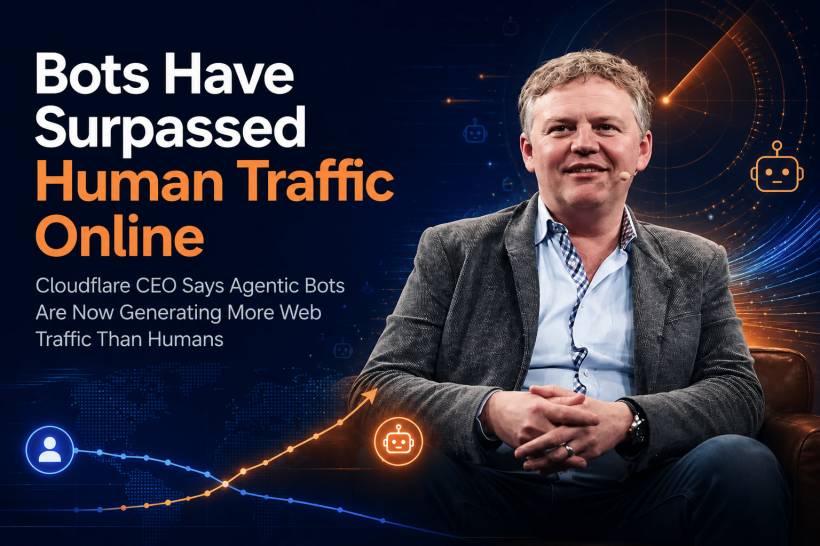
For years, the internet has been shaped around human visitors. People search, click, read, shop, watch, comment, and browse. But according to Cloudflare CEO and co-founder Matthew Prince, that balance may have now shifted in a major way.
Prince recently shared Cloudflare Radar data suggesting that bots now generate more online traffic than humans for the first time. His reaction was simple and telling: "Welp, that happened faster than I predicted."
Based on the dashboard he shared, automated traffic now accounts for 57.3% of total web traffic, while human-generated traffic makes up 42.7%. In simple terms, more than half of web traffic may now be coming from bots rather than people.
That is a pretty big milestone, especially because Prince himself did not expect this crossover to happen until the end of 2027. Instead, it appears to have arrived roughly 18 months earlier than he anticipated.
Why This Milestone Matters
At first glance, the idea of bots overtaking human traffic may sound alarming. Most people still associate bots with spam, scraping, fake accounts, credential attacks, or automated abuse. Those problems still exist, of course, but this new wave of bot traffic is not only about traditional malicious activity.
A major part of the discussion now involves agentic traffic. These are bots or automated agents that act on behalf of users. Instead of a human manually browsing multiple websites, an AI system may search, retrieve, summarise, compare, or collect information for them.
That changes the way we should think about web traffic.
In the older web model, a person visited a website directly. They clicked a link, loaded a page, viewed ads, read content, and perhaps interacted with the site. In the newer model, an AI assistant may visit or request information from the website in the background, then return a summary or answer to the user.
The website still receives traffic. But the human may never actually see the page.
Agentic Bots Are Different From Traditional Bots
It is important to separate this new type of bot traffic from the older categories we are more familiar with.
Traditional bots often include search engine crawlers, security scanners, price scrapers, spam bots, and malicious automation. Some are useful, some are harmless, and some are clearly abusive.
Agentic bots are different because they are usually connected to a user's request. For example, when someone asks an AI chatbot to search the web, compare products, summarise information, or gather data, the AI system may generate web traffic while performing that task.
This means bot traffic is no longer only a security or spam issue. It is becoming part of how people access the web.
That has major implications for website owners, publishers, SEO teams, advertisers, and anyone who depends on web visitors for revenue.
More Requests Does Not Always Mean More Attention
One important detail is that Cloudflare's figures are based on HTTP requests. That means the measurement is about web traffic activity, not necessarily human attention.
This distinction matters.
A bot may generate multiple requests while scanning, retrieving, or processing information. But it does not "read" a page the way a human does. It does not spend time comparing sections, scrolling through content, clicking ads, or absorbing a brand experience in the same way.
So while bots may now generate more traffic than humans, that does not automatically mean bots are consuming more content in a meaningful human sense.
In other words, the internet may be seeing more automated access, but human attention is still a different kind of value.
This is where things become complicated for publishers and website owners. If AI agents are visiting pages but users are not, then traditional metrics like page views, sessions, and referral traffic may become harder to interpret.
The Web Is Becoming More Automated
The rise of agentic traffic suggests that the internet is moving into a new phase. Instead of humans doing every search and every click manually, more tasks may be delegated to automated systems.
This can be useful. AI agents can help users save time, compare information faster, and reduce repetitive browsing. But it also creates new challenges.
Website owners may need to think about questions such as:
• How do we distinguish useful agent traffic from abusive scraping?
• How do we protect content while still allowing legitimate discovery?
• How do publishers earn revenue if users receive answers without visiting the site?
• How do analytics tools measure real engagement when bots generate a larger share of requests?
• How should robots.txt, AI crawler rules, and content access policies evolve?
These are not small questions. They affect the business model of the web itself.
Some Countries Are Seeing Far More Bot Traffic Than Others
The Cloudflare Radar data also shows that bot traffic is not evenly distributed across the world. According to the figures shared, Gibraltar appears to have one of the highest shares, with bot traffic accounting for 92.1% of total traffic. Singapore is also high, with automated traffic reportedly making up 76.4%.
Malaysia, however, appears to be well below the global average. The reported figure shows bot traffic at 31.6%, while human traffic still makes up 68.4%.
That difference is interesting because it shows how uneven the automated web can be. Some regions may experience much heavier bot activity due to infrastructure patterns, data centre presence, routing behaviour, business activity, or automated systems operating from certain locations.
It also means that website owners should avoid assuming that global traffic patterns apply equally to their own audience. A Malaysian website, for example, may see very different traffic behaviour compared to a site serving users in regions with heavier automated activity.
Why Website Owners Should Pay Attention
For businesses and publishers, this shift should not be ignored. If bots are becoming a larger part of overall web traffic, then website analytics need to be reviewed more carefully.
A traffic spike may not always mean more human interest. A drop in page engagement may not always mean content is weaker. A high request volume may not always represent a real audience.
Website owners should pay closer attention to bot filtering, analytics segmentation, server logs, Cloudflare traffic patterns, and crawler activity. Understanding who or what is visiting the site is becoming just as important as the total number of visits.
This is especially important for sites that depend on:
• Advertising revenue
• Affiliate clicks
• Product conversions
• SEO traffic
• Content subscriptions
• Lead generation
• Server resource planning
If automated systems are changing how people access information, then the way websites measure success will also need to change.
The Bigger Picture: AI Is Changing Web Traffic
The internet has always had bots, but AI is giving automated traffic a new role. Bots are no longer just crawling pages for search indexes or attacking login forms. Increasingly, they are becoming intermediaries between people and the web.
That could reshape how content is discovered. Instead of ten blue links, users may receive one summarised answer. Instead of browsing five product pages, an AI assistant may compare them directly. Instead of visiting a travel blog, a user may ask an AI tool for the key recommendation.
From a user convenience perspective, this can be powerful. From a website owner's perspective, it raises uncomfortable questions.
If websites provide the knowledge, but AI systems deliver the answer, how should value be shared? If traffic becomes more automated, how should content creators measure impact? If fewer humans visit the original page, what happens to the open web economy?
These questions do not have simple answers yet, but the direction is becoming clearer. The web is no longer only human-to-site. It is increasingly human-to-agent-to-site.
Final Thoughts
Cloudflare's reported milestone is more than just an interesting traffic statistic. It is a sign of how quickly the web is changing. If bots now generate more traffic than humans, then we are entering a new era where automated systems play a much larger role in how information moves online.
Still, the details matter. Bot traffic does not automatically mean bad traffic. Some of it is malicious, some of it is useful, and some of it may represent real human intent carried out through AI agents.
For website owners, the key takeaway is awareness. Traffic numbers alone are no longer enough. We need to understand the quality, source, and purpose of that traffic.
The internet may still be built for people, but more and more of the browsing is being done by machines on their behalf. That is not necessarily the end of the human web, but it does mean the rules are changing faster than many expected.











Comments 0