

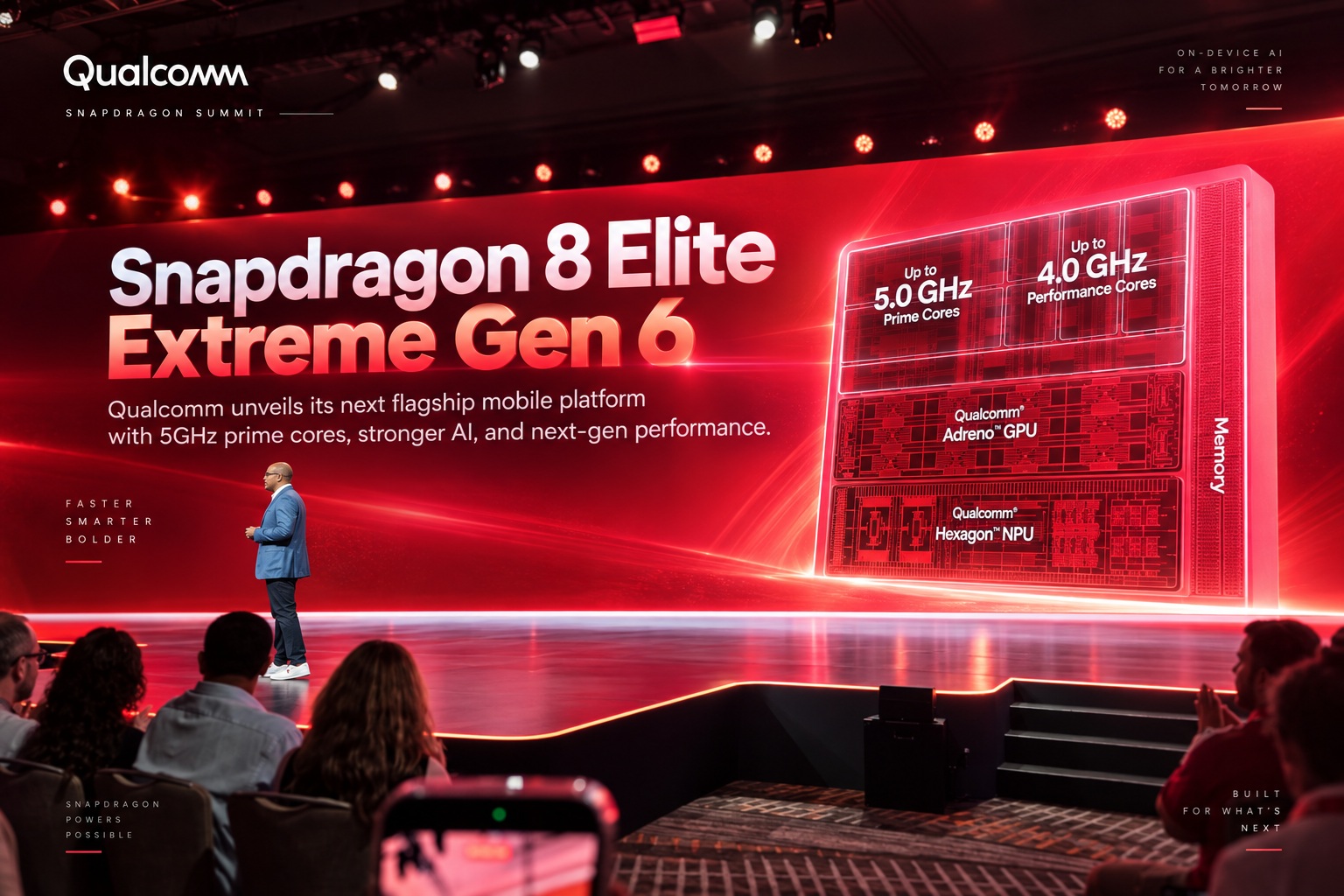
Qualcomm has officially unveiled its next generation of flagship mobile chipsets at Snapdragon Summit 2026, introducing the Snapdragon 8 Elite Extreme Gen 6 alongside the standard Snapdragon 8 Elite Gen 6. Both platforms are designed for premium smartphones and place heavy emphasis on AI, graphics performance and next-generation imaging, but the Extreme model clearly sits at the top of the lineup.
Built on TSMC's 2nm process, the Snapdragon 8 Elite Extreme Gen 6 combines extremely high CPU frequencies with a redesigned AI subsystem and a new generation of Adreno graphics. Qualcomm is positioning the platform as the foundation for more capable on-device AI agents, higher-end mobile gaming and significantly faster video processing in upcoming flagship phones.
Two Prime Cores Can Reach 5GHz
At the heart of the Snapdragon 8 Elite Extreme Gen 6 are Qualcomm's latest Oryon CPU cores. The chip uses a configuration of two Prime Cores capable of boosting up to 5GHz, alongside six Performance Cores that can reach up to 4GHz. Those frequencies are particularly aggressive for a mobile processor and underline how far smartphone CPUs have moved toward laptop-class performance characteristics.
Connecting the CPU clusters is 16MB of Qualcomm Oryon Flex Cache, which acts somewhat like the large shared cache found in modern desktop processors. Qualcomm says the cache architecture can adapt according to workload demand, allowing the processor to retain more active data when tasks become larger and more sustained.
The idea is to prevent performance from dropping too quickly when a demanding workload expands beyond the resources initially allocated to it. Rather than simply increasing clock speed and hoping for the best, the chip is designed to use cache more intelligently to keep frequently needed information closer to the CPU.
Oryon Flex Cache Is Designed for Sustained Workloads
The Flex Cache concept becomes especially important as mobile workloads get heavier. Smartphones are increasingly expected to handle video editing, gaming, local AI inference and other tasks that would previously have been associated with a desktop or laptop.
When those workloads become more complex, keeping data close to the processing cores can reduce the need to repeatedly access slower system memory. Qualcomm's Flex Cache is intended to dynamically respond to that demand rather than behaving as a fixed resource that remains the same regardless of workload.
In practical terms, the architecture should help the processor maintain responsiveness during larger tasks, although real-world efficiency will depend on thermal limits, smartphone cooling systems and how individual manufacturers tune the chip inside their devices.
The New Sensing Hub Pushes Always-On AI Further
Qualcomm is also expanding the role of its Sensing Hub, which now uses dual Micro NPUs to handle lightweight AI workloads continuously in the background. According to the company, the new implementation delivers 85% more performance than its predecessor while being 20% more power efficient.
The Sensing Hub can reportedly work with language models containing up to 200 million parameters, allowing more contextual processing to happen without constantly waking the main CPU or larger NPU. That is important for features designed to remain active throughout the day, such as voice recognition, contextual awareness and personal-assistant functions.
Qualcomm says the system can also act as a kind of personal scribe, remembering relevant information, identifying who said what and learning context from messages, emails and conversations over time. The broader goal is to make smartphones more aware of what the user is doing without depending entirely on cloud processing.
Agentic Loop Connects the Sensing Hub and Main NPU
One of the most interesting additions is what Qualcomm calls the Agentic Loop. The feature connects the low-power Sensing Hub with the more powerful Hexagon NPU so that information can move between lightweight always-on processing and deeper AI reasoning.
The Sensing Hub can continuously interpret voice commands and contextual signals using relatively little power. When more advanced reasoning is required, relevant information can be passed to the Hexagon NPU, which processes the request and builds a more complete understanding of what the user wants.
The result is intended to support AI agents capable of doing more than answering isolated questions. Instead, the system can use context gathered over time to help plan actions or respond more intelligently based on what is actually relevant to the current request.
The concept sounds powerful, but it will also place greater attention on privacy controls. Any system designed to continuously process conversations, messages or contextual information will need clear boundaries around what is stored, where it is processed and how users can control it.
Hexagon NPU Gets 50% More Shared Memory
The main Hexagon NPU has also been upgraded, with Qualcomm increasing its shared memory cache by 50% compared with the previous generation. More local memory can help AI workloads avoid frequent transfers to system memory, improving both efficiency and responsiveness.
That matters particularly for generative AI models, where memory bandwidth and capacity can quickly become major bottlenecks. Larger caches can allow more intermediate data to remain close to the accelerator, reducing latency when processing complex neural-network operations.
Qualcomm's strategy is clearly to divide AI workloads more intelligently across different parts of the chip. Lightweight tasks stay on the Sensing Hub, while heavier inference and agentic workloads move to the main NPU when needed.
Adreno Neural Fusion Brings AI Upscaling and Frame Generation
Gaming is another major focus of the Snapdragon 8 Elite Extreme Gen 6. Qualcomm is introducing a new Adreno GPU with a Neural Fusion Engine, designed to bring AI-assisted image reconstruction and frame generation into mobile gaming.
The system can upscale a game from a lower internal resolution while attempting to restore detail through AI processing. It can also generate additional frames between traditionally rendered ones, increasing perceived frame rates without requiring the GPU to render every frame natively.
This is conceptually similar to technologies already used on desktop GPUs, where AI upscaling and frame generation help improve performance at high resolutions. Bringing the same idea to smartphones could allow more demanding games to target higher frame rates without consuming as much power as fully native rendering.
Qualcomm says the Adreno Neural Fusion Engine is already supported in developer builds using Unreal Engine, Unity and Messiah, giving game studios a path toward integrating the technology into future releases.
Mobile Gaming Could Become More Efficient, Not Just Faster
The most important benefit may not simply be higher frame rates. Smartphones operate within strict thermal and battery limits, so brute-force GPU performance can only go so far before heat and power consumption become problems.
AI-assisted reconstruction allows the GPU to render fewer pixels internally while still producing an image closer to a higher-resolution output. Frame generation similarly reduces the number of fully rendered frames required to create smoother motion.
If implemented well, these techniques could allow flagship smartphones to deliver more visually ambitious games while keeping power consumption under better control. However, latency, image artefacts and game-specific optimisation will still determine whether the experience feels genuinely better.
Spectra ISP Targets 8K60 and 4K240 Video
Qualcomm is also significantly upgrading imaging with a new Spectra Image Signal Processor. The company claims the ISP can deliver up to four times the video throughput of its predecessor, enabling much more demanding recording modes.
The platform supports video capture at up to 8K60, along with 4K240 Ultra HD super slow-motion recording. Those specifications push smartphone video recording even closer to dedicated camera territory, at least in terms of raw resolution and frame-rate capability.
Higher throughput can also support more simultaneous computational-photography operations. Modern smartphones often combine sensor data, AI processing, exposure fusion and noise reduction in real time, so a faster ISP does more than simply enable higher-resolution video.
The challenge, as always, will be heat, storage consumption and sensor quality. Recording 8K60 video places enormous demands on the entire device, from the camera sensor and ISP to storage speed and thermal management.
The Standard Elite Gen 6 Sits Below the Extreme Model
Qualcomm is launching the Snapdragon 8 Elite Gen 6 alongside the Extreme edition, giving smartphone manufacturers another flagship-tier option. While both chips share the same broad generation and AI-first direction, the Extreme model is clearly positioned as the maximum-performance version.
That split gives phone makers more flexibility. A manufacturer can use the standard Elite Gen 6 for a premium flagship while reserving the Extreme version for its highest-end model, allowing performance differentiation without dropping to a completely different chipset family.
This is similar to how desktop and mobile PC processors are increasingly segmented into several performance tiers within the same generation. For Qualcomm, it also creates more room to target different price points across the premium smartphone market.
Xiaomi Will Be Among the First to Use the New Chips
The first commercial devices using the new Snapdragon platforms are expected from Qualcomm's usual group of Android partners. Xiaomi is set to be one of the first manufacturers out of the gate with its upcoming Xiaomi 18 Pro and Xiaomi 18 Pro Max.
The Xiaomi 18 Pro is expected to use the standard Snapdragon 8 Elite Gen 6, while the higher-end Pro Max will receive the Snapdragon 8 Elite Extreme Gen 6. That gives Xiaomi a clear way to separate the two devices beyond screen size or camera hardware.
Other flagship Android manufacturers are expected to follow as the next smartphone cycle begins, with the new Qualcomm platform likely appearing across premium devices throughout late 2026 and into 2027.
The Bigger Story Is On-Device AI
While the 5GHz Prime Cores and new GPU will attract plenty of attention, the larger story behind Qualcomm's new platform is clearly on-device AI. The Sensing Hub, larger Hexagon NPU memory, Agentic Loop and Neural Fusion Engine all point toward a smartphone architecture built around AI as a constant system-level capability rather than a separate feature.
The industry is increasingly moving away from AI that only responds when the user opens a chatbot. Future smartphones are expected to understand context, observe ongoing activity and proactively assist across applications.
Qualcomm wants its silicon to provide the foundation for that transition. By spreading AI processing across multiple dedicated components, the company can keep lightweight tasks running continuously while reserving the larger accelerator for more demanding inference.
Final Thoughts
The Snapdragon 8 Elite Extreme Gen 6 looks like Qualcomm's most ambitious mobile platform yet, combining a 2nm process, 5GHz Prime Cores, expanded cache, more powerful AI hardware and a new generation of graphics and imaging capabilities.
The raw performance improvements are impressive, but the architecture around AI may ultimately be more important. Qualcomm is building dedicated pathways for always-on contextual processing, larger local language models, agentic workflows and AI-assisted gaming rather than treating those features as optional extras.
The Adreno Neural Fusion Engine could also become a major development for mobile gaming if developers adopt AI upscaling and frame generation widely. Meanwhile, the Spectra ISP's support for 8K60 and 4K240 demonstrates just how aggressively smartphone imaging hardware continues to advance.
As always, chipset specifications are only part of the story. Real-world performance will depend heavily on cooling, battery capacity, software optimisation and how aggressively each phone manufacturer tunes the platform.
Still, one thing is clear: Qualcomm is no longer designing flagship mobile chips around CPU and GPU performance alone. With the Snapdragon 8 Elite Extreme Gen 6, AI has become part of the architecture itself.











Comments 0