

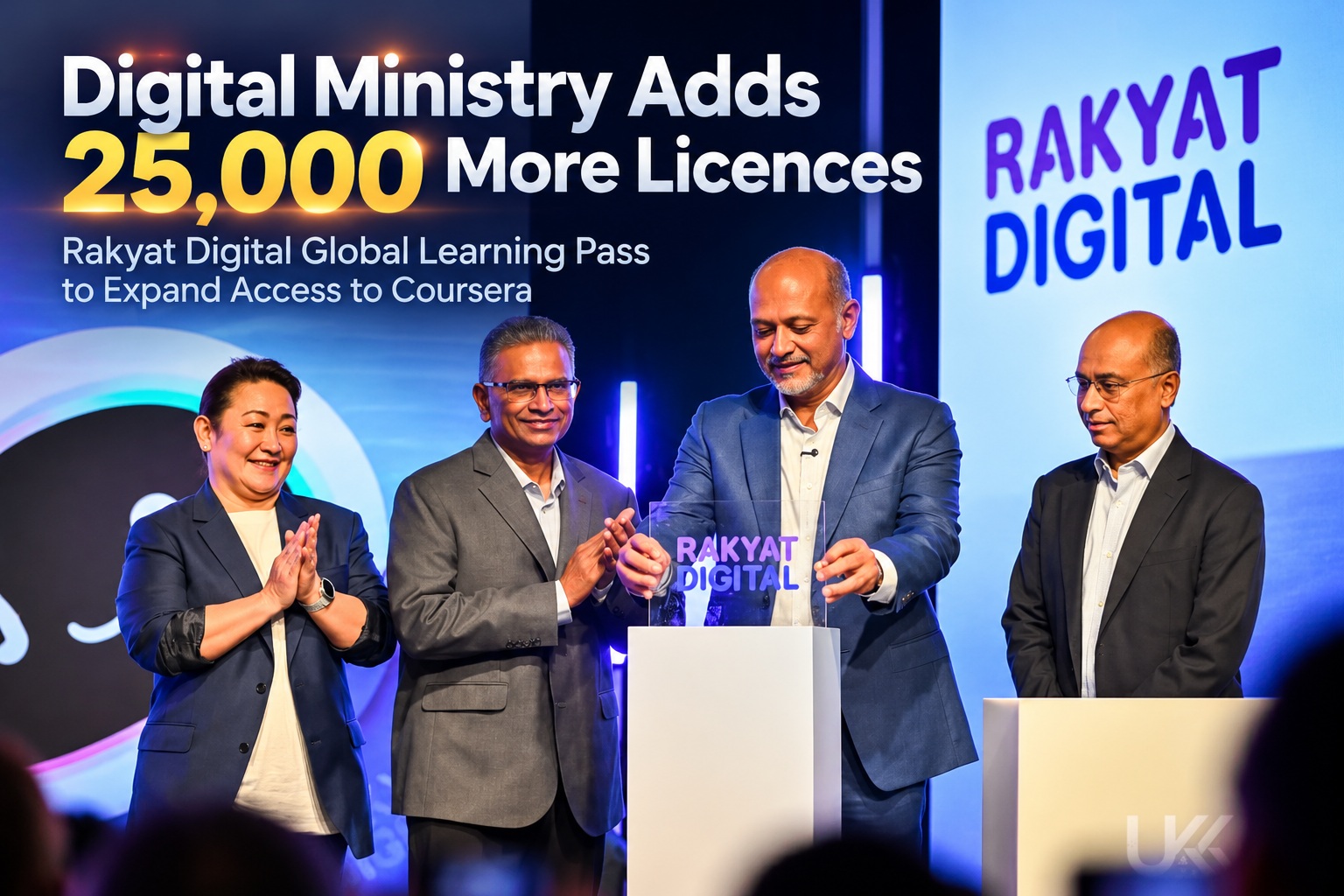
Malaysia's Digital Ministry is expanding the Rakyat Digital Global Learning Pass programme after receiving strong public interest, adding another 25,000 licences that will provide eligible Malaysians with three months of complimentary access to Coursera. The additional allocation comes on top of the 100,000 licences previously announced as part of the government's digital upskilling initiative.
The ministry said the decision reflects the significant demand for accessible online learning opportunities among Malaysians. Rather than waiting for the original phased rollout to progress as initially planned, the government is providing an additional batch to accommodate people who have already registered and are currently waiting for access.
Another 25,000 Malaysians Will Receive Coursera Access
The Global Learning Pass provides successful applicants with three months of complimentary Coursera access, allowing them to participate in online courses covering various professional and digital skills.
The programme was initially designed around 100,000 licences released gradually over several cohorts. However, demand has apparently exceeded expectations, prompting the Digital Ministry to make another 25,000 licences available.
This brings additional opportunities for Malaysians who want to improve their skills without personally paying for the learning platform during the access period.
Strong Public Demand Prompted The Additional Allocation
According to the Digital Ministry, the extra licences are being introduced because of the strong response from people registering for the programme. The ministry described the level of interest as evidence that Malaysians are actively looking for opportunities to strengthen their digital capabilities.
The government says responding to this demand is part of its wider commitment to making digital learning more accessible. By adding another allocation rather than simply leaving applicants on a long waiting list, more people will be able to begin learning sooner.
The expansion also suggests that government-supported online education programmes can attract significant interest when the financial barrier is reduced.
Gobind Singh Deo Says Malaysians Want To Keep Learning
Digital Minister Gobind Singh Deo said the response to the Global Learning Pass demonstrates a strong desire among Malaysians to continue developing new skills.
He said the additional 25,000 licences are intended to answer that demand while creating more opportunities for participants to improve their capabilities and career prospects. The programme is also intended to encourage people to apply the knowledge they gain through the available courses in practical settings.
The focus therefore goes beyond simply providing free access to an online learning platform. The wider objective is to help participants turn those skills into improved employability and professional development.
Additional Licences Will Be Released In Mid-November
The new batch of 25,000 Global Learning Pass licences is expected to be made available in mid-November.
However, the additional places are not being opened as an entirely new registration round. Instead, the ministry says the licences will be offered to applicants who are already waiting in the existing queue.
This means people who previously registered but did not receive access during the earlier allocation may have another opportunity without needing to submit a completely new application.
Applicants Should Keep Checking Their Email
People currently on the waiting list are being advised to monitor the email address they used when registering.
The ministry specifically recommends checking not only the main inbox but also Spam and Promotions folders, as notifications containing instructions for claiming the licence could potentially be filtered automatically.
Applicants should therefore avoid assuming they were unsuccessful simply because no message appears in the primary inbox. Missing the notification could potentially delay or complicate the activation process.
The Original Plan Covered 100,000 Licences
The Global Learning Pass was first announced in August as part of the expansion of the Rakyat Digital portal.
Under the original plan, the government would distribute 100,000 Coursera passes across four separate cohorts. Each cohort would contain 25,000 licences, with the overall programme spread across roughly one year.
The first batch of 25,000 became available on 16 September, beginning the phased rollout.
The newly announced allocation effectively increases the number of opportunities beyond that original schedule.
The Programme Is Designed Around Phased Access
Instead of releasing all 100,000 licences at once, the government chose a phased approach. This allows each cohort to receive access at different times while giving administrators more control over the programme.
A staged rollout can also help spread demand across the year rather than having every participant attempt to activate and use the platform simultaneously.
The strong response to the first phase, however, appears to have created enough demand for the government to add another allocation earlier than some applicants might otherwise have expected.
Coursera Provides Access To A Large Online Course Library
Through the Global Learning Pass, participants can use Coursera for a three-month period without needing to pay the normal access cost themselves.
The platform provides online courses covering professional, technical and digital subjects, giving participants the flexibility to learn according to their own schedules. This makes the programme useful for students, jobseekers and working adults who may not be able to attend conventional training sessions.
The online format also allows participants from different parts of Malaysia to access the same learning opportunities without needing to travel to a physical training centre.
Digital Upskilling Is Becoming Increasingly Important
The additional allocation arrives at a time when digital skills are becoming increasingly important across many industries.
Artificial intelligence, data analytics, cloud platforms, cybersecurity and automation are changing how organisations operate. Even jobs that are not traditionally considered technical increasingly require some level of digital knowledge.
Programmes such as the Global Learning Pass give Malaysians another way to build those skills independently rather than relying entirely on formal university or workplace training.
Career Development Is A Major Objective
The Digital Ministry specifically links the programme with improving participants' career prospects.
Learning a new technical skill does not automatically guarantee employment, but it can help people become more competitive when applying for jobs or seeking internal career progression. Online courses can also allow workers to explore areas outside their current expertise before committing to more substantial training.
For someone already working, three months of structured access can provide an opportunity to develop skills without leaving their existing job.
The Programme Can Also Benefit Students
Students and younger Malaysians can use the platform to complement what they are already learning through schools, colleges or universities.
Online courses may expose them to tools and technologies that are not yet covered extensively in their formal curriculum. This can be particularly useful in fast-moving areas such as generative AI, where technology changes more quickly than traditional academic programmes can always adapt.
The ability to learn independently can also help students prepare for the expectations of increasingly digital workplaces.
Rakyat Digital Is Becoming A Broader Learning Platform
The Global Learning Pass is only one component available through the Rakyat Digital ecosystem.
The government has also made the AI Untuk Rakyat programme available through the same portal, expanding the focus from general digital learning towards artificial intelligence.
This creates a pathway where Malaysians can first develop foundational knowledge and then gain access to more specialised AI tools.
The broader strategy appears to be building a central place where citizens can access government-supported digital learning opportunities.
AI Untuk Rakyat Offers Another Learning Path
Under the AI Untuk Rakyat programme, eligible youths need to complete five prerequisite courses before gaining access to additional benefits.
Those who complete the required learning can then receive access to four paid generative AI services. This creates an incentive for participants to learn fundamental concepts before immediately jumping into advanced tools.
The approach combines education with practical exposure, allowing participants to apply what they have learned using commercially available AI platforms.
Four Paid GenAI Tools Are Included
The four AI services currently associated with the programme are Google Gemini Enterprise, YTL's ILMUchat, Alibaba's MuleRun and WonderClip.
Providing access to several different platforms gives participants exposure to more than one AI ecosystem. Different tools may perform different tasks or offer different approaches to generative AI, allowing users to understand how their capabilities vary.
This is potentially more useful educationally than limiting participants to a single platform.
The Government Previously Offered 100,000 AI Subscriptions
The AI tool component initially included 100,000 subscriptions for eligible participants.
Demand and wider government interest in AI skills have since led to an expansion. During the tabling of Budget 2027, Prime Minister Datuk Seri Anwar Ibrahim announced another 100,000 subscriptions.
That effectively doubles the number originally made available.
Together with the additional Global Learning Pass licences, the expansion shows that the government is increasing the scale of its digital learning programmes as public interest grows.
AI Skills Are Becoming Part Of The Government's Digital Agenda
The expanded programmes also demonstrate how strongly artificial intelligence now features in Malaysia's broader digital development strategy.
The government has increasingly encouraged Malaysians to understand and use AI rather than treating the technology as something relevant only to developers or technology companies. Giving citizens access to commercial AI platforms provides an opportunity to experiment directly rather than only learning about the technology theoretically.
This could be particularly useful for younger Malaysians entering workplaces where AI-assisted productivity tools may soon become normal.
Access Alone Is Not Enough
Providing free licences is useful, but the value of the programme ultimately depends on whether participants actually complete courses and apply what they learn.
Three months can disappear quickly if users register enthusiastically but postpone beginning their courses. Successful participants therefore need to make deliberate use of the access period.
Choosing a realistic number of courses and setting aside regular learning time is likely to provide more value than enrolling in dozens of programmes without completing them.
Participants Should Choose Courses Strategically
The large number of courses available through online learning platforms can make it tempting to study everything at once.
A better approach may be selecting subjects that support a specific career or learning objective. Someone working in IT might prioritise cybersecurity, cloud computing or AI, while another person could focus on project management, business analytics or communication skills.
Having a clear goal makes it easier to turn the three-month access period into something practical.
Certificates Can Support A Broader Skills Portfolio
Course certificates can also complement a participant's existing education and work experience.
They should not necessarily be viewed as replacements for formal qualifications, but they can demonstrate continued learning and interest in specific technologies or professional areas.
For employers, evidence that someone actively develops new skills can be valuable, particularly in industries where tools and technologies change frequently.
The real value, however, still comes from understanding and applying the material rather than collecting certificates alone.
The Waiting List Shows The Programme Has Found An Audience
The fact that another 25,000 licences are being allocated specifically to people already waiting suggests that interest is significantly higher than the capacity available in the first phase.
That is a positive sign for digital learning initiatives because one challenge with government training programmes can be encouraging citizens to participate.
In this case, demand appears to be strong enough that availability rather than participation has become the immediate limitation.
Expanding capacity therefore allows the programme to respond directly to demonstrated interest.
More Allocations Could Follow If Demand Remains Strong
The ministry has not indicated whether additional Global Learning Pass licences beyond these 25,000 will be introduced later.
However, the original programme already includes several scheduled cohorts, meaning more licences are expected to become available as the rollout continues.
If demand remains significantly higher than supply, the government may eventually need to decide whether further expansion is justified.
The current additional allocation demonstrates that the programme is at least capable of being adjusted when participation exceeds expectations.
Public-Private Learning Partnerships Can Scale Quickly
Using an established platform such as Coursera allows the government to offer a very broad catalogue of courses without building an entirely new learning system from scratch.
This type of partnership can scale relatively quickly because the content and learning infrastructure already exist. The government mainly needs to fund access and provide a mechanism for citizens to register.
For participants, the experience also remains familiar to anyone who has previously used commercial online learning platforms.
Rakyat Digital Could Become More Important Over Time
As additional learning programmes are added, the Rakyat Digital portal could gradually become a more important part of Malaysia's national digital upskilling strategy.
Instead of separate initiatives requiring different registration systems, citizens can potentially discover multiple programmes through one central platform.
The combination of general digital courses, AI education and access to commercial AI tools creates a broader ecosystem than one standalone training programme.
Future additions could further strengthen that role.
Final Thoughts
The Digital Ministry's decision to add 25,000 more Global Learning Pass licences is a direct response to the strong demand generated by the Rakyat Digital programme. Malaysians receiving a licence will gain three months of complimentary Coursera access, providing another opportunity to develop digital and professional skills without paying the subscription cost themselves.
The new licences are expected to be offered in mid-November to applicants already on the waiting list. Anyone waiting should regularly check the email address used during registration, including Spam and Promotions folders, so they do not miss activation instructions.
The additional allocation builds on the original plan to distribute 100,000 licences in four groups of 25,000, beginning with the first cohort on 16 September.
At the same time, the government's wider digital learning programme continues expanding through AI Untuk Rakyat. Eligible youths who complete five prerequisite courses can gain access to Google Gemini Enterprise, YTL's ILMUchat, Alibaba's MuleRun and WonderClip, while another 100,000 GenAI subscriptions were recently added to the original allocation.
The strong response suggests Malaysians are interested in developing new digital skills when the opportunities are made accessible. The bigger challenge now is turning that access into practical knowledge, stronger career prospects and skills that participants can actually use beyond the three-month learning period.











Comments 0