

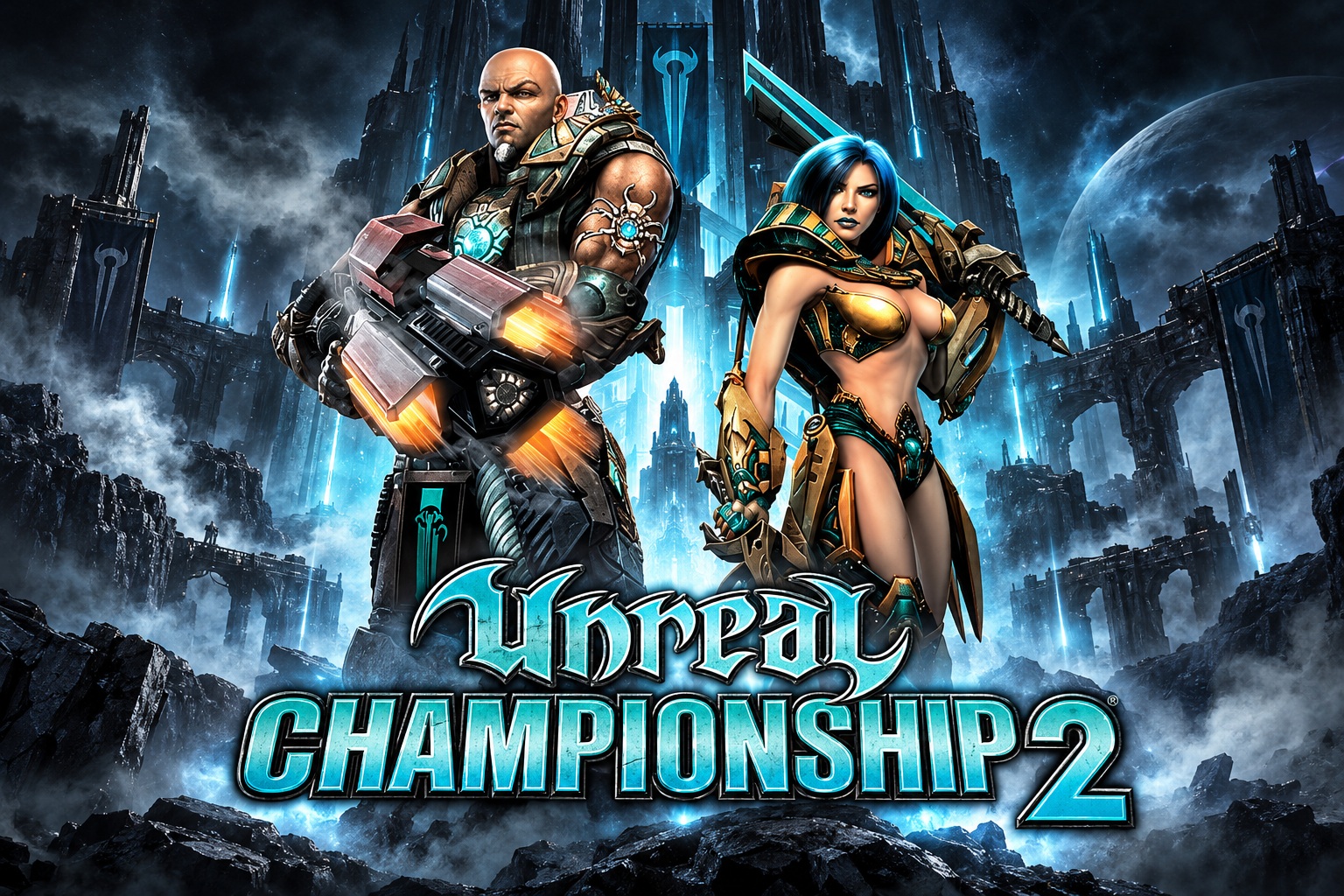
Unreal Championship 2: The Liandri Conflict is one of the most unusual experiments in the entire Unreal franchise, taking the lightning-fast arena combat associated with Unreal Tournament and combining it with third-person melee fighting, acrobatic movement, character-specific abilities, and brutal finishing attacks. Developed by Epic Games and released in 2005, the game moves beyond the traditional formula of simply running around an arena collecting increasingly powerful weapons. Fighters can instantly transition between ranged firearms and dedicated melee weapons, allowing battles to shift from Shock Rifle exchanges across a room to close-range sword or staff combat within seconds. The result is an arena game that feels familiar to Unreal veterans while still offering something dramatically different.
The game revolves around a roster of individual combatants rather than anonymous tournament competitors, with characters such as Anubis, Selket, Lauren, Brock, and others bringing their own personalities, physical characteristics, melee weapons, and Adrenaline abilities into battle. Familiar Unreal weapons including the Shock Rifle, Flak Cannon, Rocket Launcher, Stinger, and Sniper Rifle remain important, but they now exist alongside swords, staffs, claws, and other close-combat equipment. Characters can double-jump, dodge, wall-jump, deflect attacks, and rapidly close distance on opponents, creating arenas where movement is often just as important as accuracy. Even guest fighter Raiden from Mortal Kombat fits surprisingly naturally into the game's exaggerated tournament atmosphere.
Now playable online through Lemon Web Games, Unreal Championship 2: The Liandri Conflict brings its hybrid shooting and melee combat, fast arena movement, character-specific abilities, Unreal weaponry, tournament modes, and story-driven Ascension Rites campaign directly into the web browser. Players can choose different fighters, switch between guns and melee weapons during combat, use Adrenaline-powered abilities, and master arenas designed around constant movement and rapid changes in range. Traditional Unreal skills such as accurate Shock Rifle shots still matter, but relying exclusively on firearms can leave players vulnerable when an opponent suddenly closes the distance. For anyone interested in the stranger and more experimental corners of the Unreal series, Unreal Championship 2 remains a fascinating game that was willing to completely rethink what an arena shooter could be.
The Unreal Formula Is Rebuilt Around Individual Fighters
Earlier Unreal Tournament games generally treated competitors as different models operating under the same fundamental abilities. Unreal Championship 2 gives characters much stronger mechanical identities. Each fighter has unique physical characteristics, preferred melee equipment, and access to different Adrenaline powers.
This makes character selection more meaningful than simply choosing an appearance. A fighter that suits aggressive close-range combat may feel very different from one better suited to mobility or ranged pressure. Learning a character means understanding both the universal Unreal mechanics and the advantages specific to that fighter.
The roster creates an experience closer to a fighting game without abandoning the freedom of an arena shooter. Matchups can feel different depending on who enters the arena, especially when both players understand how to exploit their character's strengths.
Anubis Leads the Story
The main storyline follows Anubis, a warrior connected to the Nakhti people who becomes involved in the Ascension Rites tournament. What begins as a competitive struggle gradually becomes connected to larger political tensions involving Liandri and Anubis' relationship with Selket.
The story provides considerably more character focus than most Unreal Tournament campaigns. Anubis is not simply climbing a ladder to become tournament champion; personal history and political conflict give the competition additional meaning.
This makes the single-player experience feel closer to a traditional action campaign while still being structured around arena battles. Story sequences and rivalries connect individual matches into a larger narrative.
Selket Becomes Both Rival and Central Character
Selket plays a major role in the conflict surrounding Anubis and the Nakhti succession. She is more than another tournament opponent because her connection to Anubis gives their battles personal weight.
Her presence also reflects the game's increased emphasis on character-driven competition. Rivalries are not only about scores or tournament rankings but about relationships and competing ambitions.
This direction makes Unreal Championship 2 unusual within the franchise. The game attempts to combine arena multiplayer mechanics with a story built around specific individuals rather than generic tournament participants.
Melee Combat Completely Changes the Arena
The biggest mechanical departure is the dedicated melee system. Every fighter carries a close-range weapon that can be used alongside traditional firearms, allowing combat to continue even after opponents move inside the comfortable range of a Rocket Launcher or Shock Rifle.
Melee attacks can be chained into aggressive sequences, while defensive techniques allow skilled players to counter incoming pressure. Closing distance becomes a tactical decision rather than simply a mistake.
This creates constant shifts in combat rhythm. A firefight can begin across an arena before suddenly becoming a close-range duel when one fighter rushes forward. Players need to be comfortable with both styles if they want to survive consistently.
Switching Between Ranged and Melee Combat Is Instant
One of the smartest design choices is making the transition between weapon types extremely quick. Players are encouraged to change styles according to distance instead of committing permanently to one approach.
A Rocket Launcher may dominate an open hallway, but a sword or staff becomes much more useful once an opponent reaches melee range. The best players anticipate that change rather than reacting only after they are already under attack.
The system makes every encounter more dynamic. Distance itself becomes a resource that both players constantly attempt to control.
The Shock Rifle Still Rewards Precision
The Shock Rifle remains one of the most recognizable weapons in the Unreal universe. Its accurate primary fire makes it ideal for punishing opponents who expose themselves at medium or long range.
Secondary fire launches a slower energy projectile, preserving the familiar opportunity for more creative attacks. Skilled Unreal players will immediately recognise the value of controlling space with the weapon rather than simply firing continuously.
In Unreal Championship 2, however, players also need to consider how quickly an opponent can close the gap. Great aim remains powerful, but ranged dominance is never completely guaranteed.
The Flak Cannon Dominates Close Quarters
The Flak Cannon remains devastating when opponents enter confined spaces. Its spread of metal fragments can punish anyone who approaches carelessly, especially inside corridors or compact arena sections.
Secondary fire provides additional flexibility by launching a heavier explosive projectile. This allows the weapon to remain useful beyond immediate point-blank distance.
The presence of melee weapons makes Flak encounters especially interesting. Both fighters may be dangerous at close range, creating situations where positioning and timing become extremely important.
The Rocket Launcher Provides Heavy Explosive Pressure
The Rocket Launcher continues the Unreal tradition of rewarding prediction rather than simply aiming directly at an enemy's current location. Rockets travel through the arena, making movement prediction and splash damage important.
Firing toward floors and walls can damage opponents even without a direct hit. This becomes especially effective when trying to prevent an enemy from rushing into melee range.
The weapon remains powerful but dangerous in confined areas. A badly timed shot can punish the user just as easily as the opponent.
Movement Is Faster and More Acrobatic Than Ever
Unreal Championship 2 expands the franchise's already fast movement with double-jumps, dodges, wall-jumps, and other acrobatic techniques. Characters can cover surprising distances quickly, making static defensive play difficult.
Vertical movement is especially important because many arenas contain multiple levels, ledges, ramps, and elevated routes. A player attacking from above can disappear moments later and reappear from another direction.
Learning movement is therefore just as important as learning weapons. A fighter who understands the arena's geometry can escape dangerous situations and create attacking opportunities that slower players never see.
Wall-Jumping Opens New Routes
Wall-jumping gives players additional ways to navigate arena geometry. Surfaces that appear purely decorative can become part of advanced movement routes.
This creates shortcuts and escape options unavailable to players who simply run along the ground. Experienced competitors can move through arenas with an almost acrobatic rhythm.
The mechanic also makes chasing opponents more complicated. Someone who appears trapped may suddenly bounce away from the wall and completely reverse the encounter.
Adrenaline Powers Give Every Character Additional Identity
Adrenaline works differently from the universal combinations seen in Unreal Tournament 2004. In Unreal Championship 2, individual characters can have distinct abilities that support their particular fighting style.
These powers can enhance offence, defence, mobility, or other tactical options depending on the fighter. Managing Adrenaline therefore becomes another important part of each match.
Using an ability at the right moment can completely change the balance of a duel. Wasting it when the opponent can simply retreat may leave the player without that advantage during a more important encounter.
Finishing Moves Add Fighting-Game Personality
The game embraces its melee influence further through dramatic finishing attacks. Defeating an opponent is not always limited to simply reducing health through ordinary gunfire.
Finishers reinforce the idea that these characters are individual fighters rather than interchangeable arena avatars. They bring additional spectacle and personality to victories.
The feature also strengthens the connection between Unreal Championship 2 and traditional fighting games. Few arena shooters of the period were willing to mix genres this aggressively.
Raiden Is an Unexpected but Memorable Guest
Raiden from Mortal Kombat appears as a playable guest character, bringing one of gaming's most recognizable fighting-game personalities into the Unreal universe.
His inclusion initially seems strange, but the combination works surprisingly well because Unreal Championship 2 already embraces exaggerated warriors, supernatural abilities, and close-range combat. Raiden feels less out of place here than he would in a conventional military shooter.
The crossover also highlights how experimental the game was willing to be. Epic was clearly interested in expanding the Unreal formula beyond its established boundaries.
Deathmatch Remains the Purest Test of Combat
Deathmatch strips the experience down to individual survival and scoring. Every opponent is a target, and the arena becomes a continuous contest of movement, weapon control, melee timing, and Adrenaline management.
The hybrid combat makes Deathmatch feel very different from earlier Unreal titles. One opponent may attempt to control the arena with firearms while another aggressively pursues close-range engagements.
This variety ensures that no single distance feels completely safe. Players need to remain prepared for sudden changes in combat style.
Team Deathmatch Adds Cooperation
Team Deathmatch introduces coordination without changing the fundamental goal of defeating opponents. Supporting teammates becomes particularly valuable because melee-focused enemies can be extremely dangerous when they isolate someone.
Ranged fighters can pressure opponents while teammates move closer, creating opportunities that are difficult to achieve alone. Abilities can also become more useful when coordinated around team movement.
The mode demonstrates that the game's fighting mechanics still work within traditional Unreal team combat. Individual character identity does not prevent effective cooperation.
Capture the Flag Rewards Mobility
Capture the Flag benefits enormously from Unreal Championship 2's acrobatic movement. Fast characters can use jumps and dodges to move rapidly through enemy territory and escape after taking the flag.
Defenders need to understand those movement options as well. Blocking only the obvious route may accomplish little when experienced players can use walls and vertical geometry to escape.
The mode encourages players to think about traversal as much as direct combat. A successful flag runner often survives by avoiding unnecessary fights rather than winning every encounter.
Survival Creates a Different Kind of Pressure
Survival-style matches place greater emphasis on staying alive through repeated confrontations. Every mistake becomes more significant because recovery opportunities are more limited.
Character knowledge becomes particularly important here. Understanding when to disengage, when to use Adrenaline, and when to commit to melee can determine whether the fighter survives another round.
The mode highlights one of the game's strengths: combat can remain tense even without huge numbers of players.
Arena Knowledge Provides a Huge Advantage
As with other Unreal games, learning the maps is essential. Weapons, health, Adrenaline, escape routes, vertical shortcuts, and advantageous positions all become easier to use once the arena is familiar.
The melee system makes map knowledge even more important because players need to understand where distance can be created or removed quickly. A narrow hallway benefits different weapons and characters than an open courtyard.
Experienced players begin moving according to expected resources rather than simply chasing the nearest opponent. Arena control becomes part of the battle.
Bots Provide Strong Offline Competition
Computer-controlled opponents make Unreal Championship 2 enjoyable even without human competitors. Bots can use weapons, melee attacks, movement techniques, and objectives effectively enough to provide meaningful practice.
Different difficulty settings allow players to gradually increase the challenge as their understanding improves. Tougher bots punish predictable movement and poor resource control.
This makes the game suitable for learning at an individual pace. Players can experiment with characters and weapons before entering more demanding matches.
The Presentation Gives Every Fighter Personality
Character designs are more elaborate than the anonymous combatants typical of many arena shooters. Armour, weapons, animations, voices, and movement styles help distinguish the roster visually.
The arenas also combine science-fiction architecture with locations connected to the game's story and tournament setting. This gives matches a stronger sense of place.
The overall presentation reinforces the idea that Unreal Championship 2 is not simply Unreal Tournament with another name. It is attempting to create its own identity inside the same universe.
Playing Unreal Championship 2: The Liandri Conflict Online Today
Through Lemon Web Games, Unreal Championship 2: The Liandri Conflict can now be played directly in your web browser with no downloads or setup required. Features of the web-based version include:
New players should resist treating Unreal Championship 2 exactly like a traditional Unreal Tournament game. Firearms remain extremely important, but opponents can close distance quickly and punish players who are uncomfortable with melee combat. Practice switching between both styles until the transition feels natural.
Movement deserves equal attention. Double-jumps, wall-jumps, and dodges can escape dangerous melee pressure or create opportunities to attack from unexpected angles. Learning the arena while mastering those movement options provides a much greater advantage than relying only on weapon accuracy.
Who Should Play Unreal Championship 2: The Liandri Conflict
Unreal Championship 2 is particularly suitable for players who enjoy games that refuse to fit neatly into one genre. It combines shooting, fighting, acrobatic movement, character abilities, and arena objectives without completely becoming either an FPS or a traditional fighting game.
It should also appeal to longtime Unreal fans curious about the franchise's most experimental period. Many familiar weapons and concepts remain, but they are rearranged around a dramatically different style of combat.
Play Unreal Championship 2: The Liandri Conflict Online Now
Unreal Championship 2 takes the speed and weapon design of Unreal Tournament and throws dedicated melee combat directly into the arena. Fire the Shock Rifle across an open room, rush forward with a sword or staff, dodge along walls, activate character-specific Adrenaline abilities, and finish opponents before they can regain control of the fight.
Through Lemon Web Games, players can experience this unusual Unreal entry directly in the browser and discover why it remains so different from almost everything else Epic created in the series. Its mixture of firearms and melee makes every encounter unpredictable, especially once both players understand how quickly the battle can shift between long and short range.
Final Thoughts
Unreal Championship 2: The Liandri Conflict remains fascinating because it was willing to take genuine risks with a successful formula. Epic could have produced another straightforward arena shooter, but instead built a game where character identity, melee combat, finishing moves, wall-jumps, and unique Adrenaline abilities matter alongside the Shock Rifle and Flak Cannon. That experimentation makes it immediately recognizable even among other Unreal titles.
The strongest part of the design is how naturally the ranged and melee systems can interact. A firefight does not need to remain a firefight, and closing distance does not automatically end the usefulness of traditional Unreal weapons. Players are constantly moving between different ranges and deciding which style offers the greatest advantage at that moment.
Through Lemon Web Games, Unreal Championship 2 can now be enjoyed directly in the browser as one of the Unreal franchise's boldest experiments. It combines arena shooting, fighting-game aggression, acrobatic movement, distinctive characters, and classic Unreal weapon design into something that still feels unusual today. For players willing to embrace its hybrid approach, The Liandri Conflict offers a side of Unreal that no other entry quite replicated.











Comments 0