

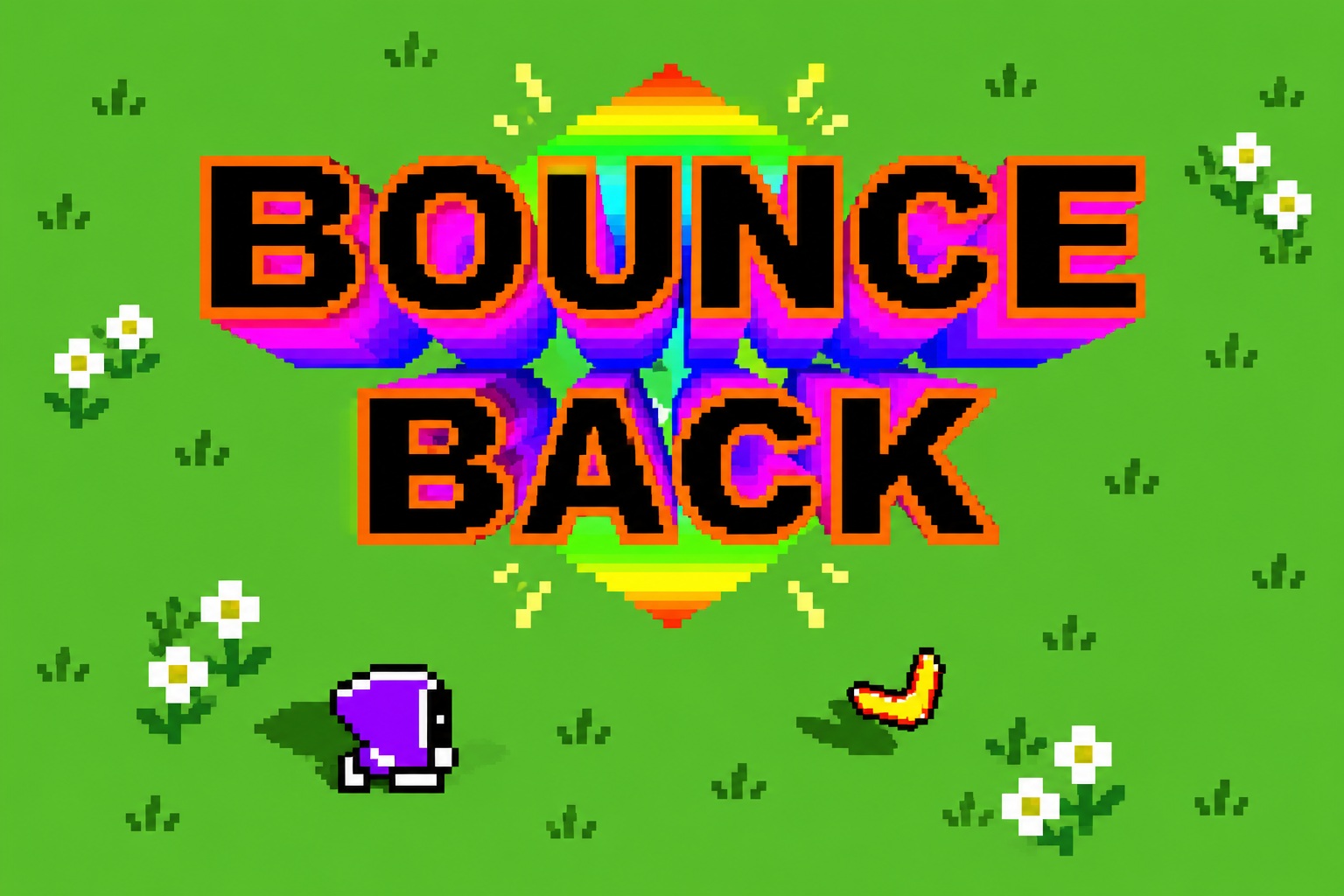
Bounce Back is a compact action roguelite that proves a game does not need a huge download, elaborate graphics, or hundreds of mechanics to deliver a surprisingly complete adventure. Created by Frank Force for the 2019 js13kGames competition, the entire original game was built to fit within the contest's extremely restrictive 13 KB size limit. Despite that limitation, Bounce Back manages to include procedurally generated levels, multiple enemy types, upgrades, shops, persistent progression, a mini-map, a boss encounter, and even a dedicated speed-run mode. Its top-down pixel presentation immediately recalls classic action adventures, but the boomerang-focused combat gives the game an identity of its own.
The adventure begins with a mysterious character stealing the player's heart container and escaping through a portal. From that simple opening, the objective becomes clear: follow the thief through increasingly dangerous areas and eventually take the heart back. The player is armed primarily with a boomerang rather than a conventional sword or firearm, creating combat built around throwing angles, movement, catching, knockback, and positioning. Combined with a protective dash and progressively more difficult enemies, this simple weapon becomes the foundation for a surprisingly tactical action game.
Now playable online through Lemon Web Games, Bounce Back brings this award-winning js13kGames adventure directly into modern web browsers with no installation required. Players can fight through procedurally generated environments, collect coins, purchase upgrades, experiment with different boomerangs, and gradually push toward the final confrontation. Because money and progression features help soften the impact of failure, repeated attempts feel like another opportunity to improve rather than simply starting over without anything gained. Its compact structure makes it easy to begin playing, while the procedural layouts and speed-run challenge provide plenty of reasons to keep coming back.
Created Under the 13 KB js13kGames Challenge
Bounce Back was created for js13kGames, an annual game development competition built around an unusual restriction: the submitted JavaScript game must fit within only 13 kilobytes. That limitation forces developers to think very differently from conventional game development, where graphics, audio, libraries, and code can consume enormous amounts of storage. Every effect, mechanic, enemy, sprite, and line of logic needs to justify its place inside the tiny file size. Bounce Back pushes that limitation surprisingly far.
The original competition version fits an extensive amount of functionality into that restricted space. Procedural level generation eliminates the need to manually store large numbers of maps, while compact pixel artwork provides recognizable characters without consuming much data. Audio effects and visual systems are similarly optimized to create a polished presentation with minimal resources. The result feels much larger than its actual download size suggests.
Bounce Back ultimately achieved second place overall in the 2019 competition, standing out among a large field of entries. Its success came not simply from technical compression but from delivering an actual game that feels complete. The mechanics work together coherently rather than appearing as disconnected demonstrations of programming tricks. That distinction is important because the small-file challenge becomes almost invisible once the player becomes absorbed in the action.
A Boomerang Is Your Primary Weapon
The defining mechanic of Bounce Back is the boomerang. Instead of giving the player a collection of ordinary weapons, the game builds its entire combat system around throwing and recovering this single type of projectile. The mouse controls aiming, allowing the player to send a boomerang precisely toward enemies rather than being restricted to four fixed directions. This immediately makes movement and positioning important.
Once thrown, the boomerang travels outward before being pulled back toward the player. Enemies can be struck on both parts of the journey, allowing a carefully aimed throw to cause damage going out and again while returning. Hits also apply knockback, which can push enemies away from the player or alter their position within the environment. A well-placed throw therefore provides both offensive damage and crowd control.
The player's own movement affects the behavior of the projectile as well. Throwing while moving can influence its velocity and create longer or more unusual trajectories. Skilled players can combine movement and throwing to reach targets that would be difficult to hit while standing still. This gives a deceptively simple weapon much more depth than an ordinary straight-line projectile.
You Actually Need to Catch the Boomerang
Bounce Back does not automatically return every thrown boomerang safely to the player's inventory. If the projectile is not caught when it comes back, it gradually loses height and eventually falls onto the ground. The player then needs to physically retrieve it before using that boomerang again. This small mechanic significantly changes the way combat works.
Throwing carelessly can leave the player without their best weapon at exactly the wrong moment. An enemy might force the player away from the returning projectile, or a poorly positioned throw may cause it to land behind environmental obstacles. Suddenly the battle becomes less about attacking and more about recovering equipment while surviving enemy pressure. These moments create plenty of unexpected tension.
Lost boomerangs are displayed prominently on the mini-map, preventing the player from having to search blindly across the entire level. This is a useful quality-of-life feature because procedural environments can become surprisingly large. Recovering a weapon can itself become a miniature objective during difficult encounters. The mechanic makes the boomerang feel like a physical object rather than an unlimited projectile that simply disappears and reappears.
Multiple Boomerangs Change the Combat
Players are not necessarily limited to carrying a single boomerang. Additional boomerangs can be acquired, allowing several to be thrown and active at the same time. This dramatically increases offensive potential because one projectile may be travelling outward while another is already returning. Managing several trajectories creates a much more chaotic but powerful combat style.
The game also includes specialized boomerangs with different properties. The yellow boomerang can grab pickups and bring them back to the player, making it especially useful when health, coins, or other useful objects are positioned in dangerous locations. Instead of walking directly toward the reward, players can sometimes collect it from a safer distance. This turns the weapon into an exploration and resource-management tool as well as an attack.
The blue super boomerang focuses instead on raw damage, dealing significantly greater punishment to enemies. Its increased offensive capability comes with different limitations, encouraging players to think about which boomerang is currently most useful. The active boomerang is even visually represented on the player's back, providing an immediate indication of what will be thrown next. Small details like this make the minimalist presentation surprisingly readable.
The Dash Is More Than a Movement Boost
Movement is another essential part of Bounce Back's combat. Pressing the dash button gives the player a temporary burst of speed that can be used to escape dangerous situations, rapidly reposition, or close distance. More importantly, the dash protects the player from damage while it is active. This turns it into both a movement tool and a temporary defensive ability.
The dash recharges after a short cooldown rather than being available continuously. Players therefore need to decide whether to use it aggressively or save it for an emergency. Spending the dash simply to travel faster may leave no defensive option when several enemies suddenly attack. Holding onto it forever, however, can also waste opportunities to reposition effectively.
Dashing can also break through environmental objects such as bushes and rocks. This creates another connection between combat and exploration, allowing players to clear paths or escape through areas that initially appear blocked. Combining a dash with a boomerang throw can increase range, while dashing toward a returning weapon can help make a difficult catch. These interactions make the movement system feel tightly connected to the core weapon mechanic.
Procedurally Generated Levels Keep Runs Unpredictable
Bounce Back does not rely entirely on fixed handcrafted maps. Its main levels are procedurally generated, producing different layouts between runs and preventing players from memorizing every path. The underlying generation system creates maze-like structures that are then shaped into more natural environments. As a result, each level maintains a recognizable structure while still offering variation.
The mini-map gradually reveals the level as the player explores. This helps players understand how different areas connect and makes it easier to locate unexplored passages. Enemy positions and important objects can also appear within revealed sections, providing valuable information when planning the next move. The map becomes increasingly useful as the environments grow larger.
Procedural generation works particularly well within the strict size limitations of js13kGames. Instead of storing many manually designed maps, relatively compact code can create enormous numbers of possible layouts. The result provides additional replay value while consuming very little storage. It is an excellent example of technical constraints directly influencing game design in a positive way.
Grass, Sand, Bushes, and Rocks Shape Each Arena
The environments may appear simple at first glance, but terrain affects how encounters unfold. Open ground allows unrestricted movement, while sand slows movement and can change the pace of a pursuit. Enemies are also affected by sand in useful ways, allowing clever players to manipulate positioning and create distance. What looks like basic terrain can therefore become part of the combat strategy.
Bushes and rocks provide physical obstacles throughout the maps. They can block movement, interfere with boomerang trajectories, and create temporary protection from certain enemies. Players can also destroy these objects, gradually changing the shape of the battlefield during a fight. A route that was blocked at the beginning of an encounter may become open after enough destruction.
These environmental interactions are particularly important because different enemy types handle obstacles differently. Some become trapped behind terrain, while others can jump over or smash directly through it. Understanding how an enemy interacts with the environment can provide a major advantage. Bounce Back encourages players to use the level layout rather than treating every battle as an empty arena.
Slimes Introduce the Combat Basics
Blue slimes are among the first enemies encountered and provide an effective introduction to the boomerang system. They move somewhat unpredictably while generally drifting toward the player, creating enough pressure to demand attention without immediately becoming overwhelming. Their movements make them good targets for learning how returning boomerangs can strike an enemy twice. They also demonstrate how terrain can be used to control movement.
Defeating a larger slime can create smaller versions, meaning that eliminating one target may temporarily increase the number of enemies on screen. Players who attack without considering positioning can quickly become surrounded. This encourages the use of knockback and careful movement rather than simply throwing repeatedly in one direction. The mechanic makes even a basic enemy slightly more interesting.
Stronger red variations appear later, providing greater durability and increasing the pressure during more advanced levels. These tougher versions ensure that familiar enemies remain relevant after the player has gained upgrades. Sand and environmental obstacles can still be used against them effectively. Learning those interactions early becomes useful throughout the entire adventure.
Jumping Enemies Demand Better Timing
Jumpers introduce a completely different combat problem. These enemies leap across the environment, allowing them to bypass certain obstacles that might stop ordinary creatures. Their jumping movement makes them less predictable and prevents players from relying too heavily on bushes or rocks for protection. They can quickly turn a seemingly safe position into a dangerous one.
A jumper can only be damaged effectively while it is on the ground. This creates short windows during which the player needs to time the boomerang carefully. Throwing while the enemy is airborne may simply waste the opportunity and leave the weapon travelling uselessly across the level. The encounter becomes about timing rather than pure accuracy.
Because jumpers are not affected by terrain in the same way as slower ground enemies, players need to adapt their strategy. Sand that might help contain a slime offers much less protection against something capable of leaping across it. The increasing enemy variety prevents one simple tactic from dominating every encounter. Each new level asks players to reconsider what previously worked.
Shielded Enemies Turn Positioning into a Puzzle
Shielded enemies provide one of the strongest tests of boomerang control. Their shield protects the front of the body, meaning straightforward attacks can simply bounce away harmlessly. Players need to strike from the sides or behind, making positioning much more important than against earlier enemies. This naturally works well with a weapon that curves back toward the player.
A clever throw can pass beyond a shielded enemy and hit them during the return journey. Alternatively, the player can move around the opponent while the boomerang is in flight, effectively changing the angle from which it returns. These situations highlight the depth hidden inside the simple throw-and-catch mechanic. Combat begins to resemble a positioning puzzle rather than a conventional shooting game.
Shielded enemies can also charge and smash through environmental objects. This prevents players from hiding indefinitely behind terrain and keeps the battlefield changing. Rocks and bushes that initially provide protection may disappear once a shielded opponent begins pursuing aggressively. Their presence ensures that later levels feel significantly more dangerous.
Giant and Invisible Enemy Variants Increase the Challenge
Later levels introduce enemy variants that can be applied to existing enemy types. Giant enemies are larger, more aggressive, and capable of absorbing considerably more damage. They effectively function as miniature bosses within otherwise ordinary encounters. Their increased size also makes them easier to identify on the mini-map.
Invisible enemies create a very different kind of challenge. They are extremely difficult to see directly but are not completely undetectable. Their shadows remain visible, and they become temporarily easier to identify after taking damage. Environmental traces can also reveal where they have been moving.
The most intimidating possibility is an enemy carrying more than one difficult modifier. A giant invisible enemy combines increased durability with reduced visibility, creating exactly the kind of unpredictable encounter that makes procedural games memorable. These variants allow the game to increase difficulty without requiring dozens of completely separate enemy designs. It is an efficient system that fits the tiny-file philosophy perfectly.
Coins Turn Failure into Progress
Bounce Back incorporates a light persistent progression system through money earned during runs. Defeating enemies can produce coins and other useful pickups, encouraging players to engage with dangerous encounters rather than simply avoiding everything. Money becomes valuable because it can be spent on upgrades that improve future attempts. Even a run that ends in defeat can therefore contribute toward eventual success.
Most importantly, collected money is not lost when the player dies. This changes the emotional impact of failure significantly. Instead of losing everything and returning to the beginning with nothing gained, the player can gradually accumulate enough resources to purchase better equipment. Each attempt can make the next one slightly more manageable.
This system gives Bounce Back a roguelite quality without becoming excessively complicated. There are no enormous skill trees or hundreds of statistics to manage. The progression simply encourages players to continue trying, build resources, and return better prepared. It is a particularly effective design choice for a game intended to be quickly accessible through a browser.
Shops Provide Useful Upgrades
Shops give players opportunities to turn earned money into practical advantages. Upgrades can improve survivability, provide additional boomerangs, or introduce specialized weapon variants. Because money persists between attempts, expensive items can become long-term goals. A difficult run that earns plenty of coins may therefore still feel productive.
Choosing what to buy can affect the style of the next attempt. Additional boomerangs increase offensive flexibility, while stronger equipment can help players survive later enemy waves. Specialized boomerangs support different strategies, whether focusing on item collection or direct damage. The shop system remains compact but provides meaningful decisions.
Death may remove some temporary advantages, but accumulated currency ensures that progression never feels completely erased. Players gradually become more familiar with both enemy behavior and upgrade priorities. Mechanical improvement and persistent resources therefore progress together. That combination makes eventually reaching the final levels feel earned.
The Hub Acts as a Physical Menu
Rather than relying heavily on traditional menu screens, Bounce Back integrates several functions directly into the game world. The starting hub acts as the central location players return to after death or restarting. Portals provide access to progression features and different modes, allowing the interface to remain minimal. This approach saves space while also keeping the experience immersive.
Once enough progress has been made, a warp portal becomes available to return toward the highest level previously reached. This prevents players from being forced to replay every early level after each failure. The system respects the player's progress while still preserving the challenge of later stages. It also makes shorter sessions much more practical.
Information about unlocked modes and progression is presented naturally within the hub. The environment effectively functions as a menu that the player physically walks through. This is both an efficient technical solution and an elegant design choice. It allows Bounce Back to provide persistent functionality without interrupting the action with elaborate interface screens.
Ten Levels Build Toward a Final Confrontation
The main adventure consists of ten progressively more challenging levels beyond the central hub. Each level increases the pressure by expanding the environment and introducing tougher enemies or more dangerous variants. Procedural generation ensures that the exact journey changes, but the difficulty still follows a clear progression. Reaching deeper levels feels like a genuine achievement.
Clearing the enemies causes an exit portal to appear, pulling the player forward toward the next challenge. This gives every level a straightforward objective: survive, defeat what stands in the way, and keep moving. The portal's appearance provides a clear visual reward after a difficult battle. Players always know when the immediate danger has finally been overcome.
The relatively short number of stages works well because individual levels become increasingly demanding. Bounce Back is not trying to provide dozens of hours of scripted story content. Instead, it builds replayability through procedural layouts, upgrades, enemy combinations, and repeated attempts. Completing all ten levels becomes a focused but meaningful goal.
The Final Boss Brings the Opening Mystery Back
The mysterious character seen during the opening eventually becomes the final obstacle. The stolen heart container introduced at the beginning returns to the center of the story, giving the otherwise minimal narrative a satisfying sense of closure. Unlike ordinary shielded enemies, this opponent protects its back, forcing the player to attack from the front. This reverses an important rule learned during previous encounters.
The final arena is also more deliberate than the procedurally generated levels leading up to it. Trees and rocks create a large battlefield that gradually changes as the fight becomes more destructive. The heart itself appears within the environment, giving observant players opportunities to interact with the objective before the battle fully develops. The arena becomes increasingly chaotic as the confrontation continues.
After being provoked, the boss becomes substantially larger and more aggressive. The fight therefore tests everything learned throughout the adventure: movement, dash timing, accurate throws, weapon recovery, environmental awareness, and positioning. It is an appropriately exaggerated ending for a game built around a very simple initial mechanic. Recovering the stolen heart provides a satisfying conclusion to the journey.
Winning Unlocks Speed-Run Mode
Completing Bounce Back does not necessarily mean the adventure is finished. Victory unlocks a dedicated speed-run mode accessible from the hub. This changes the objective from simply surviving to completing the entire journey as quickly as possible. A timer records the run and encourages players to refine their routes and combat efficiency.
Speed runs begin without relying on accumulated advantages in quite the same way as ordinary progression, creating a more standardized challenge. Players need to make quick decisions about upgrades, movement, and enemy engagement while avoiding unnecessary delays. Procedural generation adds another layer because layouts cannot simply be memorized perfectly. Adaptability becomes just as important as raw execution.
The player's best completion time is preserved, creating a clear target for future attempts. Shaving even a small amount from a previous record can provide another reason to return. This mode is especially appealing once the normal progression has been mastered. It transforms a completed adventure into a performance challenge.
Pixel Graphics Inspired by Classic Action Adventures
Bounce Back uses deliberately compact pixel artwork influenced by classic handheld action games. Characters and enemies are represented with small sprites, but their silhouettes and movement remain easy to understand during fast combat. The limited palette gives the entire game a cohesive visual style. Rather than trying to hide the size restriction, the artwork embraces simplicity.
Animation is used efficiently to give the world more life than might be expected from such a tiny game. Enemies leave traces behind them, movement creates visible trails, and combat produces persistent environmental details. These effects make levels feel increasingly marked by the battles that have taken place. The battlefield can look noticeably different after an intense encounter.
The portal effects deliberately stand apart from the surrounding pixel artwork, creating a striking visual contrast whenever the path forward appears. Small interface touches, such as dash-charge indicators and low-health warnings, provide important feedback without cluttering the screen. Every visual element serves a practical purpose. The result is minimalist without feeling unfinished.
A Mini-Map That Does More Than Show Direction
The mini-map is an especially useful feature because the procedural levels can become large enough to make navigation difficult. Areas are revealed as the player explores, gradually building a picture of the generated layout. Enemy and object information becomes visible within explored territory, helping players decide where to travel next. This reduces aimless wandering without completely revealing the stage from the beginning.
Lost boomerangs are displayed particularly clearly. Because dropping a weapon somewhere inside the level can otherwise become extremely frustrating, the map makes recovery practical. Giant enemies also appear more prominently, allowing dangerous encounters to be identified from a distance. These features turn the map into a tactical tool rather than a decorative overview.
Invisible enemies remain detectable through map information even when their bodies are difficult to see during ordinary gameplay. This provides another countermeasure against one of the game's most dangerous variants. Players who regularly check the mini-map gain valuable situational awareness. It is an impressive amount of interface functionality for a project created under such strict storage limitations.
Why Bounce Back Feels Larger Than 13 KB
The most impressive quality of Bounce Back is how rarely its technical limitation feels like a limitation during normal play. Procedural generation provides varied maps, enemy variants create additional combat combinations, persistent progression encourages repeated attempts, and multiple boomerang types expand the player's options. Every system creates additional gameplay without requiring enormous amounts of stored content. The result is a game that feels substantially larger than its file size.
Its mechanics also reinforce one another rather than existing independently. The boomerang interacts with player movement, dash mechanics affect both defense and environmental destruction, terrain alters enemy movement, and the mini-map supports both exploration and weapon recovery. Shops connect enemy combat to persistent progression, while procedural levels ensure that those encounters happen in different contexts. This interconnected design is what makes the game feel complete.
The size restriction may have encouraged the developer to focus heavily on systems rather than scripted content. Instead of storing dozens of fixed levels, the game generates them. Instead of creating huge numbers of unique enemies, it combines a smaller number of enemy types with variants and environmental interactions. This is precisely the kind of efficient design that makes js13kGames entries so fascinating.
Playing Bounce Back Online Today
Through Lemon Web Games, Bounce Back can now be played directly in your web browser with no downloads or setup required. Features of the web-based version include:
Bounce Back is particularly well suited to browser play because the entire experience was originally designed as a lightweight JavaScript game. Movement uses familiar keyboard controls while the mouse provides precise aiming for boomerang throws. Sessions can be relatively short, but persistent money and warp progression encourage players to return after a failed attempt. The game is easy to begin without lengthy tutorials or complicated menus.
Its procedural design also means that returning for another run does not simply involve repeating exactly the same route. Familiar enemies can appear in different situations, terrain may create new tactical opportunities, and difficult variants can turn ordinary encounters into unexpected problems. Players gradually improve at reading the game rather than memorizing one fixed sequence. This makes repeated browser sessions especially enjoyable.
Who Should Play Bounce Back
Bounce Back is particularly suitable for players who enjoy games where one carefully designed mechanic supports an entire combat system. The boomerang may appear simple, but throwing angles, catching, knockback, movement, enemy shields, terrain, and multiple projectile types create plenty of room for experimentation. The dash adds another layer by providing both mobility and temporary protection. Players who enjoy mastering movement and positioning will find much more depth here than the tiny file size might suggest.
The game should also appeal to anyone interested in the creative side of browser game development. Bounce Back demonstrates how procedural systems, compact artwork, and carefully chosen mechanics can replace enormous amounts of conventional game content. It does not feel like a technical demo created merely to prove that something can fit within 13 KB. It feels like a genuine game whose technical constraints helped shape its strongest ideas.
Play Bounce Back Online Now
Bounce Back delivers a complete action adventure around one deceptively simple idea: throw a boomerang and make sure it comes back. From that foundation grows a combat system involving knockback, weapon recovery, multiple boomerangs, specialized variants, tactical dashing, destructible terrain, enemies with different defensive behaviors, and increasingly chaotic procedural encounters. Coins and shops provide meaningful progression between attempts, while the ten-level journey gives each run a clear objective. The stolen heart provides just enough story to keep the adventure moving toward a satisfying final confrontation.
Through Lemon Web Games, players can jump directly into the action and experience one of the standout games from the 2019 js13kGames competition. Its controls are straightforward, but mastering the relationship between movement and boomerang trajectories takes practice. Every failed catch, risky dash, and difficult shielded enemy teaches something useful for the next encounter. Once the main adventure has been completed, the unlockable speed-run mode provides another reason to return and refine those skills.
Final Thoughts
Bounce Back is an excellent demonstration of how strong game design can matter far more than file size. Its original 13 KB limitation could easily have resulted in a short novelty, yet the game manages to include procedural generation, persistent progression, multiple enemies, weapon upgrades, environmental interaction, a hub, a final boss, and speed-running support. More importantly, those systems are built around a single coherent mechanic rather than feeling like features added simply to impress competition judges. The boomerang remains central from the first enemy encounter to the final confrontation.
The combat works because the boomerang is treated as a physical object with consequences. A careless throw can leave the player temporarily unarmed, a clever returning trajectory can bypass an enemy's defenses, and movement can influence both range and recovery. The dash complements this system perfectly by providing temporary protection while also enabling faster catches and environmental destruction. Enemy designs then challenge different parts of those mechanics, gradually forcing players to become more precise.
Years after its original js13kGames appearance, Bounce Back remains a compelling example of what browser gaming can achieve with extremely limited resources and focused design. Its retro presentation is immediately approachable, while procedural levels and tactical combat provide enough unpredictability to support repeated runs. Through Lemon Web Games, players can recover the stolen heart, experiment with different boomerangs, battle through increasingly dangerous procedural environments, and discover why this tiny action roguelite earned such strong recognition despite fitting into barely more storage than a small image file.











Comments 0