

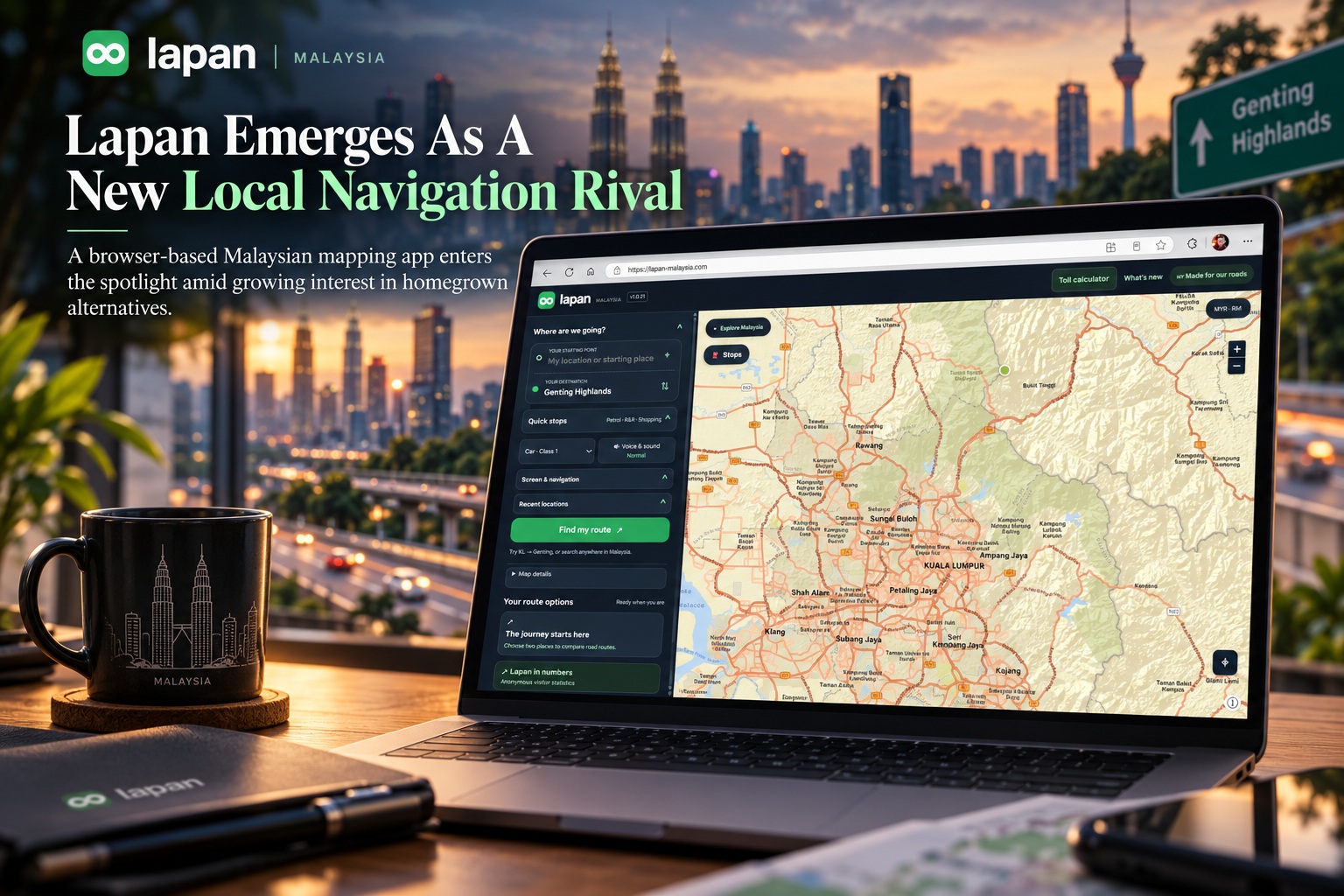
Malaysia's growing interest in locally developed navigation platforms has produced another unexpected entrant. Developer Alan Chung, frustrated by the technical disruptions and limitations surrounding the TuJu navigation app, decided to build an alternative of his own. The result is Lapan, a free browser-based navigation service that already includes several of the basic features users would expect from a mapping platform.
Lapan is still clearly an early-stage project rather than a polished competitor to Waze, Google Maps or even TuJu. Nevertheless, the fact that one local developer could put together a working navigation service relatively quickly highlights how accessible modern mapping technologies and AI-assisted development tools have become. It also adds another interesting dimension to the ongoing debate surrounding Malaysia's push for local navigation alternatives.
The Name Lapan Is An Obvious Play On TuJu
The name immediately gives away some of the humour behind the project. TuJu sounds like the Malay word for seven, while lapan means eight, making the new app's name a playful dig at the increasingly prominent government-supported navigation platform.
Beyond the joke, however, Lapan is a functioning browser-based navigation service rather than simply a concept or demonstration. Users can access it directly without creating an account or installing an application, making it relatively easy to try.
The service currently supports both 2D and 3D map views, and there is no registration requirement. For users who simply want to experiment with the platform, that low barrier to entry is one of its immediate advantages.
Lapan Includes Suggested And Alternative Routes
The app already provides several familiar navigation functions, including suggested routes and alternative routes between destinations. Its primary suggested route can also incorporate live traffic information supplied through TomTom.
That integration is important because building an entire real-time traffic network from scratch would be extremely difficult for an independent developer. Using an established traffic-data provider allows Lapan to offer at least some of the dynamic routing functionality users expect from modern navigation services.
Alternative routing also makes the platform more useful because drivers are not necessarily forced into one suggested path. Users can compare different options depending on distance, road conditions or personal preference.
There Is Also A Toll Calculator
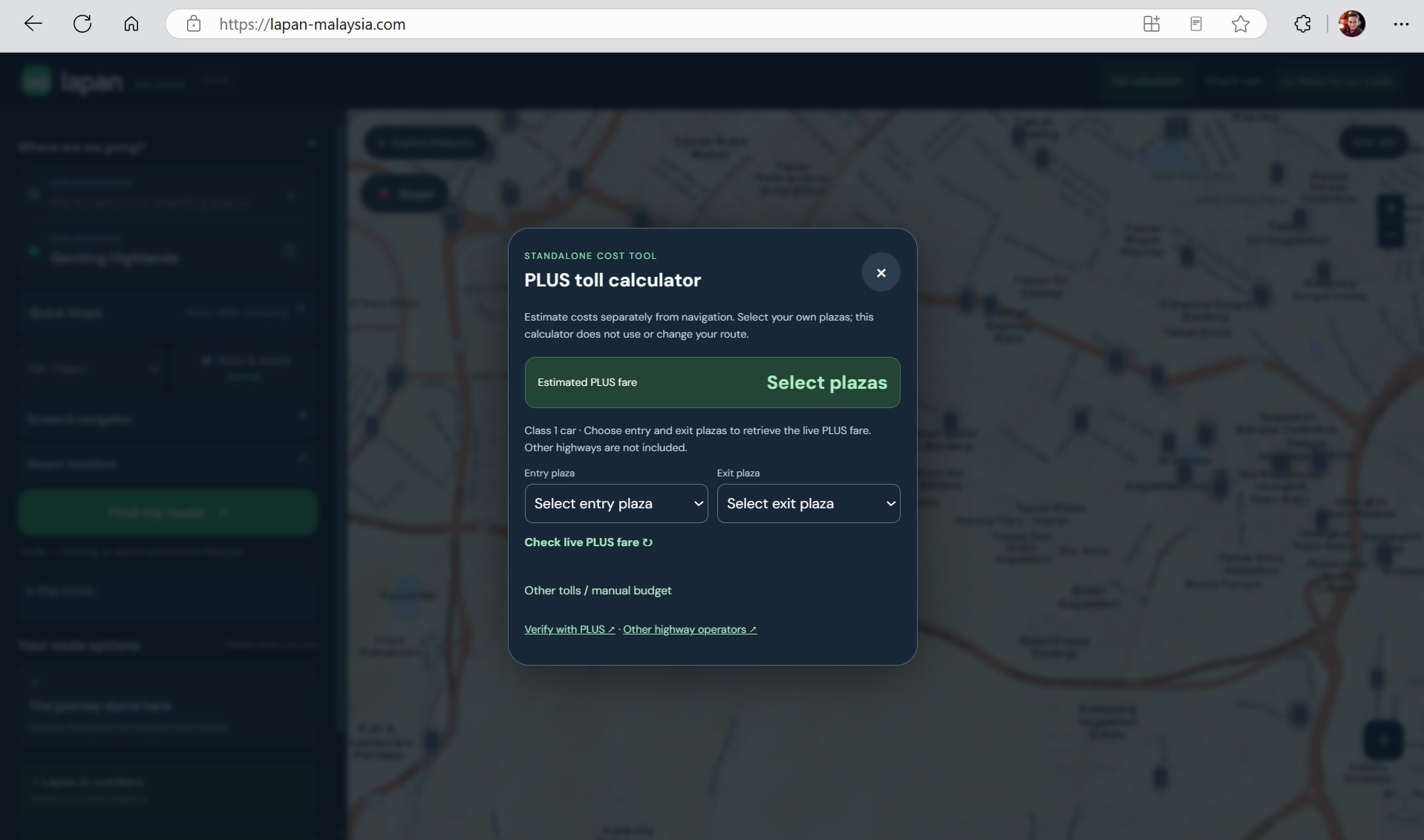
Lapan includes a toll calculation feature, although its implementation currently appears less automated than users might expect from a mature navigation platform. Rather than calculating toll charges directly from the selected route, the feature seems to require some manual input.
That makes it less convenient than a fully integrated toll system, but its presence still shows that the developer is thinking about Malaysian-specific driving requirements. Toll costs matter significantly when comparing routes across Klang Valley and interstate highways.
With further development, automatically linking toll calculations to selected journeys would make the feature substantially more useful.
The Project Feels Like It Was Built Very Quickly
Lapan also gives the impression of being developed rapidly, which is understandable given the circumstances behind its creation. The project appears to have emerged as an immediate response to frustration surrounding TuJu rather than as a long-term commercial navigation platform that had been under development for years.
That fast turnaround has obvious advantages because Chung was able to demonstrate a working alternative relatively quickly. At the same time, the application still shows several characteristics of an early prototype, particularly in its interface and overall polish.
This is not necessarily a criticism of the concept itself. It simply means expectations should be calibrated appropriately when comparing a recently created independent project against navigation platforms backed by large engineering teams.
AI-Assisted Development May Have Played A Role
The interface also has characteristics commonly associated with modern AI-assisted development, sometimes referred to as vibecoding. The layout, typography and structure resemble patterns frequently produced when developers use AI coding assistants to quickly generate web applications.
There is nothing inherently wrong with that approach. AI tools have made it dramatically easier for independent developers to transform ideas into functioning prototypes without manually writing every component from scratch.
In fact, Lapan demonstrates one of the most interesting consequences of this shift. A project that previously might have required a small development team can now potentially be created by one motivated developer using existing APIs, mapping services and AI-assisted coding tools.
Vibecoding Is Lowering The Barrier To Application Development
AI-assisted development has created a growing community of people building their own applications for personal use or sharing them publicly. Some developers use AI primarily to accelerate repetitive work, while others rely much more heavily on natural-language instructions to generate significant portions of the project.
The result is that building a reasonably functional application has become accessible to far more people. Someone no longer needs years of experience across frontend development, backend systems, APIs and interface design before experimenting with a new idea.
However, creating something that works is very different from building something reliable enough for thousands or millions of users. That distinction becomes especially important for navigation software, where inaccurate information can have real-world consequences.
Destination Search Still Has Problems
One of Lapan's current limitations appears when users manually enter specific destinations rather than selecting one of the locations provided through the search results. In some cases, the application is unable to calculate a route when the manually entered destination does not match the available result data.
That creates an obvious usability issue because users expect modern navigation applications to recognise a wide variety of addresses, landmarks and businesses. A navigation service becomes frustrating very quickly if users need to guess which search result format the system understands.
Improving geocoding and destination matching would therefore be one of the most important areas for future development.
Some Locations Are Still Missing
The app's location database is also incomplete. Certain destinations and points of interest cannot currently be found, further reinforcing that Lapan is still under active development rather than being a finished national navigation service.
Comprehensive place information is one of the hardest parts of building a serious navigation platform. Users expect petrol stations, restaurants, shopping centres, hospitals, government offices and countless smaller locations to appear immediately when searched.
Large services have spent years building and continuously updating those databases. For an independent Malaysian project, reaching comparable coverage will require time and access to better datasets.
Open Government Data Could Help Projects Like Lapan
Interestingly, Lapan appears at a time when the Malaysian government is actively encouraging developers to make better use of public transport and open government datasets. Transport Minister Anthony Loke recently highlighted that various transport datasets have already been made available for developers.
Projects such as Lapan could potentially benefit from greater access to government road, highway and public transport information. Better APIs and standardised datasets could allow independent developers to create more accurate applications without having to build every database themselves.
This is where Malaysia's broader open-data initiatives could become genuinely valuable. Instead of only supporting one government-associated app, public information could help an entire ecosystem of local navigation projects emerge.
Testing Has So Far Been Limited
Chung reportedly tested Lapan personally before releasing it, but the project does not appear to have undergone the kind of large-scale testing expected from a commercial navigation platform. That means there will almost certainly be situations and routes that behave differently from what the developer encountered during initial testing.
Navigation software needs testing across urban roads, rural areas, highways, unusual junctions and rapidly changing traffic conditions. Thousands of different destination combinations also need to work reliably.
A larger group of users can help expose these problems quickly, but the developer will then need a practical way of receiving feedback and fixing issues.
There Is No Dedicated Android Or iOS App Yet
Lapan currently operates through a web browser rather than through a dedicated mobile application. There is no Android or iOS version available at the moment, and Chung has not indicated whether native apps are planned.
The browser approach has some advantages. Users can access the service instantly without installing anything, and the developer only needs to maintain one main application rather than separate Android and iOS codebases.
However, native apps can provide deeper integration with smartphones, including better background location handling, notifications and potentially smoother navigation. If Lapan gains a significant user base, dedicated mobile versions could become a logical next step.
TuJu's Problems Helped Inspire The Project
Lapan's appearance is closely tied to the recent attention surrounding TuJu. The Malaysian Highway Authority's navigation app experienced technical disruptions after receiving a sudden surge of users following government promotion.
Prime Minister Datuk Seri Anwar Ibrahim encouraged Malaysians to consider TuJu instead of Waze amid concerns surrounding movement data and national security. Civil servants were subsequently barred from using Waze for official duties, dramatically increasing public awareness of local alternatives.
That sudden attention placed TuJu's technical limitations under much greater scrutiny. Lapan appears to have emerged partly from the frustration generated by that experience.
TuJu Was Never Originally Designed As A Full Waze Replacement
Part of the challenge is that TuJu was originally focused heavily on Malaysia's expressway network. It offers useful features such as highway CCTV snapshots, toll information and details about rest areas, but broader navigation outside major highways remains an area still being improved.
The government has since asked for wider road coverage and stronger reliability, while the Malaysian Highway Authority and developer Prosignal Consortium are working to increase capacity following the surge in users.
TuJu therefore has considerably more institutional backing than Lapan, but it also carries much higher expectations because it is being promoted nationally.
A Potential Waze Ban Has Increased Interest In Alternatives
The discussion has become even more significant because Anwar has said the government has not ruled out a broader restriction on Waze. At present, the mandatory prohibition applies to civil servants using it for official duties, while ordinary Malaysians remain free to use the platform.
The possibility of wider restrictions has naturally generated resistance, especially because many drivers rely heavily on Waze's mature traffic information and crowdsourced incident reporting.
This makes the quality of local alternatives increasingly important. People are much more likely to support a change when the replacement provides a comparable or better experience.
Independent Developers Could Play An Important Role
Lapan shows that local navigation development does not necessarily need to come exclusively from government agencies or large corporations. Independent developers can experiment with different interfaces, data sources and features much more quickly.
A healthy ecosystem could eventually include several specialised navigation applications rather than one official Malaysian platform attempting to handle every possible use case. Some might focus on highways, others on public transport, EV charging, urban driving or privacy.
Competition between local developers could ultimately produce better applications because users would have several alternatives rather than being expected to accept whichever platform receives official support.
The Biggest Challenge Is Moving Beyond A Prototype
The difficult part begins after the initial application is working. Maintaining a navigation platform requires constantly updated map information, traffic feeds, infrastructure monitoring and continuous software development.
Users also expect extremely high reliability. A minor bug in a social application may be annoying, but a routing error can send someone kilometres in the wrong direction or into unnecessary congestion.
Lapan therefore has plenty of room to evolve before it should be considered a serious competitor to established navigation services. Its current value may be less about replacing Waze immediately and more about demonstrating what a motivated local developer can build quickly.
AI Can Accelerate Development But Not Replace Testing
If AI-assisted coding was indeed used heavily in Lapan's development, the project also provides a useful example of both the strengths and limitations of the approach. AI can generate interfaces, integrate APIs and produce working code extremely quickly.
What it cannot automatically guarantee is production reliability. Developers still need to verify routing logic, validate unusual inputs, test real-world conditions and ensure that the application behaves correctly when thousands of people use it simultaneously.
Vibecoding can dramatically shorten the journey from idea to prototype. Turning that prototype into dependable infrastructure still requires conventional engineering discipline.
Final Thoughts
Lapan is an interesting addition to Malaysia's suddenly crowded conversation around local navigation platforms. Built by developer Alan Chung after frustrations with TuJu, the browser-based application already provides 2D and 3D maps, suggested and alternative routes, live traffic information through TomTom and a basic toll calculator without requiring users to register.
It is also clearly still an early-stage project. Destination matching can fail when manually entered locations do not correspond with search results, some places remain missing and there is currently no dedicated Android or iOS application. These shortcomings make it difficult to view Lapan as a complete replacement for established navigation services today.
Still, the project is significant for another reason. It demonstrates how modern APIs, open data and AI-assisted development are dramatically lowering the barrier for Malaysians who want to build their own applications.
TuJu may have unintentionally created its first homegrown rival, and whether Lapan develops into something substantial or remains an experimental side project, its existence shows that Malaysia's next navigation platform does not necessarily have to come from a large company or government agency. It could begin with one frustrated developer deciding that they can build something better.











Comments 0