

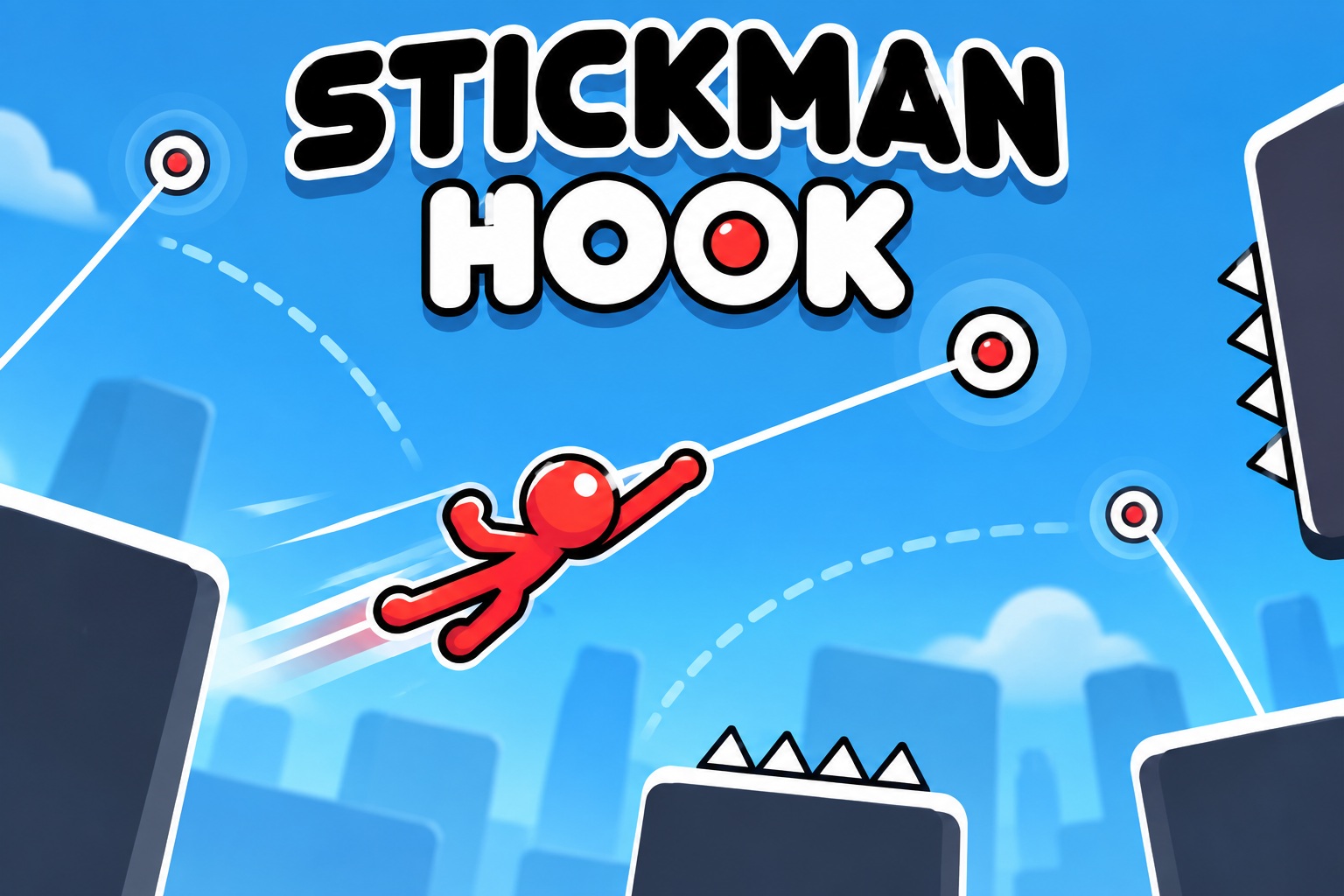
Stickman Hook is a fast and addictive physics-based platform game built around swinging from hooks, building momentum, bouncing from pads, avoiding obstacles, and launching a stickman toward the finish line with smooth acrobatic movement. The game gives players an energetic browser experience where timing, momentum, angle control, and smart hook selection all matter. Its controls are incredibly simple, but mastering the physics and learning how to carry speed through each stage creates a surprisingly satisfying challenge.
The appeal of Stickman Hook comes from how naturally movement flows once everything starts working together. Players grab onto hooks, swing through the air, release at the right moment, bounce off platforms, and connect with the next anchor before falling. A perfectly timed sequence can turn an awkward obstacle course into one continuous acrobatic run, while a mistimed release can send the stickman flying in completely the wrong direction.
Now playable online through Lemon Web Games, Stickman Hook can be experienced directly in your web browser as part of a growing collection of physics, platform, stickman, arcade, casual, and browser-playable games. Its web-based availability makes it easy to jump into this energetic swinging challenge, where hooks, ropes, bounce pads, obstacles, momentum, and perfectly timed launches come together in one highly replayable browser experience.
A Platform Game Built Around Swinging
Stickman Hook stands out because ordinary running and jumping are not the main focus. Movement is built primarily around swinging from fixed anchor points.
When the stickman connects to a hook, momentum begins carrying the character in an arc. Players then need to decide exactly when to release.
Letting go too early may leave the character short of the next anchor. Holding on too long can send the stickman backward or into an obstacle.
That simple decision forms the heart of the entire game.
Momentum Is Everything
Momentum plays a major role in Stickman Hook.
A strong swing can launch the stickman across large gaps, while a weak one may barely move the character far enough to continue.
Players gradually learn that speed should often be preserved rather than constantly reset.
The best runs come from carrying momentum from one hook to the next, allowing each swing to support the following movement.
Timing the Perfect Release
Releasing the rope at exactly the right moment is one of the most important skills in the game.
The stickman continues travelling according to the direction and speed generated during the swing.
A release near the bottom of the arc can produce strong horizontal speed, while releasing higher may create more vertical movement.
Understanding this difference helps players adapt to different obstacle layouts.
Hook Selection Matters
Some stages contain several possible hooks.
The closest anchor is not always the best choice.
A farther hook may provide a better angle, more speed, or an easier path toward the next section.
Players who look ahead before attaching can often complete stages more smoothly than those who simply grab the first available hook.
Simple Controls With Surprising Depth
One of Stickman Hook's greatest strengths is its simplicity.
Players do not need complicated controls or long tutorials. The basic interaction can be understood almost immediately.
However, good performance requires much more than simply pressing and releasing at random.
Timing, trajectory, momentum, and obstacle awareness gradually become more important as stages become more demanding.
Physics Make Every Swing Feel Different
The game's physics help make movement feel satisfying.
Speed, angle, rope length, and release timing all influence where the stickman travels next.
Even small changes can produce very different results.
A slightly earlier release might send the character directly toward the next hook, while waiting another moment could completely change the trajectory.
Bounce Pads Add Another Layer
Bounce pads provide another important movement mechanic.
Landing on one can launch the stickman upward or forward, creating enough momentum to reach distant hooks or clear large obstacles.
The angle of approach also matters.
Hitting a bounce pad with good speed can produce a powerful launch, while landing awkwardly may waste momentum.
Combining Hooks and Bounces
Some of the most enjoyable stages combine rope swinging with bounce-pad movement.
Players may need to swing from a hook, release onto a pad, launch upward, and quickly grab another anchor before falling.
These sequences make the game feel almost like an acrobatic performance.
When everything is timed correctly, the stickman can move through an entire section without ever losing speed.
Obstacles Force Better Planning
Later stages introduce obstacles that make direct movement more difficult.
Walls, gaps, awkward hook placements, and narrow openings force players to think about trajectory before releasing.
Speed alone is not enough.
Sometimes slowing down or taking an extra swing gives a much better angle for the next section.
You Do Not Always Need Every Hook
An important lesson in Stickman Hook is that not every anchor needs to be used.
Strong momentum can sometimes carry the stickman past several hooks completely.
Skipping unnecessary anchors can make a run faster and smoother.
It also creates opportunities for stylish shortcuts once players become comfortable with the physics.
Swinging Too Long Can Be a Mistake
Holding onto a hook for too long can destroy momentum.
The stickman may swing back in the opposite direction or lose the ideal launch angle.
Learning when to release is more important than simply staying attached.
The best swings are often surprisingly short.
Sometimes One Extra Swing Helps
Although fast releases are usually valuable, there are situations where allowing one additional arc can improve the approach.
A second swing can build a better angle or reposition the stickman for a cleaner launch.
This becomes particularly useful when hooks are placed awkwardly.
Good players learn when to preserve speed and when to sacrifice a little time for better positioning.
Quick Restarts Keep the Game Addictive
Mistakes happen constantly in Stickman Hook.
A missed hook or bad release can quickly send the stickman off the course.
Fortunately, restarting is fast.
That quick retry loop keeps failure from becoming frustrating and encourages experimentation with different timing and routes.
Every Failure Teaches Something
A failed attempt usually provides useful information.
Players may discover that a release happened too early, that a different hook would create a better angle, or that more momentum was needed before attempting a jump.
Because stages can be retried immediately, learning feels natural.
Each run gradually becomes cleaner.
Movement Can Become Surprisingly Smooth
The most satisfying moments happen when several actions connect perfectly.
A strong swing leads into a clean release, the stickman hits a bounce pad, grabs another hook, and continues forward without losing momentum.
At that point, the game stops feeling like a collection of separate obstacles.
The entire stage begins to feel like one flowing movement sequence.
Acrobatic Stickman Animation
The stickman's exaggerated movement gives the game additional personality.
While swinging and flying through the air, the character twists and rotates in ways that make even failed attempts entertaining.
This visual style fits the physics-based gameplay perfectly.
The stickman looks less like a traditional platform hero and more like a tiny acrobat being thrown through an obstacle course.
Bright and Minimalist Presentation
Stickman Hook uses a clean, colorful visual style.
The simple backgrounds and clearly visible hooks make it easy to understand the course at a glance.
This clarity is important because players need to react quickly to upcoming anchors and obstacles.
The minimalist presentation keeps attention focused entirely on movement.
A Great Game for Quick Sessions
Stickman Hook works extremely well for short browser sessions.
Individual stages can be attempted quickly, and there is very little downtime between failures and retries.
Players can complete a few levels during a short break or continue much longer while chasing smoother runs.
That flexibility makes it easy to return to repeatedly.
Speedrunning Naturally Emerges
Once players become familiar with a level, simply reaching the finish is no longer the only challenge.
The next goal becomes reaching it faster.
Players begin skipping hooks, using stronger swings, and searching for routes that preserve more momentum.
This naturally turns completed stages into informal speedrunning challenges.
Shortcuts Reward Confidence
Some stages allow players to bypass parts of the intended route by maintaining enough speed.
These shortcuts can feel risky because missing the next anchor may send the character off the stage entirely.
Successful shortcuts feel extremely satisfying.
They reward players who understand the game's physics well enough to push beyond the safest route.
Momentum Can Be More Valuable Than Height
New players often focus on reaching the highest possible point during a swing.
However, horizontal momentum is frequently more useful.
A low but fast release may carry the stickman much farther than a high vertical launch.
Learning to recognize which type of movement a stage requires is part of mastering the game.
The Camera Encourages Forward Thinking
As the stickman progresses, players need to keep watching what appears ahead.
Reacting only to the current hook can lead to poor positioning for the next section.
Looking forward allows players to choose better release angles and anticipate upcoming bounce pads or obstacles.
This turns each stage into a small route-planning challenge.
No Traditional Combat Required
Stickman Hook does not rely on enemies, weapons, or combat.
The challenge comes entirely from movement.
This gives the game a different kind of tension.
The opponent is really the obstacle course itself, along with the player's ability to control momentum.
Precision Without Complicated Inputs
Many precision games require numerous controls.
Stickman Hook achieves its challenge with extremely limited input.
The complexity comes from understanding physics rather than remembering buttons.
That makes the game approachable for casual players while still offering plenty of room for mastery.
Why Stickman Hook Still Feels Fun
Stickman Hook remains fun because its central mechanic feels good almost immediately.
Swinging creates momentum, momentum creates distance, and a perfectly timed release creates a satisfying sense of flow.
The game then keeps building on that foundation with bounce pads, awkward hook placements, shortcuts, obstacles, and increasingly demanding stages.
For modern players, Stickman Hook offers a browser-playable arcade experience with strong casual appeal. It is a great choice for anyone who enjoys physics games, platform challenges, stickman games, quick levels, and movement mechanics that reward practice.
Playing Stickman Hook Online Today
Through Lemon Web Games, Stickman Hook can now be played directly in your web browser with no downloads or setup required. Features of the web-based version include:
• Browser-based play for quick access
• No installation required
• Physics-based swinging built around hooks, ropes, momentum, and timed releases
• Bounce pads, obstacles, gaps, shortcuts, and increasingly challenging stage layouts
• Simple controls with timing-based movement and quick restarts
• Accessible play through Lemon Web Games
Playing Stickman Hook online today makes it easy to jump directly into the swinging action. The browser format suits the game particularly well because stages are quick, controls are simple, and restarting after a mistake takes almost no time.
The game is best enjoyed by focusing on momentum rather than simply grabbing every hook. Watch the stickman's direction, release when the trajectory looks right, and use bounce pads or alternate anchors to keep the movement flowing.
Who Should Play Stickman Hook
• Players who enjoy physics-based platform games
• Fans of stickman games and acrobatic movement
• Players who like rope swinging, momentum, bounce pads, and obstacle courses
• Fans of simple controls with skill-based timing
• Players looking for browser-playable games suitable for quick sessions
• Anyone interested in a game where smoother movement gradually replaces trial and error
Stickman Hook is especially suitable for players who enjoy mechanics that are easy to learn but difficult to perform perfectly.
It is also a strong choice for players browsing the Lemon Web Games library in search of something immediately accessible but highly replayable.
Play Stickman Hook Online Now
Stickman Hook is now available to play online through Lemon Web Games, giving players a simple way to experience this physics-based swinging game directly in the browser. Its web-based format makes it easy to start playing without downloads or setup, while preserving the hooks, ropes, momentum, bounce pads, quick restarts, and obstacle-course challenges that define the experience.
For players exploring the Lemon Web Games library, Stickman Hook offers a focused arcade challenge built around one extremely satisfying idea: grab a hook, build momentum, release at exactly the right moment, and keep moving.
Playing Stickman Hook today is a chance to enjoy a browser-playable game built around timing, trajectory, and acrobatic movement. Whether approached as a casual stickman game, a physics challenge, a platformer, or a speed-focused obstacle course, it delivers enjoyable gameplay where every swing, release, bounce, shortcut, and landing matters.
Final Thoughts
Stickman Hook remains enjoyable because it turns one simple mechanic into an entire movement system. Swinging from hooks sounds easy, but rope physics, momentum, release angles, bounce pads, and obstacle layouts create plenty of room for experimentation and improvement.
Its greatest strength lies in the feeling of flow. Early attempts may involve awkward swings and frequent falls, but experienced players begin connecting hooks almost instinctively, skipping unnecessary anchors and carrying momentum through entire sections in one smooth sequence.
Through Lemon Web Games, Stickman Hook becomes easy to access and enjoy directly in the browser. It remains a worthwhile game for players who enjoy physics challenges, casual platformers, and skill-based movement. For anyone looking for a browser-playable game built around hooks, momentum, perfectly timed releases, acrobatic swings, and quick one-more-try gameplay, Stickman Hook delivers a simple but highly addictive experience.











Comments 0