

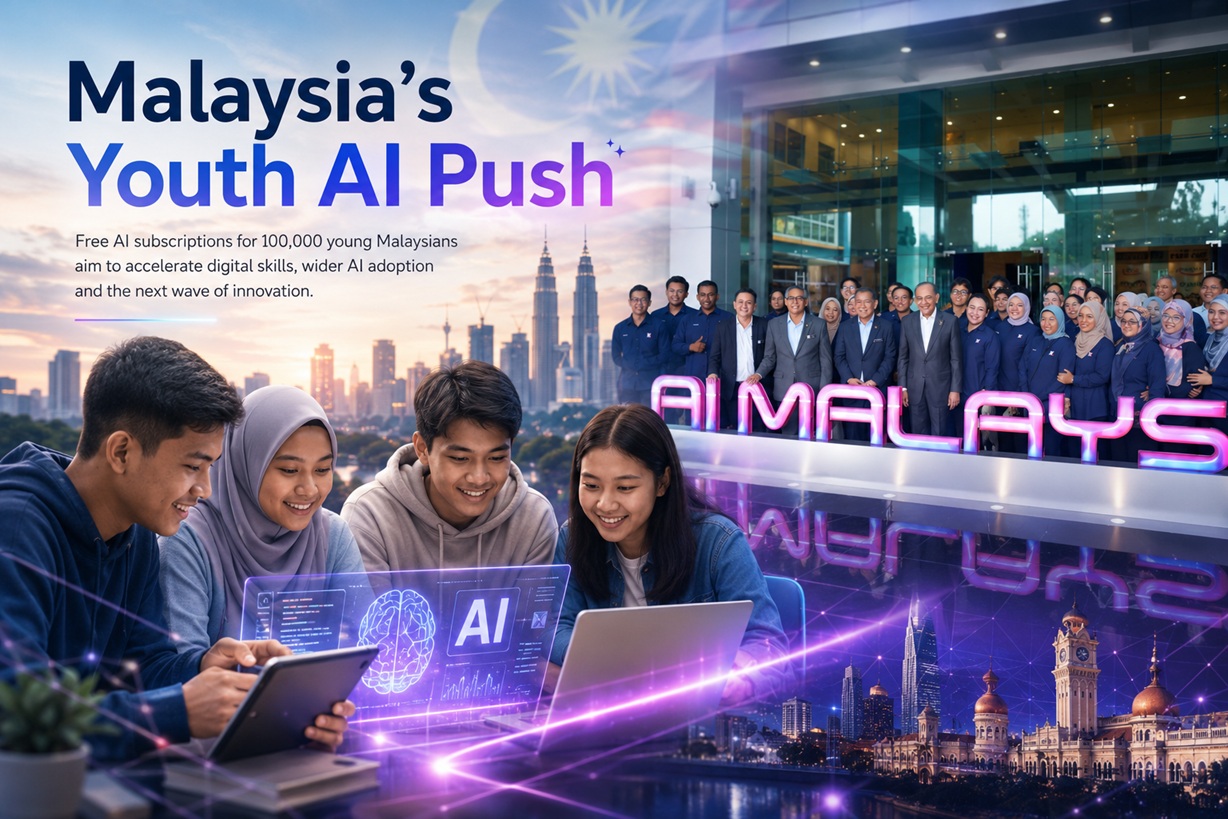
Malaysia is preparing to give as many as 100,000 young people free access to selected artificial-intelligence software, in what could become one of the country's most practical efforts to move AI from government speeches into everyday use.
The initiative will open on 31 August 2026 to Malaysians aged between 18 and 30. Those who complete the required digital-learning modules will receive three months of access to selected AI applications. The programme was announced by Prime Minister Datuk Seri Anwar Ibrahim during the launch of AI Malaysia Berhad and forms part of the broader effort to develop Malaysia into an AI-driven nation by 2030.
On the surface, three months of free software may not sound like a major national transformation. However, the strategy makes sense when viewed as an investment in exposure, experimentation and future workforce development.
Personally, I believe this is a very good direction for the government. Giving young Malaysians practical access to AI could accelerate adoption today and contribute to stronger AI-related industries five to ten years from now.
At the same time, one part of the strategy leaves me wondering: instead of directing most of the support towards foreign AI providers, why not also use the programme to strengthen Malaysian platforms such as ILMUchat?
It Is More Than a Free Software Giveaway
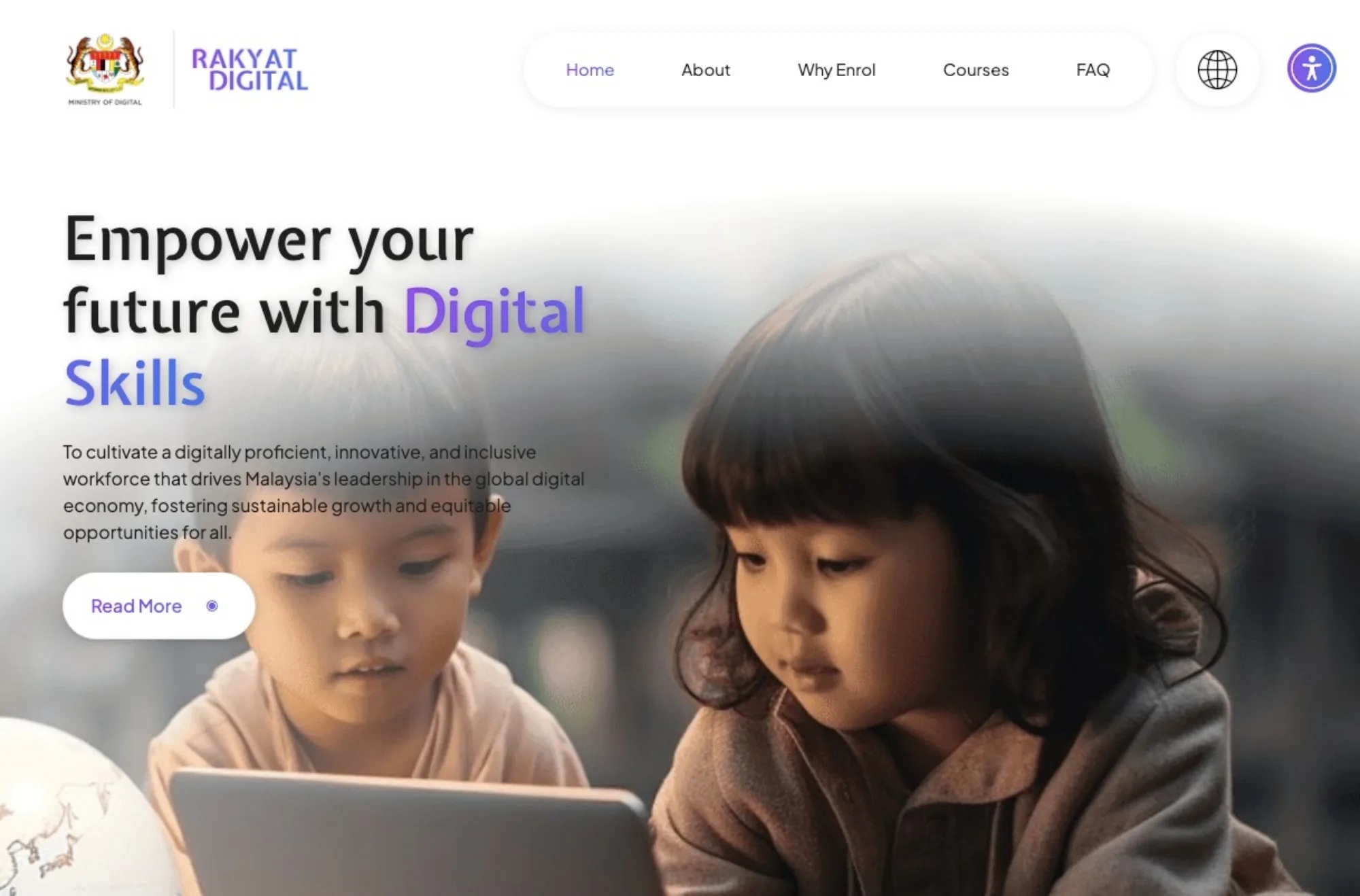
The government is not planning to distribute subscriptions without any preparation. Participants must first complete several courses through the Rakyat Digital platform.
The announced modules cover areas such as AI safety, CyberSAFE, agentic AI, generative AI and cloud computing. The intention is to ensure that participants understand the basic capabilities, risks and responsibilities associated with AI before they receive access to more advanced tools.
This requirement is sensible.
It would be easy to provide thousands of free subscriptions, publish a large participation number and describe the programme as a success. However, access alone does not mean that people know how to use AI productively.
Without basic guidance, many participants may use an AI assistant only for casual questions or copying text. They may not understand how to write effective prompts, verify generated information, protect confidential data or recognise misleading outputs.
By requiring participants to complete the learning modules first, the government is attempting to connect three important stages: awareness, access and adoption.
Digital Minister Gobind Singh Deo has described these as the programme's key areas. People must first understand that the technology exists, then gain access to it, and finally learn how to integrate it meaningfully into their daily activities.
Rakyat Digital Provides the Learning Foundation
Rakyat Digital is designed as a central learning platform for emerging technologies. Its existing courses include AI Fluency, AI Safety, AI Untuk Rakyat, Agentic AI for All, Generative AI, Cloud Untuk Rakyat and CyberSAFE Untuk Rakyat, among others. Courses are free for Malaysian citizens, with certificates or digital badges available after completion.
This is important because AI literacy is not the same as technical expertise.
Malaysia does not need every participant to become a machine-learning engineer. It needs students, administrators, designers, healthcare workers, entrepreneurs, educators and small-business owners who understand how AI can improve their particular field.
A marketing student may use AI to study customer behaviour. A software developer may use it to review code. A young entrepreneur may use it to prepare product descriptions, study a market or design an initial business plan.
The value comes from applying AI within many different industries rather than limiting it to the technology sector.
Why This Could Pay Off Five to Ten Years from Now
From my perspective, the government's strategy should be seen as a long-term investment rather than a short promotional campaign.
Young adults who become comfortable using AI today may enter the workforce with a stronger understanding of automation, data analysis, generative tools and AI-assisted problem-solving. Over time, some may establish startups, build specialised applications or introduce AI into traditional industries.
The immediate outcome may simply be 100,000 people experimenting with new tools. The longer-term outcome could be a generation of workers and entrepreneurs who no longer see AI as something distant, complicated or limited to major technology companies.
That change in mindset is extremely valuable.
Countries that encourage widespread experimentation early are more likely to develop local expertise later. Industries rarely appear overnight. They grow when enough people have access to the technology, understand its possibilities and begin finding problems that it can solve.
Five or ten years from now, some participants may be developing Malaysian AI products, leading digital-transformation programmes or training the next generation of workers. The programme could therefore contribute to economic growth well beyond the value of the initial subscriptions.
Three Months Can Be Enough to Build a Habit
A three-month subscription is relatively short, but it may be long enough for participants to move beyond initial curiosity.
The first few days may involve testing prompts and exploring features. After several weeks, users may begin incorporating AI into their studies, projects or work. By the third month, some may have created regular workflows that save time or improve the quality of their output.
Once people experience those benefits, they are more likely to continue using AI, whether through paid plans, free alternatives or workplace-provided tools.
The programme could therefore function as a structured trial. Instead of asking young Malaysians to pay for unfamiliar technology, it allows them to learn first, experiment without the subscription cost and decide whether the tools provide lasting value.
However, the programme should also consider what happens after the free period ends. Participants who cannot afford a subscription may stop using the platform just as they become comfortable with it.
This is another reason local and affordable AI alternatives should form part of the discussion.
The Selected AI Providers Have Not Been Confirmed
One major detail remains unresolved: the government has not announced which AI applications will be included.
The Ministry of Digital has said discussions with providers are continuing and that the final partners, rewards and delivery mechanism are still being worked out. It is therefore not yet clear whether participants will receive direct subscriptions, vouchers, tokens, credits or another form of sponsored access.
This means it may be premature to describe the programme strictly as a reimbursement scheme.
The government could negotiate bulk subscriptions directly with technology companies, distribute redemption codes or provide participants with credits that can be used across approved services.
The final arrangement matters because it will determine which companies benefit financially, where user data is processed and whether Malaysian AI providers receive meaningful participation.
Why Not Prioritise a Malaysian LLM Such as ILMUchat?
This is where I believe the government should look more closely at local platforms.
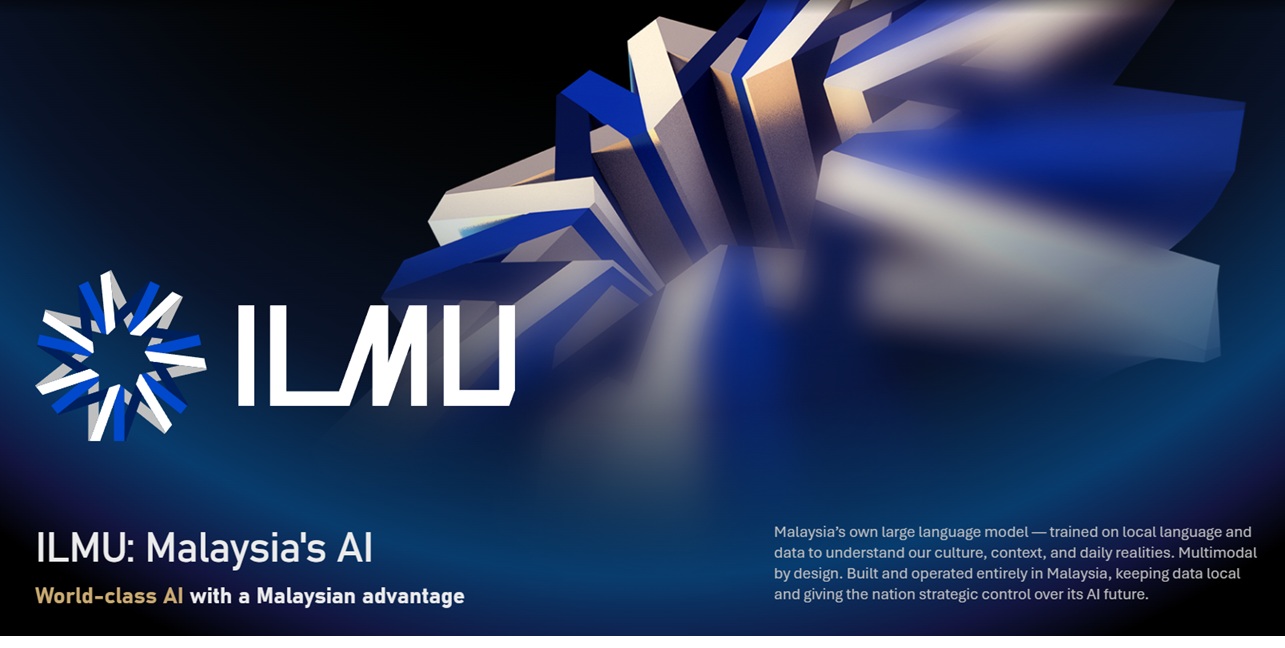
Malaysia already has ILMU, a locally developed large language model from YTL AI Labs, together with its public-facing assistant, ILMUchat.
ILMU is presented as a Malaysian sovereign AI platform trained with local language and cultural context. It is designed to understand Bahasa Melayu, English, Manglish, mixed-language conversations and Malaysian references, while being hosted and operated in Malaysia.
That makes it directly relevant to the government's national AI ambitions.
If public funds or government-negotiated incentives are used to increase AI adoption, part of that support should help strengthen Malaysia's own AI ecosystem. Otherwise, the programme may successfully train Malaysians to use AI while directing most of the economic value, subscription revenue and user engagement towards foreign technology companies.
That would improve adoption, but it would do less to build domestic capability.
Supporting ILMUchat could provide several national benefits at the same time: young Malaysians gain practical AI access, a local provider gains users and feedback, Malaysian-language performance can improve, and more AI-related activity remains within the country.
ILMUchat Already Has a Free Tier—So What Could Government Support Add?
ILMUchat currently provides a free Basic plan, while its Pro plan is listed at RM50 per month. The Pro tier includes expanded access to features involving content creation, coding, files, conversations, slides and posters.
Since the basic version is already available without charge, the government could consider sponsoring the Pro plan for eligible participants.
It could also provide other forms of support, such as additional usage capacity, educational features, API credits, specialised training or access to more advanced Malaysian AI models.
This would offer participants something beyond what they can already use freely while still supporting a home-grown platform.
The programme could become a large national testing environment for ILMUchat. One hundred thousand young users from different educational, cultural and professional backgrounds could provide valuable feedback on accuracy, language support, usability and missing features.
That kind of real-world feedback could help a Malaysian AI platform improve much faster than testing within a limited corporate or research environment.
Local Support Does Not Mean Rejecting Global AI Tools
Prioritising Malaysian AI does not mean the government should exclude international platforms.
Young Malaysians should be exposed to a variety of tools. Different AI applications have different strengths, whether in research, coding, writing, image creation, data analysis or productivity.
A balanced programme could therefore offer participants a selection.
Part of the access could involve established global AI services so participants understand the tools widely used internationally. Another part could provide enhanced access to Malaysian platforms such as ILMUchat.
This would allow users to compare systems, understand their different capabilities and choose the right tool for each task.
More importantly, it would prevent the initiative from becoming an indirect promotion campaign for only one foreign company.
A national programme should be designed around Malaysia's strategic interests, not simply around whichever global provider offers the most convenient package.
Data Sovereignty Should Be Part of the Conversation
The choice of provider is not only an economic matter. It also raises questions about data location, privacy and national control.
Participants may eventually use AI for school assignments, business ideas, personal documents or workplace-related tasks. They need to understand what information should never be uploaded and how each provider manages their data.
ILMUchat states that it is hosted, managed and governed in Malaysia, with data residing locally and protection aligned with Malaysia's Personal Data Protection Act.
Local hosting does not automatically make every service risk-free, but it gives Malaysia stronger jurisdictional and strategic control over how infrastructure and data are managed.
The programme's AI Safety and CyberSAFE modules should therefore cover more than general online safety. Participants should learn how to compare provider privacy terms, disable unnecessary data sharing and avoid entering confidential information into consumer AI platforms.
The Programme Must Reach Beyond Urban, Technology-Savvy Youth
A programme involving 100,000 participants may attract large numbers of university students and young professionals who are already comfortable with digital tools.
However, those who could benefit most may be people with limited exposure to AI.
This includes youths in rural areas, vocational students, jobseekers, small traders and workers in sectors that have not yet adopted digital technology widely.
Rakyat Digital requires participants to have a suitable smart device and an adequate internet connection. Although this is a basic technical requirement, it may still create barriers for people with older devices, limited mobile data or unreliable connectivity.
The government should therefore monitor whether participation is concentrated mainly in major cities and higher-education institutions.
A genuinely national programme should include outreach through universities, community colleges, vocational institutions, libraries and local digital centres. Otherwise, the initiative could unintentionally benefit those who already have the strongest access to technology.
Access Should Lead to Real Projects
Completing courses and activating subscriptions should not be the final measurement of success.
The government should examine what participants actually create during the three-month period.
Did they develop prototypes? Did students use AI to improve research or presentations? Did jobseekers learn new skills? Did young entrepreneurs improve their businesses? Did developers build applications using Malaysian data or languages?
These outcomes would provide a more meaningful picture than registration numbers alone.
Participants could be encouraged to complete a small practical project, such as designing an AI-assisted business idea, creating a public-awareness campaign, analysing a dataset or developing a simple digital service.
The strongest projects could then receive extended subscriptions, mentorship, cloud credits or entry into further training programmes.
This would create a pathway from learning to experimentation, and from experimentation to innovation.
Avoid Turning It into a Certificate-Collection Exercise
Malaysia already has many online training programmes that produce certificates. The risk is that participants complete the shortest possible route, collect the digital credential and barely use the knowledge afterwards.
The AI subscription should provide a strong reason to take the training seriously.
Course assessments should test understanding rather than require users only to click through videos. Participants should be able to recognise hallucinated information, identify privacy risks, verify AI-generated content and understand when human judgement is still necessary.
The free tools should then be connected directly to practical exercises.
This would make the programme more than another item added to a résumé. It would help participants develop genuine confidence and useful AI habits.
A Good Policy That Could Become Even Better
Overall, I view the initiative positively.
Providing 100,000 young Malaysians with training and practical AI access is a smart strategy. It recognises that national AI development cannot depend only on data centres, corporate investments or government agencies. Ordinary people must also understand and use the technology.
The benefits may not be fully visible within three months. The more meaningful impact could appear five to ten years from now, when today's participants become managers, founders, educators, developers and decision-makers.
However, Malaysia should not miss the opportunity to connect public AI adoption with domestic AI development.
If the government is negotiating access to leading AI applications, ILMUchat and other credible Malaysian AI initiatives should receive serious consideration alongside international providers.
The objective should not merely be to help Malaysians consume AI created elsewhere. It should also be to develop the users, feedback, talent and market needed for Malaysia to build competitive AI products of its own.
Final Thoughts
The free AI subscription initiative has the potential to become one of Malaysia's most practical digital-literacy programmes.
Its combination of training, safety awareness and hands-on access is stronger than simply giving out software licences. It encourages participants to understand the technology before using it and creates a pathway from awareness to genuine adoption.
But the final provider selection will determine whether the initiative also strengthens Malaysia's own AI industry.
Global platforms can give young Malaysians exposure to world-leading technology. Local platforms such as ILMUchat can provide Malaysian context, domestic infrastructure and a direct opportunity to grow national capability.
The strongest strategy would include both.
Malaysia's ambition should not stop at creating 100,000 new AI users. It should aim to turn some of those users into the builders, researchers, entrepreneurs and industry leaders who will shape the country's AI ecosystem over the coming decade.











Comments 0