

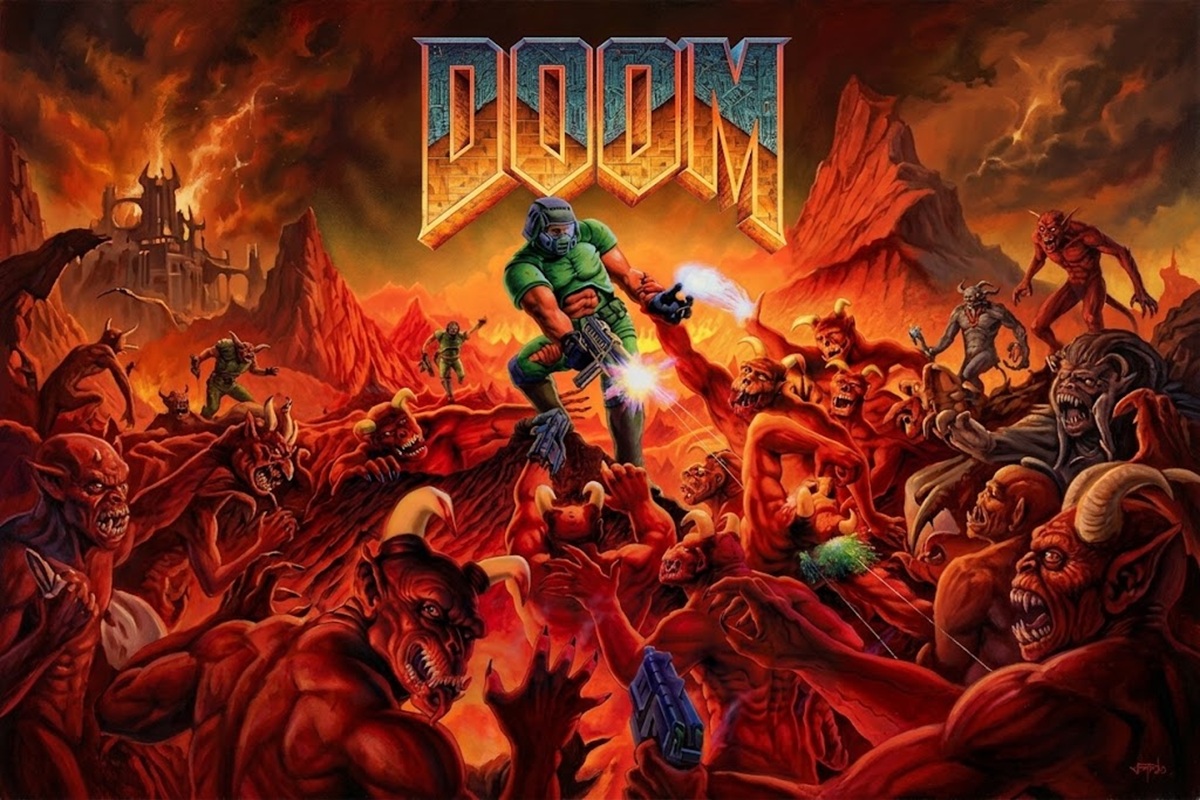
DOOM 1993 is one of the most influential first-person shooters ever created, combining lightning-fast movement, maze-like environments, aggressive enemies, powerful weapons, hidden secrets, and a relentless heavy-metal-inspired atmosphere. Developed by id Software and originally released in December 1993, the game places players in the role of a lone space marine fighting through demon-infested facilities on Mars and eventually into Hell itself. Its straightforward objective—survive, find keys, discover exits, and destroy everything standing in your way—became the foundation for countless shooters that followed. More than three decades later, its speed and responsiveness still make it remarkably enjoyable.
What makes DOOM memorable is how effectively exploration and combat support one another. Levels are not simply corridors leading directly toward the exit; they contain locked doors, hidden switches, elevators, secret rooms, branching paths, environmental hazards, and strategically placed enemy encounters. Players are constantly moving between firefights and exploration while managing ammunition, health, armor, and weapon choices. This combination gives DOOM a rhythm that remains immediately recognizable even today.
Now playable online through Lemon Web Games, DOOM 1993 can be experienced directly in your web browser as part of a growing collection of classic, retro, action, first-person shooter, and browser-playable games. Its browser-based format makes it easy to revisit the original demon-slaying experience without losing the qualities that made the game so important: rapid movement, responsive shooting, atmospheric levels, hidden secrets, memorable weapons, and constant pressure from increasingly dangerous monsters. Whether you experienced DOOM during the early days of PC gaming or are discovering it for the first time, the original game remains an essential piece of gaming history.
A First-Person Shooter That Changed Everything
Before DOOM, first-person action games already existed, but DOOM helped establish the formula that would define the genre for years. Movement was fast, combat was immediate, and levels encouraged players to explore rather than simply move forward in a straight line. The game also demonstrated how convincing atmosphere, sound, lighting, enemy placement, and level design could make relatively simple technology feel immersive. Its influence became so widespread that early first-person shooters were often described simply as "DOOM clones."
The game's success was also strongly connected to the way it was distributed. The first episode was made widely available through shareware, allowing players to experience a substantial portion of the game before purchasing the full version. This helped DOOM spread rapidly between computers, workplaces, universities, and home users during the early 1990s. The combination of technical achievement, addictive gameplay, and unusual distribution helped turn it into a cultural phenomenon.
You Are the Last Marine Standing
DOOM begins with the player stationed on Mars after being transferred following an incident involving a commanding officer. Experiments conducted by the Union Aerospace Corporation have opened gateways between the Martian moons and Hell, allowing demons to invade the facilities. A military response quickly collapses, leaving the player as one of the few surviving humans capable of fighting back. The story remains deliberately simple so that the action can begin almost immediately.
That minimal narrative works perfectly for DOOM because the environment tells much of the story itself. Military bases gradually become darker, stranger, and increasingly corrupted as the player progresses. Technological corridors give way to demonic imagery, blood-stained chambers, unnatural architecture, and finally the landscapes of Hell. The transition makes the campaign feel like a descent into something progressively more hostile.
Fast Movement Defines the Experience
Movement speed is one of the first things modern players notice when returning to DOOM. The marine moves extremely quickly compared with many later first-person shooters, allowing players to sprint through rooms, dodge projectiles, circle enemies, and reposition during combat. This speed gives the game an aggressive personality and encourages constant movement rather than hiding behind cover. Standing still for too long is often more dangerous than charging forward.
The movement system also works perfectly with the enemy design. Many demons use projectiles that can be avoided if the player keeps moving, while melee enemies become dangerous when allowed to get too close. Good players learn to weave between attacks while simultaneously returning fire and watching the surrounding environment. This creates a combat style that feels almost like an action dance once the mechanics become familiar.
The Pistol Gets You Started
Every new game begins with a basic pistol, giving players a reliable but relatively weak weapon for dealing with early enemies. It works well against individual Zombies and Imps, but its limitations quickly become obvious once larger groups appear. This naturally encourages exploration because finding better weapons dramatically improves survival chances. Discovering a shotgun early in a level can completely change the player's confidence.
The pistol also establishes DOOM's straightforward approach to weapon progression. Each new weapon generally offers a clear advantage in certain situations without making every earlier weapon completely useless. Ammunition availability matters, so players cannot simply use the most powerful gun continuously. Choosing the right weapon for the current encounter becomes an important part of efficient play.
The Shotgun Became an FPS Icon
Few weapons are as closely associated with classic DOOM as the shotgun. It delivers strong close-to-medium-range damage, uses relatively common ammunition, and produces a satisfying firing rhythm that makes it useful through almost the entire game. The combination of sound, animation, and enemy reaction gives every blast a sense of impact. Even simple encounters become enjoyable when handled with a well-timed shotgun shot.
The shotgun also demonstrates how important weapon feel is to DOOM. The game does not rely on realistic physics or complicated animations, yet firing the weapon feels immediate and powerful. Players quickly learn how many shots different enemies usually require, allowing combat decisions to become almost instinctive. This clarity is one reason the original arsenal remains memorable.
The Chaingun Brings Sustained Firepower
The chaingun offers rapid automatic fire and becomes especially useful against groups of weaker enemies or targets that need to be kept under constant pressure. Because it shares ammunition with the pistol, players need to watch their bullet reserves carefully during extended fights. Its speed can make it tempting to hold the trigger continuously, but conserving ammunition becomes important during longer levels. Strategic bursts can often be more effective than indiscriminate firing.
One useful property of rapid fire is its ability to interrupt certain enemies repeatedly. This can make dangerous encounters easier if the player has enough ammunition available. However, stronger demons may still require heavier weapons, particularly when fighting in confined areas. The chaingun therefore becomes part of a broader decision about efficiency rather than an automatic solution to every problem.
The Rocket Launcher Changes Large Encounters
Finding the rocket launcher introduces a completely different style of combat. Rockets deal heavy damage and can affect groups of enemies through explosions, making the weapon extremely powerful in crowded rooms. However, firing too close to a wall or nearby enemy can damage the player, meaning positioning becomes crucial. The weapon rewards awareness and careful distance management.
The rocket launcher becomes especially useful against tougher demons or large groups occupying open spaces. A few well-placed rockets can solve encounters that would consume large amounts of ammunition with weaker weapons. At the same time, tight corridors make the weapon risky because splash damage can quickly turn a successful attack into a disaster. This risk-and-reward balance gives the weapon lasting tactical value.
The Plasma Gun Feels Like Pure Power
The plasma gun provides rapid energy-based fire and can tear through enemies extremely quickly. Its projectiles travel rapidly across the screen, allowing players to maintain pressure on dangerous targets without waiting between individual shots. The weapon feels dramatically more powerful than the conventional firearms encountered earlier. Finding enough energy cells to use it freely becomes a valuable advantage.
Because plasma ammunition is less common than basic bullets or shells, players often save the weapon for difficult situations. This creates memorable moments where a room suddenly fills with blue energy as the player unleashes stored ammunition against a dangerous group. It is especially effective against powerful enemies that would otherwise take a long time to eliminate. The weapon reinforces the feeling that the player is gradually becoming capable of handling increasingly extreme threats.
The BFG 9000 Became Legendary
The BFG 9000 is one of the most famous weapons in video game history. It consumes a large amount of energy ammunition to deliver devastating damage capable of clearing groups of demons or heavily damaging major enemies. The firing sequence creates immediate anticipation because players know something powerful is about to happen. Few weapon pickups communicate raw destructive potential as effectively.
Using the BFG efficiently requires more understanding than simply pointing it toward the nearest target. Its damage behavior rewards positioning and awareness of nearby enemies, making experienced use much more effective than random firing. Because energy cells are valuable, wasting a shot can be painful. Saving the BFG for major encounters often becomes an important part of survival.
Enemies Are Simple but Carefully Designed
DOOM's enemies are memorable because each one communicates its role very clearly. Former humans use firearms, Imps throw fireballs and attack at close range, Demons rush aggressively toward the player, Cacodemons float through the environment, and larger creatures introduce increasingly dangerous attacks. The player can usually understand what kind of threat has appeared simply by recognizing its silhouette and sound. This visual clarity remains one of the game's strongest design features.
The enemies also work well together because different attack styles create different pressures. A group of melee demons may force the player to move backward while ranged enemies continue attacking from across the room. Flying enemies can appear from unexpected angles, while tougher monsters control large areas through powerful projectiles. The difficulty often comes from enemy combinations rather than complicated individual behavior.
Monster Infighting Creates Useful Chaos
One of DOOM's most entertaining systems is monster infighting. When certain demons accidentally damage one another, they can turn their attention away from the player and begin fighting each other instead. Skilled players can deliberately position themselves so that enemy attacks trigger these conflicts. This can save ammunition and create spectacular battles without requiring the player to defeat every monster personally.
Infighting becomes especially useful during large encounters. A powerful demon that would normally consume significant ammunition can sometimes be encouraged to attack weaker creatures nearby. The player can then wait for the fight to reduce both sides before finishing whoever remains. This mechanic gives DOOM's combat additional unpredictability and rewards environmental awareness.
Keycards Guide Exploration
Many levels require players to find colored keycards or skull keys before certain doors can be opened. These objectives provide a clear reason to explore while allowing maps to unfold gradually. A locked blue door seen near the beginning of a level may only become accessible after travelling through several other areas. Returning with the required key can reveal an entirely new section.
The system is simple but effective because it gives players goals without relying on objective markers or detailed maps. You know that a colored door means the corresponding key exists somewhere within the level. Finding it becomes part of the exploration challenge. This structure encourages players to remember locations and understand how different parts of the map connect.
Secret Areas Reward Curiosity
Secrets are one of the defining features of classic DOOM level design. Hidden doors, unusual wall textures, concealed switches, and suspicious architectural details can reveal ammunition, health, armor, weapons, or entirely hidden rooms. Some secrets are relatively easy to notice, while others require experimentation or detailed knowledge of the map. Discovering one creates a strong sense of reward because it feels like uncovering something the level deliberately tried to hide.
Secrets also encourage repeated play. A level can be completed without finding everything, giving players a reason to return and search more carefully later. Experienced players often remember secret locations and use them to gain an advantage during future runs. This hidden layer gives individual maps much greater replay value.
The Automap Helps You Understand the Maze
DOOM includes an automap that displays explored sections of the current level. This becomes extremely useful in complicated maps where corridors loop around one another or several doors remain unexplored. The map does not simply solve the level, but it helps players understand how the environment fits together. Checking it periodically can prevent unnecessary backtracking.
The automap also reinforces the exploration-focused nature of the game. Players can see areas they have already visited and identify suspicious spaces that may contain secrets or alternate routes. Learning to use it effectively becomes especially important in larger episodes. It remains a simple but invaluable navigation tool.
Health and Armor Encourage Resource Management
Health is limited, and recovering from mistakes usually requires finding medikits, stimpacks, health bonuses, or other pickups scattered throughout the levels. Armor absorbs part of incoming damage and can significantly improve survivability during difficult encounters. Players therefore need to think carefully about when to collect major health items rather than automatically grabbing everything immediately. Leaving a medikit behind can be useful if the current health level is already high.
This resource management creates tension between exploration and survival. A player may remember seeing health in an earlier room and decide whether returning for it is worth the risk. Secret areas can become particularly valuable when they contain large health or armor bonuses. The game constantly rewards players who pay attention to their surroundings.
Ammunition Management Matters
DOOM gives players multiple ammunition types including bullets, shells, rockets, and energy cells. Each weapon draws from one of these limited supplies, meaning the player must constantly balance firepower against availability. Using rockets against a weak enemy may be wasteful, while trying to save too much ammunition can leave the player taking unnecessary damage. Good resource management involves understanding when each weapon is appropriate.
This system keeps the entire arsenal relevant throughout the game. Players frequently switch weapons based on what ammunition remains rather than simply relying on one favorite gun. Running low on shells may make the chaingun more attractive, while a large stockpile of rockets can encourage a more aggressive approach. These decisions add strategy without slowing down the action.
Level Design Encourages Constant Exploration
The original DOOM maps remain memorable because they frequently loop back on themselves and reveal new paths as switches are activated. Doors open, elevators move, walls lower, and previously inaccessible spaces suddenly become available. This creates a sense that levels are changing around the player rather than remaining completely static. Progress often requires understanding how one action affects another part of the map.
The design also uses visual landmarks to help players navigate despite the complexity. Distinct rooms, lighting changes, textures, and architectural shapes create recognizable spaces that players gradually learn. Even when a map initially feels confusing, familiarity develops through exploration. This makes completing a difficult level feel like understanding a place rather than simply reaching an objective marker.
Lighting Creates Atmosphere and Danger
DOOM's lighting is surprisingly effective despite the limitations of early 1990s hardware. Dark corridors, flashing lights, bright outdoor areas, and sudden changes in illumination create tension and help define different spaces. Entering a dim room can immediately make the player cautious because enemies may be hidden just beyond visibility. Lighting becomes part of both the atmosphere and the gameplay.
Some areas deliberately use darkness to make combat more difficult. Hearing an enemy before seeing it creates uncertainty, while muzzle flashes and projectiles briefly illuminate parts of the room. These techniques demonstrate how much atmosphere can be created through relatively simple technology. The game frequently feels darker and more threatening than its technical limitations would suggest.
Sound Design Remains Instantly Recognizable
Enemy sounds are extremely important because they often reveal danger before the player sees it. Hearing the growl of a Demon or the distinctive noise of a nearby enemy can completely change how you approach the next corner. Weapons also have immediately recognizable sounds that reinforce their identity. This audio feedback makes the world feel active even when nothing is currently visible.
The MIDI soundtrack adds another major part of DOOM's personality. Fast, energetic tracks push players forward during combat, while more atmospheric pieces create tension in quieter areas. The music contributes strongly to the game's mixture of science fiction, horror, and heavy-metal energy. Many tracks remain instantly recognizable to longtime players.
The Status Bar Became Iconic
DOOM's classic status bar displays health, armor, ammunition, keys, and the animated face of the marine. The face reacts to damage, looks in different directions, and changes expression based on the player's condition. This small detail gives the otherwise silent protagonist a surprising amount of personality. It also provides useful visual feedback without interrupting gameplay.
Watching the face become increasingly injured as health drops creates additional tension during difficult fights. When the player collects powerful equipment or survives a dangerous encounter, the expression can change accordingly. The status bar became one of the most recognizable interface elements in early PC gaming. Even modern source ports often retain some version of it for nostalgic appeal.
Three Episodes Define the Original Campaign
The original registered version of DOOM contains three major episodes, each taking the player deeper into the invasion. Knee-Deep in the Dead begins on Phobos and introduces the basic enemies, weapons, and mechanics. The Shores of Hell moves the action to Deimos and presents increasingly strange environments, while Inferno takes the player directly into Hell. This progression creates a clear escalation in atmosphere and difficulty.
Each episode has its own memorable maps and visual identity. The environments become less grounded in ordinary military architecture as the campaign continues, gradually incorporating more demonic and supernatural imagery. This transition helps maintain variety even though the fundamental mechanics remain consistent. By the final episode, the world feels dramatically different from where the game began.
Boss Encounters Mark Major Milestones
Major enemies appear at important moments throughout the campaign and help give each episode a stronger sense of progression. These encounters test whether the player has learned how to move, conserve ammunition, and choose the correct weapons. Fighting a powerful enemy in a confined arena creates a different challenge from clearing ordinary rooms. The encounters also introduce creatures that may later appear as regular threats in more difficult situations.
Boss battles are memorable partly because of the buildup surrounding them. Players often enter these fights after navigating a long level and collecting valuable resources in preparation. Hearing an unfamiliar enemy sound or seeing a huge creature for the first time creates immediate tension. Defeating one provides a satisfying conclusion to a major section of the journey.
DOOM Rewards Aggressive Play
Many modern shooters encourage players to stay behind cover and wait for health regeneration, but DOOM rewards constant movement and decisive action. Enemies are most dangerous when they are allowed to surround the player or control the available space. Moving aggressively creates openings, separates groups, and makes projectile attacks easier to avoid. The game therefore feels faster and more active than many shooters released decades later.
Aggression does not mean ignoring strategy. Charging blindly into every room can quickly lead to disaster, especially on higher difficulty settings. The best approach combines confidence with awareness, using speed to control encounters while still respecting ammunition, health, and enemy placement. This balance gives DOOM's combat its lasting appeal.
Difficulty Levels Change the Experience
DOOM offers several difficulty settings that allow players to choose how demanding they want the campaign to be. Lower settings provide a more forgiving introduction, while higher difficulties increase enemy presence and make encounters significantly more dangerous. Nightmare pushes the experience even further and is intended for players who want an extreme challenge. This range makes the game accessible while preserving substantial difficulty for experienced players.
Higher settings also change how players think about each room. An encounter that feels straightforward on a normal difficulty can become a serious resource-management problem when more enemies are present. Familiar maps therefore gain additional replay value when revisited at a harder setting. Mastery involves not only learning the layout but also adapting to increasingly intense enemy placement.
DOOM Became a Modding Foundation
One of DOOM's most important long-term contributions was the way its game data could be modified through WAD files. Players and creators began producing custom maps, levels, graphics, sounds, and eventually enormous total conversions. This helped create one of the longest-running modding communities in gaming history. New DOOM content continues to appear decades after the original release.
The modding scene also extended the life of the game far beyond what would normally be expected from a title released in 1993. Players can experience thousands of community-created maps ranging from faithful classic designs to enormous modern environments. Entire new games have even been built using DOOM technology and its descendants. The original release effectively became both a game and a creative platform.
Source Ports Kept DOOM Alive
After the DOOM source code became publicly available, developers created numerous source ports that expanded compatibility and introduced modern features. These projects helped the game continue running on newer operating systems and hardware long after the original DOS environment disappeared. Some ports focus on preserving the original behavior as closely as possible, while others add high resolutions, advanced rendering, scripting, multiplayer improvements, and extensive mod support.
This diversity allows players to experience DOOM in many different ways. Purists can choose an experience close to the original release, while others can use modern enhancements without changing the fundamental gameplay. The flexibility has contributed enormously to the game's longevity. Few titles from the early 1990s remain this active across so many platforms.
The Game Runs on Almost Everything
DOOM has become famous for being ported to an enormous variety of devices. Beyond conventional computers and consoles, enthusiasts have demonstrated versions running on calculators, cameras, embedded systems, unusual electronics, and countless experimental platforms. Running DOOM has almost become a technical tradition among programmers and hardware enthusiasts. The question "Can it run DOOM?" has become part of gaming culture.
This phenomenon reflects how recognizable and technically accessible the game has become. Even people who have never completed the campaign often understand the significance of seeing DOOM running on an unexpected device. The game has effectively become a benchmark for unusual computing experiments. That cultural status goes far beyond its original purpose as a 1993 PC shooter.
Multiplayer Helped Popularize Deathmatch
DOOM also played an important role in the development of multiplayer first-person shooters. Players could connect computers and fight one another in competitive matches, helping popularize the term "deathmatch." Instead of battling demons together, players could turn the game's weapons against each other. This created an entirely different style of fast and unpredictable combat.
Network multiplayer became hugely popular in schools, workplaces, and gaming communities. The demand became significant enough that network administrators sometimes had to deal with DOOM traffic affecting local systems. These early multiplayer experiences helped demonstrate how exciting competitive first-person action could be. Many later multiplayer shooters built on ideas that DOOM helped popularize.
Why DOOM 1993 Still Feels Fun
DOOM 1993 remains enjoyable because its core mechanics are exceptionally focused. Movement is fast, weapons respond immediately, enemies have clear roles, and levels reward exploration without constantly interrupting the action. There are very few unnecessary systems separating the player from the fundamental experience of moving through a dangerous environment and fighting demons. This directness makes the game easy to return to even after decades of increasingly complex shooters.
Its difficulty also feels closely connected to player skill. Better movement, stronger map knowledge, smarter weapon selection, and improved resource management all produce noticeable results. Players can revisit familiar levels and complete them faster, discover new secrets, or attempt harder difficulty settings. The game continues rewarding improvement long after the basic campaign has been understood.
Playing DOOM 1993 Online Today
Through Lemon Web Games, DOOM 1993 can now be played directly in your web browser with no downloads or setup required. Features of the web-based version include:
• Browser-based play for quick access
• No installation required
• Classic fast-paced first-person shooter gameplay
• Iconic weapons including the shotgun, chaingun, rocket launcher, plasma gun, and BFG 9000
• Demon-filled levels featuring keycards, switches, secrets, elevators, hazards, and maze-like exploration
• Traditional health, armor, ammunition, and resource-management systems
• Accessible play through Lemon Web Games
Playing DOOM 1993 online today provides an easy way to experience one of the foundations of the FPS genre without needing to recreate an original DOS gaming setup. The browser format allows players to jump directly into the action while preserving the speed, exploration, weapons, monsters, and secret-filled levels that define the original experience. Whether you want to complete an entire episode or simply revisit a favorite level, DOOM remains perfectly suited to both quick sessions and extended play.
Who Should Play DOOM 1993
• Players who enjoy classic first-person shooters
• Fans of fast movement, aggressive combat, and traditional FPS weapon systems
• Players who enjoy exploration, secret areas, keycards, and maze-like level design
• Retro gaming fans interested in one of the most influential PC games ever released
• Players who enjoy demon-filled science-fiction and horror environments
• Anyone looking for a browser-playable shooter with simple controls and deep replay value
DOOM 1993 is especially suitable for players who want to understand where many modern FPS conventions originated. It is also an excellent choice for experienced shooter fans who appreciate games built around movement, map knowledge, and weapon management rather than complex progression systems. Despite its age, the game rarely feels slow because almost every mechanic is designed to keep the player moving forward.
Play DOOM 1993 Online Now
DOOM 1993 is now available to play online through Lemon Web Games, giving players an easy way to experience this legendary first-person shooter directly in the browser. Its web-based format makes it possible to begin exploring demon-infested facilities almost immediately, with no complicated setup standing between the player and the action. The familiar combination of keycards, hidden rooms, powerful weapons, fast movement, and relentless enemies remains just as recognizable today as it was during the early 1990s.
For players exploring the Lemon Web Games library, DOOM represents far more than another retro shooter. It is a landmark game that helped establish the language of modern first-person action while remaining genuinely enjoyable on its own terms. Every shotgun blast, secret wall, rocket explosion, Cacodemon encounter, and frantic escape through a crowded room demonstrates why its design has endured for so long.
Final Thoughts
DOOM 1993 remains one of the clearest examples of timeless game design. The technology may belong to another era, but the fundamental combination of responsive movement, satisfying weapons, readable enemies, secret-filled levels, strong atmosphere, and relentless combat still works remarkably well. Its mechanics are simple enough to understand within minutes, yet the game rewards years of improvement through faster movement, better resource management, deeper map knowledge, and mastery of increasingly difficult encounters.
Its influence on the gaming industry is difficult to overstate. DOOM helped popularize shareware distribution, multiplayer deathmatch, user-created modifications, fast-paced FPS design, and the idea that a game could remain alive through an enthusiastic community long after its original release. The fact that players still create maps, source ports, modifications, speedruns, and unusual hardware ports decades later demonstrates how deeply the game became embedded in gaming culture.
Through Lemon Web Games, DOOM 1993 becomes easy to access and enjoy directly in the browser. It remains essential for fans of classic PC games, retro shooters, action games, and anyone curious about the origins of modern first-person combat. More than three decades after its original release, DOOM still delivers exactly what made it legendary in the first place: fast movement, powerful weapons, hidden secrets, memorable demons, and the irresistible urge to open one more door and see what is waiting on the other side.











Comments 0