

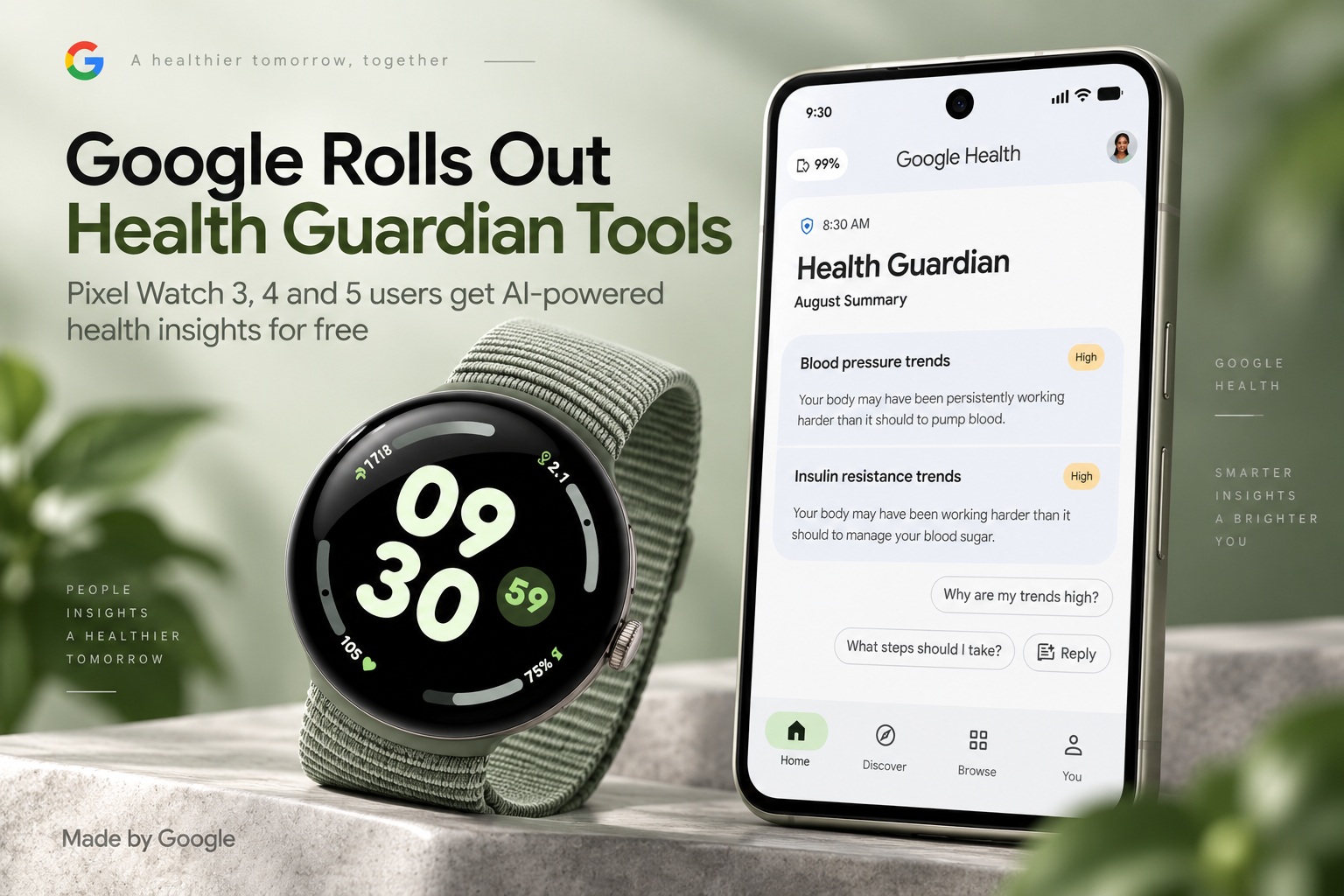
Google is beginning to roll out its new Health Guardian features, expanding the health-tracking capabilities available through the Google Health app and selected Pixel Watch models. The tools were first introduced alongside the Pixel Watch 5 in August and are now becoming available more broadly, with Pixel Watch 3, 4 and 5 owners receiving access without an additional subscription.
Health Guardian is not a single feature. Instead, it is a collection of AI-assisted health insights designed to monitor longer-term trends in areas such as blood pressure, insulin resistance and sleep breathing quality. Rather than attempting to diagnose a condition from one reading, the system looks for patterns over time and generates periodic reports that users can review.
Google says the first trend reports should begin appearing in early October.
Health Guardian Focuses on Longer-Term Patterns
Modern smartwatches already track an enormous amount of physiological information throughout the day, including heart rate, activity, sleep and blood oxygen. Health Guardian takes a slightly different approach by attempting to turn that continuous stream of sensor data into broader health trends.
Instead of presenting users with another collection of individual measurements, the system analyses data accumulated over days or weeks and looks for subtle changes that may be worth paying attention to.
The idea is to encourage more proactive health awareness. A person may not notice a gradual pattern developing from day-to-day readings, but a monthly report could make those changes easier to identify.
Google describes the new capabilities as AI-driven and says they are supported by clinical research. However, the company is also careful to position them as health insights rather than medical diagnoses.
Blood Pressure Trends Arrive Monthly
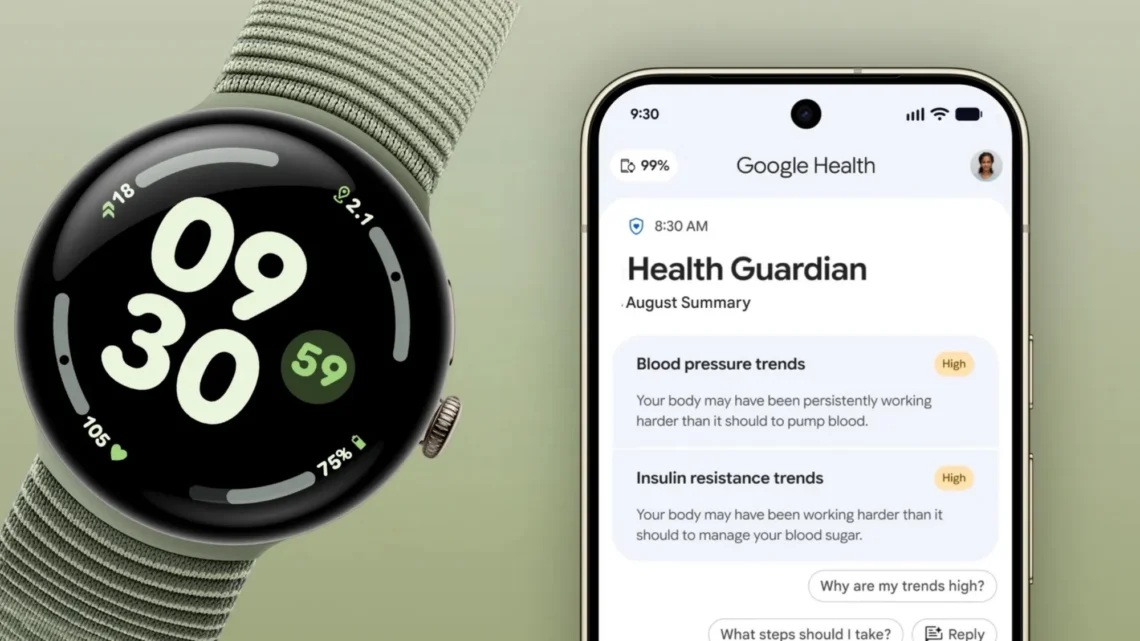
One of the Health Guardian tools focuses on blood pressure patterns. Because the feature relies on information collected from the watch rather than a conventional blood-pressure cuff, Google presents the results as estimates intended to highlight possible trends rather than replace proper medical measurements.
To generate a monthly blood pressure report, the system needs enough continuous data to establish a meaningful pattern. Google says users must have at least five consecutive days of data within a week before the feature can produce its insight.
When sufficient data is available, the blood pressure trend report is expected to appear on the first day of each month.
This approach is useful because it avoids giving too much significance to one isolated reading. Health indicators naturally fluctuate, so looking at sustained trends may provide more meaningful context than focusing on a single number.
Insulin Resistance Insights Need More Data
Health Guardian also includes insights related to insulin resistance, another area where Google is relying on patterns rather than specialised diagnostic equipment.
For this feature, users need at least seven days of data within a month before a report can be generated. Once enough information has been collected, the insight is also delivered at the beginning of the following month.
Again, Google does not position this as a replacement for laboratory testing or professional medical assessment. Instead, the system is intended to give users another indication of how their health may be changing over time.
That distinction is important because smartwatch sensors have limitations. They can provide useful estimates and identify patterns, but they do not replace clinical equipment designed specifically to measure particular conditions.
Sleep Breathing Quality Is Also Part of Health Guardian
The third major area covered by Health Guardian is sleep breathing quality. Sleep has become an increasingly important part of wearable health tracking, with smartwatches now monitoring movement, heart rate, oxygen levels and other signals while the user is asleep.
Health Guardian uses this information to identify patterns that may indicate changes in breathing quality during sleep.
Like the other tools, the purpose is not to deliver an immediate diagnosis. Instead, the system gives users another way to observe changes they might not otherwise notice.
Someone may feel generally normal during the day while still experiencing changes in sleep quality over time. A wearable that continuously tracks relevant signals can potentially highlight those patterns earlier and encourage the user to seek further advice if necessary.
Pixel Watch 3, 4 and 5 Get the Features for Free
One of the more welcome aspects of the rollout is that Pixel Watch 3, Pixel Watch 4 and Pixel Watch 5 users will receive Health Guardian without an additional subscription.
This gives owners of several generations of Pixel Watch access to the same core health-trend features rather than limiting them exclusively to the newest model.
That is particularly notable because advanced health features are increasingly being placed behind subscription services across the wearable industry. Google's decision to include Health Guardian on supported Pixel Watches without an additional fee could make the feature more attractive to existing owners.
It also extends the useful life of older hardware by introducing capabilities that were not necessarily available when those devices originally launched.
The Google Health App Becomes the Central Hub
Health Guardian sits inside the Google Health app, which launched earlier this year as a reworked version of Fitbit.
The application is intended to bring Google's health and wellbeing tools into one central location, giving users a single place to review activity data, sleep information and newer AI-powered health insights.
This integration is important because wearables now generate so much information that simply collecting data is no longer enough. The challenge is making those readings understandable and useful.
Health Guardian appears to be part of Google's attempt to move from displaying isolated metrics toward helping users understand what those metrics may mean over time.
These Are Estimates, Not Medical Diagnoses
Google repeatedly stresses that Health Guardian should not be treated as a replacement for professional medical advice.
That warning matters because features relating to blood pressure or insulin resistance can sound much more clinical than ordinary fitness tracking. Users may understandably be tempted to treat the results as definitive medical conclusions.
The tools instead use available wearable sensor data to identify patterns and provide estimates. They are intended to encourage awareness and potentially prompt users to investigate changes further.
If a report suggests something unusual, the appropriate next step is still to use established medical testing or consult a qualified healthcare professional.
The smartwatch is providing context, not making the final diagnosis.
Feature Availability Depends on Region and Device
Not every Health Guardian capability will be available in every country or on every supported wearable.
Google says regional availability will vary because some health features require additional regulatory approval or depend on hardware capabilities that differ between devices.
This means two people using similar Google Health setups in different countries may not necessarily see the same collection of tools.
The rollout will therefore remain somewhat fragmented while Google expands approvals and support across different regions.
Fitbit Air Users Will Have a Different Model
Google is also bringing some of these capabilities to Fitbit Air, although the experience will be different from what Pixel Watch owners receive.
Fitbit Air users are expected to gain access to blood pressure and insulin resistance trends later this year, but those features will require a paid subscription.
That creates an interesting distinction inside Google's wearable ecosystem. Pixel Watch 3, 4 and 5 users receive Health Guardian functionality for free, while Fitbit Air users will need to subscribe for at least some of the same insights.
For users choosing between the two product families, that difference could become part of the longer-term ownership cost.
Breathing Emergency Detection Is Coming to Europe
Pixel Watch 4 and Pixel Watch 5 users in Europe are also gaining access to another safety-oriented feature: breathing emergency detection.
The feature is designed to identify severe drops in blood oxygen and can automatically trigger a call to emergency services when the system believes the user may be experiencing a serious breathing-related event.
That makes it different from the monthly Health Guardian reports because it is designed for urgent situations rather than long-term trend monitoring.
For now, Google has only confirmed the feature for supported European markets, and it remains unclear whether breathing emergency detection will eventually expand to countries such as Malaysia.
Regional regulatory requirements will likely influence how quickly the feature becomes available elsewhere.
Wearables Are Moving From Fitness Toward Preventive Health
The Health Guardian rollout reflects a much broader change in wearable technology.
Early smartwatches were primarily fitness accessories. They counted steps, recorded workouts and displayed notifications. Over time, they gained continuous heart-rate monitoring, ECG capabilities, blood oxygen measurements and increasingly sophisticated sleep tracking.
Now the emphasis is shifting toward preventive health insights.
The wearable is no longer simply recording what happened during a workout. It is continuously looking for subtle physiological changes that might indicate something worth paying attention to.
AI plays an obvious role here because the challenge is not collecting the information but recognising useful patterns within months of sensor data.
The Value Comes From Trends Rather Than Individual Numbers
This is arguably where Health Guardian makes the most sense. A smartwatch will never replicate every piece of specialised clinical equipment, but it has one enormous advantage: it can collect information continuously.
A blood pressure cuff may produce a more authoritative reading, but most people do not wear one throughout the day. Laboratory tests can provide accurate metabolic information, but they happen only occasionally.
A smartwatch, meanwhile, can observe the user almost continuously.
That creates opportunities to detect gradual patterns between formal medical checks. The individual readings may be imperfect, but a consistent change over several weeks could still provide useful information.
The key is interpreting those trends responsibly.
Final Thoughts
Google's rollout of Health Guardian marks another step toward making the Pixel Watch a broader health-monitoring device rather than simply a fitness tracker.
The combination of blood pressure trends, insulin resistance insights and sleep breathing analysis gives Pixel Watch 3, 4 and 5 owners more ways to understand changes in their health over time, and the fact that these tools are being provided without an additional subscription is particularly welcome.
The system still comes with important limitations. These are AI-assisted estimates based on wearable sensors, not medical diagnoses, and regional availability will continue to vary.
Still, that does not make the information useless. The real value of wearable health technology may increasingly come from noticing subtle changes that a person would never see on their own.
A smartwatch does not need to replace a doctor to be useful.
Sometimes, helping someone recognise that something has changed is already valuable enough.











Comments 0