

Artificial intelligence is making it easier to analyse enormous codebases, but it is also making the economics of cybersecurity more complicated. A powerful frontier model may be capable of finding subtle vulnerabilities, yet running that model continuously across millions of lines of code can become extremely expensive.
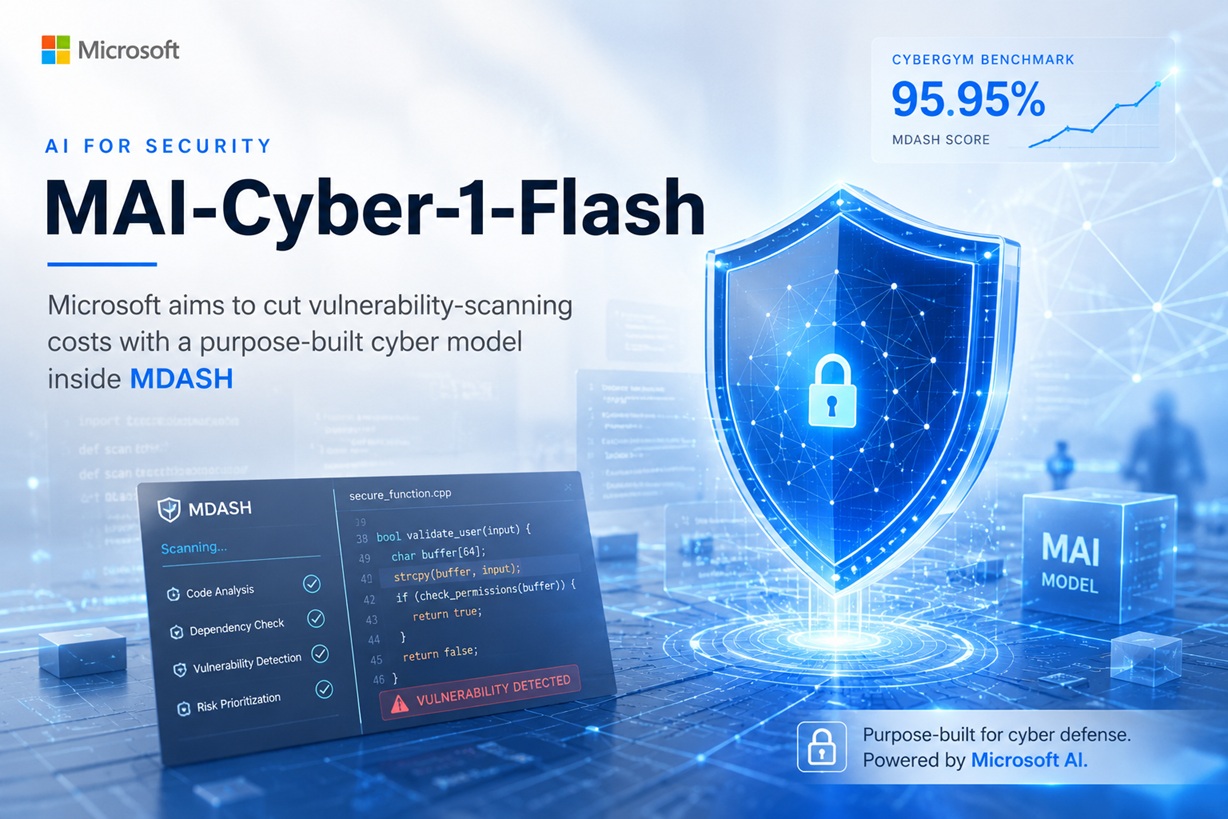
Microsoft is attempting to address that problem with MAI-Cyber-1-Flash, its first purpose-built cybersecurity model. The new model is being integrated into MDASH, Microsoft's multi-agent vulnerability discovery and remediation system, where it is intended to handle the majority of routine security-analysis tasks before escalating the hardest cases to a larger model.
Microsoft says the combined system can deliver strong vulnerability-detection performance at approximately half the cost of its previous MDASH configuration. The broader goal is to make continuous code scanning financially realistic rather than something organisations perform only occasionally.
Cybersecurity Is Facing a Scale Problem
Modern organisations produce and maintain enormous amounts of software. Internal applications, cloud services, mobile apps, APIs, legacy systems and open-source dependencies all require security review.
At the same time, attackers are increasingly using automation and AI to search for weaknesses faster and across much larger targets.
Microsoft argues that the traditional approach—scanning software periodically and patching vulnerabilities later—is becoming inadequate when attackers can probe systems continuously. The company believes defenders also need systems capable of operating at machine speed and reviewing code far more frequently.
The problem is no longer simply whether an advanced AI model can find vulnerabilities. It is whether an organisation can afford to run that model often enough across every important repository.
Even a relatively small cost per analysis becomes substantial when multiplied across thousands of repositories, branches, builds and code changes.
A Cheaper Model Handles Most of the Work
Microsoft designed MAI-Cyber-1-Flash as a compact, code-focused security model derived from its MAI-Thinking-1 family.
Inside MDASH, the model is expected to handle up to 90% of vulnerability-analysis tasks. The remaining 10%, described by Microsoft as exceptionally difficult cases, can be routed to the more powerful and expensive GPT-5.4 model.
This creates a tiered system.
MAI-Cyber-1-Flash performs the high-volume work, while GPT-5.4 is reserved for situations requiring deeper reasoning. The idea is similar to a security operations centre where routine alerts are handled through standard processes and only the most complex incidents are escalated to senior specialists.
Using the most expensive model for every task would be wasteful when many findings can be analysed by a smaller specialised model. Conversely, relying only on a lightweight model could cause difficult vulnerabilities to be missed.
Microsoft's approach attempts to balance both sides by automatically matching the task to the appropriate level of AI capability.
The Cost Saving Comes from Model Routing
Microsoft says MDASH with MAI-Cyber-1-Flash produces a 50% cost saving compared with its previous best MDASH configuration, which used GPT-5.4, GPT-5.4 Mini and GPT-5.3 Codex.
That saving does not necessarily mean MAI-Cyber-1-Flash itself is twice as efficient as every competing model. The reduction comes from changing how models are assigned work.
Instead of sending every task through a collection of relatively expensive systems, MDASH begins with the specialised model and escalates selectively.
This is an important distinction because the product is not simply one AI model. It is an orchestrated environment involving models, agents, validation stages and security tools.
The financial benefit depends on the routing system correctly recognising which tasks can be handled cheaply and which ones need deeper analysis.
Microsoft Reports a 96% CyberGym Score
According to Microsoft's internal evaluation, the combination of MAI-Cyber-1-Flash and GPT-5.4 achieved approximately 96% on CyberGym, a benchmark designed to test whether AI systems can reason across real-world codebases and identify vulnerabilities.
Microsoft says this result was 12 percentage points higher than Anthropic's Mythos result in its comparison and also exceeded the Gemini and GPT configurations included in its published chart.
The performance claim is significant, but it should be interpreted carefully.
The benchmark results, routing configuration and cost measurements were produced by Microsoft using its own infrastructure. Independent testing will be needed to determine how the system performs across codebases that Microsoft did not select or prepare.
Benchmarks are useful for controlled comparison, but production repositories are rarely clean or consistent.
A real enterprise environment may contain:
A system that performs extremely well on a structured benchmark may encounter far more ambiguity in a large internal codebase.
The 90/10 Split May Change in the Real World
Microsoft's claim that MAI-Cyber-1-Flash can handle up to 90% of tasks is one of the most important parts of the announcement.
It is also one of the areas enterprises should evaluate most closely.
If a customer's repositories resemble the workloads used during Microsoft's testing, only a relatively small percentage of tasks may need the expensive escalation path. That would support the company's cost-saving estimate.
However, a particularly complex or poorly documented environment may send significantly more work to GPT-5.4.
A financial institution with decades of custom applications, for example, may have code that is harder to analyse than a modern cloud-native service with clear documentation and standard frameworks.
If 30% or 40% of tasks require escalation instead of 10%, the real cost could differ substantially from Microsoft's headline figure.
Organisations should therefore measure the routing distribution within their own repositories rather than relying entirely on the benchmark average.
MDASH Is More Than a Vulnerability-Scanning Model
MAI-Cyber-1-Flash operates inside MDASH, Microsoft's multi-model agentic scanning harness.
MDASH coordinates more than 100 specialised agents to inspect code, debate potential findings and confirm whether a suspected weakness can actually be triggered. Microsoft describes it as an end-to-end vulnerability discovery and remediation pipeline rather than a single scanning model.
Its main stages include:
This last stage is particularly important.
Traditional scanning tools often generate large lists of suspicious code patterns. Security teams then spend considerable time determining which findings are genuinely exploitable.
MDASH attempts to go further by generating evidence and, where appropriate, constructing test inputs that demonstrate the vulnerability.
Finding a Vulnerability Is Not the Same as Proving It
A scanner might detect that memory is handled incorrectly or that user-controlled data reaches a sensitive function.
That does not automatically mean an attacker can exploit the weakness.
The suspicious code may be unreachable in a real deployment. Another validation layer may already block the input. The flaw may cause only a harmless crash under highly unusual circumstances.
MDASH uses separate groups of specialised agents to examine these questions. Auditor agents propose vulnerabilities, while other agents challenge the findings and investigate whether they are reachable and exploitable.
This adversarial process can help reduce false positives.
A finding must survive multiple stages of review rather than relying on the judgement of one prompt and one model response.
Microsoft emphasises that the value comes from the overall harness, not from expecting a single model to discover, validate and prove a complex vulnerability in one attempt.
MDASH Has Already Been Used on Windows Code
Before introducing MAI-Cyber-1-Flash, Microsoft had already demonstrated MDASH across parts of the Windows networking and authentication stack.
The company reported that the system helped its researchers identify 16 vulnerabilities, including four critical remote-code-execution flaws. It also found all 21 deliberately planted vulnerabilities in a private test driver during one controlled evaluation, with no false positives in that run.
MDASH also recorded strong retrospective results when tested against previously confirmed Microsoft Security Response Center cases, including 96% recall across a five-year set of clfs.sys vulnerabilities and 100% across seven tcpip.sys cases.
These results suggest that AI-assisted vulnerability research can now identify more than obvious coding mistakes.
Some of the documented Windows findings involved complex memory-lifetime problems, concurrency conditions and relationships spanning several source files—the type of weaknesses that are difficult for simple pattern-based scanners.
Perception Takes the Process Beyond Identification
Microsoft is also introducing Project Perception, a broader agentic security platform that works across detection, investigation and remediation workflows.
Within the system, red-team agents examine possible routes an attacker could use. Blue-team agents investigate the environment and assess meaningful risk. Green-team agents take corrective actions and strengthen the organisation's defences.
MAI-Cyber-1-Flash initially focuses on software-vulnerability work through MDASH, but Microsoft says Project Perception will eventually use the model across additional security scenarios.
The distinction is important:
MAI-Cyber-1-Flash provides specialised reasoning. MDASH coordinates vulnerability discovery and validation. Project Perception connects findings to broader security monitoring and action.
Microsoft announced that Project Perception would enter public preview on 3 August 2026.
Faster Detection Does Not Automatically Mean Faster Remediation
Finding more vulnerabilities can create a new operational problem.
A security team may already have hundreds or thousands of unresolved findings. Adding an AI system that discovers vulnerabilities faster could increase the backlog unless the organisation also improves its remediation process.
Developers still need to understand the affected component, assess the business risk, create a patch, test the change and deploy it safely.
An automatically generated patch may appear technically correct while introducing performance problems, breaking compatibility or changing business logic.
Microsoft acknowledges that security professionals remain essential even as AI-assisted remediation becomes more common.
The most valuable deployment will not merely generate more findings. It will help teams prioritise the vulnerabilities that are both exploitable and relevant to the organisation's environment.
A smaller list of validated, high-confidence risks is far more useful than thousands of speculative warnings.
Human Oversight Still Matters
Microsoft describes Project Perception as an agentic system capable of continuously perceiving risk, reasoning over context and taking action.
However, the company also says humans remain in control.
That oversight is crucial when the system can potentially inspect confidential source code, generate proof-of-concept exploits or recommend changes to production software.
Organisations should define clear boundaries around what the agents may do automatically.
Low-risk actions might include:
Higher-risk actions should normally require approval, including:
AI can accelerate the investigation, but accountability should remain with qualified people.
Microsoft Has Added a Stronger Governance Layer
Because MAI-Cyber-1-Flash is Microsoft's first dedicated cybersecurity model, the company says it subjected the system to extensive internal and external evaluation.
The model was assessed by Microsoft's AI Red Team, tested through automated and expert-led adversarial exercises, and evaluated by an unnamed third party.
Through MDASH, Microsoft says customers also receive role-based access controls, tenant isolation, encryption, audit logging and sandboxed execution environments without internet access.
The no-internet sandbox is particularly important when agents are attempting to prove vulnerabilities.
A system generating exploit inputs or executing potentially unsafe code should be isolated from external services and production networks.
Audit logs are equally important. Security teams need a clear record of which model analysed the code, what actions it performed, what evidence it produced and who approved any resulting changes.
Security Leaders Should Still Validate the System Themselves
Vendor testing is useful, but it should not replace customer validation.
A vulnerability-analysis model receives access to some of an organisation's most sensitive intellectual property. If the system is misconfigured, compromised or given excessive permissions, it could widen the same attack surface it is intended to reduce.
Before broad deployment, organisations should conduct their own testing around:
A limited pilot should begin with selected repositories rather than the entire software estate.
Security teams should compare the AI findings with existing tools and manual reviews, then measure whether the system improves real outcomes.
Microsoft Believes Its Security Data Is the Main Advantage
Microsoft says MAI-Cyber-1-Flash benefits from more than model architecture alone.
The company processes over 100 trillion security signals each day and draws operational insight from approximately 1.6 million customers. These signals span identity, endpoint, cloud, data, browser and application environments.
Microsoft argues that this history gives it access not only to examples of attacks, but also to information about what happened afterwards:
This outcome data can be more valuable than simply training on public source-code repositories.
A public repository may show that a vulnerability existed and was patched. Microsoft's security telemetry may also reveal whether attackers exploited it, how defenders detected it and which containment methods worked.
A Continuous Learning Loop
Microsoft describes its approach as a live reinforcement-learning loop.
Security professionals investigate incidents, triage alerts, remediate vulnerabilities and deploy protections. The outcomes of those actions can then inform future model development.
In theory, this means the model should improve as Microsoft observes more attacks and defensive actions.
However, using real security telemetry also raises important governance questions.
Customers will want clarity about how their data contributes to model improvement, what information is retained and whether proprietary code or incident details are used beyond the agreed service boundaries.
Strong anonymisation, contractual controls and transparent documentation will be essential for maintaining trust.
The Cost Claim Is Attractive but Difficult to Verify
The headline message is easy to understand: better vulnerability detection at half the previous cost.
The comparison, however, is between Microsoft's new MDASH configuration and Microsoft's earlier configuration. It is not a full independent comparison against the pricing and operational costs of competing platforms.
The true cost for a customer may include more than model tokens.
Organisations must also consider:
A lower model-inference cost is valuable, but it does not automatically mean that the entire vulnerability-management programme will cost 50% less.
The strongest evidence will come from customers using the system on real enterprise software and publishing measurable results.
The Larger Strategy Is About Continuous Security
Microsoft's broader argument is that security should move from occasional scanning towards continuous analysis.
Instead of waiting for a quarterly assessment or a major release, an agentic system could examine code whenever meaningful changes occur.
For example, a repository could be reassessed when:
This could help organisations identify risks much earlier in the development lifecycle.
It may also reduce the gap between discovering a new threat and checking whether internal systems are exposed to it.
AI Should Complement Existing Security Tools
MAI-Cyber-1-Flash and MDASH should not be viewed as replacements for every existing development-security control.
Traditional static analysis remains useful for detecting common coding mistakes quickly and predictably. Software-composition analysis identifies vulnerable dependencies. Secret scanners detect exposed credentials. Dynamic testing examines applications while they are running.
Human penetration testers also provide creativity, business context and intuition that automated systems may not replicate consistently.
Microsoft's own documentation describes MDASH as an additional reasoning layer rather than a replacement for static analysis or manual review.
The most effective approach will combine these methods.
Simple tools can handle predictable problems cheaply. AI agents can investigate deeper and more complex cases. Human specialists can validate critical findings and understand the wider business impact.
Final Thoughts
MAI-Cyber-1-Flash addresses a genuine challenge in modern cybersecurity: advanced AI models can inspect code more deeply, but their cost can make continuous scanning impractical.
Microsoft's answer is not to rely on one model for everything. It uses a specialised, lower-cost cyber model for most tasks and escalates the hardest cases to GPT-5.4 through MDASH.
The reported 96% CyberGym result and 50% cost reduction are promising, but they remain Microsoft's own measurements. Customers will need to test how the system behaves against complex, undocumented and unfamiliar enterprise codebases.
The most important question is not whether MAI-Cyber-1-Flash performs well on a benchmark. It is whether it helps organisations find meaningful vulnerabilities earlier, reduce false positives and fix problems faster without creating an unmanageable remediation backlog.
If Microsoft can deliver that balance, the model could make continuous AI-assisted vulnerability management more practical for large organisations.
The future of software security may not belong to the largest model running every task. It may depend on using the right model, the right agent and the right level of human oversight at precisely the right moment.











Comments 1