

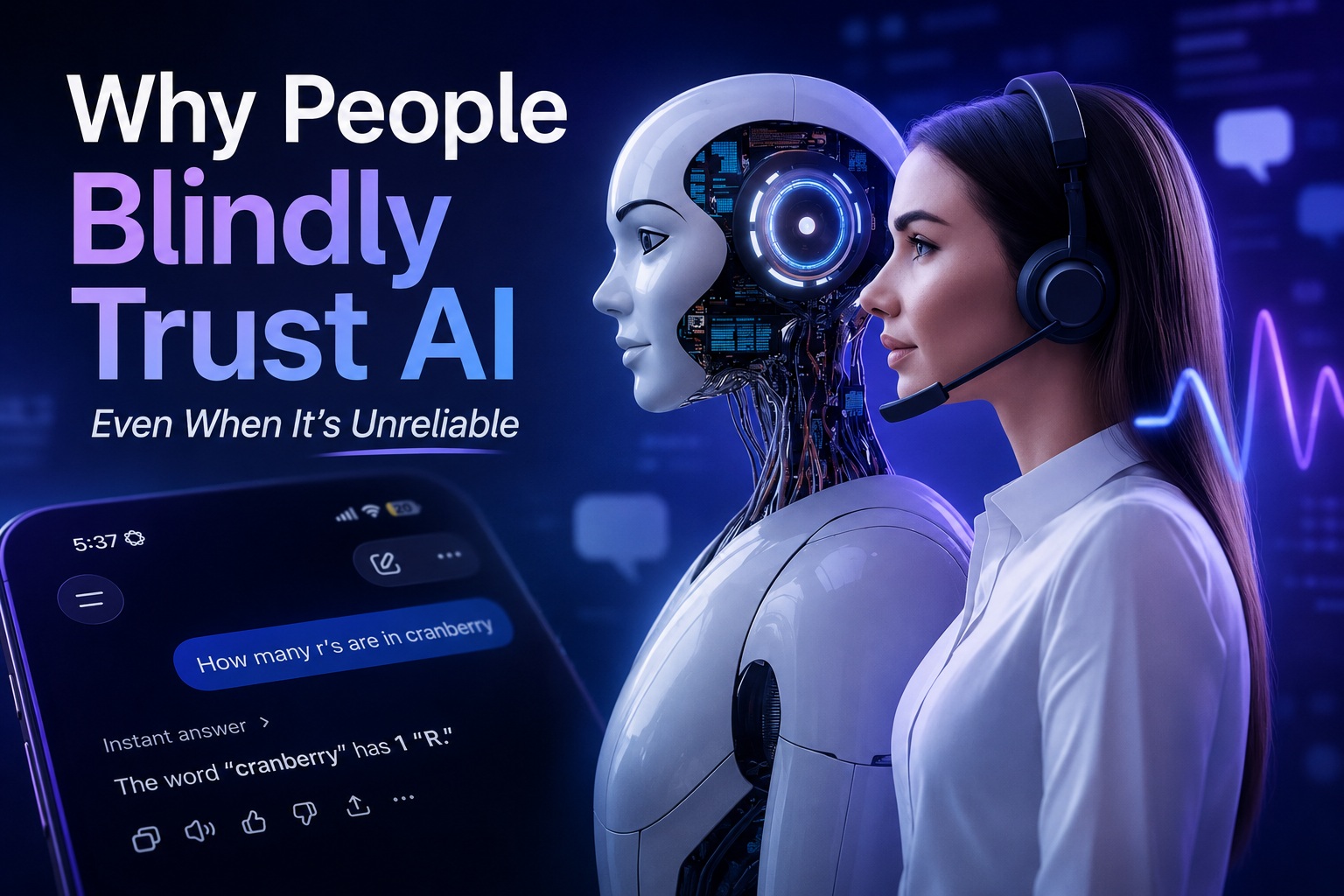
Artificial intelligence has moved from being a novelty to something many people now encounter every day. AI summaries appear in search results, chatbots sit inside productivity tools, and digital assistants are increasingly being built directly into phones, browsers and operating systems.
Malaysia is also encouraging wider AI adoption as part of its broader digital ambitions.
The convenience is obvious. Instead of spending 20 minutes comparing several websites, we can ask an AI tool a question and receive a polished answer within seconds.
The problem is that many people gradually stop treating AI as a tool and begin treating it as an authority.
We already know these systems can hallucinate, misunderstand instructions and confidently provide completely incorrect information. Yet people continue trusting them.
Why?
A large part of the answer lies in how our own brains work.
Automation Bias Makes Us Trust the Machine
There is a psychological tendency known as automation bias, where people place excessive confidence in automated systems simply because the recommendation came from a machine.
Part of this comes down to convenience.
Humans naturally prefer solutions that require less effort, and that applies just as much to thinking as it does to physical work.
If an AI provides a ready-made answer, verifying it requires additional effort.
You need to search for sources, compare information and decide whether the AI's explanation actually makes sense.
Accepting the answer takes seconds.
The temptation becomes even stronger when dealing with subjects we know little about.
If we cannot independently judge the topic, it is easy to assume that a sophisticated computer system must know more than we do.
Sometimes it does.
But that does not mean it is correct.
AI Is Designed to Feel Convenient
Modern AI interfaces reinforce this behaviour.
Consider something like Google's AI-generated search summaries.
Instead of presenting only a collection of links, the system places a neat summary near the top of the page.
For many casual searches, that feels perfect.
You ask a question.
The answer appears immediately.
You do not have to open several websites, compare sources or read lengthy explanations.
Even when the interface reminds users that AI can make mistakes, most people are unlikely to verify something unless the subject is particularly important.
Convenience wins.
And once users repeatedly receive answers that appear correct, trust gradually increases.
Eventually, the habit becomes:
That is where the risk begins.
Fluent Language Looks Like Intelligence
Another reason AI feels trustworthy is simply that it communicates extremely well.
People naturally associate good language ability with knowledge and intelligence.
Someone who explains something confidently, clearly and professionally often sounds more credible than someone who struggles to communicate.
Large language models exploit this assumption unintentionally because producing fluent language is precisely what they are exceptionally good at.
A chatbot can confidently explain a subject using perfect grammar, organised paragraphs and technical terminology.
That presentation makes the answer feel authoritative.
But linguistic confidence and factual accuracy are two very different things.
An AI-generated answer can be beautifully written and completely wrong at the same time.
That is one of the most dangerous characteristics of modern generative AI.
Poor information does not necessarily look poor anymore.
Chatbots Also Feel Social
Chatbots introduce another psychological factor.
They talk to us.
They answer follow-up questions.
They remember context within conversations.
Some systems can maintain preferences or memory across sessions.
Their personalities are deliberately designed to be helpful, friendly and easy to communicate with.
Humans are extremely good at assigning personality and intention to anything that behaves socially.
We do it with pets, cars and even simple computer characters.
A conversational AI makes that tendency even stronger.
After enough interactions, a chatbot can begin to feel less like software and more like an assistant that "understands" you.
Personalisation strengthens that illusion.
When an AI remembers preferences or previous discussions, it can feel as if there is an ongoing relationship.
But there is an important distinction.
The system can behave empathetically without actually experiencing empathy.
It can produce caring language without caring.
It can remember information about you without understanding you in the human sense.
That does not make the technology useless.
It simply means users need to remember what they are actually interacting with.
Confidence Is Not Evidence
Perhaps the biggest weakness of generative AI is that these systems do not naturally behave like cautious researchers.
Large language models generate responses by predicting likely sequences based on patterns learned from enormous amounts of data.
When they lack reliable information, they may still produce something plausible.
That is where hallucinations come from.
A model may invent:
And it may present that invention with exactly the same confidence it uses when providing something completely accurate.
This creates a major problem for inexperienced users.
If you already know the subject, you may immediately notice that something looks suspicious.
If you do not, the answer can sound perfectly convincing.
The people who most need help evaluating an answer may therefore be the people least equipped to recognise when the AI is wrong.
Why Doesn't AI Simply Say "I Don't Know"?
In theory, the obvious solution seems simple.
If the AI does not know, it should say so.
In practice, uncertainty is difficult to calibrate.
These systems are trained to be useful and answer questions.
An assistant that constantly refuses to answer would frustrate users.
That creates tension between two objectives:
Be helpful.
Be accurate.
Sometimes the safest answer is uncertainty.
But from a product perspective, an assistant that frequently says "I don't know" may appear less capable than one that confidently produces something.
Modern AI companies are increasingly working on this problem, but hallucination is not a simple software bug that can just be patched once.
It is closely connected to how generative models produce language in the first place.
Specialised Topics Are Where Things Get Dangerous
For straightforward questions, AI can be remarkably reliable.
Ask for a basic explanation of HTML or how percentages work, and the response will often be perfectly useful.
Problems become more serious as subjects become specialised.
Healthcare.
Law.
Cybersecurity.
Finance.
Engineering.
Scientific research.
These domains contain exceptions, rapidly changing information and details where small errors matter.
An AI might provide something that is 90% correct but contain one incorrect technical detail.
For a casual explanation, that may not matter.
For configuring a production server or making a medical decision, that remaining 10% could be extremely important.
The more consequential the decision, the less sensible it becomes to treat AI output as the final authority.
Over-Reliance Can Also Weaken Our Skills
There is another concern that is less dramatic but potentially more important over the long term.
If AI performs too much thinking for us, we may gradually practise certain cognitive skills less often.
Learning normally involves struggle.
You search.
You compare possibilities.
You make mistakes.
You solve problems.
That process builds understanding.
AI can shortcut much of it.
Instead of working through a programming error, someone can paste the code into a chatbot.
Instead of reading several sources and forming an argument, a student can request a summary.
Instead of drafting an email, the AI can produce the entire thing instantly.
There is nothing inherently wrong with using those capabilities.
The danger appears when assistance becomes replacement.
If someone repeatedly outsources every difficult thinking task, they may become increasingly dependent on the tool.
Cognitive Offloading Is Useful — Until It Becomes Automatic
Humans have always used tools to reduce mental workload.
Calculators reduce arithmetic effort.
GPS reduces the need to memorise routes.
Search engines reduce the need to memorise facts.
AI is simply a much more powerful form of the same phenomenon.
This is called cognitive offloading.
It can be incredibly beneficial.
There is little value in forcing everyone to manually perform tedious tasks when technology can handle them efficiently.
The problem arises when we offload tasks that we still need the ability to evaluate.
A calculator gives you an answer, but someone who understands basic mathematics can recognise when the result looks absurd.
With AI, users may eventually lose enough subject knowledge that they cannot tell whether the response makes sense at all.
That is a much more dangerous form of dependency.
Agentic AI Raises the Stakes Further
This issue becomes even more important as we move from generative AI toward agentic AI.
A chatbot mainly tells you things.
An AI agent can potentially do things.
It may:
When an AI merely produces an incorrect paragraph, the user can ignore it.
When an AI incorrectly performs an action, the consequences can be harder to undo.
Trust therefore becomes a governance issue rather than simply an information-quality issue.
We need to think carefully about how much autonomy an AI should receive.
The Right Approach Isn't to Stop Using AI
The solution is probably not abandoning AI altogether.
That would ignore how useful these systems have already become.
AI can dramatically accelerate research, programming, writing, analysis and countless repetitive tasks.
The better approach is learning how to use it with the correct level of trust.
Think of AI as an extremely capable junior assistant.
It can work incredibly quickly.
It can provide excellent suggestions.
But important work still needs review.
For low-risk tasks, accepting an AI response directly may be perfectly reasonable.
For high-risk decisions, verification should become automatic.
A Simple Rule: Trust According to Consequence
Not every AI response deserves the same level of scrutiny.
If you ask:
"What are some dinner ideas using chicken?"
You probably do not need three independent sources.
If you ask:
"Can I stop taking this medication?"
That deserves an entirely different standard.
The greater the consequences of being wrong, the more verification you should require.
The same applies professionally.
Drafting a meeting agenda with AI is low risk.
Allowing an AI agent to modify a production database is not.
This risk-based approach makes much more sense than either blindly trusting AI or refusing to use it entirely.
Check Sources, Especially When Something Matters
When AI provides factual information, ask where the information came from.
Open the sources.
Check whether they actually support the claim.
Pay attention to dates because AI may provide information that was once correct but is now outdated.
For technical questions, compare the response with official documentation.
For legal, medical or financial decisions, consult qualified professionals or authoritative sources where appropriate.
Verification does not mean repeating the entire research process manually every time.
It simply means maintaining enough scepticism to recognise that AI output is a starting point, not automatically the truth.
AI Literacy Will Become as Important as Digital Literacy
Twenty years ago, people needed to learn that not everything found on the internet was trustworthy.
Now we need another layer of literacy:
Not everything generated by AI is trustworthy either.
AI literacy means understanding:
As AI becomes integrated into phones, search engines and workplace systems, this knowledge will become increasingly important.
People will not necessarily make an active decision to "use AI."
AI will simply be there.
That makes healthy scepticism even more valuable.
Final Thoughts
People trust AI too easily partly because the technology is extremely good at presenting itself as trustworthy. It is fast. It is articulate. It is convenient. It sounds confident. It responds socially. And increasingly, it remembers enough context to feel personalised. All of those qualities make AI extraordinarily useful. They also make its mistakes more convincing. The important thing is not to become paranoid about every AI response. It is to remember that fluency is not proof, confidence is not accuracy, and friendliness is not understanding. AI should help us think faster, research better and automate repetitive work. But when the decision actually matters, we still need to remain the final judge. The biggest danger may not be that AI occasionally gets things wrong. It is that we become so accustomed to convenient answers that we eventually stop checking whether they are right.











Comments 0