

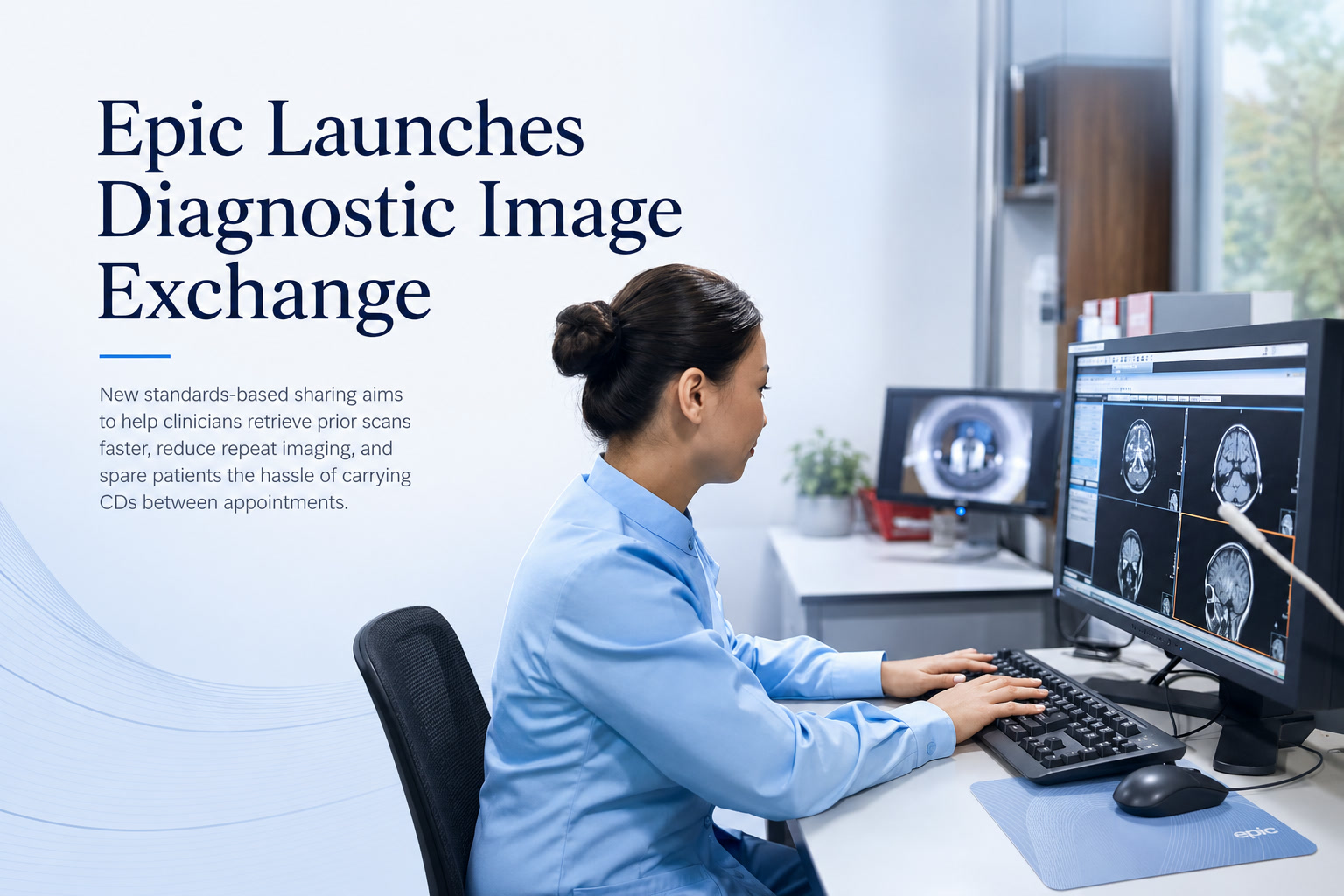
Epic is expanding healthcare interoperability beyond traditional medical records with the wider availability of its new Care Everywhere Diagnostic Image Exchange. The feature is designed to let healthcare organisations exchange diagnostic-quality medical images directly between systems using open standards, reducing the need for patients to carry CDs between hospitals or undergo repeat scans simply because previous images cannot be accessed.
For clinicians, this could mean faster access to earlier CT scans, MRIs, X-rays and other imaging studies. For patients, it could mean fewer delays, fewer unnecessary repeat procedures and less exposure to avoidable radiation.
Medical Image Sharing Has Lagged Behind Other Health Data
Epic's Care Everywhere platform has long supported the exchange of health information such as medications, allergies, diagnoses, laboratory results, clinical notes and radiology reports.
Diagnostic images themselves, however, have traditionally been much harder to move between organisations.
According to Epic, image exchange has often depended on proprietary connections rather than widely adopted open standards. That has created a fragmented environment where one health system may not be able to easily retrieve imaging performed somewhere else.
In practice, patients have sometimes been forced to carry physical CDs from one appointment to another just to make sure a new doctor can review previous scans.
That approach has always been inconvenient, but it can also affect care.
FHIR and DICOMweb Are Central to the New Exchange
Epic says the new Diagnostic Image Exchange uses open standards including FHIR and DICOMweb to move diagnostic-quality images between healthcare organisations.
DICOM has long been the foundation for medical imaging, while DICOMweb extends that functionality into modern web-based environments.
FHIR, meanwhile, has become increasingly important for healthcare interoperability because it provides a standard way for systems to exchange structured clinical information.
By combining these standards, Epic is trying to make image sharing work more like the exchange of other health information rather than requiring one-off proprietary connections.
That is an important step because healthcare interoperability becomes much more useful when organisations do not need a different technical integration for every vendor they communicate with.
Clinicians Can Retrieve Previous Images Directly
The new feature allows doctors to retrieve a patient's earlier diagnostic images through Epic instead of relying solely on reports or asking patients to obtain the files themselves.
That can be particularly important in areas such as radiology, oncology, orthopaedics, neurology and emergency care, where comparing current images against previous studies can significantly influence clinical decisions.
A radiology report may describe what was seen during an earlier scan, but having access to the actual images gives clinicians much more information.
For example, a specialist may want to compare the size of a lesion, evaluate changes in anatomy or review the exact appearance of an earlier abnormality.
Direct image retrieval can make those comparisons faster and more reliable.
Better Image Exchange Could Reduce Repeat Scans
One of the biggest potential benefits is reducing unnecessary duplicate imaging.
If clinicians cannot see that a patient recently underwent a CT scan or MRI elsewhere, they may order another examination.
Sometimes repeating the scan is clinically necessary, but other times it simply happens because the previous study is unavailable.
Epic says its existing duplicate-order checks already prevent more than 21,000 repeat scans each year, but Diagnostic Image Exchange goes further by giving clinicians direct access to earlier images.
That could help avoid duplicated procedures when the existing scan already provides the information needed.
Fewer Duplicate Scans Also Means Less Radiation Exposure
Reducing unnecessary imaging is not just about saving time and money.
Some diagnostic tests, particularly CT scans, involve ionising radiation.
A single medically necessary scan may provide significant benefit, but repeating the same imaging without a good reason exposes the patient to radiation that could potentially have been avoided.
Better access to previous studies can therefore improve patient safety as well as efficiency.
It can also reduce the frustration of having to repeat a test that the patient believes was already completed elsewhere.
Image Sharing Can Speed Up Treatment
Delays in accessing previous imaging can also slow down diagnosis and treatment.
A clinician may need to wait for a patient to locate a CD, request records from another facility or ask staff to manually coordinate image transfer.
That delay can be especially problematic when patients are referred between hospitals or specialists.
If previous imaging can be retrieved electronically through Care Everywhere, clinicians can potentially begin reviewing the case much sooner.
For urgent cases, even relatively small reductions in waiting time can matter.
Epic Wants TEFCA to Support Image Exchange More Broadly
Epic is also looking beyond its own network.
The company says it wants diagnostic image exchange to become part of the broader Trusted Exchange Framework and Common Agreement, or TEFCA, interoperability ecosystem.
Epic has participated in TEFCA through its qualified health information network, Epic Nexus, since 2023.
According to Epic, around 90% of Epic users are already live on or implementing TEFCA.
The company now wants to work with other qualified health information networks, healthcare providers, vendors and federal organisations to make standards-based image exchange more common across the United States.
If successful, this could allow image sharing to extend beyond Epic-to-Epic environments.
The Advantage of Using an Existing National Network
One of the strongest arguments for using TEFCA is that the connections already exist.
Rather than creating a completely separate nationwide network specifically for medical images, healthcare organisations could potentially use the same interoperability framework already supporting other types of health-data exchange.
Epic's position is that TEFCA could accelerate adoption because vendors would not need to establish another independent network from scratch.
The challenge will be developing the necessary policies and ensuring participating vendors adopt compatible image-sharing standards.
That means the technical capability alone is not enough.
Healthcare organisations, vendors and regulators also need agreement on how image exchange should operate across the wider ecosystem.
Interoperability Is Moving Beyond Documents
For years, healthcare interoperability discussions largely focused on getting patient records from one EHR into another.
That has improved considerably.
The next challenge is making richer forms of clinical information equally portable.
Medical imaging is a good example.
An image file is much larger and more complex than a medication list or laboratory result. It also needs to preserve diagnostic quality, associated metadata and links to the correct patient and study.
Making this information move reliably between systems requires more than simply attaching a file to a record.
That is why standards such as DICOMweb are so important.
Patients Should Not Have to Be the Integration Layer
Perhaps the clearest benefit is that patients should no longer need to act as the messenger between disconnected systems.
The traditional process of asking someone to collect a CD from one hospital and physically bring it to another is an obvious example of poor interoperability.
The patient becomes responsible for solving a technical problem that should really be handled by the healthcare system.
That approach is inefficient and prone to failure.
CDs can be forgotten, damaged or incompatible with another organisation's software.
Electronic exchange removes much of that burden.
Administrative Teams Could Benefit as Well
The impact is not limited to clinicians and patients.
Health-information management teams, radiology departments and administrative staff often spend significant time responding to requests for outside images.
Those requests may involve downloading studies, burning CDs, confirming patient identity and coordinating delivery.
Automated image exchange can reduce some of that manual work.
That gives staff more time to focus on requests that genuinely require human intervention.
At scale, reducing thousands of manual image-transfer tasks can create meaningful operational savings.
Open Standards Matter More Than Proprietary Connections
Epic's emphasis on open standards is particularly important.
Proprietary exchange mechanisms can work well when both organisations use compatible systems, but they create barriers when different vendors are involved.
Open standards provide a common technical language.
If EHR vendors, imaging systems and healthcare organisations all support the same standards, interoperability becomes much easier to scale.
That does not eliminate every challenge, but it reduces dependence on custom integrations.
Epic says it wants to work with the wider TEFCA community to encourage this type of standards-based image sharing nationally.
Final Thoughts
Epic's Diagnostic Image Exchange addresses one of the more frustrating gaps in healthcare interoperability.
Medical records have become increasingly portable, but diagnostic images have often remained stuck behind proprietary systems, manual requests and physical media.
Using FHIR and DICOMweb to move images through Care Everywhere could make it much easier for clinicians to retrieve previous studies directly, compare them with new imaging and avoid unnecessary repeat examinations.
The potential benefits are straightforward: faster care, less administrative work, fewer duplicate scans and reduced unnecessary radiation exposure.
The bigger opportunity, however, comes from Epic's push to bring image exchange into TEFCA.
If other vendors and qualified health information networks adopt the same standards, diagnostic images could eventually move between healthcare organisations as naturally as laboratory results or clinical notes do today.
That would be a meaningful step toward a healthcare system where patients no longer have to carry their own medical history from one provider to another.











Comments 0