

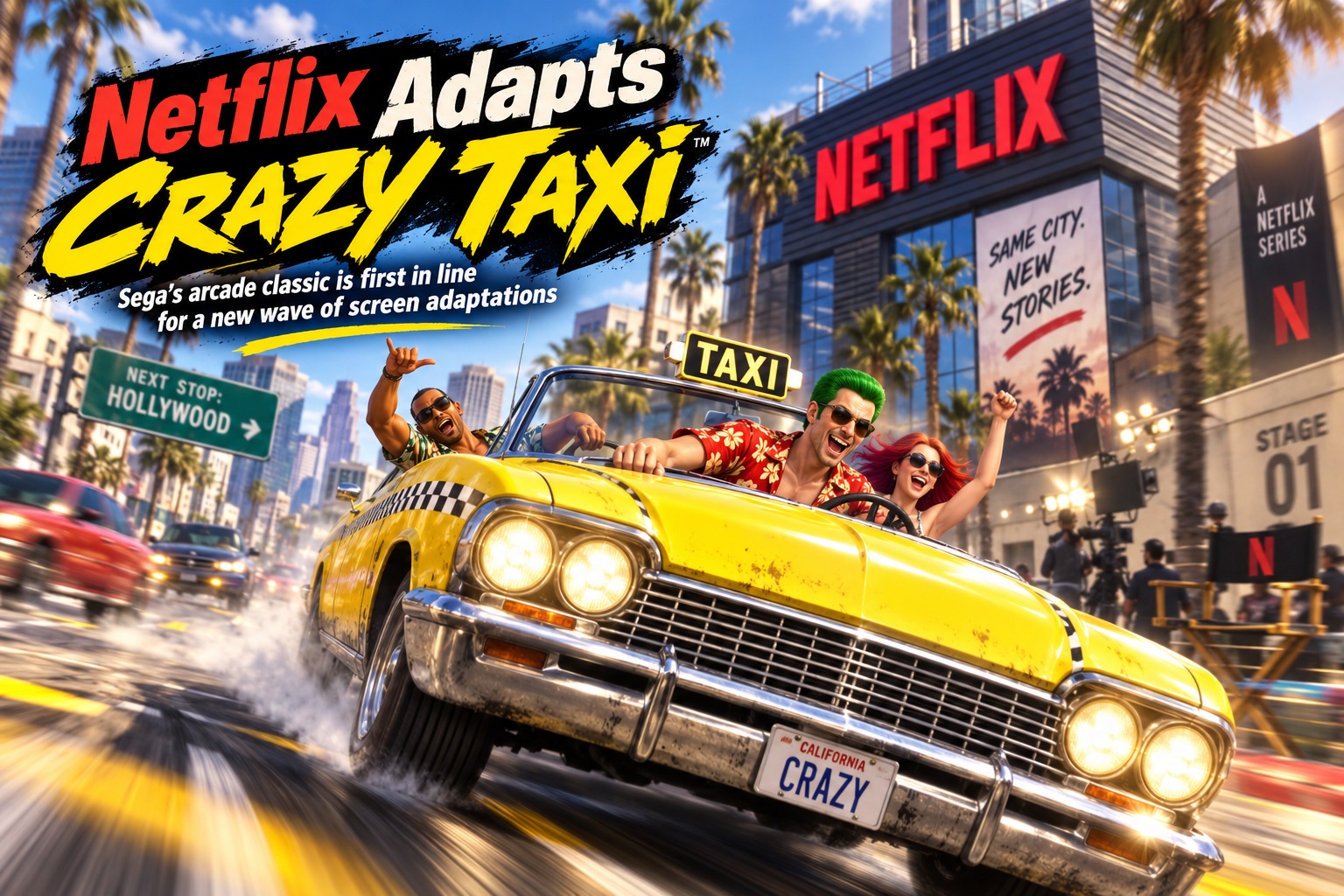
Netflix is expanding its relationship with video game properties once again, this time through a new deal with Sega that will bring several of the publisher's franchises to the screen. The most eye-catching project is a live-action adaptation of Crazy Taxi, while Netflix is also developing a new Sonic animated series and a live-action version of Sega's upcoming game Stranger Than Heaven. The announcement gives Netflix another major collection of gaming IP to work with as the company continues investing heavily in adaptations of established entertainment franchises.
Video game adaptations have become much more attractive to streaming platforms in recent years, especially as audiences have responded more positively to projects that stay closer to the tone and identity of the original games. Sega has already enjoyed considerable success with Sonic on the big screen, so expanding into more properties is a logical next move. Crazy Taxi in particular stands out because of how different it is from the story-driven games that usually receive adaptations, making Netflix's approach to the project especially interesting.
Crazy Taxi Is First in Line
Among the newly announced projects, Crazy Taxi appears to be the furthest along, although development is still at an early stage. Netflix has confirmed that the adaptation will be live-action, taking Sega's famously chaotic arcade driving game and attempting to turn its frantic energy into a full narrative production. That alone raises plenty of questions, because the original game is built around an extremely simple concept: pick up passengers, race through the city at ridiculous speeds, and earn as much money as possible before time runs out.
Netflix has brought in Dan Gregor and Doug Mand to write the adaptation. The pair previously worked on the 2025 reboot of The Naked Gun, which suggests Netflix may be leaning heavily into comedy rather than trying to reinvent Crazy Taxi as a serious action drama. According to the announcement, the goal is to preserve the game's chaotic and comedic personality, which is probably the most sensible direction considering how strongly the original series is associated with exaggerated physics, reckless driving, loud music, and over-the-top arcade energy.
Also involved are Toby Ascher and Toru Nakahara, both of whom have been closely associated with Sega's Sonic productions. Their involvement gives the project some continuity with Sega's most successful screen adaptations and may help ensure that the film understands the appeal of the source material rather than simply borrowing the title. The challenge will be finding enough story to support a full movie or series without losing the fast, arcade-like identity that made Crazy Taxi memorable in the first place.
Turning an Arcade Game Into Live Action Will Be the Real Test
Crazy Taxi does not come with a deep cast of characters, complicated mythology, or a story-heavy campaign, which makes it a very different adaptation challenge from something like The Last of Us or Fallout. Its appeal has always been immediate and mechanical: colourful cities, impatient passengers, outrageous shortcuts, and the constant pressure of the timer. Any live-action version therefore needs to create its own characters and plot while still feeling unmistakably like Crazy Taxi.
That could actually work in the project's favour if Netflix treats the source material as a foundation rather than a script. A comedy centred around eccentric drivers, increasingly absurd fares, citywide chaos, and high-speed races could capture the spirit of the game without pretending there is more narrative material than there really is. The writers have plenty of freedom, but that freedom also means the adaptation will depend heavily on tone and execution rather than fan familiarity with a detailed storyline.
There is also the question of how much of the game's original personality will survive the transition. Crazy Taxi became iconic partly because of its soundtrack, exaggerated San Francisco-inspired environments, arcade presentation, and deliberate lack of realism. A polished but generic action-comedy would miss the point entirely, so the adaptation will likely need to embrace the ridiculousness instead of trying to make everything grounded.
A New Sonic Animated Series Is Also in Development
Netflix and Sega are also working on another Sonic project, although this one is aimed at a noticeably younger audience. The new animated series is described as targeting the upper pre-school demographic, while still trying to maintain some of Sonic's attitude, humour, and sense of adventure. Netflix describes the concept as high-energy and comedic but also emotionally grounded, with an emphasis on friendship and the feeling of belonging to a close-knit group.
The series is currently being developed by Carlos Stevens and Toru Nakahara, although very little has been revealed about its story, animation style, cast, or release window. Because of the younger target audience, it will likely be quite different from some of the Sonic projects aimed at older fans, but the franchise has always been flexible enough to support multiple interpretations at the same time. Sega has spent decades adapting Sonic for different age groups through games, cartoons, comics, and films, so another animated series is hardly unexpected.
Netflix already has three seasons of Sonic Prime, giving audiences something to watch while the new project remains in development. Sonic Prime leaned more heavily into multiverse storytelling and action, while this upcoming series sounds like it may focus more strongly on accessible comedy, teamwork, and character relationships. Whether it will exist in the same continuity or stand completely on its own has not yet been explained.
Stranger Than Heaven Is Getting Adapted Before the Game Even Launches
The most unusual project in the deal may be Stranger Than Heaven, simply because the game itself has not been released yet. Sega currently plans to launch the title on 15 January 2027, meaning Netflix is committing to a live-action adaptation before audiences have even had the chance to experience the original game. That makes the project considerably harder to judge because very little is known about either the game or the adaptation.
Stranger Than Heaven is expected to connect to the wider Yakuza / Like a Dragon universe, serving as a prequel and exploring an earlier period in that world. That immediately gives Netflix more narrative material to work with than Crazy Taxi, as the Like a Dragon series is already known for long-form storytelling, complex characters, crime drama, and an unusual mixture of serious emotional moments and absurd comedy. If Stranger Than Heaven follows a similar structure, it could translate naturally into live action.
For now, however, Netflix is keeping details under wraps. That is understandable because revealing too much about the adaptation could potentially spoil aspects of a game that has not yet launched. More information will likely emerge after Sega begins showing more of the game itself, and the adaptation may not move into full production until audiences have a clearer idea of what Stranger Than Heaven actually is.
Sega Is Becoming Increasingly Comfortable With Screen Adaptations
Sega's willingness to move more of its franchises into film and television is not particularly surprising after the success of Sonic. The Sonic movies proved that Sega properties can perform well outside gaming when the adaptation finds the right tone, and the company now has a stronger foundation for experimenting with less obvious franchises. Bringing producers familiar with the Sonic projects into these new adaptations suggests Sega wants to carry some of that experience forward.
The choice of properties is also interesting because the three announced projects target very different audiences. Crazy Taxi could become a broad action-comedy, the new Sonic series is aimed at younger viewers, while Stranger Than Heaven has the potential to become a darker crime drama for older audiences. Rather than forcing every Sega property into the same style, Netflix appears to be treating each franchise according to what makes it distinctive.
That variety may prove important if this partnership continues. Sega owns a large catalogue of recognisable franchises, ranging from arcade classics to RPGs, action games, and cult favourites. If these projects perform well, there is plenty of room for the collaboration to expand further.
Netflix Is Still Betting Heavily on Gaming Adaptations
Netflix has already experimented extensively with adaptations of gaming and entertainment properties, with results ranging from highly successful productions to projects that struggled to win over fans. The company nevertheless continues to invest in familiar IP because established franchises provide a built-in audience and a strong marketing advantage. The challenge is ensuring that recognition alone does not replace good writing and thoughtful adaptation.
Recent successes across the wider entertainment industry have shown that audiences are much more receptive to video game adaptations than they were a decade ago. Projects based on games are no longer automatically treated as novelty productions, and studios are increasingly involving creators who understand the original material. That shift has encouraged companies like Sega to take more of their franchises seriously as potential film and television properties.
Netflix's latest deal fits directly into that trend. Crazy Taxi may be the strangest choice on paper, but its simplicity could actually allow the filmmakers to create something fresh without being restricted by a complicated canon. Sonic already has proven appeal, while Stranger Than Heaven could provide Netflix with a more dramatic and story-driven production if the game finds an audience after launch.
Final Thoughts
Netflix and Sega's new partnership is interesting because it does not revolve around a single type of adaptation. Crazy Taxi, Sonic, and Stranger Than Heaven are completely different properties, and each one will require a very different approach to work on screen. That gives Netflix plenty of creative freedom, but it also means there is no single formula the company can rely on.
Crazy Taxi will probably attract the most immediate curiosity because turning an arcade driving game into live action sounds both ridiculous and strangely promising. If the writers genuinely embrace the chaotic humour of the games, it could become a very entertaining action-comedy rather than another overly serious attempt to modernise an older franchise. The involvement of producers experienced with Sonic at least suggests Sega wants to maintain some control over how its properties are represented.
The Sonic animated series feels like the safest project of the three, while Stranger Than Heaven may ultimately have the most storytelling potential once the game itself is released. For now, however, all three remain relatively early in development, and there are still plenty of unanswered questions around casting, production schedules, and release dates.
What is clear is that Sega is becoming increasingly serious about expanding beyond games, while Netflix remains eager to turn recognised gaming brands into streaming properties. If Crazy Taxi somehow manages to capture the same frantic energy that once kept players racing across virtual cities for one more fare, this could end up being one of the more unusual—and potentially entertaining—video game adaptations in development.











Comments 0