

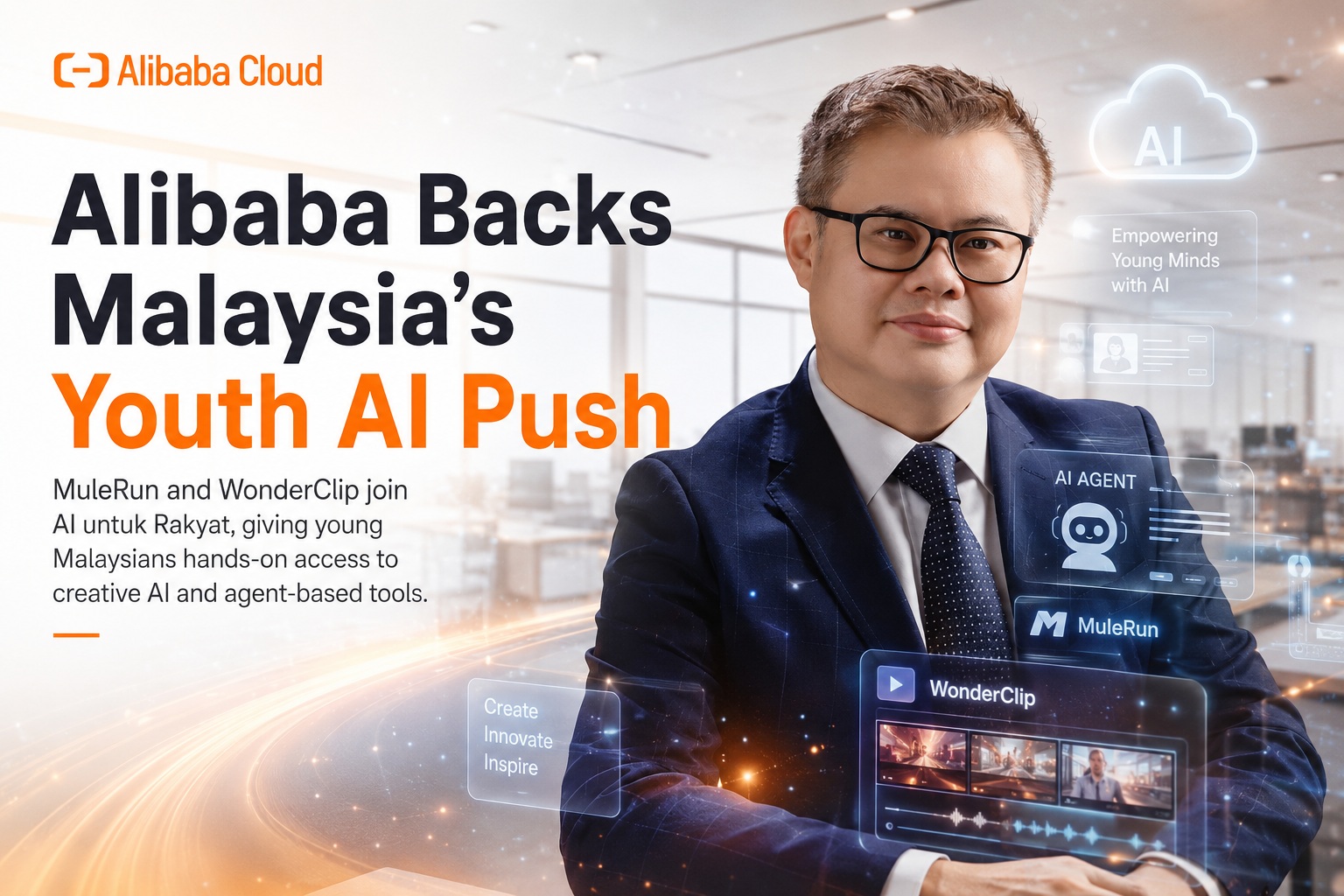
Malaysia's push to make artificial intelligence more accessible to young people is gaining additional industry support, with Alibaba joining the AI untuk Rakyat programme through two of its AI platforms. The initiative is designed to help young Malaysians move beyond simply hearing about AI and actually start using it.
Through the programme, eligible participants can learn how modern AI tools work, complete structured learning modules and, if they successfully pass the required components, gain temporary access to selected commercial AI applications.
Alibaba is participating with two very different tools: MuleRun, which focuses on building AI agents and automating workflows, and WonderClip, which is designed around AI-assisted video creation.
Together, the two platforms give participants exposure to both creative generative AI and the increasingly important world of agentic AI.
AI untuk Rakyat Targets 100,000 Young Malaysians
The AI untuk Rakyat initiative is being led by Malaysia's Ministry of Digital and implemented by MyDIGITAL Corporation through the Rakyat Digital platform.
The programme is expected to benefit around 100,000 Malaysians aged between 18 and 30.
That age range is significant.
Young adults entering universities, starting their careers or moving into the workforce over the next few years will likely encounter AI in almost every industry.
Whether they eventually work in software development, marketing, healthcare, finance, engineering, education, media or administration, the ability to understand and use AI effectively could become as fundamental as knowing how to work with spreadsheets, search engines or cloud applications.
The programme therefore goes beyond simply promoting awareness.
It is attempting to give participants access to practical tools so they can experiment with AI themselves.
Participants Can Earn Free Access to AI Applications
One of the more useful aspects of the initiative is that participants are not simply given access to tools without guidance.
They first need to complete the programme's required learning modules.
Those who successfully complete and pass the relevant modules can then redeem three months of free access to selected AI applications.
This model makes sense because access alone does not automatically translate into useful skills.
Give someone an AI tool without understanding its capabilities and they may only use it for basic questions.
Give that same person some structured knowledge about prompting, automation, content creation and responsible AI use, and the tool becomes significantly more valuable.
The programme therefore connects learning with hands-on experimentation.
Alibaba is among the first technology companies contributing applications to that ecosystem.
WonderClip Brings AI Into Video Production
The first Alibaba platform being offered through the programme is WonderClip.
WonderClip is aimed at video production and brings several stages of the creative process together within an AI-assisted environment.
It can support tasks such as:
For young creators, students and small businesses, these capabilities could significantly lower the barrier to producing video content.
Traditionally, creating a polished video might require separate tools for scripting, illustration, editing, visual effects and animation.
Generative AI platforms are gradually combining many of these functions into a single workflow.
Someone could potentially begin with an idea or written script, ask AI to help visualise the scenes, generate supporting imagery and then turn those concepts into video.
Alibaba Is Combining Several of Its AI Models Behind WonderClip
WonderClip is not based on a single AI model.
Alibaba integrates several technologies behind the platform, including HappyHorse, Wan and Qwen.
Each contributes different capabilities to the broader content-generation process.
The result is an example of how modern AI applications are becoming less about individual models and more about orchestrating multiple models together.
A user may not necessarily care which model generates a particular frame, image or piece of text.
They care about whether the entire workflow helps them produce the final result.
That is likely where many AI products are heading.
Rather than asking users to manually move between separate text, image and video generators, applications increasingly coordinate those capabilities in the background.
MuleRun Introduces Young People to AI Agents
Alibaba's second contribution, MuleRun, focuses on a very different side of AI.
Instead of primarily generating media, MuleRun allows users to create, deploy and manage AI agents using natural-language instructions.
Agentic AI is becoming one of the fastest-growing areas of artificial intelligence.
Traditional AI assistants generally wait for a user to ask something and then provide a response.
AI agents can potentially go further.
They can be given a goal and then perform several steps in sequence to achieve it.
For example, an AI agent might:
The important difference is that the user does not necessarily need to instruct the AI separately at every stage.
The agent coordinates more of the workflow itself.
Natural Language Makes Automation More Accessible
Historically, building automation systems required programming knowledge.
A developer might need to work with APIs, scripts, databases and workflow engines before a system could perform even relatively straightforward multi-step tasks.
Tools such as MuleRun are part of a broader trend toward making automation available through natural language.
Instead of writing extensive code, users can increasingly describe what they want the system to accomplish.
That could make AI automation accessible to people who do not come from traditional technical backgrounds.
A marketing student, for example, could create an agent that researches competitors and prepares a summary.
A small entrepreneur might create one that organises customer enquiries and drafts responses.
A university student could potentially create an agent that gathers research material and categorises sources.
These examples still require users to understand the limitations of AI, but the technical barrier is becoming lower.
AI Skills Are Expanding Beyond Prompt Writing
Much of the early discussion around AI skills focused heavily on prompt engineering.
Learning how to ask better questions was considered one of the most useful capabilities when using generative AI.
That remains important, but the skillset is rapidly expanding.
Future AI literacy may also involve understanding how to:
Providing young Malaysians with access to platforms such as MuleRun could therefore expose them to a more advanced form of AI use than simply interacting with a chatbot.
Alibaba Sees AI as a Tool for Broader Participation in the Digital Economy
Choong Hon Keat, General Manager of Malaysia at Alibaba Cloud Intelligence, described AI as technology that could potentially act as a great equaliser.
The basic idea is that AI could give people from different educational and economic backgrounds access to tools that were previously available mainly to larger companies or highly specialised professionals.
A young creator may not have access to an animation studio.
A small business may not have a dedicated research team.
A student may not have advanced programming skills.
AI cannot completely replace those capabilities, but it can potentially narrow some of the gaps.
That is why access matters.
However, Alibaba also emphasised that simply providing technology is not enough.
The aim is to help participants turn that access into practical learning and meaningful outcomes.
That distinction is important.
AI adoption should not be measured by how many people have opened a chatbot or created an account.
A much better measure is whether people can actually use the technology to solve problems, improve productivity, create something useful or develop new skills.
Malaysia's AI Talent Pipeline Is Becoming Increasingly Important
The AI untuk Rakyat programme also fits into Malaysia's broader ambition to strengthen its digital economy.
As artificial intelligence becomes embedded in more industries, countries are competing not only to attract AI infrastructure and investment but also to develop enough local talent to support those investments.
Data centres, cloud infrastructure and AI platforms provide the technical foundation.
People still need to know how to use them.
That creates demand for professionals who understand areas such as:
But it also creates demand for ordinary workers who may never become AI engineers yet still need to use AI effectively in their jobs.
That is where broad AI-literacy programmes can play an important role.
Young People Need More Than AI Theory
There is no shortage of online courses explaining artificial intelligence.
The problem is that theoretical understanding alone has limited value.
Someone can watch hours of videos about generative AI without ever learning how to use it effectively in a real workflow.
Hands-on exposure is different.
When participants actually experiment with tools, they encounter practical issues such as:
These experiences help build genuine AI literacy.
They also teach one of the most important lessons about modern AI: the technology is powerful, but it is not automatically correct.
Access to AI Tools Could Help Young Entrepreneurs
Malaysia has a large community of small businesses, freelancers and independent creators who may benefit particularly from AI tools.
Someone launching an online business could use AI for:
Previously, some of these tasks might have required several different specialists or subscription services.
AI can reduce some of those barriers.
That does not mean one person suddenly becomes a professional designer, developer, marketer and analyst overnight.
But it does mean individuals can experiment and prototype ideas much more quickly than before.
For young entrepreneurs with limited starting capital, that could be particularly valuable.
Creative AI Is Becoming More Accessible
WonderClip also reflects how rapidly AI-generated video is improving.
Video generation was one of the weaker areas of generative AI only a few years ago.
Today, AI systems can increasingly produce animation, cinematic scenes, advertisements, concept videos and social-media content from relatively simple instructions.
This could have a major impact on Malaysia's digital creative economy.
Young creators who previously needed expensive cameras, editing suites or production teams may increasingly be able to produce sophisticated content using AI-assisted workflows.
The technology will not eliminate traditional creative skills.
In many cases, artistic judgement becomes even more important because someone still needs to determine:
AI may increasingly handle production tasks while people focus on creative direction.
Agentic AI Could Be Even More Transformative
While generative video may attract more immediate attention, agentic AI could ultimately have an even larger impact on productivity.
If AI agents become reliable enough to perform repetitive research, administrative and data-processing work, many everyday digital workflows could change substantially.
Instead of employees manually switching between multiple applications, an AI agent could potentially coordinate those systems.
The person becomes more of a supervisor.
That future is not completely here yet, and autonomous AI still comes with important concerns around reliability, security and governance.
But giving young people early exposure to agent-building concepts could prove valuable as these technologies mature.
Responsible Use Has to Grow Alongside Accessibility
Greater access to AI also needs to come with greater awareness of its risks.
Young users should understand that AI can:
Agentic systems introduce additional risks because they may execute actions rather than simply produce text.
Teaching people how to use AI therefore cannot stop at demonstrating features.
It should also include verification, privacy, security and responsible use.
Those skills could become just as important as knowing how to generate content.
Alibaba Already Has a Long-Term Technology Presence in Malaysia
Alibaba's involvement in the programme also builds on its existing presence in Malaysia.
Alibaba Cloud established its first Malaysian data centre more than a decade ago and has continued expanding its local activities through infrastructure investment, talent initiatives and industry partnerships.
That makes its participation in AI untuk Rakyat part of a wider relationship rather than an isolated project.
Cloud providers are increasingly competing not only on infrastructure but also on developer ecosystems and talent development.
Training people to use their AI platforms creates a larger community of developers, businesses and organisations familiar with their technologies.
For Malaysia, the opportunity is to ensure those partnerships also contribute to building sustainable local capabilities.
AI Education Should Ultimately Lead to Something Practical
The most important test for AI untuk Rakyat will not necessarily be the number of participants enrolled.
It will be what participants are able to do afterward.
Ideally, some will create projects.
Others may automate parts of their existing work.
Some could develop businesses.
Others might discover an interest in AI development, data science or cloud computing.
Even participants who never work directly in technology could gain a better understanding of how AI is likely to affect their careers.
That practical impact is what makes initiatives like this more meaningful than simple awareness campaigns.
Final Thoughts
Alibaba's participation in Malaysia's AI untuk Rakyat programme brings two useful dimensions to the initiative.
WonderClip gives young Malaysians an opportunity to experiment with increasingly sophisticated AI-powered creative production, while MuleRun introduces them to AI agents and multi-step automation.
Together, they represent where artificial intelligence appears to be heading.
The first phase of generative AI was largely about asking machines to produce text and images.
The next phase is increasingly about asking AI to create entire workflows and carry out tasks on our behalf.
For Malaysia, giving young people early exposure to both sides of that transformation could be important.
The real value, however, will come from ensuring participants learn more than how to press a button and generate something impressive.
They need to learn how to question AI outputs, verify information, understand its limitations and use the technology responsibly.
If that happens, programmes such as AI untuk Rakyat could help transform AI from something Malaysians merely consume into something the next generation actively uses to build, create, automate and innovate.











Comments 0