

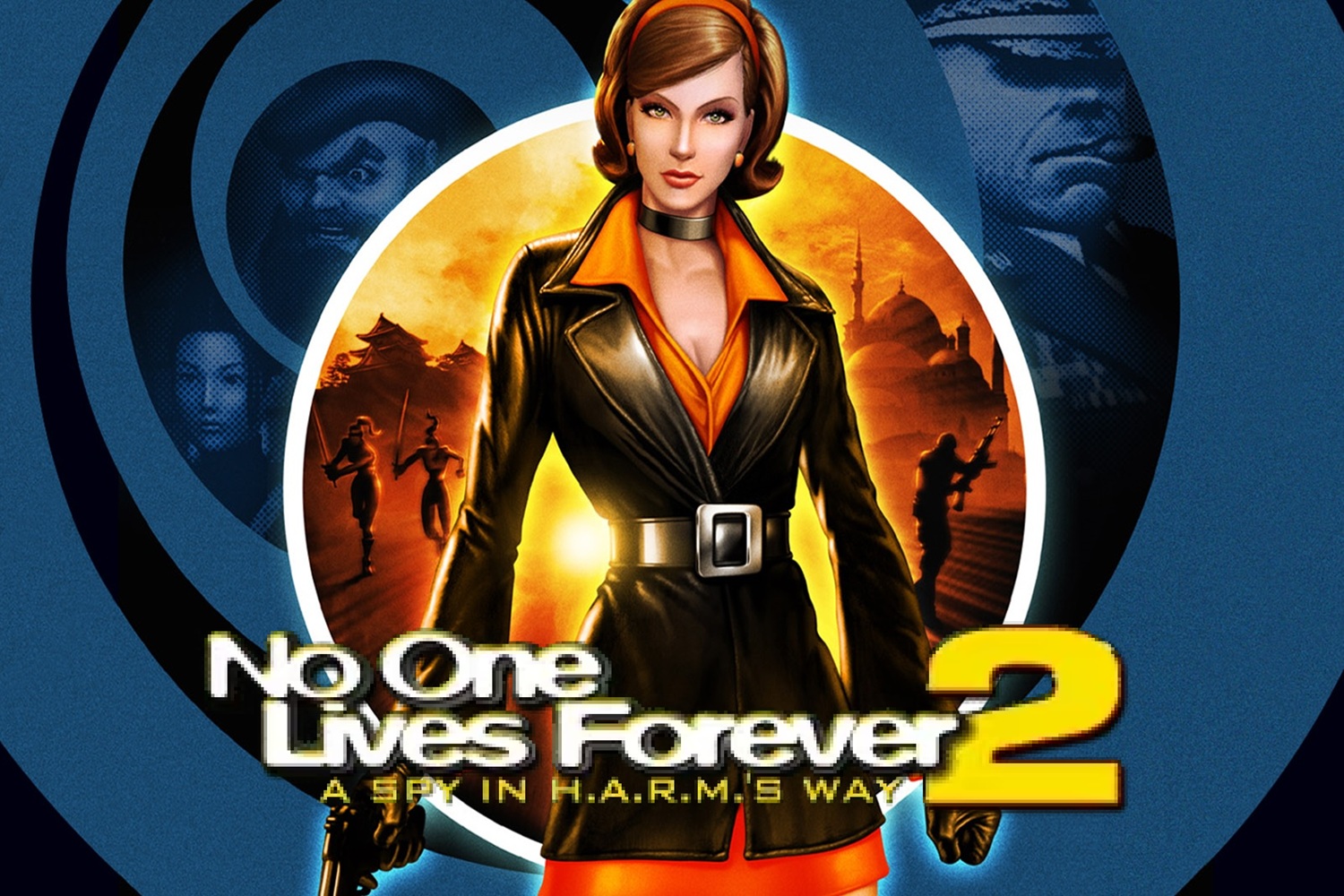
No One Lives Forever 2: A Spy in H.A.R.M.'s Way takes everything that made the original adventure memorable and develops it into a larger, more polished, and more flexible espionage experience. Released in 2002, the sequel once again places players in control of Cate Archer, the sharp-witted UNITY operative who must investigate another increasingly elaborate conspiracy involving the criminal organization H.A.R.M. The game combines first-person shooting, stealth, exploration, spy gadgets, character progression, and intelligent comedy inside a wonderfully exaggerated interpretation of 1960s espionage fiction. Rather than simply repeating the first game's formula, the sequel expands its environments, improves enemy behavior, introduces a skill-development system, and gives players greater freedom in how missions are approached.
Cate's new assignment takes her across a remarkably varied collection of locations, including Japan, Siberia, India, secret facilities, and even an unforgettable American trailer park caught in the middle of a tornado. One mission may encourage careful observation and silent infiltration, while the next becomes a chaotic firefight involving heavily armed H.A.R.M. soldiers, ninja assassins, or other unexpected threats. The writing remains just as important as the action, with guards discussing completely ordinary problems while working for an international criminal organization and villains behaving with the theatrical confidence expected from classic spy fiction. The result is a campaign that constantly shifts tone without losing the personality that made No One Lives Forever unique.
Now playable online through Lemon Web Games, No One Lives Forever 2: A Spy in H.A.R.M.'s Way brings Cate Archer's second major espionage adventure directly into modern web browsers. Players can infiltrate secure locations, search for intelligence, use disguised spy gadgets, improve Cate's abilities, and decide whether difficult situations should be handled quietly or with considerably more firepower. The browser-playable experience provides an accessible way to revisit one of the most distinctive first-person shooters of the early 2000s without depending on an original physical installation. Whether you already know Cate Archer or are discovering her adventures for the first time, the sequel remains an excellent example of how stealth, action, humor, and strong character writing can work together inside a first-person game.
Cate Archer Returns as a More Experienced Operative
Cate Archer enters No One Lives Forever 2 as a much more established member of UNITY than she was during the original adventure. She has already demonstrated her ability to survive impossible missions, uncover enormous conspiracies, and deal with the eccentric personalities surrounding international espionage. The sequel therefore spends less time proving that Cate belongs in the field and more time placing her inside increasingly dangerous assignments. Her confidence and dry sense of humor remain central to the experience.
Cate is still surrounded by people who occasionally underestimate her, but she is far more comfortable challenging those assumptions. She responds intelligently to absurd briefings, maintains control when missions collapse unexpectedly, and frequently appears to be the most rational person involved in the operation. This creates a protagonist who feels capable without becoming emotionless. Her personality remains visible even though most of the action is experienced from a first-person perspective.
The game also gives Cate more room to develop mechanically. Skill points allow players to influence how she improves throughout the campaign, adding a light role-playing layer to the espionage formula. Players can strengthen abilities that better suit their preferred approach, whether that involves stealth, combat, searching, or general efficiency. This makes Cate feel increasingly capable because of both story progression and player decisions.
UNITY Faces Another Global H.A.R.M. Conspiracy
UNITY once again serves as the organization coordinating Cate's missions. Intelligence reports suggest that H.A.R.M. is involved in another dangerous international operation, forcing agents to investigate activities occurring across several countries. What initially appears to be a collection of isolated incidents gradually develops into a much broader conspiracy. Cate repeatedly finds herself at the center of situations that are far stranger than the original briefing suggested.
H.A.R.M. remains one of the game's greatest sources of personality. The organization is genuinely dangerous, yet its internal culture is often hilariously dysfunctional. Guards complain about supervisors, employees discuss workplace problems, and high-ranking villains behave like exaggerated executives running a criminal corporation. This gives H.A.R.M. far more character than a generic organization filled with identical enemies.
The sequel also benefits from returning characters and unresolved relationships from the original game. Familiar figures appear alongside new villains, allowing the world to feel connected rather than completely reset between adventures. Cate's previous experiences influence how certain characters respond to her. The campaign therefore feels like a genuine continuation rather than merely another mission using the same protagonist.
A More Refined Combination of Stealth and Shooting
One of the biggest strengths of No One Lives Forever 2 is the way it allows stealth and conventional first-person combat to coexist. Players can approach many encounters quietly, observe enemy patrols, wait for guards to separate, and use suppressed weapons or gadgets to reduce attention. If that careful plan collapses, however, the game often allows the situation to transition naturally into a firefight rather than immediately declaring failure. This creates flexibility without making stealth meaningless.
Quiet approaches can provide major advantages. Remaining undetected may prevent reinforcements from appearing, preserve ammunition, and make it easier to explore optional rooms for intelligence. Players also have more opportunities to hear enemy conversations when they avoid immediately opening fire. The game regularly rewards patience.
Direct combat remains satisfying when circumstances demand it. Cate has access to a broad range of firearms, and larger encounters can quickly become energetic action sequences. Enemy groups attempt to respond to danger rather than simply standing still and waiting to be shot. The result feels more dynamic than the original game's simpler combat encounters.
Improved Enemy Intelligence Makes Infiltration More Tense
Enemy behavior was significantly improved for the sequel. Guards can investigate suspicious sounds, notice unusual activity, communicate with nearby allies, and search areas when they believe something is wrong. This means players cannot always eliminate one enemy and assume everyone else will continue behaving normally. A careless action can gradually escalate the entire area.
Guards may search for Cate after losing sight of her instead of immediately returning to a completely passive state. This creates tense moments where players hide nearby while enemies investigate. The ability to escape detection after being noticed gives stealth encounters a more dynamic quality. Players can recover from mistakes without every mission turning permanently into open combat.
Bodies and environmental clues can also attract attention, encouraging players to think about where enemies are eliminated. A perfectly placed silent shot can still create trouble if another guard discovers what happened moments later. This makes positioning and timing more important. Stealth becomes a process of managing the entire environment rather than merely using quiet weapons.
The Skill System Adds Meaningful Character Progression
No One Lives Forever 2 introduces a skill system that allows Cate to improve during the campaign. Players earn points through mission progress and exploration, then invest those points into abilities that support different play styles. This creates a greater sense of long-term development than the original game offered. Cate does not simply collect increasingly powerful weapons; her personal capabilities can improve as well.
Players interested in stealth can focus on abilities that make quieter approaches more effective. Those who prefer direct combat can strengthen areas connected to weapon handling and survivability. Other improvements support searching, movement, or general operational efficiency. The system is flexible enough to encourage experimentation without turning the game into a complicated RPG.
Skill progression also gives optional exploration more value. Discovering intelligence or completing additional objectives can contribute toward improvement rather than serving purely as collectible completion. Players who investigate thoroughly may therefore become better prepared for later missions. This reinforces the game's emphasis on observation.
Spy Gadgets Remain Essential to the Experience
Cate's gadgets continue to distinguish No One Lives Forever from ordinary shooters. UNITY equips her with devices designed for surveillance, infiltration, sabotage, and other specialized tasks. Many are disguised as ordinary personal items or harmless objects, maintaining the playful spirit of classic spy fiction. The contrast between appearance and function provides both humor and practical gameplay.
Certain gadgets allow Cate to bypass security systems or manipulate locked objects. Others are designed for collecting information, dealing with electronic obstacles, or handling mission-specific problems. Understanding which tool is needed becomes part of exploration. Players who attempt to solve everything with firearms will eventually encounter situations where equipment is the only sensible answer.
The sequel improves gadget integration by making them feel more naturally connected to mission objectives. They are not merely novelty items introduced once and forgotten. Several tools remain useful across multiple environments. This helps Cate feel like a genuine field operative equipped for more than combat.
Searching Environments Rewards Careful Players
Exploration plays a major role throughout the campaign. Important rooms frequently contain intelligence, ammunition, equipment, skill-related rewards, or humorous documents that provide additional context about the world. Players who simply run toward the next objective can complete many missions, but they will miss a considerable amount of personality. The environments are designed to reward curiosity.
Searching can also become part of progression. Better searching ability helps Cate investigate rooms more efficiently and find useful resources. This creates an interesting connection between exploration and character development. Players who enjoy examining every corner can build a character particularly suited to that style.
The levels contain many believable spaces that exist beyond immediate combat requirements. Offices contain desks and paperwork, residential spaces feel lived in, and industrial locations include equipment appropriate to their function. This helps the world feel more convincing. Even strange H.A.R.M. facilities often resemble actual workplaces beneath their villainous purpose.
Enemy Conversations Remain One of the Best Features
The sequel continues the original game's tradition of giving ordinary guards unusually detailed conversations. H.A.R.M. employees discuss workplace conditions, management decisions, personal ambitions, and completely mundane problems while standing inside secret facilities. These conversations frequently become so entertaining that players deliberately wait before attacking. Listening often feels like its own reward.
The humor comes from treating these guards as actual employees rather than generic enemies. They have opinions about their organization and sometimes seem painfully aware of how ridiculous their jobs are. A secret global conspiracy still has paperwork, office politics, and incompetent supervisors. This humanizes the world while making H.A.R.M. even funnier.
Listening can also provide tactical advantages. Conversations may reveal information about nearby areas or security arrangements. Players who immediately start shooting can miss these clues entirely. The game subtly encourages patience without formally announcing that dialogue is important.
Japan Introduces Ninjas and Stealth-Focused Tension
Japan provides one of the campaign's most memorable early locations. Cate investigates H.A.R.M.-related activity while dealing with heavily guarded environments and ninja opponents capable of moving quickly through the area. The architecture and atmosphere create an immediate contrast with the locations from the original game. It also establishes that the sequel intends to experiment with enemy types.
Ninja enemies are particularly dangerous because they behave differently from ordinary guards. Their mobility and close-range attacks can make direct confrontations unpredictable. Players need to remain aware of vertical space and unexpected approaches. Traditional assumptions about enemy positioning do not always apply.
The Japanese setting also provides plenty of opportunities for stealth. Quiet exterior spaces, buildings, and guarded compounds encourage observation before movement. The atmosphere can shift rapidly from calm exploration into dangerous combat. These contrasts help make the opening portion of the game especially memorable.
Siberia Creates a Colder, More Hostile Environment
Siberia offers a dramatic change of scenery. Snow-covered landscapes and military facilities replace the more colorful Japanese environments, creating a colder and more isolated atmosphere. Visibility, patrol positioning, and open spaces become important factors during infiltration. Cate frequently feels exposed while travelling between secure locations.
The environment itself contributes to tension because large outdoor areas provide fewer obvious places to hide. Guards can occupy elevated positions or patrol wide routes, forcing players to plan movement carefully. Silenced weapons become particularly valuable when avoiding large-scale alerts. A single mistake can attract attention from several directions.
Interior sections provide a different challenge, moving Cate into laboratories, offices, and secure installations. The transition between open snowfields and enclosed facilities keeps the pacing varied. Siberia feels like an extended operation rather than a single isolated level.
India Brings Color and Another Change of Pace
India provides another major visual shift, demonstrating how strongly the campaign relies on geographic variety. Warm colors, distinctive architecture, crowded environments, and different forms of security create a very different atmosphere from snowy Siberia. Cate once again needs to adapt her approach. The game rarely allows players to become too comfortable with one environment.
The setting also reinforces the globe-spanning nature of UNITY's investigation. H.A.R.M.'s influence extends across multiple countries rather than remaining concentrated in one hidden headquarters. Each location reveals another part of the conspiracy. Cate's mission gradually begins to feel genuinely international.
Exploration remains important throughout these sections. Side areas can contain intelligence or useful supplies, while guards provide additional dialogue worth hearing. The environment rewards players who slow down. No One Lives Forever 2 consistently encourages curiosity even when the story creates urgency.
The Ohio Tornado Sequence Is One of Gaming's Strangest Set Pieces
One of the most unforgettable sections takes Cate to a trailer park in Ohio during a tornado. It is exactly the kind of scenario that demonstrates why No One Lives Forever 2 remains difficult to compare with conventional shooters. Buildings shake, objects fly through the air, and the environment becomes increasingly chaotic while Cate attempts to complete her mission. The entire sequence balances genuine danger with absurdity.
The tornado is not merely a visual background effect. Environmental objects can move dramatically, forcing players to remain aware of changing surroundings. The scene feels unpredictable in a way few shooter levels from the period attempted. Ordinary combat suddenly becomes much stranger when the entire environment appears ready to disappear into the sky.
This mission also highlights the game's willingness to move beyond standard espionage locations. Secret laboratories and military bases are expected in a spy story; a Midwestern trailer park being destroyed by a tornado is far less conventional. Yet the game somehow makes the sequence fit naturally within its exaggerated universe. It is one of the clearest examples of the sequel's creativity.
Mission Design Constantly Changes the Player's Priorities
The campaign rarely allows one objective structure to dominate for too long. Some missions focus heavily on infiltration, while others involve searching for specific intelligence or equipment. Certain sequences become more action-oriented, while others emphasize observation and gadget use. This prevents the campaign from feeling like a collection of identical maps.
Secondary objectives add another layer. Players may discover optional information or activities that are not strictly necessary for completing the primary mission. These rewards encourage exploration and can contribute toward skill progression. Completion-focused players therefore have additional reasons to revisit levels.
The game also understands the value of pacing. Intense firefights are often followed by quieter sections where players can explore or listen to dialogue. This prevents combat from becoming exhausting. The campaign feels more like a spy adventure than a continuous shooting gallery.
Weapons Support Both Quiet and Aggressive Approaches
Cate's arsenal includes weapons suitable for different situations. Quiet firearms allow precise eliminations during infiltration, while stronger automatic weapons become useful when stealth breaks down. Shotguns and heavier options provide substantial stopping power during close encounters. Players can adapt equipment choices according to the mission.
Ammo availability encourages restraint. Firing powerful weapons unnecessarily can leave the player poorly prepared for later encounters. Accurate shots and careful weapon selection become increasingly important on higher difficulties. This makes combat more deliberate.
The distinction between quiet and loud weapons also affects enemy behavior. A suppressed shot can preserve the advantage of surprise, while loud gunfire may attract guards from nearby rooms. Weapon choice therefore influences more than damage. It becomes part of the stealth system.
Searching Bodies and Rooms Adds Tactical Value
Defeated enemies can provide useful resources, making post-combat searching worthwhile. Ammunition, keys, information, or other objects may be found after an encounter. This creates another reason to examine the environment rather than immediately moving forward. The player frequently benefits from being thorough.
Rooms can hide equally important resources. Drawers, desks, shelves, and side areas may contain items needed for later encounters. Searching efficiently becomes increasingly valuable during difficult missions where supplies are limited. The game rewards careful players with greater flexibility.
This mechanic also strengthens immersion. Cate behaves more like an operative gathering whatever resources are available during a mission. The environment becomes interactive rather than purely decorative. Small systems like this help distinguish the sequel from more straightforward shooters.
Level Layouts Are Larger and More Flexible
Compared with the original game, many environments feel broader and more open-ended. Players frequently have several routes through a location rather than one obvious corridor. Buildings contain multiple entrances, outdoor areas offer alternative approaches, and optional spaces encourage exploration. This gives players greater control over how an operation unfolds.
The larger environments also improve stealth. Players can observe patrol patterns from a distance, circle around guarded locations, or search for quieter entrances. A direct route may be faster but significantly more dangerous. These decisions make each mission feel more tactical.
Backtracking can occasionally become necessary when objectives change or new information is discovered. Because locations are designed as coherent spaces rather than simple linear sequences, returning through an area often feels natural. Players gradually learn the geography. This knowledge becomes useful when alarms or reinforcements complicate the situation.
The LithTech Jupiter Engine Provides a Major Visual Upgrade
No One Lives Forever 2 uses Monolith's LithTech Jupiter technology, providing a significant improvement over the original game's presentation. Environments feature greater detail, lighting is more sophisticated, and character models are noticeably more expressive. Outdoor locations can feel substantially larger. These improvements support the sequel's broader mission design.
Character animation also benefits from the technology. Guards react more convincingly to their surroundings, while story scenes provide stronger facial and body animation. This makes dialogue more engaging. Considering how heavily the game relies on personality, improved character presentation is especially valuable.
The visual upgrade also allows the 1960s art direction to become even more elaborate. Interiors feature bold colors, patterns, furniture, and decorative objects appropriate to the period. H.A.R.M. facilities combine stylish design with exaggerated villain architecture. Even today, the strong art direction helps the game remain visually distinctive.
Sound and Music Strengthen the Spy-Movie Atmosphere
The soundtrack continues the franchise's commitment to cinematic spy music. Different locations receive distinct musical identities, while action sequences shift toward more energetic arrangements. Quiet infiltration often uses restrained music that supports tension without becoming distracting. The soundtrack reacts well to the changing pace.
Voice acting remains equally important. Cate's calm delivery contrasts effectively with the exaggerated personalities surrounding her. Guards sound like actual coworkers having ordinary conversations rather than generic combat units. Villains enthusiastically embrace their theatrical roles.
Environmental audio contributes to stealth as well. Footsteps, conversations, gunfire, and alarms provide useful information about nearby activity. Careful players can often hear enemies before seeing them. Sound becomes both atmospheric and practical.
Humor Is Sharper Because the World Takes Itself Seriously
The comedy in No One Lives Forever 2 works because most characters behave as though their ridiculous world is completely normal. H.A.R.M. employees do not recognize that their organization resembles a parody of corporate villainy. They worry about promotions, workplace rules, and professional respect while participating in international criminal operations. The contrast creates constant humor.
Cate is usually aware of how absurd things have become, but she rarely exaggerates her reaction. Her understated responses make the surrounding characters seem even stranger. This keeps the comedy from becoming exhausting. The game trusts players to recognize the joke.
The humor also avoids undermining every serious moment. Dangerous situations remain genuinely dangerous, and important story developments are allowed to carry weight. The game knows when to become quieter. This balance is one of its greatest strengths.
Returning Characters Strengthen the Continuity
The sequel benefits from bringing back characters connected to Cate's earlier mission. Familiar allies and enemies help establish that the world has continued developing since the first game. Relationships have history, and previous conflicts still matter. This gives returning players an additional layer of context.
H.A.R.M. likewise feels like an organization with continuity. The group has survived previous setbacks and continues pursuing elaborate plans. Cate's reputation now precedes her in certain situations. Enemies know they are dealing with someone who has already caused serious problems for the organization.
New players can still follow the story without understanding every previous detail, but familiarity with the original adds extra meaning. The sequel rewards returning fans without becoming inaccessible. This balance makes it a strong continuation.
Higher Difficulties Reward Careful Espionage
Players seeking a tougher experience can increase the difficulty, making combat more dangerous and careless mistakes more expensive. Enemies become harder to deal with through brute force, encouraging greater use of stealth and efficient ammunition management. Gadgets become more important because avoiding unnecessary fights can preserve valuable resources. The game begins feeling more like a true infiltration challenge.
Skill allocation also matters more under these conditions. Poorly chosen upgrades can make certain situations more demanding, while a focused build can support a preferred approach effectively. Players need to understand which abilities provide the greatest practical benefit. Progression becomes more strategic.
Higher difficulty also makes environmental awareness essential. Knowing where guards patrol, where supplies are located, and which routes provide cover can determine whether an operation succeeds. The same mission can feel substantially different. Replay value increases naturally.
Why No One Lives Forever 2 Still Feels Different
Even decades later, very few games combine these exact elements. There are plenty of first-person shooters, stealth games, comedy games, and spy adventures, but few bring all four together with such confidence. No One Lives Forever 2 can move from a careful infiltration to a gunfight, then into a ridiculous conversation between guards before ending with an enormous cinematic set piece. The transitions feel surprisingly natural.
Cate Archer is central to that success. A weaker protagonist might have disappeared beneath all the surrounding absurdity, but Cate provides enough personality and competence to hold everything together. Players understand why UNITY trusts her with increasingly impossible missions. She remains one of the most memorable protagonists from the era.
The game's variety also protects it from feeling repetitive. Japan, Siberia, India, Ohio, secret installations, and other environments continually change the atmosphere. Weapons and gadgets support different approaches, while skill development provides long-term progression. There is always another system or location preventing the campaign from settling into routine.
Playing No One Lives Forever 2: A Spy in H.A.R.M.'s Way Online Today
Through Lemon Web Games, No One Lives Forever 2: A Spy in H.A.R.M.'s Way can now be played directly in your web browser with no downloads or setup required. Features of the web-based version include:
Playing No One Lives Forever 2 through a browser provides a convenient way to experience an ambitious classic that still feels unusually modern in several respects. Missions frequently provide enough freedom for players to experiment rather than following one predetermined solution. A careful player can observe patrols and complete portions quietly, while someone who prefers action can often respond aggressively when stealth fails. The flexibility makes each operation more engaging.
Returning players can revisit memorable sections such as the Japanese infiltration missions, snowy Siberian installations, and the famous tornado sequence, while newcomers can discover why the game developed such a strong reputation. The graphics clearly reflect their era, but the visual style, writing, and mission design continue to carry the experience. Few shooters from the early 2000s display this much personality.
Who Should Play No One Lives Forever 2: A Spy in H.A.R.M.'s Way
No One Lives Forever 2 is particularly suitable for players who enjoy having options. Missions rarely feel like pure shooting galleries because observation, gadget use, exploration, and stealth can significantly change how encounters unfold. Players who like experimenting with different routes will find plenty to investigate. The skill system further supports personal preferences.
It is equally appealing to anyone who values writing and atmosphere in a first-person game. Cate Archer remains an excellent protagonist, while even minor characters can deliver surprisingly memorable dialogue. H.A.R.M. manages to be threatening and hilarious at the same time. The game consistently demonstrates that strong characterization can improve gameplay rather than merely decorating it.
Play No One Lives Forever 2: A Spy in H.A.R.M.'s Way Online Now
No One Lives Forever 2 expands Cate Archer's espionage adventures with larger environments, smarter enemies, stronger stealth systems, character progression, new gadgets, and an even more varied collection of international missions. Players can infiltrate compounds quietly, search rooms for intelligence, improve Cate's skills, listen to H.A.R.M. guards complain about their jobs, and switch to direct combat when operations become chaotic. The campaign constantly changes its priorities, ensuring that stealth, exploration, shooting, and narrative all receive time to shine.
Through Lemon Web Games, players can experience this stylish spy adventure directly through a modern web browser without relying on the original installation. Returning fans can rediscover familiar characters and memorable missions, while newcomers can experience one of the most unusual first-person shooters of the early 2000s. Its blend of humor and danger remains particularly effective because neither side completely overwhelms the other. The game is funny without becoming meaningless and exciting without becoming generic.
Final Thoughts
No One Lives Forever 2: A Spy in H.A.R.M.'s Way is an excellent example of a sequel understanding what made the original special while improving almost every mechanical system around it. The larger environments provide more freedom, smarter enemies make stealth more interesting, and the skill system gives Cate meaningful long-term progression. Gadgets remain central to the espionage fantasy, while firearms ensure that missions can still become satisfying action sequences whenever subtlety disappears. The result feels broader without losing focus.
Its strongest quality, however, remains personality. Cate Archer is intelligent, capable, and consistently entertaining, while H.A.R.M. continues to provide some of the funniest villains and ordinary enemy conversations found in a shooter. The colorful 1960s presentation, spy-movie soundtrack, globe-spanning environments, and increasingly ridiculous situations create a world that feels unmistakably its own. Few games can place the player inside a covert operation one moment and an Ohio trailer park during a tornado the next without completely losing credibility.
More than two decades after its original release, No One Lives Forever 2 remains one of the most distinctive combinations of stealth, shooting, exploration, comedy, and espionage ever created. Its technology has naturally aged, but its mission design, writing, protagonist, and sense of style still provide an experience that is difficult to replicate. Through Lemon Web Games, players can once again join Cate Archer, investigate H.A.R.M.'s latest scheme, develop her abilities, and survive an increasingly unpredictable series of international operations directly in their browser.











Comments 0