

AI coding tools are making software development dramatically faster. A developer can describe a feature in plain language, let an AI agent generate the code, install supporting packages, connect a database, and deploy a working application in far less time than it once took.
That speed is exciting, but it also creates a new security problem.
When AI agents recommend and install open-source packages at machine speed, developers may not always have time to inspect every dependency before it enters a project. A single unsafe package can create risks long before an application reaches production.
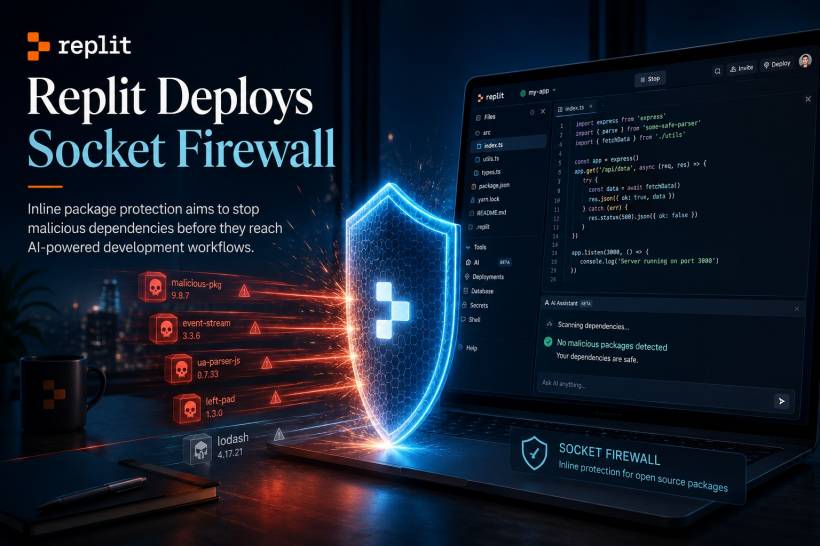
To address this, Replit has integrated Socket Firewall into its development environment through a feature called Package Firewall. The goal is simple: stop malicious or compromised packages at the moment they are being installed, rather than waiting until code review or deployment.
Why AI Coding Creates a New Supply-Chain Risk
Modern applications depend heavily on third-party packages.
A simple web app may rely on libraries for authentication, forms, payment processing, database access, image uploads, API requests, email delivery, charts, validation, logging, and dozens of other functions. Developers rarely write every component from scratch, and open source makes it possible to build quickly.
AI coding assistants accelerate this process even further.
An AI agent may suggest a package, add it to a project, run an installation command, and start using it almost immediately. That creates convenience, but it can also create risk when the recommended package is outdated, misspelled, compromised, or simply not the package the developer intended to use.
The challenge is not that AI tools are unsafe by default. The challenge is that AI can move faster than traditional review processes.
A package can be installed in seconds. A human security review may happen much later.
What Replit's Package Firewall Does
Replit's Package Firewall sits directly in the dependency-installation path.
When a developer or Replit Agent runs a command such as npm install, pip install, or another supported package-manager request, the installation is checked before the package enters the development environment.
If the package appears safe, the installation continues normally.
If it has been identified as malicious, compromised, or associated with a known security concern, Replit blocks it before its code is downloaded into the project.
This matters because some malicious packages are dangerous at installation time, not only when an application is launched.
A harmful package may attempt to:
• Steal API keys, tokens, or environment variables.
• Run hidden installation scripts.
• Fetch an additional malicious payload.
• Create backdoors inside a development environment.
• Exfiltrate sensitive information from the project.
• Abuse a developer's machine, cloud workspace, or CI/CD credentials.
Blocking the package before it enters the environment is much safer than discovering the issue after the code has already been installed.
The Rise of Typosquatting and AI "Slopsquatting"
One of the most common risks in open-source ecosystems is typosquatting.
This happens when an attacker creates a package with a name that looks very similar to a legitimate library. A developer may accidentally install the wrong package because of a typing mistake, a misleading search result, or a recommendation that looks believable at first glance.
For example, a legitimate package name may be altered by one letter, an extra hyphen, or a slightly different spelling. The false package may appear harmless, but its installation process could contain malicious code.
AI introduces another related risk: hallucinated package names.
Sometimes an AI model may suggest a package that sounds technically plausible but does not actually exist. An attacker can register that package name in a public registry and wait for users or AI agents to attempt an installation.
This type of problem is increasingly referred to as "slopsquatting" because the AI-generated package name may be fictional, but the malicious package registered under that name is very real.
Replit's firewall is designed to catch these kinds of risks before the install proceeds.
Why Traditional CVE Scanning Is Not Enough
Most development teams are already familiar with vulnerability scanning.
A typical software composition analysis tool checks a project's dependencies against known Common Vulnerabilities and Exposures, commonly known as CVEs. That remains important, especially for older libraries with publicly disclosed security issues.
But CVE scanning has limits.
A newly published malicious package may not have a CVE yet. Security researchers may need time to identify the problem, investigate its behaviour, publish an advisory, and update vulnerability databases.
During that window, a poisoned package could still be downloaded by developers or AI agents that trust its name, description, popularity, or apparent usefulness.
That is why install-time protection matters.
Rather than relying only on known historical vulnerabilities, the firewall uses Socket's security intelligence to identify packages that have already been flagged as malicious or compromised. This gives developers another layer of defence before the dependency becomes part of the project.
Security Moves Closer to the Moment of Creation
Traditionally, security checks are often performed later in the development lifecycle.
A team may scan dependencies before deployment, run code analysis before merging a pull request, or carry out a security review after a feature is complete.
Those steps are still important. But AI-assisted development has changed the pace of software creation.
When a coding agent can add several dependencies during a single task, waiting until the end of the workflow may be too late. The package has already entered the environment and may already have executed an installation script.
Replit's approach pushes a security control earlier in the process.
Instead of asking developers to manually inspect every library before installation, the firewall works in the background as part of the normal build flow.
That does not eliminate the need for secure coding practices. It simply helps reduce the chance that an obviously dangerous dependency gets through in the first place.
How This Fits Into Replit's Wider Security Approach
Package Firewall is part of Replit's broader Auto-Protect strategy.
The platform separates security into different stages of the application lifecycle:
• Package Firewall checks packages at install time.
• Dependency scanning can identify newly disclosed vulnerabilities after packages are already in a project.
• Security-focused review tools can inspect code and project risks before publishing.
This layered approach is important because no single security tool can cover every risk.
A firewall may block a malicious dependency, but it cannot automatically guarantee that an application's business logic is correct. Dependency scanning may catch an outdated library, but it may not detect a weak password policy or insecure API design. A pre-deployment review may identify coding issues, but it happens later than an install-time block.
The best security model combines multiple layers rather than relying on one final check.
What It Means for Developers
For developers, especially people using AI tools to build quickly, the biggest benefit is less interruption.
Security controls are more likely to be used when they are built into the workflow rather than added as an extra task after every coding session. Developers should not need to pause and manually investigate every dependency before they can continue working.
When a package is blocked, Replit provides information about why it was stopped. Its AI agent can also use that signal to suggest a safer alternative or correct a possible typo.
This is especially useful for:
• Solo developers building prototypes quickly.
• Startups moving from idea to MVP.
• Students and new developers learning through AI-assisted coding.
• Small teams without dedicated application-security specialists.
• Enterprise teams using AI agents to accelerate internal tools.
• Developers working with open-source packages across JavaScript, Python, and Go projects.
Why This Matters for Malaysian Developers
The same supply-chain risks apply to developers in Malaysia.
Local startups, web agencies, freelancers, university teams, internal IT departments, and enterprise software teams are all increasingly using AI coding tools to speed up development. Many projects also rely heavily on npm, PyPI, GitHub repositories, cloud APIs, and third-party packages.
For a Malaysian development team, a compromised dependency can affect more than just a single project. It may expose customer data, API credentials, payment information, database access, or internal cloud environments.
This is especially relevant for developers working on:
• E-commerce and payment platforms.
• Healthcare or clinic-management systems.
• Financial dashboards and fintech applications.
• Government or public-facing services.
• SaaS products handling customer data.
• Corporate internal tools connected to Microsoft 365, cloud storage, or business systems.
AI can help teams build faster, but the speed of development should not become a reason to weaken software supply-chain controls.
AI Security Should Be Built In, Not Added Later
The wider lesson from Replit and Socket's partnership is that security needs to keep pace with automation.
AI agents can write code, refactor files, install dependencies, test applications, and deploy projects. As these agents become more autonomous, the risk is no longer limited to what a developer manually types into a terminal.
Security needs to watch the actions that AI agents take on behalf of users.
That means checking dependencies at install time, monitoring exposed secrets, reviewing generated code, enforcing access controls, and keeping software components updated after vulnerabilities are discovered.
The future of secure development is not about slowing AI down. It is about giving AI workflows the right safety rails.
Final Thoughts
Replit's integration with Socket Firewall reflects a major shift in how development platforms need to think about security.
The threat is not only vulnerable code that reaches production. It is also the unsafe dependency that enters a project during development, often without attracting much attention.
By blocking malicious and compromised packages before they are installed, Replit is moving supply-chain protection closer to the exact moment where risk begins.
For developers, that is the kind of security that makes sense in an AI-driven world: automatic, immediate, and built directly into the creative process.











Comments 0