

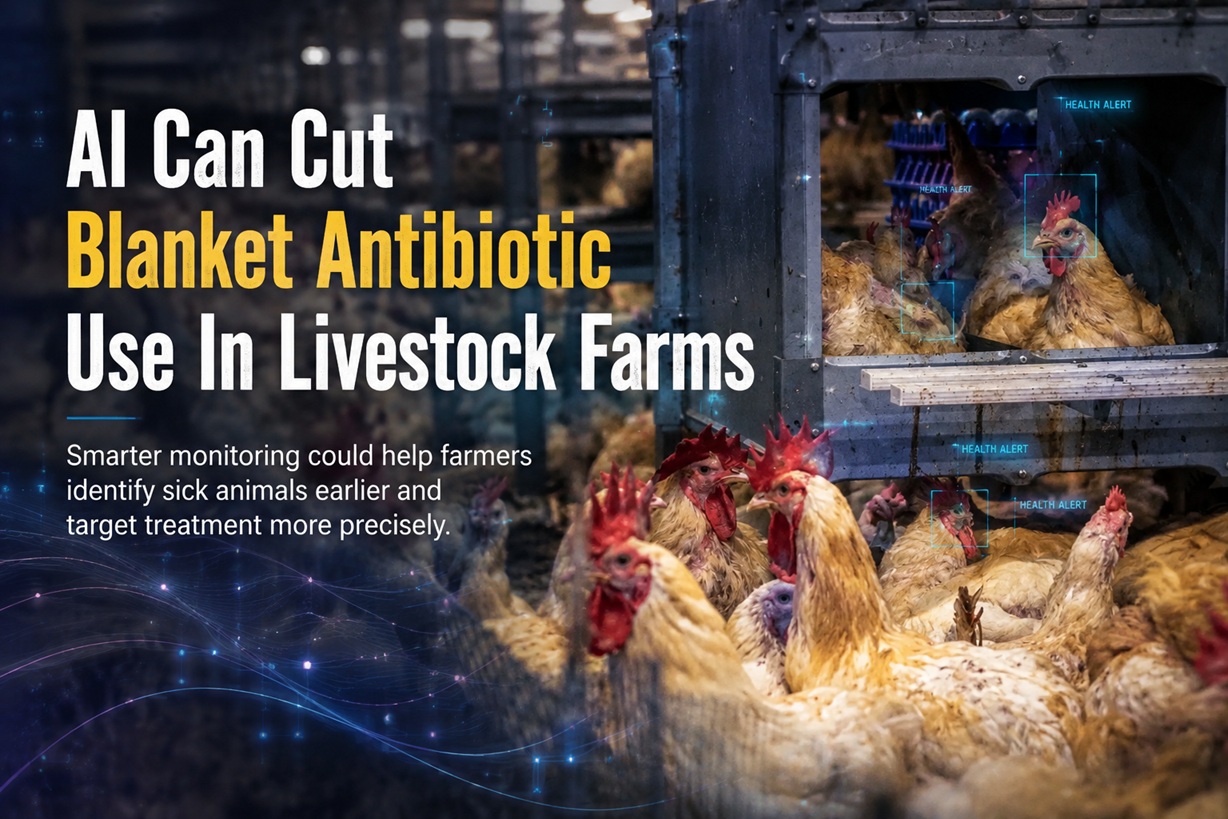
Artificial intelligence could play an increasingly important role in reducing unnecessary antibiotic use on livestock farms by helping farmers identify exactly which animals are becoming sick instead of routinely medicating an entire herd or flock.
That is the view of Prof Dr Goh Yong Meng, dean of Universiti Putra Malaysia's Faculty of Veterinary Medicine and chair of the Education and Promotions Committee of the Animal Welfare Board. Speaking at the Global Animal Production and Veterinary Industry Summit (GAVIS) 2026, he explained how AI-powered monitoring could support earlier diagnosis, more targeted treatment and broader efforts to tackle antimicrobial resistance.
From Blanket Treatment To Individual Care
One of the biggest opportunities comes from combining AI with sensors, microphones and biometric monitoring. Instead of treating animals as one large group, farms could continuously observe movement, behaviour, sound and other health indicators at the individual level.
Dr Goh highlighted an example from a pig farm in China where AI is used to identify coughing among specific animals. By analysing movement and sound, the system can pinpoint which pigs may be showing early signs of respiratory illness rather than assuming that every animal in the pen needs medication.
The practical benefit is straightforward. If only a small number of animals appear unwell, veterinarians can focus treatment on them instead of giving antibiotics to an entire group as a precaution. That could reduce drug use while still allowing farmers to intervene before an infection becomes more serious.
AI Could Help Fight Antimicrobial Resistance
Reducing unnecessary antibiotic use is particularly important because of antimicrobial resistance, or AMR. When antibiotics are used too frequently or unnecessarily, bacteria have more opportunities to evolve resistance, making infections harder to treat in both animals and humans.
Precision monitoring could help change that. AI systems capable of detecting subtle changes in activity, stress levels, feeding behaviour or vocalisations may provide an early warning before visible symptoms become obvious.
That gives veterinarians a chance to act sooner and more accurately. Instead of waiting until illness spreads through a herd and then resorting to large-scale treatment, farms could intervene selectively at the earliest stage.
Dr Goh sees this as a major improvement over routine prophylactic antibiotic use because the treatment follows evidence of need rather than being applied automatically.
Predictive Care Could Change Livestock Management
The broader shift is toward what could be described as predictive animal healthcare. Modern livestock production is increasingly adopting connected sensors, computer vision and AI systems capable of watching animals continuously in ways that would be impossible for farm workers to do manually.
Over time, these systems could build an individual health profile for each animal, detecting deviations from normal behaviour and flagging potential problems.
An animal that becomes less active, changes its feeding habits or begins making unusual sounds could trigger an alert long before the condition becomes severe. That not only has the potential to reduce antibiotic use but could also improve welfare by ensuring sick animals receive attention sooner.
The real value of AI here is therefore not simply automation. It is giving farmers and veterinarians better information at the moment intervention matters most.
Animal Health, Human Health And The Environment Are Connected
Dr Goh linked this approach to the broader One Health philosophy, which recognises that human health, animal health and environmental health are closely connected.
How livestock are raised can have consequences well beyond the farm itself. Poor animal health can contribute to disease outbreaks, greater antibiotic consumption and the spread of resistant organisms through people, food systems and the environment.
Better welfare therefore becomes more than an ethical issue. It can also be considered a public health strategy.
Healthy animals kept under appropriate conditions are generally less vulnerable to stress-related illness and infectious disease, which in turn reduces the need for medical intervention.
That makes prevention increasingly important. If technology can help farmers identify stress and illness earlier, the benefits may extend to the entire food production ecosystem.
Better Productivity Should Not Come At The Expense Of Welfare
Modern livestock breeding has dramatically improved food production efficiency. Chickens grow faster, dairy animals produce more milk and livestock can reach market weight considerably sooner than in previous generations.
But those gains can come with biological costs.
Dr Goh warned that selective breeding for maximum productivity can place significant physiological stress on animals if welfare considerations are not kept in balance. Rapid-growing broiler chickens, for example, can sometimes develop skeletal problems because their bodies gain weight faster than their bones can comfortably support.
The broader lesson is that productivity cannot be viewed in isolation.
Higher output may improve efficiency, but excessive physical stress can increase health problems and potentially create greater dependence on medication. That is why Dr Goh emphasised balance between productivity, animal health and welfare.
AI monitoring could eventually help farmers manage that balance by making stress and health problems easier to detect before they become severe.
Animal Welfare Is Also Becoming A Trade Issue
Animal welfare is no longer limited to farm management or public opinion. It increasingly affects international trade as well.
Countries exporting livestock and animal products may impose welfare requirements on their trading partners, meaning access to certain markets or suppliers can depend on meeting recognised standards.
Dr Goh pointed to Malaysia's Animal Welfare Act 2015, noting that having an established welfare framework also helps the country meet expectations imposed by nations with stricter animal welfare requirements, including Australia.
In that sense, regulation and trade standards can accelerate improvements that might otherwise happen more slowly.
For livestock businesses, good welfare practices are therefore becoming part of maintaining market access, protecting reputation and remaining competitive internationally.
Technology Can Help, But It Cannot Replace Responsibility
AI will not solve animal welfare problems by itself. Cameras, microphones and predictive algorithms are only useful if farmers and veterinarians act appropriately on the information they provide.
There also needs to be careful oversight of how automated systems are used. A false alert could result in unnecessary treatment, while a missed detection could allow disease to spread.
Human veterinary judgement therefore remains essential.
The ideal model is likely to involve AI continuously monitoring large populations of animals, identifying unusual patterns and helping professionals decide where their attention is most urgently required.
That can make livestock care more precise without shifting responsibility entirely to technology.
Final Thoughts
AI-powered livestock monitoring offers a promising alternative to the traditional approach of treating entire groups of animals simply because some may become sick.
By combining movement tracking, sound detection, biometric information and predictive analytics, farms could identify problems earlier and target antibiotics only where they are genuinely needed. That could improve animal welfare while also supporting the global effort to reduce antimicrobial resistance.
More importantly, the technology reflects a broader change in how livestock farming is being approached. Productivity alone is no longer enough. Health, welfare, sustainability and public health increasingly need to be considered together.
As Dr Goh's message suggests, the future of animal agriculture may depend less on treating more animals and more on understanding each animal well enough to know when treatment is actually necessary.











Comments 0