

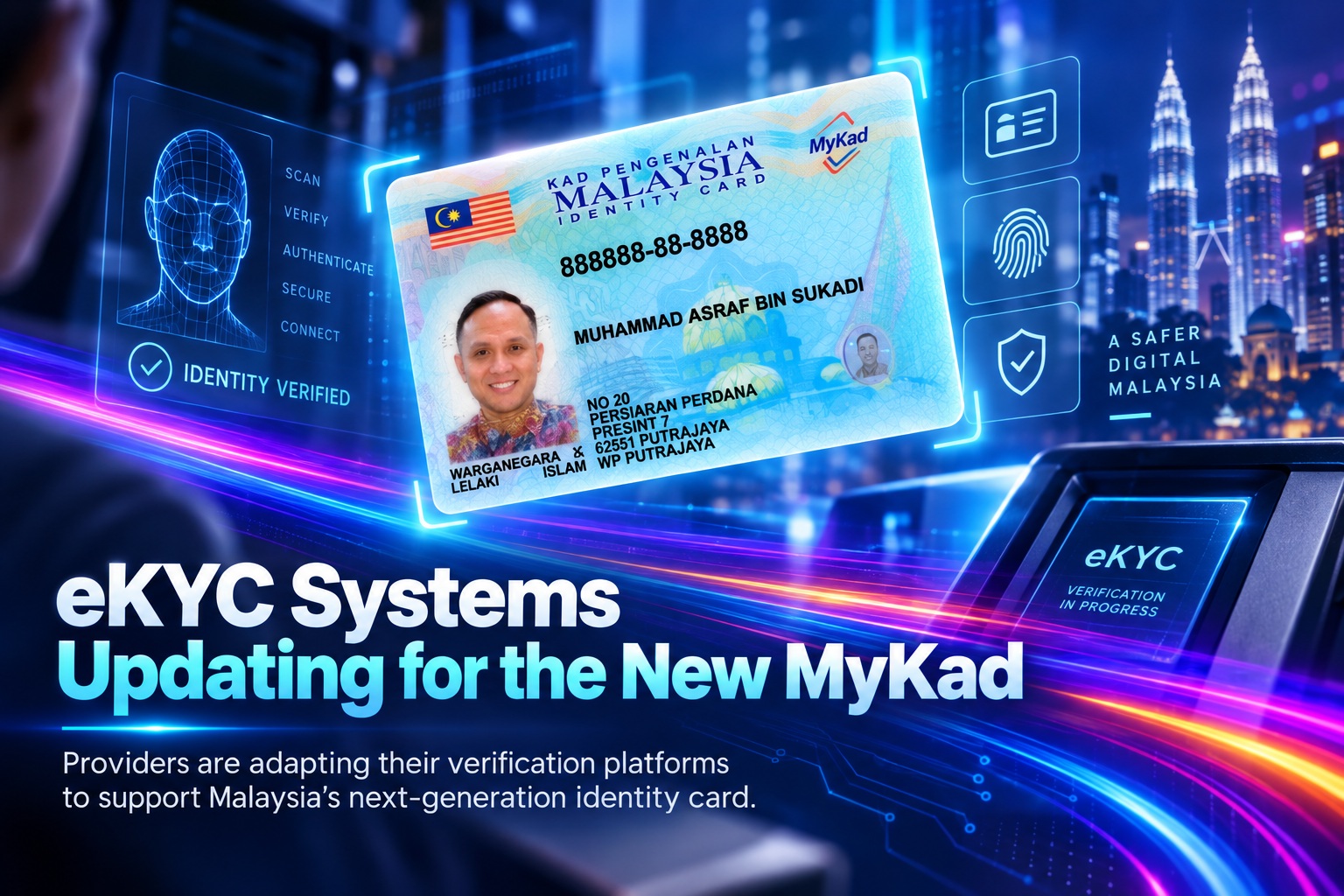
Malaysia's rollout of the new-generation MyKad is now prompting electronic Know Your Customer, or eKYC, providers to update their verification systems so they can properly recognise the redesigned card. The National Registration Department (JPN) confirmed that some holders of the new MyKad have experienced difficulties completing identity verification through digital onboarding systems, particularly where the software was still configured around the previous card layout. The issue does not affect the validity of the new MyKad itself, but rather the compatibility of third-party systems that need time to adapt to its new design and security features.
JPN says it is already working with relevant agencies and eKYC service providers to address the problem. Several engagement sessions have either taken place or are still ongoing, with the aim of ensuring that identity verification continues to work smoothly as the new MyKad becomes more widely used. The transition is therefore being handled progressively rather than through a single nationwide software update.
eKYC Systems Need to Learn the New Card Layout
The compatibility issue is understandable from a technical perspective because many eKYC systems rely on visual recognition, document templates and automated data extraction. These systems are often trained to expect the cardholder's photograph, chip, identification number and other features to appear in very specific locations. Once those elements move, the system may incorrectly reject the card even though it is genuine.
The new-generation MyKad introduces several notable layout changes, including the relocation of the physical chip and QR code from the front of the card to the rear. That alone is enough to affect systems that depend heavily on the previous design. Providers therefore need to update their document-recognition models, scanning logic and verification workflows before the new card can be processed reliably.
This kind of transition is not unusual when a national identity card undergoes a major redesign. The challenge is that MyKad is used across a very large ecosystem, including banking, digital wallets, telecommunications, government services and other platforms that depend on automated identity verification. Every one of those systems must eventually understand the new format.
JPN Is Working With Providers During the Transition
According to JPN, engagement sessions are being conducted with agencies and eKYC providers to make sure the necessary changes are implemented properly. These discussions are intended to help service providers understand the new card's design, security elements and technical requirements so that verification systems can be updated without weakening fraud controls.
That coordination is important because eKYC systems cannot simply accept every document that looks vaguely similar to MyKad. They still need to distinguish between genuine cards, altered documents and attempts at identity fraud. Updating compatibility therefore needs to be done carefully rather than by simply relaxing validation rules.
JPN says it will continue monitoring the situation and working with the relevant parties until the necessary updates have been completed. As more users begin receiving the new MyKad, feedback from real-world use will also help expose services that may still require further adjustment.
Alternative Verification May Be Available in the Meantime
For users who encounter problems with eKYC, JPN advises contacting the institution or service provider involved. Some organisations may already offer alternative verification methods while their automated systems are being updated, allowing customers to complete registration without waiting for full compatibility.
Those alternatives will vary depending on the provider. A bank, for example, may offer manual document review or in-person verification, while another digital service may temporarily direct users through a different onboarding route. The important point is that a failed automated scan does not necessarily mean the user cannot proceed at all.
Customers should therefore avoid repeatedly attempting the same failed eKYC process without checking for another option. If the card is being rejected because the service has not yet updated its recognition system, trying again with the same workflow is unlikely to produce a different result.
The New MyKad Brings a Major Security Upgrade
The new-generation MyKad officially began rolling out on 17 September 2026, bringing significant changes to both its physical construction and security design. The card now uses a polycarbonate body, which is intended to improve resistance against heat, chemicals and physical wear compared with older materials.
JPN says the redesigned card incorporates 53 security elements, including a dynamic security hologram, ultraviolet features, intricate Guilloche patterns and a transparent window. These additions are designed to make counterfeiting and tampering more difficult while giving authorised agencies additional ways to confirm that a card is genuine.
The increased security is one of the main reasons for the redesign. MyKad plays such a central role in Malaysian identity verification that improving resistance to fraud becomes increasingly important as digital services depend more heavily on remote onboarding.
The Chip and QR Code Have Moved to the Back
One of the most obvious physical changes is the relocation of the chip and QR code to the rear of the card. The new design therefore looks noticeably different from the previous generation, especially to automated systems that were trained around the older arrangement.
The chip itself has also been upgraded to a dual-interface design, meaning it can communicate through conventional contact-based card readers as well as NFC-enabled contactless systems used by authorised devices. This gives government agencies and approved service providers more flexibility in how identity information can be verified.
The change also reflects how identity cards are becoming more integrated with digital systems. Instead of relying solely on visual inspection and physical contact readers, future verification can increasingly make use of secure contactless communication where appropriate.
The QR Code Is Not Meant for Ordinary Smartphone Scanning
The QR code on the rear of the new MyKad is specifically intended for authorised identity verification. JPN says it cannot simply be scanned using a normal smartphone camera in the same way as a restaurant menu or payment QR code.
Instead, it is designed to work within verification systems approved by JPN. At present, one of its purposes is to help confirm whether the person presenting the MyKad is the legitimate owner of that card.
This controlled approach is important because a national identity QR code potentially interacts with sensitive information. Restricting its use to authorised systems reduces the risk of people casually extracting data through ordinary scanning applications.
Touch 'n Go Functionality Has Been Removed
Another major change is that the new-generation MyKad no longer includes the Touch 'n Go functionality found on older cards. That means the redesigned MyKad cannot be used in the same way as a conventional Touch 'n Go card for compatible payments or transport services.
Existing users with older MyKad cards can continue using the Touch 'n Go functionality already available on those cards, subject to normal validity conditions. Those moving to the new card will instead need to rely on a separate Touch 'n Go card or the Touch 'n Go eWallet where supported.
Removing the function also helps simplify the role of MyKad as an identity document. The new generation places stronger emphasis on security and digital identity verification rather than combining national identification with unrelated payment functionality.
Existing MyKad Holders Do Not Need to Rush
JPN has repeatedly stressed that Malaysians with a current MyKad in good condition do not need to replace it immediately. Existing cards remain valid, and the new generation is being introduced gradually rather than through a compulsory nationwide replacement exercise.
That is particularly useful while banks, eKYC providers and other services complete their system updates. Holders of the previous-generation MyKad are unlikely to encounter the same compatibility issues because existing verification platforms have already been designed around that card for years.
The gradual rollout therefore gives the wider digital ecosystem time to catch up while allowing people to continue using their existing identification as normal.
A National ID Upgrade Requires More Than a New Card
The early eKYC issues highlight how complicated modern identity infrastructure has become. Updating the physical card is only one part of the transition. Banks, fintech companies, government agencies, telecommunications providers and many other organisations also need their systems to recognise and validate the new format correctly.
This is especially important as more services move toward digital-only onboarding. When identity verification happens through a smartphone rather than at a physical counter, the software needs to recognise the document accurately without human assistance. Even a minor layout change can therefore have a surprisingly large operational impact.
The new MyKad rollout is a reminder that identity modernisation is really an ecosystem project. Stronger security features are valuable, but the benefits are only fully realised when all the services depending on that identity document can support them reliably.
Final Thoughts
The compatibility problems surrounding the new-generation MyKad appear to be part of a temporary transition rather than a problem with the card itself. eKYC providers are now updating their systems, while JPN continues working with agencies and service operators to make sure the redesigned card can be recognised properly across digital platforms.
For users who encounter failed verification, the best approach is to contact the service provider and ask whether an alternative verification method is available. As more institutions update their systems, these early compatibility problems should gradually become less common.
The new MyKad introduces substantially stronger security, a dual-interface chip, a controlled QR verification system and a more durable polycarbonate body. Those improvements represent an important modernisation of Malaysia's national identity infrastructure, but they also require the surrounding digital ecosystem to evolve alongside them.
For now, Malaysians with an existing MyKad that still works properly can continue using it as usual. The transition is gradual, and the priority should be making sure the systems around the new card are just as ready as the card itself.











Comments 0