

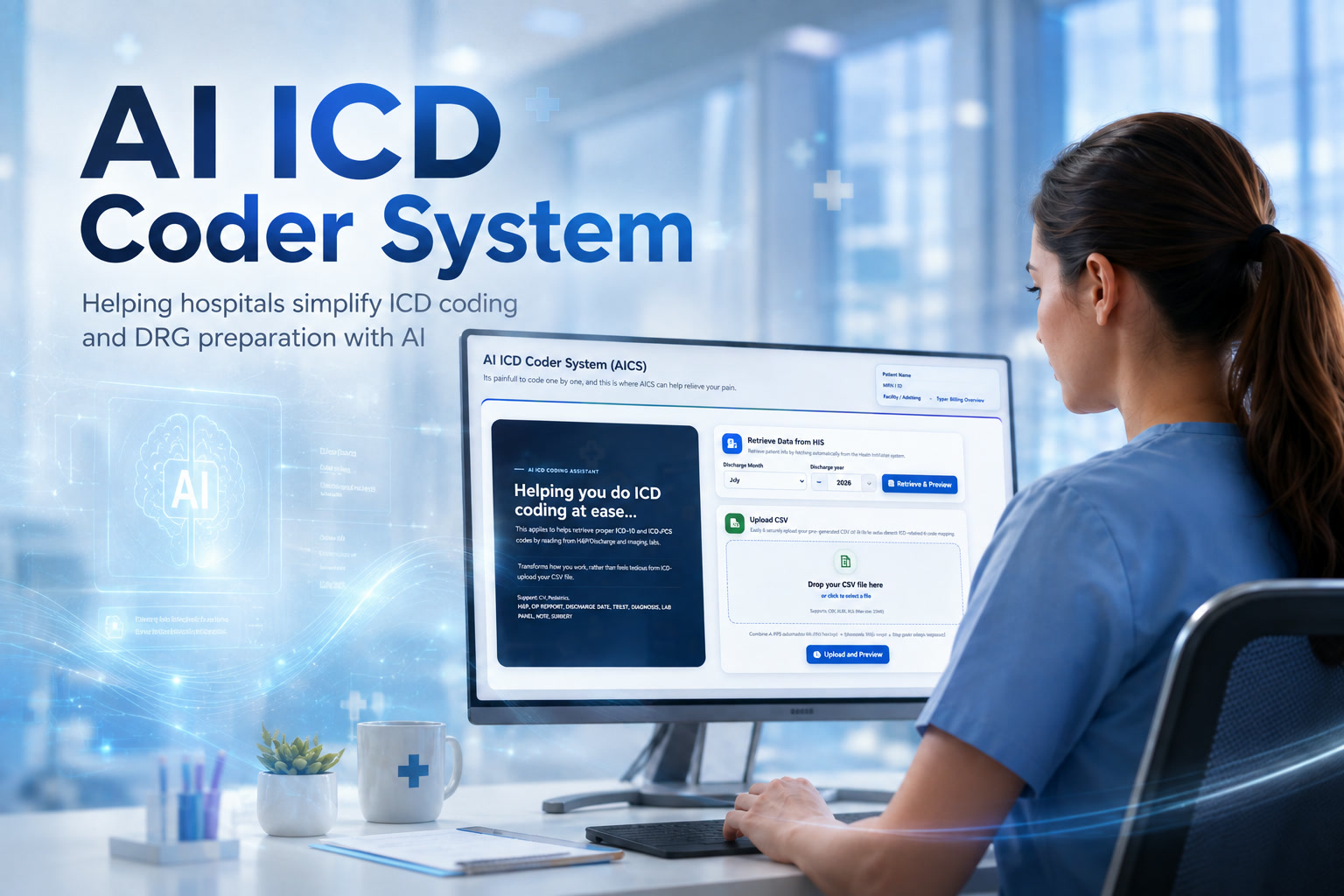
Clinical coding is one of those hospital processes that is absolutely essential, but it can also be repetitive, time-consuming and mentally demanding. When coders need to go through one discharge after another, interpret free-text diagnoses and procedures, search for the appropriate ICD codes, verify them and finally prepare the information for DRG submission, even a relatively straightforward workload can quickly become a lengthy exercise.
This is exactly the problem the AI ICD Coder System (AICS) was created to address.
AICS is an AI-assisted hospital coding application designed to help clinical coding teams generate and review ICD-11 diagnosis codes and ICD-9-CM procedure codes more efficiently. Instead of expecting users to manually code every case from scratch, the system reads the available clinical information, uses AI to suggest suitable codes, and guides the user through a structured review process before producing the final DRG-ready information. The application itself sums up its purpose quite nicely: helping users perform ICD coding "at ease" by using HIS data together with AI.
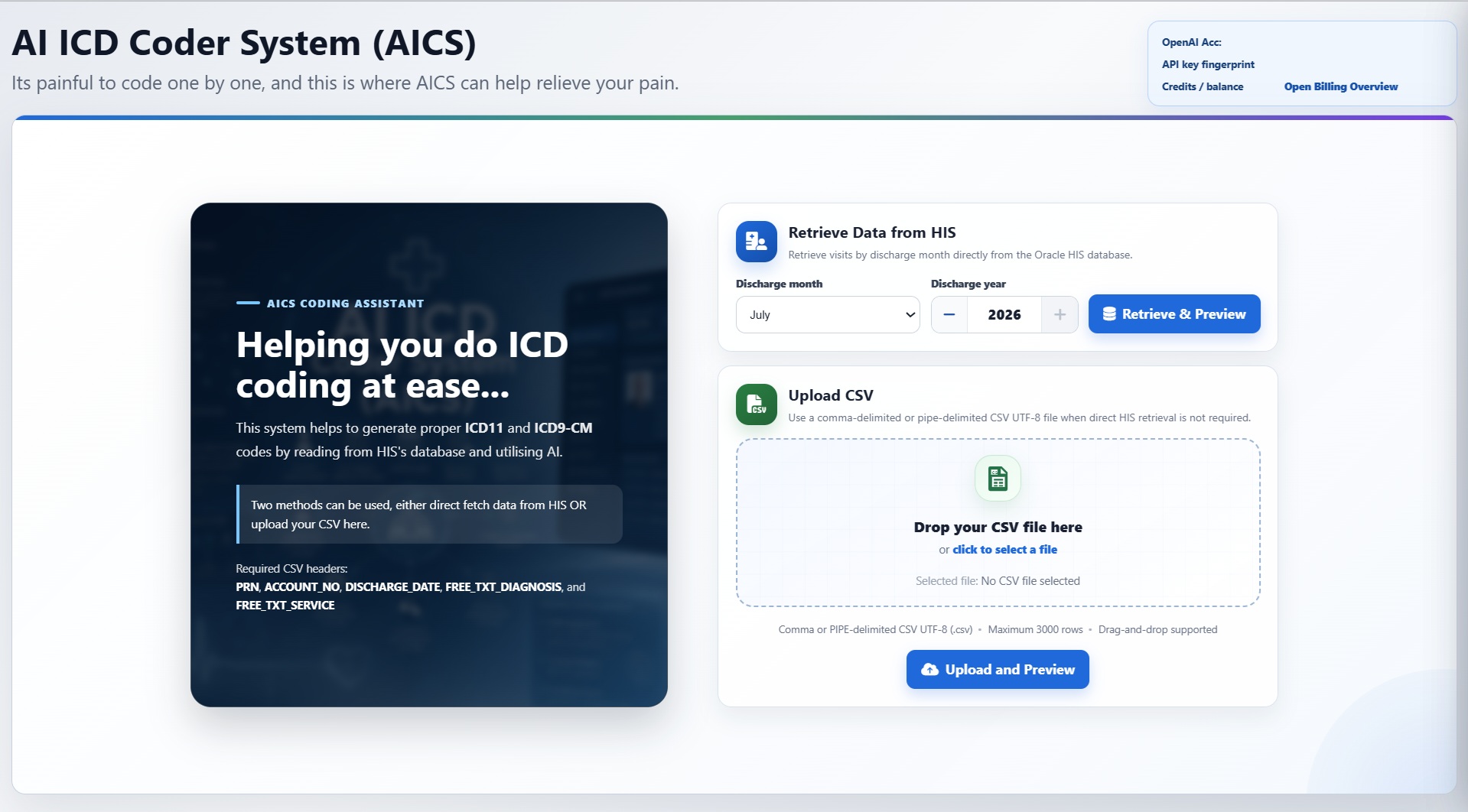
Starting Directly from the Hospital Information System
One of the biggest conveniences of AICS is that users do not necessarily need to manually prepare data before they can begin coding.
The application provides two ways of bringing patient discharge information into the system. Users can retrieve completed discharge-month records directly from the hospital's Oracle-based HIS database, or they can upload a prepared CSV file containing the required information.
For CSV-based processing, AICS works with key information such as PRN, account number, discharge date, free-text diagnosis and free-text service information. It supports comma- or pipe-delimited UTF-8 CSV files and can process up to 3,000 rows per dataset.
For hospital users, this means less copying and pasting between different applications. Once the clinical documentation is available in HIS, AICS can bring the information into a dedicated coding workflow where the coder can concentrate on reviewing the clinical information rather than spending unnecessary time preparing it.
AI Reads the Diagnosis and Suggests ICD-11 Codes
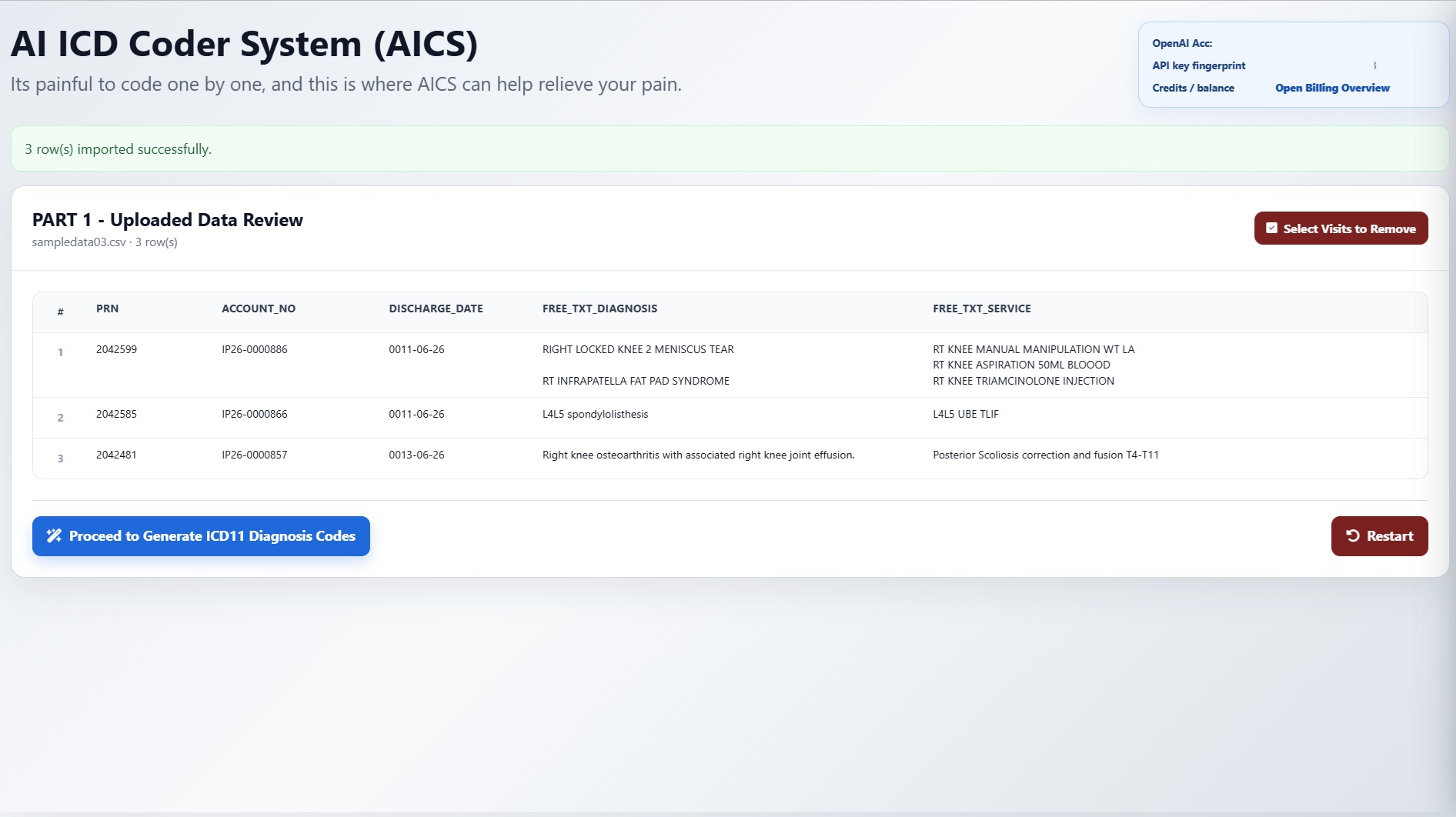
Once the data has been retrieved or uploaded, users first get an opportunity to review the imported visits. Individual or multiple visits can even be removed before coding begins, giving the user control over exactly which cases should be processed.
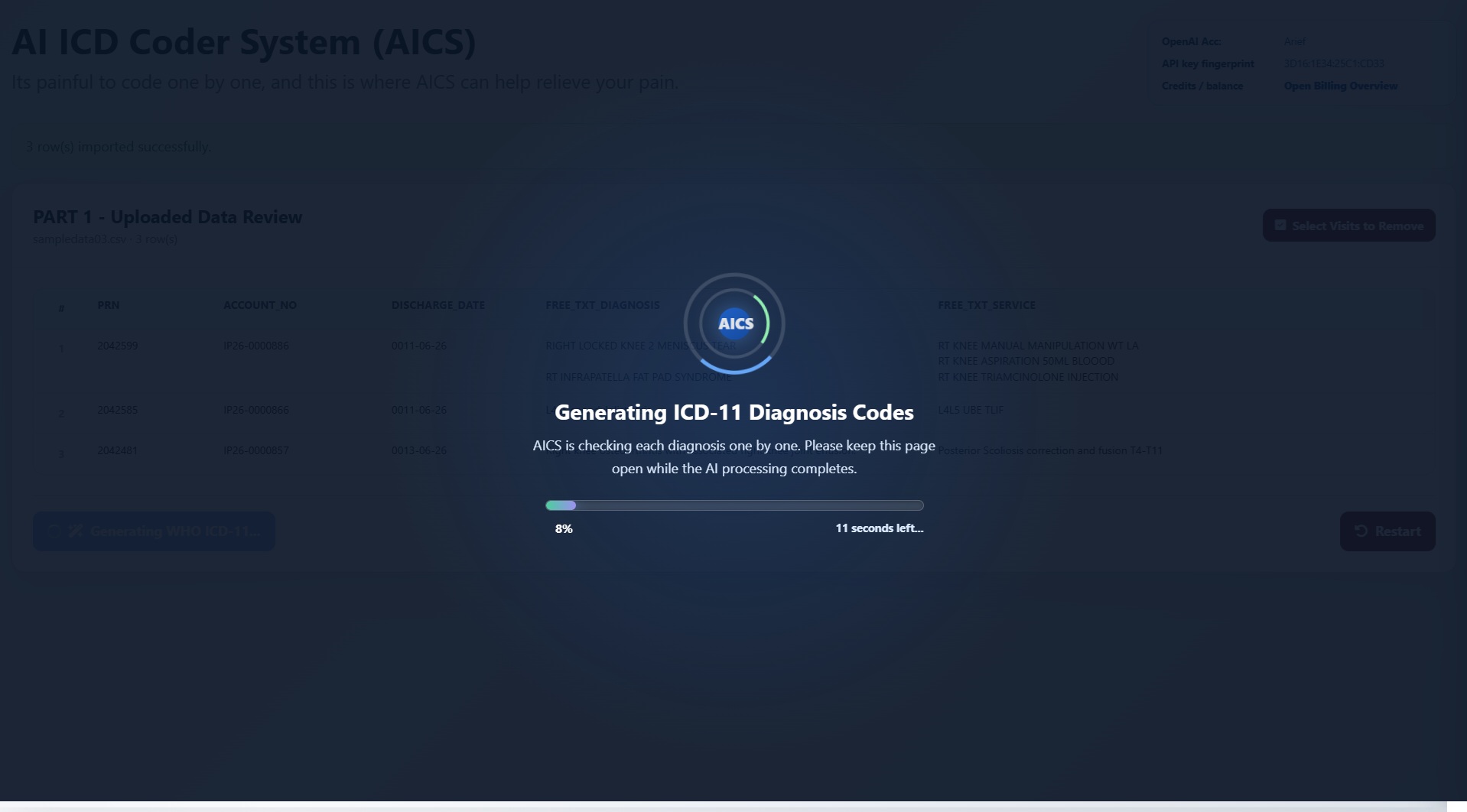
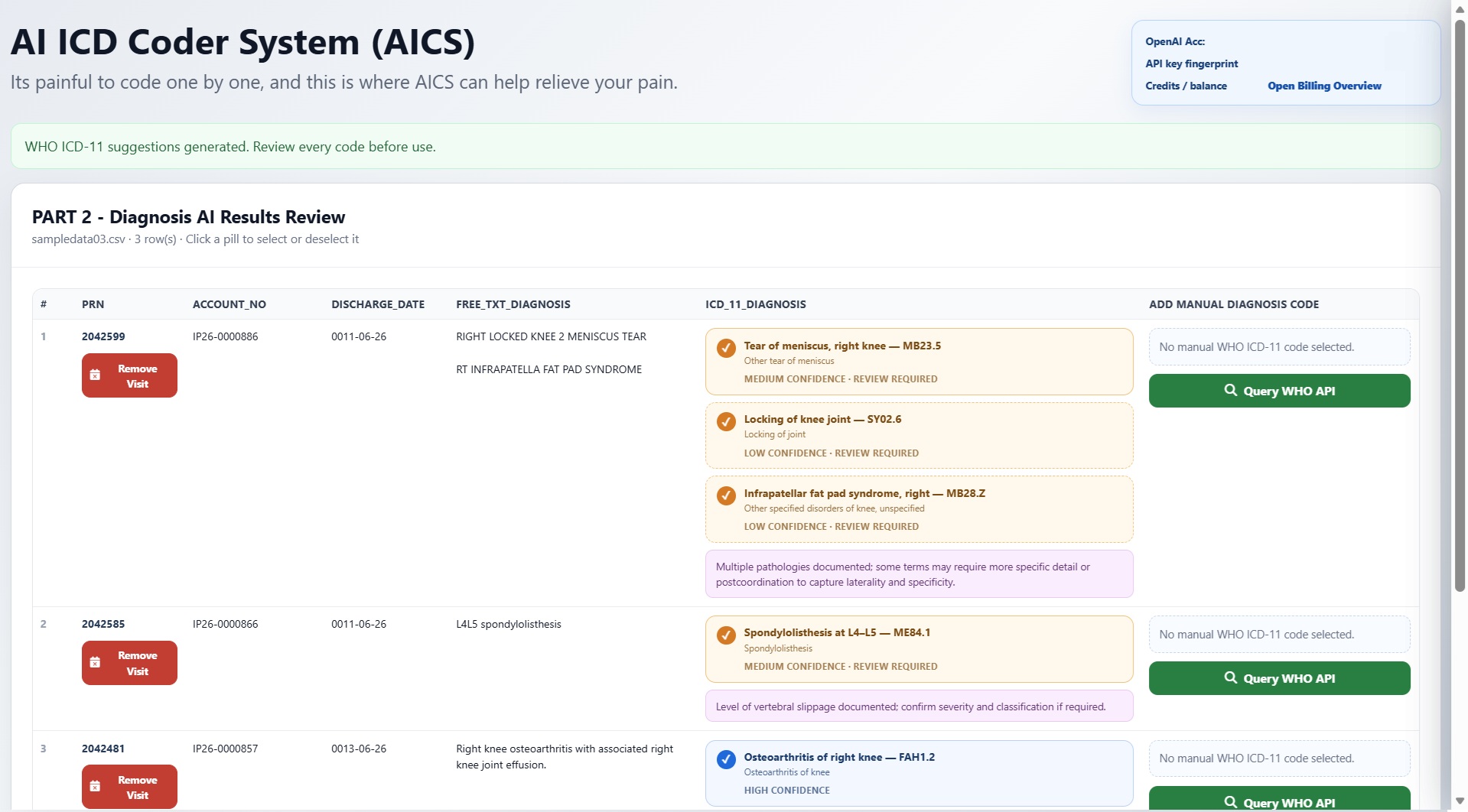
AICS then analyses the documented free-text diagnosis and uses AI to generate possible WHO ICD-11 MMS diagnosis codes.
Instead of simply returning one answer and treating it as final, the system presents the AI-generated results for human review. Users can select or deselect suggested diagnoses before proceeding. The application explicitly treats these results as suggestions that must be reviewed, rather than automatically declaring the AI output as authoritative clinical coding.
This human-in-the-loop approach is particularly important in healthcare. AI provides the speed and assistance, while the qualified coding team continues to make the final decision.
The Coder Still Remains in Control
AICS is not intended to remove the coder from the process. In fact, the workflow has deliberately been designed around review and confirmation.
During the Diagnosis AI Results Review, the coder can examine the original diagnosis together with the ICD-11 suggestions and select the codes that are appropriate for the case.
If the AI suggestion is not suitable or the coder wants to locate another diagnosis, AICS also provides the ability to manually query the WHO ICD API and add an appropriate ICD-11 code.
That combination is useful because it provides the best of both approaches: AI helps narrow down the coding workload quickly, while authoritative lookup and human judgement remain available whenever further verification is needed.
From Diagnosis Coding to DRG Diagnosis Review
After the appropriate diagnosis codes have been selected, AICS prepares them for a separate DRG ICD-11 Diagnosis Review.
At this stage, users can clearly see the original free-text diagnosis alongside the selected ICD-11 diagnosis and its corresponding Diagnosis DRG information. Only the diagnoses selected during the previous review stage are carried forward.
This staged workflow makes the application easier to follow because users are not presented with everything at once. Each step has a clear purpose: import, generate, review, confirm and then continue.
AI-Assisted ICD-9-CM Procedure Coding
Diagnosis coding is only one part of the DRG workflow. AICS also processes documented services and procedures.
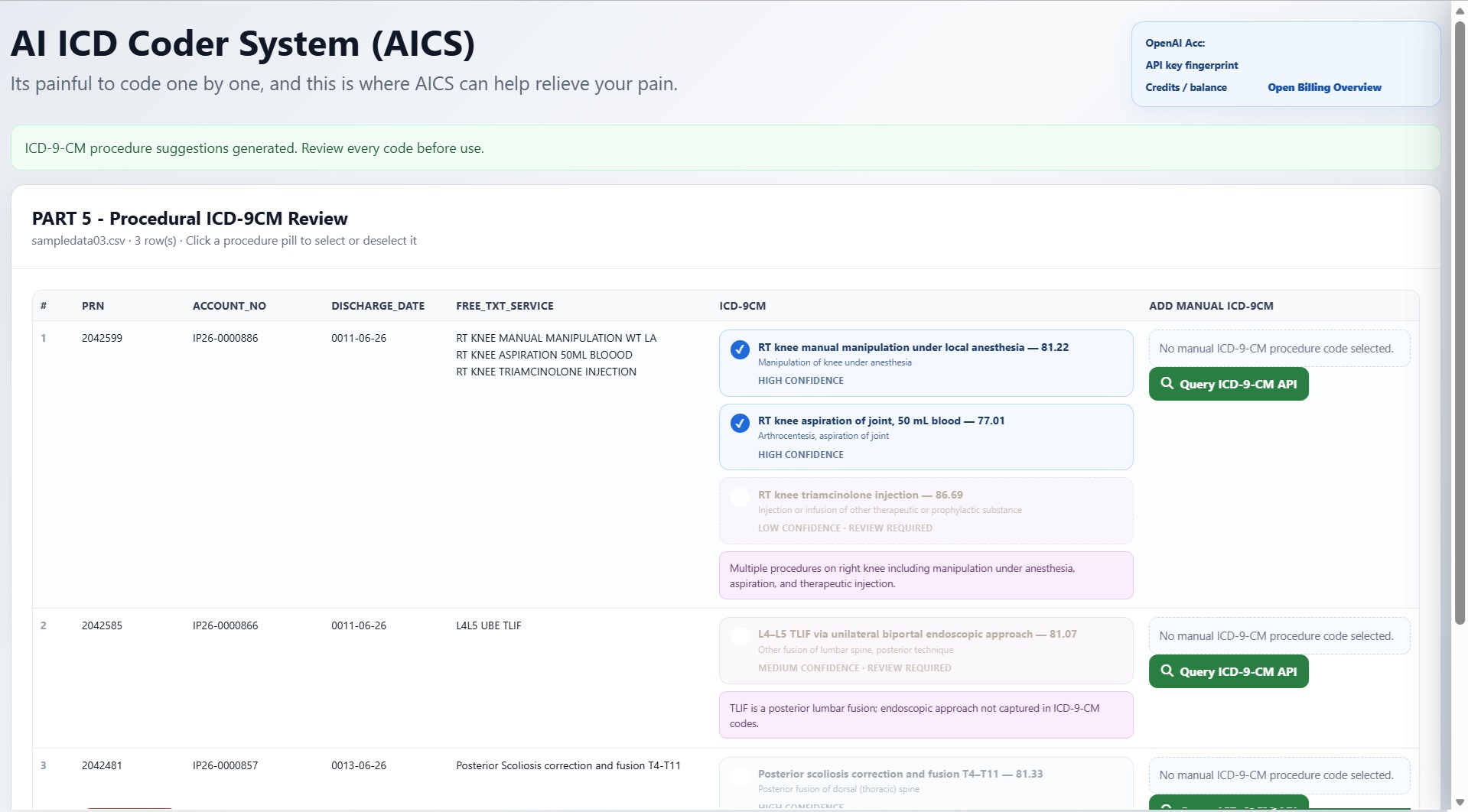
After the diagnosis review is completed, the system uses AI to analyse the hospital's FREE_TXT_SERVICE information and generate suggested ICD-9-CM Volume 3 procedure codes. The AI is instructed to identify the procedures explicitly documented in the clinical information and avoid inventing clinical details that were never recorded.
Just like the diagnosis stage, the resulting procedure codes are not accepted blindly.
Users are taken to a dedicated Procedural ICD-9-CM Review, where individual procedure suggestions can be selected or deselected.
Manual ICD-9-CM procedure searching is also available, giving coders another way to locate and add a suitable procedure when the AI-generated suggestion requires correction or supplementation.
What If No Procedure Was Performed?
Not every admission has a reportable procedure, and AICS has been designed to recognise this real-world scenario.
Instead of forcing the user to select an inappropriate procedure code just to continue, the coder can explicitly choose "Confirmed No Procedure Done."
Once confirmed, the case can proceed with a blank procedure value and any previously selected AI or manual procedure codes for that visit are cleared.
It is a small feature, but an important one because hospital systems need to accommodate genuine clinical situations rather than forcing every patient record into the same template.
A Final Procedure DRG Review Before Submission
After procedure selection, AICS provides another dedicated review stage for the DRG ICD-9-CM Procedure Review.
Here, users can compare the original service documentation, the selected ICD-9-CM procedure code and the resulting Procedure DRG value before anything progresses to the final submission stage.
Again, the intention is to make the workflow easier to audit visually. There are multiple checkpoints where a coder can go backwards, correct something and review it again instead of discovering a problem only after preparing the final submission.
One Final View of the Complete DRG Coding Result
Once both diagnosis and procedure reviews have been completed, AICS combines everything into its Final Review DRG Clinical Submission screen.
The final screen brings together the PRN, account number, discharge date, Diagnosis DRG and Procedure DRG for every processed visit.
This provides the coding team with one final opportunity to review the completed information before it leaves the AICS workflow.
The system can then generate a final CSV containing the information needed for downstream DRG processing.
Preparing the Data for Protech Health's DRG System
An important goal of AICS is not merely to generate ICD codes, but to make those results useful in the hospital's wider DRG workflow.
The final application screen is already structured around submission to Protech Health (PH), with separate DEMO and PROD submission controls alongside the option to download the final CSV. In the current application build, the PH DEMO and PROD submission buttons are present but disabled, while CSV download is available.
This means AICS already produces a submission-ready final dataset, while direct integration with Protech Health's DRG environment can form the next step of the workflow once the required submission interfaces are enabled.
Rather than having a coder finish the ICD work and then manually reconstruct everything again in another format, the objective is a much smoother journey:
That is where the real operational value of the application becomes much clearer.
Reducing Repetitive Work for Clinical Coders
The greatest benefit of AICS is not simply that "it uses AI."
The benefit is what AI allows the coding team to stop doing manually.
Instead of starting every diagnosis or procedure search from a blank page, the coder receives a set of relevant suggestions to review. Instead of repeatedly transferring clinical information from HIS into another working file, the system can retrieve the information directly. Instead of separately preparing diagnosis and procedure information for the final DRG workflow, AICS progressively builds the submission data as the user completes each review stage.
The coder therefore spends more time on validation, judgement and exceptions, and less time on repetitive searching and data preparation.
A Consistent Coding Workflow Across Cases
Another advantage is consistency.
AICS takes every case through the same structured sequence of review stages. Diagnosis coding is reviewed before it becomes Diagnosis DRG information. Procedure coding is reviewed before it becomes Procedure DRG information. Both are then brought together for a final review.
This does not guarantee that every code will automatically be correct—and the application specifically avoids making that claim—but it gives coding teams a much more consistent process for reviewing cases.
That consistency can become increasingly valuable when dealing with hundreds or thousands of discharged patient records.
Helping Hospitals Work Smarter, Not Simply Faster
Healthcare AI is most useful when it supports professionals rather than trying to replace their judgement.
AICS follows that principle quite closely. The AI handles the repetitive first-pass analysis, while the hospital's coding team remains responsible for reviewing and selecting the appropriate codes. The system even requires valid selections before cases can move forward and repeatedly reminds users to review AI-generated coding suggestions.
For hospitals, that means the potential benefits extend beyond speed. AICS can help create a more organised coding workflow, reduce repetitive manual work, simplify preparation of DRG data and provide a clearer path between the clinical documentation stored in HIS and the information eventually required by the DRG platform.
From Hours of Searching to a Guided Coding Process
Traditional ICD coding can involve repeatedly reading a diagnosis, searching references, selecting codes, documenting them and then preparing everything for the next system.
AICS transforms that into a guided process.
Retrieve the discharged cases. Review the clinical information. Let AI generate possible diagnosis codes. Confirm them. Review the DRG diagnosis result. Generate procedure codes. Confirm those. Review the procedure DRG result. Then inspect the complete dataset before preparing it for Protech Health.
The complexity of clinical coding does not disappear, but much of the repetitive work around it can be reduced.
Final Thoughts
The AI ICD Coder System (AICS) represents a practical use of artificial intelligence within hospital operations.
Rather than using AI simply because it is the latest technology, AICS applies it to a very specific problem: making ICD coding easier for the people who actually have to perform it.
By connecting hospital discharge information with AI-assisted ICD-11 diagnosis coding, ICD-9-CM procedure coding, manual verification tools, structured human review and a final DRG submission workflow, AICS turns what can otherwise be a fragmented and repetitive process into a much more manageable one.
Most importantly, the application keeps people at the centre of the process. AI suggests. The coder reviews. The hospital remains in control.
And once direct submission to Protech Health's DRG System is enabled, the vision becomes even more complete: a streamlined journey from the hospital's own clinical documentation all the way to DRG submission, with significantly less repetitive manual work in between.











Comments 0