

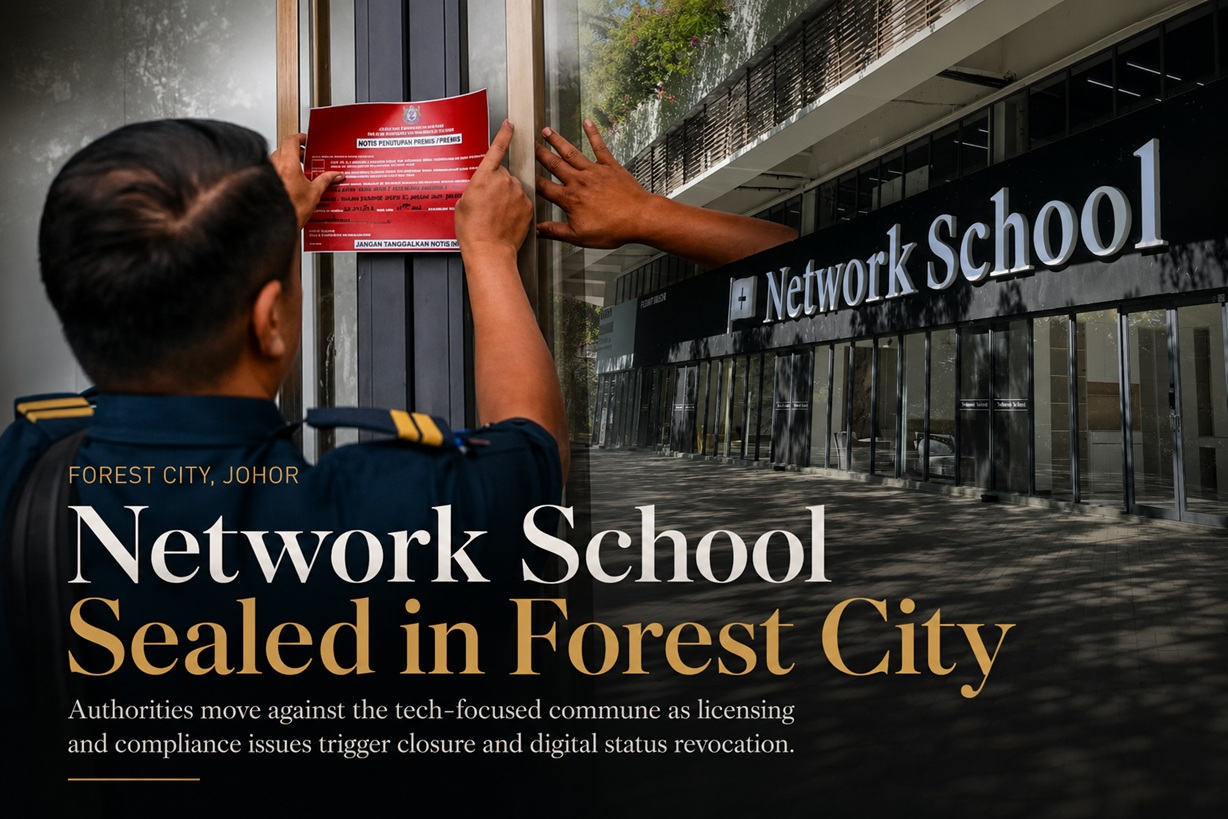
Network School's operations in Forest City, Johor, have been brought to an abrupt halt after the Iskandar Puteri City Council revoked the business licence held by its operator, NSO Malaysia Sdn Bhd. Council enforcement officers arrived at the premises on 22 July 2026, inspected the site, sealed one of the entrances and displayed an official closure notice. Network School signs around the area had also been removed or covered following an order requiring the organisation to stop operating.
The action comes after days of public controversy involving immigration checks, questions about the organisation's activities and unverified social media allegations concerning Israeli nationals. However, the enforcement measures announced by local authorities have primarily focused on business licensing, advertising approval and the permitted use of the premises.
Why MBIP Revoked the Business Licence
The Iskandar Puteri City Council, better known as MBIP, carried out several inspections at Network School's premises on 12, 14, 19 and 20 July.
According to the findings, the company was operating from two premises. One had a valid licence as an administrative office, while the other was allegedly operating without a business licence issued by the council.
Inspectors also found that the licensed office was being used as a classroom, which did not match its approved purpose. In addition, the organisation was accused of conducting promotional activities and displaying advertising materials without obtaining the necessary approval.
MBIP subsequently cancelled the company's business and advertising licences and issued a notice ordering all activities to stop from 22 July.
The closure notice was enforced under the council's Trade, Business and Industrial Licensing By-laws 2018. The action demonstrates that holding a company registration or receiving recognition from a national investment agency does not replace the need to obtain local operating, premises and advertising approvals.
What Exactly Is Network School?
Despite its name, Network School is not officially recognised as a Malaysian school, university or private higher education institution.
The organisation was founded by former Coinbase chief technology officer and technology investor Balaji Srinivasan. It describes itself as a residential technology community where developers, entrepreneurs, investors, researchers and digital professionals can live, work, attend programmes and develop business ideas together.
Its concept combines elements of co-living, co-working, professional networking and technology education rather than operating like a conventional institution offering recognised academic qualifications.
Malaysia's Higher Education Ministry clarified that Network School was not registered as a private higher education institution under the Private Higher Educational Institutions Act 1996. The ministry also found no recognised partnership or formal involvement between Network School and any Malaysian public university or registered private higher education institution.
The ministry instead described it as a private residential community and co-working environment for technology entrepreneurs, investors and startup practitioners.
That distinction matters because the word "school" may give the public the impression that an organisation is regulated as an educational institution. In this case, its legal and operational status was closer to a private technology community than a registered college or university.
How the Israeli Nationality Allegations Entered the Controversy
Network School attracted much wider attention after social media posts alleged that Israeli nationals were among those living or participating in the Forest City community.
Malaysia does not maintain diplomatic relations with Israel, and entry by Israeli passport holders generally requires special approval. The allegations therefore triggered considerable public concern and prompted checks by immigration and other enforcement agencies.
Some online posts went further, claiming that Network School was connected to an Israeli plan to establish a presence in Malaysia through cryptocurrency and technology investments.
Those wider claims have not been publicly substantiated by Malaysian authorities. The known enforcement action against Network School has centred on licensing conditions and the approved use of its premises—not a confirmed Israeli or cryptocurrency-related conspiracy.
Keeping that distinction clear is important. Regulatory violations can be investigated and documented, while serious political claims should not be presented as fact without evidence.
Immigration Checks Found Valid Documents
During an earlier inspection, the Immigration Department examined 266 foreign nationals from approximately 40 countries at Network School.
Initial checks found that those inspected possessed valid immigration documents. Subsequent investigations also found no evidence that the people examined had misused passports or identity documents.
Immigration authorities later said they had identified 430 people connected with Network School. Of those, 210 were believed to remain in Malaysia, while 201 had already left the country.
The movement of another 19 individuals could not immediately be traced, and the Immigration Department said further inquiries were being conducted to determine whether they remained in Malaysia or had already departed.
The absence of evidence of passport misuse does not automatically settle every immigration question. Authorities may still verify visa categories, entry conditions, permitted activities and the relationship between a foreign national's declared purpose of travel and their actual activities.
However, it also means allegations of illegal entry should not be treated as proven merely because they circulated widely online.
Malaysia Digital Status Is Also Being Withdrawn
The consequences for Network School extend beyond its local business licence.
The Malaysia Digital Economy Corporation has announced immediate steps to revoke the Malaysia Digital status awarded to NSO Malaysia Sdn Bhd.
Malaysia Digital status is granted to eligible technology companies under a national initiative administered by MDEC. Approved companies may receive access to facilitation services, incentives and other privileges intended to support digital investment and expansion in Malaysia.
Those benefits are conditional. Companies must obtain the permits and licences required for their approved activities and comply with Malaysian laws and regulatory requirements. MDEC said the cancellation of NSO Malaysia's business licence represented a breach of those conditions.
MDEC maintained that Malaysia remains open to high-quality digital investment, while emphasising that regulatory compliance cannot be compromised.
The move reinforces an important principle: investment incentives do not exempt companies from municipal regulations, immigration requirements or other local laws.
Why Premises Use Became an Important Issue
The case also highlights an easily overlooked part of business compliance: a valid licence may apply only to a specific activity and location.
An office licence does not necessarily permit the premises to be used as a classroom, event venue, residential facility or public training centre. Each use can involve different requirements relating to safety, occupancy, zoning, fire protection and public access.
Similarly, a company operating from several spaces may need separate approval for each location. Having one properly licensed office does not automatically legalise activities conducted elsewhere.
MBIP's findings suggest that the Network School dispute was not simply about whether NSO Malaysia existed as a registered company. It concerned whether the company was conducting the correct activities at properly licensed premises under the conditions set by the local authority.
This is particularly relevant for newer business models combining accommodation, education, events, co-working and startup development. A concept may not fit neatly into a single traditional business category, but it must still satisfy the rules applicable to each activity.
A Test for Malaysia's Technology Investment Ambitions
The controversy places Malaysia in a delicate position.
The country wants to attract technology entrepreneurs, skilled professionals, digital nomads and international investors. Johor, in particular, is increasingly promoted as a location for data centres, technology businesses and cross-border investment because of its proximity to Singapore.
At the same time, welcoming international investment does not mean allowing companies to define their own regulatory boundaries.
Network School's founder previously argued that the immigration controversy could harm Malaysia's reputation among global technology investors, especially after inspections found no immigration-document violations among those examined.
From the authorities' perspective, however, the eventual closure was based on local licensing and premises-use violations identified through multiple inspections.
Both issues can exist at the same time. Malaysia must ensure that investigations are evidence-based and professionally conducted, while international companies must understand that innovative business models are still subject to Malaysian law.
Online Allegations Should Be Separated From Verified Findings
The Network School episode also demonstrates how quickly unrelated issues can become combined in public discussion.
There are at least three separate matters:
Immigration authorities said they had not found passport misuse among the foreign nationals inspected. MBIP separately identified licensing and premises-use violations. The wider claims involving an alleged Israeli or cryptocurrency agenda remain unconfirmed.
Treating all three matters as though they have already been proven risks creating confusion.
Regulatory enforcement should be evaluated using inspection reports, licence conditions and applicable laws. Allegations involving nationality, politics or national security require their own evidence and should not be used as substitutes for documented findings.
What Happens Next
For now, Network School has been ordered to cease operations at its Forest City premises, and at least one of its operating spaces has been officially sealed.
MDEC is proceeding with the withdrawal of the operator's Malaysia Digital status, while immigration authorities continue efforts to establish the movements of the remaining individuals connected to the organisation.
Whether the operator will challenge the licensing decisions, restructure its Malaysian activities or seek permission to operate under different conditions has not been officially confirmed in the cited announcements.
Any future operation would likely require the company to resolve its licensing position, ensure that each premises is approved for its intended use and satisfy the relevant local and national regulatory requirements.
Final Thoughts
The closure of Network School is not simply a story about a controversial technology community in Forest City.
It is also a reminder that unconventional business models must still operate within conventional legal frameworks. A company may bring international talent, investment and ambitious ideas, but it must obtain the correct licences and use its premises according to approved conditions.
At the same time, enforcement should remain grounded in verified evidence. Immigration checks found no passport misuse among the people inspected, while the confirmed action taken by MBIP focused on business licensing, advertising and premises use.
Malaysia can remain open to international technology investment without lowering its regulatory standards. The balance depends on clear rules, fair enforcement and a willingness by investors to understand that innovation does not place any organisation above the law.











Comments 0