

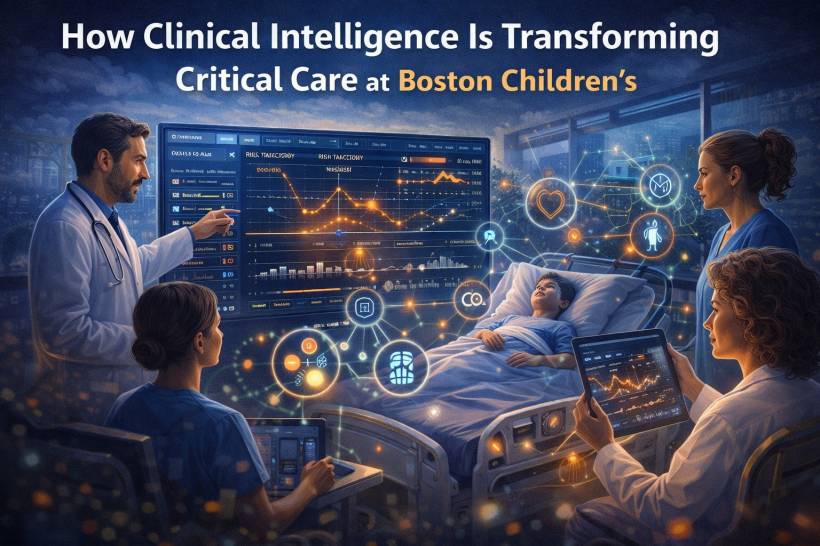
In modern intensive care units, data isn't the problem—there's plenty of it. The real challenge is making sense of it all in time to make the right decision. That's exactly the situation at Boston Children's Hospital, where clinicians deal with massive streams of real-time patient data every second. Despite having access to this information, teams were struggling to connect the dots—until a new AI-powered clinical intelligence platform changed the way they work.
The Hidden Problem: Data That Disappears
In critical care, especially for children, patients generate continuous streams of physiological data—heart rate, oxygen levels, carbon dioxide readings, and more. But traditionally, much of this data is only visible momentarily on monitors before it disappears. That created a serious problem. Different clinicians were often interpreting different snapshots of a patient's condition, leading to inconsistent decision-making. In some cases, important patterns were missed simply because no one had a complete, continuous view of what was happening over time. Dr. Peter Laussen highlighted that without a clear way to track how a patient's condition evolves, it becomes difficult to predict risks or respond early to deterioration. Even basic documentation added to the challenge. As Dr. Josh Salvin explained, clinicians often had to reconstruct a patient's overnight condition using periodic notes—essentially trying to connect scattered dots rather than seeing a full picture.
A Smarter Approach: Turning Data Into Insight
To solve this, the hospital adopted an AI-driven clinical intelligence platform from Etiometry. The idea wasn't just to collect data—but to make it usable. The platform continuously captures high-resolution physiological signals and allows clinicians to replay events with precision, even down to a few seconds. More importantly, it aggregates multiple signals to show how a patient's condition is evolving over time. Instead of isolated readings, clinicians now see trajectories—patterns that indicate whether a patient is stabilising, improving, or at risk.
Supporting Decisions, Not Replacing Them
One key design principle of the platform is that it doesn't tell doctors what to do. Instead, it acts as a decision support tool—highlighting trends, surfacing risks, and prompting clinicians to take a closer look when something changes. This is especially important in critical care, where every patient is different and clinical judgment remains essential. By reducing noise and presenting meaningful insights, the platform helps teams make more informed, timely decisions without taking control away from them.
From Individual Patients to Unit-Wide Awareness
The benefits go beyond individual patient care. At the bedside, clinicians use continuous risk indicators to guide decisions like when to remove ventilators or adjust medications. Meanwhile, charge nurses can monitor an overview of the entire unit, identifying which patients may be heading toward complications. This allows teams to shift from reactive care to proactive management—allocating attention and resources before a situation worsens.
A Real Impact: Smarter, Faster, and Safer Care
One of the most impactful use cases has been in de-escalating treatment. In the past, patients often remained on certain medications or interventions longer than necessary, simply because it was difficult to track subtle improvements in real time. Now, with continuous monitoring and automated calculations, clinicians can more confidently adjust treatments—such as reducing vasoactive drugs—based on accurate, up-to-date data. The platform also improves decision-making in areas like extubation (removing breathing support). By combining traditional clinical assessment with AI-driven risk indicators, doctors can better determine the right timing, reducing the likelihood of complications.
Changing How Teams Think and Work
Interestingly, the impact isn't just technical—it's cultural. The way clinicians discuss cases, conduct rounds, and interpret patient data has evolved. Instead of relying on intermittent calculations or fragmented information, teams now work from a shared, real-time understanding of each patient's condition. This alignment reduces variability in care and helps ensure everyone is literally "on the same page."
Measurable Outcomes—and Long-Term Benefits
While linking every clinical decision directly to data remains complex, early outcomes are promising. Hospitals using similar approaches have reported reductions in ICU length of stay, which brings both clinical and operational benefits. Shorter stays mean:
• Lower risk of complications
• Reduced healthcare costs
For pediatric patients, the long-term impact is even more significant. Reducing time spent in intensive care—especially under sedation or complex treatments—can positively influence brain development and overall health outcomes.
The Bigger Picture: Data-Driven Healthcare That Actually Works
From a financial perspective, the impact is just as compelling. Analyses suggest that scaling such platforms could deliver strong returns, with significant cost savings driven by shorter hospital stays, reduced intervention time, and improved efficiency. But beyond the numbers, the real value lies in something simpler: better care. By turning raw data into actionable insight, clinical intelligence platforms are helping healthcare teams move from guesswork to precision—ensuring that decisions are based on a complete, continuously updated understanding of each patient.
Final Thoughts
What's happening at Boston Children's Hospital is a glimpse into the future of healthcare. It's not about replacing doctors with AI—it's about giving them the tools to see more clearly, act earlier, and care more effectively. As healthcare continues to generate more data than ever before, solutions like this will play a critical role in bridging the gap between information and action—ultimately improving outcomes for patients who need it most.











Comments 0