

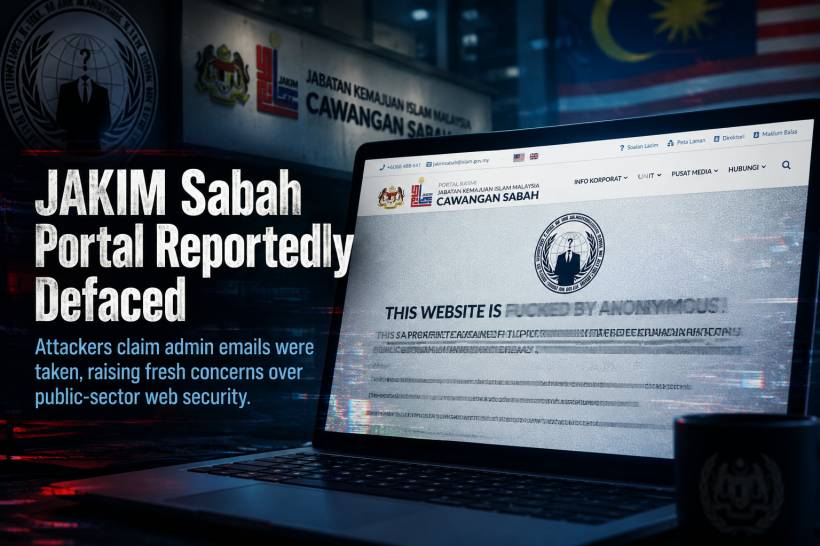
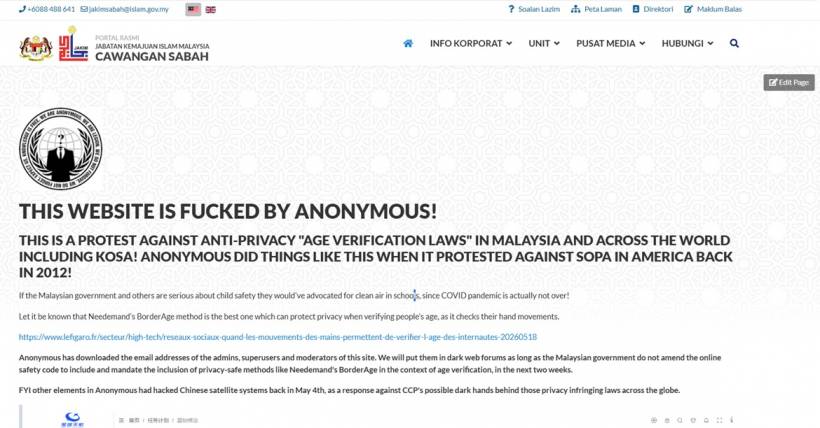
The JAKIM Sabah website was reportedly targeted in a recent cyber incident that briefly saw its normal homepage replaced with a message claiming responsibility for the disruption. The message used the "Anonymous" name and presented the attack as a protest connected to privacy concerns around online age-verification requirements and digital safety measures. It also included a more serious allegation: that email addresses belonging to site administrators, superusers, and moderators had been obtained during the incident.
At this stage, however, the alleged data access has not been independently verified. A defaced website can confirm that unauthorised changes were made to a public-facing page, but it does not automatically prove that attackers reached internal systems, extracted records, or accessed administrator accounts.
That distinction matters.
The JAKIM Sabah portal is now reachable again, suggesting that recovery or restoration work has taken place. Even so, the incident highlights why website defacements should never be dismissed as a cosmetic problem alone. A visible page replacement may be the most obvious sign to the public, but organisations still need to investigate whether the compromise went further behind the scenes.
A Public Website Defacement Is Still a Security Incident
When a government website is altered without authorisation, it affects more than the design of the page.
For visitors, the immediate issue is trust. A public portal represents an agency, and people expect official websites to provide accurate information, reliable services, and safe access to online resources. When that website suddenly displays an attacker's message, users are left questioning whether the rest of the platform, including contact forms, directories, and downloadable documents, can still be trusted.
From an information-security perspective, a defacement usually points to a weakness somewhere in the web environment. That weakness could involve an outdated component, poor access controls, a vulnerable extension, compromised credentials, or a server configuration issue. The exact cause cannot be assumed without a proper forensic investigation, but the visible change itself is enough to justify an urgent response.
A successful defacement also affects the integrity of the website. In cybersecurity, integrity means that information remains accurate and unchanged unless an authorised person updates it. Once an outside party is able to replace content, that assurance is disrupted.
The Data-Theft Claim Needs Careful Handling
The most concerning part of the attackers' message was the claim that they had obtained email addresses associated with website administrators, moderators, and superusers.
Claims made by attackers should always be treated cautiously. Threat actors often use high-profile statements to attract attention, create pressure, or make an incident appear larger than it may actually be. Until the organisation involved, a regulator, or an independent forensic investigation confirms the details, it is not responsible to state that a data breach has definitely occurred.
That said, the claim cannot simply be ignored either.
If administrator email addresses or related account details were exposed, they could potentially be used in targeted phishing attempts. Staff might receive convincing-looking messages that appear to come from colleagues, technology vendors, government agencies, or internal support teams. This is why organisations responding to a suspected exposure should remain alert for unusual login requests, password-reset emails, unexpected file-sharing links, and messages that create urgency.
The right approach is not panic. It is verification, containment, and clear communication.
Why "Anonymous" Is Not a Confirmed Attribution
The defacement message reportedly used the well-known Anonymous banner. However, Anonymous is not a formal organisation with a central leadership structure, official membership list, or verified communication channel.
Over the years, the name has been used by many unrelated individuals and groups. Some may share similar political views, while others may simply use the branding because it attracts attention.
As a result, the appearance of the Anonymous name on a compromised website does not independently identify who carried out the attack. Attribution in cybersecurity requires evidence, not just a signature left on a webpage.
Investigators would normally examine technical indicators such as server logs, malicious files, access patterns, reused infrastructure, and other traces left during the incident. Even then, identifying the people behind an attack can be difficult.
For now, it is more accurate to say that the attackers claimed the Anonymous identity rather than treating that claim as a confirmed attribution.
The Privacy Debate Behind the Message
The reported message linked the incident to concerns about age verification and online safety rules. These issues are increasingly debated worldwide as governments and platforms try to improve protections for children and younger users online.
Supporters of stronger age-verification measures argue that digital platforms need better safeguards to reduce exposure to harmful content and prevent underage access to restricted services. Critics, meanwhile, raise questions about privacy, data retention, identity collection, and whether users may be required to hand over more personal information than necessary.
Those are legitimate public-policy questions that deserve discussion through proper channels, consultation, legislation, and transparent technical standards.
However, website defacement is not a legitimate way to settle those debates. Altering a public website without authorisation disrupts services, damages trust, and risks creating anxiety for the people who rely on that portal for official information.
What Organisations Should Do After a Defacement
A defaced homepage should trigger a structured incident-response process, not simply a quick replacement of the original page.
The first priority is containment. The affected site may need to be taken offline temporarily while technical teams assess whether the intrusion is still active. It is important to preserve relevant logs and evidence before making major changes, as this information may help identify the initial point of compromise.
Next comes investigation. Teams need to determine whether the incident was limited to public-facing content or whether attackers accessed the content-management system, web server, databases, user accounts, or administrator credentials.
Credentials connected to the website should be reviewed and reset where appropriate, particularly for administrator accounts. Multi-factor authentication should be enforced wherever possible, and any outdated plugins, templates, extensions, or server packages should be assessed for known vulnerabilities.
Finally, communication matters. People are more likely to remain calm and trust an organisation when it provides clear updates about what happened, what services are affected, what has been restored, and whether users need to take any action.
A Reminder That Public Portals Need Continuous Protection
Government websites often operate as important public touchpoints. They publish announcements, provide agency information, host digital services, and connect citizens with essential resources.
That makes them attractive targets for opportunistic attackers, politically motivated groups, and individuals looking for visibility.
The JAKIM Sabah incident serves as another reminder that web security is not a one-time project. A portal can look modern and function well while still carrying hidden risks if its software, access controls, monitoring, and incident-response procedures are not continuously maintained.
Regular patching, secure administration, strong authentication, backup testing, vulnerability assessments, and active log monitoring are all part of keeping an online service trustworthy.
Final Thoughts
The reported JAKIM Sabah defacement may have been resolved at the public website level, but the questions raised by the incident should not end there.
The alleged theft of administrator email addresses remains unverified, and the use of the Anonymous name should be treated as a claim rather than a confirmed attribution. What is clear is that an unauthorised change to an official portal can quickly become a wider issue of public confidence, cybersecurity readiness, and digital trust.
As more government services move online, agencies must be prepared not only to prevent attacks, but also to respond transparently and responsibly when an incident occurs. The portal's public page is currently loading, while reporting and social posts from the past day described the temporary defacement and outage. Malaysia's age-verification rollout has also become a live policy issue in June 2026.











Comments 1