

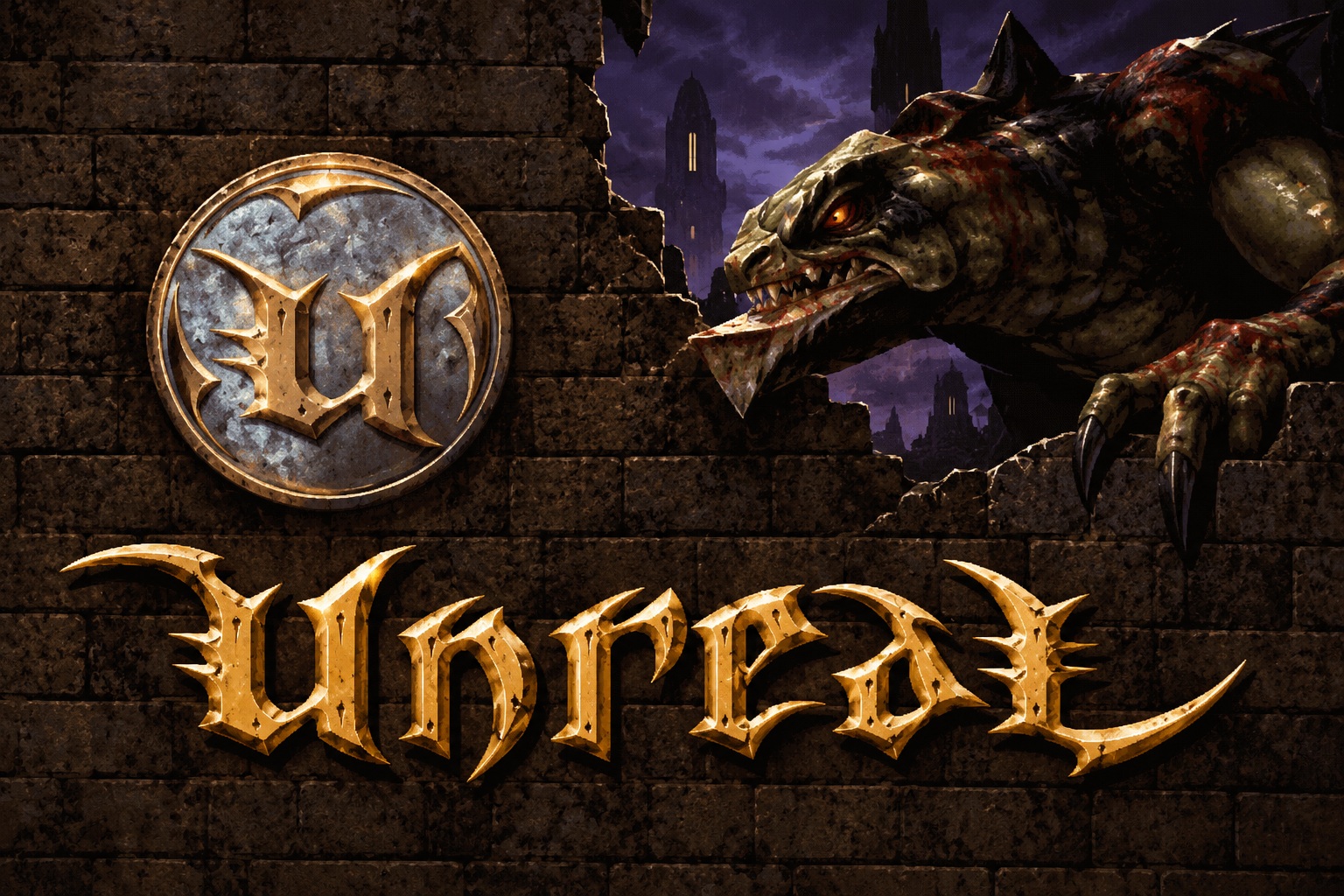
Unreal is a landmark 1998 first-person shooter from Epic MegaGames and Digital Extremes that combines fast combat with an unusually strong sense of exploration. Players take the role of Prisoner 849, a passenger aboard the prison transport Vortex Rikers when the ship crashes on the mysterious alien world of Na Pali. Escaping the wreckage begins a much larger journey through enormous temples, caves, villages, mines, industrial complexes, ancient ruins, floating structures, and alien strongholds. Along the way, the player gradually discovers the peaceful Nali population and the brutal occupation imposed by the technologically advanced Skaarj.
What separated Unreal from many shooters of the late 1990s was how much attention it gave to atmosphere between battles. The game frequently slows down long enough for players to walk through huge landscapes, inspect alien architecture, read messages left by inhabitants, discover hidden routes, and simply absorb the environment. One moment may involve fighting several Skaarj inside a dark corridor, while the next opens into a vast outdoor valley beneath a colourful alien sky. Combined with dynamic lighting, unusual architecture, reflective surfaces, ambient sound, and a memorable soundtrack, Na Pali feels like a place rather than a sequence of disconnected combat arenas.
Now playable online through Lemon Web Games, Unreal brings its classic first-person shooting, enormous alien environments, Skaarj encounters, Nali storyline, alternate-fire weapon system, exploration, secrets, and atmospheric journey across Na Pali directly into the web browser. Players can escape the Vortex Rikers, search ruined temples and alien facilities, collect an increasingly powerful arsenal, uncover the history of the planet, and fight their way toward the forces controlling the Nali. The campaign rewards curiosity because hidden areas frequently contain ammunition, armour, health, and other useful resources. For players who enjoy classic FPS action combined with genuine exploration, Unreal remains one of the most distinctive shooters of its era.
The Vortex Rikers Crash Begins the Journey
Unreal begins aboard the Vortex Rikers, a prison transport that has crashed violently onto Na Pali. Most of the crew and prisoners are already dead, leaving Prisoner 849 to search the damaged ship for a way out.
The opening immediately establishes the atmosphere. Emergency lighting, broken corridors, damaged equipment, and scattered bodies suggest that something went catastrophically wrong before the player fully understands the situation.
Leaving the wreck is one of the game's most memorable early moments because the environment suddenly opens from cramped metallic corridors into the alien landscape outside. It immediately communicates that Unreal is going to be much larger than the prison ship where it begins.
Na Pali Feels Like a Real Alien World
The planet is one of Unreal's greatest achievements. Rather than relying entirely on corridors and industrial rooms, the campaign constantly moves through dramatically different environments.
Players explore forests, rivers, caves, towering temples, settlements, mines, ancient ruins, spacecraft, research facilities, and vast outdoor areas. The architecture frequently looks unfamiliar enough to feel genuinely alien without becoming impossible to navigate.
The world also appears connected through environmental storytelling. Nali villages, Skaarj machinery, religious structures, and abandoned facilities all suggest different cultures and histories coexisting on the same planet.
The Nali Give the World Emotional Weight
The Nali are the native inhabitants of Na Pali, a peaceful species that has been enslaved by the Skaarj. Players frequently discover their villages, temples, writings, and imprisoned people throughout the campaign.
They are not simply background decoration. Their presence explains much of what the player sees and gives the conflict a stronger purpose than simply surviving another enemy encounter.
Messages left around the world describe fear, religious beliefs, suffering, and resistance. Reading them gradually creates a picture of what happened before Prisoner 849 arrived.
The Skaarj Are More Than Ordinary Shooter Enemies
The Skaarj quickly became one of Unreal's most recognizable enemy types because they behave very differently from simple targets that stand still and fire.
They can strafe, dodge projectiles, close distance rapidly, retreat, and respond aggressively to the player's movement. Some encounters feel almost like duels rather than ordinary firefights.
Their intelligence makes slower projectile weapons especially interesting. Firing directly at a moving Skaarj may cause it to dodge, encouraging players to predict movement or use splash damage instead.
Enemy Variety Keeps Combat Interesting
Na Pali contains much more than Skaarj warriors. Players encounter creatures such as Brutes, Krall, Gasbags, Slith, Tentacles, Pupae, and other hostile species.
Each behaves differently enough that weapon choice matters. Small fast creatures require a different response from large heavily armoured enemies, while flying targets can make slow projectiles difficult to use.
This variety prevents the campaign from relying on one universal combat strategy. Players are constantly adapting to whatever the next location contains.
The Dispersion Pistol Is More Useful Than It Looks
The Dispersion Pistol is the first weapon obtained and initially appears relatively modest. However, it can be upgraded throughout the campaign, gradually becoming much more capable.
Its rechargeable nature also makes it useful when ammunition for stronger weapons becomes scarce. Players who dismiss it completely may overlook a dependable backup weapon.
The pistol introduces one of Unreal's defining ideas immediately: weapons often have more depth than their basic appearance suggests.
The Automag Provides Reliable Conventional Firepower
The Automag works as a straightforward ballistic weapon and becomes a dependable option during many early and mid-game encounters.
Its accuracy makes it useful against enemies that do not justify wasting heavier ammunition. The weapon also demonstrates how different firing modes can change the way a familiar gun behaves.
Unreal rarely gives players a weapon that becomes completely meaningless once something stronger appears. Ammunition availability and enemy behaviour keep older equipment relevant.
The Stinger Delivers Rapid Crystal Fire
The Stinger fires fast crystal shards and is particularly effective when sustained fire is needed.
Its alternate firing mode changes the spread and rate of attack, making it useful at different ranges. Against groups or larger targets, the weapon can deliver substantial pressure.
The unusual crystal-based design also contributes to Unreal's alien technology aesthetic. The arsenal rarely feels like a simple collection of ordinary military weapons.
The ASMD Shock Rifle Became Legendary
The ASMD Shock Rifle is one of the most famous weapons associated with the Unreal series. Its primary fire produces an instant energy beam, while alternate fire launches a slower energy sphere.
The real brilliance appears when both modes are combined. Shooting the moving energy sphere with the primary beam creates a powerful Shock Combo explosion.
This mechanic rewards both accuracy and creativity. The Shock Rifle is not merely powerful; it gives skilled players a completely different way to control space during combat.
The Eightball Gun Combines Rockets and Grenades
The Eightball Gun functions as a versatile heavy weapon capable of launching rockets or grenades depending on the firing mode.
Players can also load multiple rockets before releasing them, producing devastating bursts against strong enemies or clustered targets. The trade-off is ammunition consumption and the risk of damaging yourself at close range.
Its flexibility makes it one of the most useful weapons in the game. Direct fire, splash damage, and arcing grenades all become available through one weapon.
The Flak Cannon Turns Close Combat Into Chaos
The Flak Cannon is another weapon that became iconic throughout the Unreal franchise. Its primary fire launches a spread of hot metal fragments that can ricochet from surfaces, making it devastating at close range.
Alternate fire launches an explosive flak shell that arcs through the environment before detonating. This makes the weapon effective beyond short-range engagements as well.
The combination is especially useful in confined spaces where ricocheting fragments can continue damaging enemies even after the initial shot.
The Razorjack Rewards Precision
The Razorjack launches spinning blades that can bounce around the environment and deal heavy damage.
Its projectiles make corridors and enclosed rooms particularly interesting because blades can ricochet from surfaces. Skilled players can use those rebounds to hit enemies that are not directly visible.
It is a risky but satisfying weapon, especially when a carefully aimed blade produces an immediate kill.
The GES BioRifle Controls Space
The BioRifle fires unstable green biological material rather than conventional ammunition.
Primary fire launches smaller blobs, while alternate fire allows a larger mass to be charged before release. The resulting material can stick around long enough to create dangerous areas that enemies must cross.
This makes the BioRifle useful for more than direct damage. Players can effectively turn parts of the environment into temporary traps.
Alternate Fire Gives the Arsenal Unusual Depth
One of Unreal's most influential weapon ideas is the widespread use of secondary firing modes. Most weapons are effectively two tools in one.
A firearm that seems mediocre in primary mode may become extremely useful when its alternate attack is understood. Some weapons even allow both modes to interact.
This gives the arsenal far more tactical variety than a simple progression from weak gun to strong gun. Learning each weapon becomes part of mastering the game.
Exploration Is Just as Important as Shooting
Unreal frequently hides useful resources away from the obvious route. Side passages, ledges, underwater areas, vents, and suspicious architecture can contain valuable pickups.
Exploring carefully can reveal armour, ammunition, health, and other supplies that make later encounters significantly easier. Secret areas also reward players who study the level rather than simply following the main path.
The campaign therefore encourages curiosity without forcing it. Players can continue toward the objective, but investigating unusual spaces often pays off.
Large Levels Make Navigation Part of the Adventure
Many locations are considerably larger than the compact arenas found in contemporary shooters. The player may travel through several connected structures before discovering how they relate to one another.
Switches can open distant doors, lifts can connect different floors, and underwater routes may reveal completely new areas. Navigation therefore becomes part of the challenge.
The large scale also helps Na Pali feel convincing. Players are travelling through actual settlements and complexes rather than rooms designed only around enemy placement.
Dynamic Lighting Was a Major Technical Showcase
Unreal became famous partly because its engine produced visual effects that were remarkable in 1998. Coloured lighting, shadows, glowing energy, reflections, fog, and atmospheric effects appeared throughout the campaign.
Lighting is often used to establish mood rather than simply illuminate the environment. A dark hallway filled with pulsing coloured lights can immediately feel dangerous before any enemy appears.
These effects helped establish Unreal Engine as a major technology platform. The engine would eventually become far more influential than the original game itself.
Outdoor Areas Were Particularly Impressive
Leaving an interior structure and stepping into a huge open landscape was one of Unreal's most memorable technical tricks.
Mountains, skies, rivers, architecture, and distant scenery gave the impression of exploring spaces far larger than typical FPS levels of the period.
These areas were not merely visual showcases. Enemies, hidden routes, water, vertical terrain, and distant landmarks made them genuine gameplay environments.
The Soundtrack Gives Na Pali Its Identity
Unreal's music combines atmospheric electronic tracks with more energetic combat themes. The soundtrack changes naturally as players move between exploration and danger.
Quiet environments can feel mysterious or lonely, while battles suddenly become much more intense once the music shifts.
Several tracks remain strongly associated with specific locations. The music helps Na Pali feel emotionally distinct rather than simply visually impressive.
Environmental Audio Creates Constant Atmosphere
The game also makes strong use of ambient sound. Wind, water, machinery, animals, distant creatures, and strange alien noises fill the environments.
These sounds make quiet exploration feel active even when no enemy is visible. Players often hear something before they understand what produced it.
This creates natural tension. The world never feels completely empty, even in isolated areas.
Messages Reveal the Story Without Constant Cutscenes
Much of Unreal's narrative is delivered through text messages, logs, signs, and environmental clues.
These provide information about Nali culture, Skaarj activity, previous expeditions, imprisoned inhabitants, and events inside specific locations.
The approach allows players to engage with the story at their own pace. Those who want pure action can continue moving, while curious players can uncover far more context.
The Game Rarely Interrupts Exploration
Unreal uses relatively few long cinematic interruptions compared with many later shooters.
The player remains in control through most of the journey, allowing environments themselves to communicate scale and atmosphere.
This makes the adventure feel continuous. Prisoner 849 is not being transported between unrelated missions; the player feels as though they are physically travelling across Na Pali.
Health and Armour Encourage Careful Play
Enemies can deal substantial damage, especially on harder difficulties. Health pickups and armour therefore become important resources.
Entering an unknown area with low health can make even an ordinary encounter dangerous. Thorough exploration can provide enough supplies to avoid that problem.
The game rewards players who preserve resources rather than relying entirely on aggressive rushing.
Water Is Frequently Part of the Level Design
Swimming plays a surprisingly significant role throughout the campaign.
Underwater tunnels can provide routes between locations, while lakes and flooded areas may hide secrets or important objectives. Players need to monitor air while exploring deeper sections.
Water therefore functions as genuine level space rather than simple decoration. Some of Unreal's more memorable discoveries are hidden beneath the surface.
Verticality Makes Environments Feel Larger
Levels frequently extend above and below the player's initial route. Towers, lifts, cliffs, bridges, pits, and underground tunnels create substantial vertical movement.
Enemies can attack from elevated positions, while useful pickups may be visible long before the player understands how to reach them.
This layered design encourages players to look upward and downward instead of treating every environment like a flat maze.
The Translator Helps Explain the World
Prisoner 849 carries a Universal Translator capable of reading messages encountered throughout Na Pali.
This device provides context for signs, logs, and Nali writing without requiring traditional dialogue scenes.
The Translator becomes one of the player's most important storytelling tools. It quietly turns scattered text into a larger historical record of the planet.
Boss Encounters Provide Major Milestones
While much of Unreal focuses on exploration and regular combat, several larger encounters provide dramatic peaks in difficulty.
These battles test weapon knowledge, movement, resource management, and the player's understanding of enemy behaviour.
Large enemies also reinforce the scale of the alien world. Prisoner 849 is clearly not the most powerful creature on Na Pali and survives primarily through skill and persistence.
Playing Unreal Online Today
Through Lemon Web Games, Unreal can now be played directly in your web browser with no downloads or setup required. Features of the web-based version include:
New players should explore beyond the obvious route whenever possible. Unreal frequently places useful equipment and ammunition inside optional areas, and those resources can make difficult encounters considerably easier. Pay attention to unusual architecture, water routes, ledges, and sections that look deliberately accessible.
It is also worth learning both firing modes for every weapon. Alternate fire is not merely a novelty; several weapons become dramatically more useful once their secondary functions are understood. The Shock Rifle in particular demonstrates how combining both modes can transform a weapon completely.
Who Should Play Unreal
Unreal is particularly suitable for players who enjoy FPS games that allow time to explore between firefights. The campaign frequently creates quiet stretches where atmosphere and environmental discovery become just as important as shooting.
It should also appeal to players interested in technological history. Many of the lighting, environmental, and rendering techniques showcased here helped establish Unreal Engine as one of the most important technologies in gaming.
Play Unreal Online Now
Unreal begins inside a destroyed prison ship and gradually opens into one of the most memorable alien worlds of the 1990s. Escape the Vortex Rikers, explore Na Pali, discover the fate of the Nali, fight Skaarj warriors and hostile creatures, collect increasingly powerful weapons, uncover hidden areas, and travel deeper into the forces controlling the planet.
Through Lemon Web Games, players can experience Unreal directly in the browser and revisit the game that helped establish Epic's technology and design legacy. The combat remains fast, the arsenal remains creative, and Na Pali still feels unusually atmospheric compared with many shooters built around far more modern technology.
Final Thoughts
Unreal remains important because it proved that a first-person shooter could deliver both intense combat and a genuine sense of place. Na Pali is not merely a backdrop for enemies; it contains villages, temples, wildlife, waterways, ruins, industrial structures, and histories that players can discover simply by exploring. The quieter moments make the violent encounters feel more meaningful because the world surrounding them appears worth understanding.
Its weapons are equally memorable. Alternate-fire modes, Shock Combos, ricocheting Flak, charged rockets, biological traps, and bouncing Razorjack blades give players far more tactical flexibility than the simple weapon ladders used by many shooters of the era. Combined with agile Skaarj opponents, these systems create battles that remain engaging decades later.
Through Lemon Web Games, Unreal can now be enjoyed directly in the browser as one of the defining PC shooters of 1998. Its technology was groundbreaking, but the game remains compelling for reasons beyond graphics: enormous environments, atmospheric music, intelligent enemies, creative weapons, and the unforgettable feeling of stepping out of the Vortex Rikers and seeing Na Pali for the first time.











Comments 0