

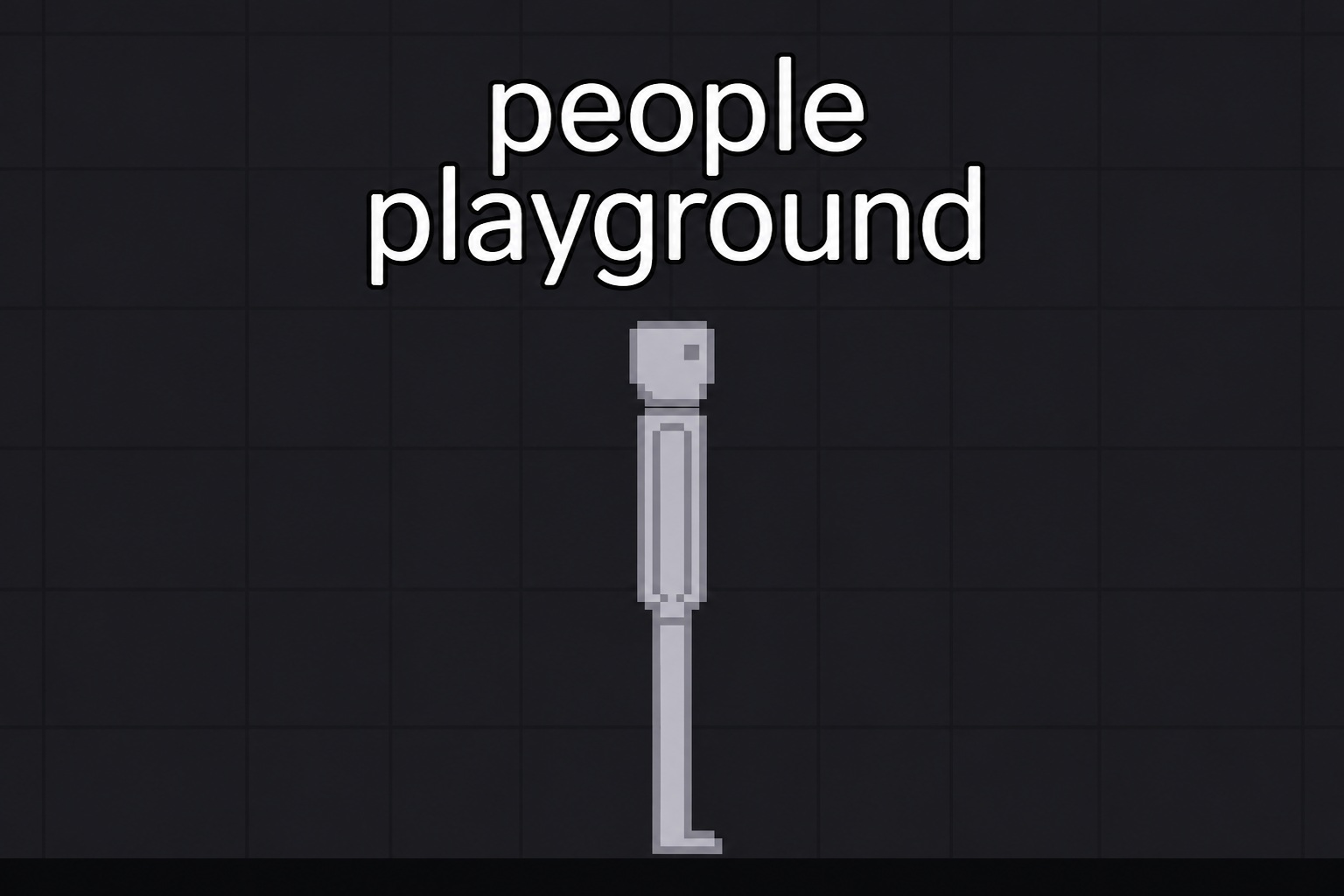
People Playground is a physics-driven sandbox built around one simple idea: give players a large collection of interactive objects, remove almost every traditional objective, and let experimentation become the game. Human ragdolls, firearms, explosives, vehicles, mechanical components, medical equipment, electrical devices, liquids, ropes, cables, thrusters, pistons, and countless other objects can be spawned freely and combined however the player wants. One session might involve building a functioning machine, while the next becomes an elaborate test of destruction, engineering, or completely ridiculous physics. There is no campaign telling players what must happen next, which means creativity becomes the main source of progression.
What makes People Playground especially compelling is how deeply objects interact with one another. Characters respond to impacts, heat, electricity, bleeding, broken limbs, explosions, and environmental forces, while machines can be activated, connected, powered, suspended, launched, or combined into larger systems. Even relatively simple experiments can produce unexpected results because the physics simulation is constantly affecting everything on screen. The game is therefore equally comfortable as an engineering sandbox, ragdoll simulator, destruction playground, or digital laboratory for players who simply enjoy asking, "What happens if I connect these two things together?"
Now playable online through Lemon Web Games, People Playground brings its physics experimentation, ragdoll simulation, machinery, vehicles, explosives, electrical systems, and open-ended creativity directly into the web browser. Players can spawn objects freely, construct mechanical devices, test weapons, create vehicles, connect electrical components, and experiment with complex interactions without being forced toward a predetermined goal. The sandbox structure makes it suitable for quick experiments or much longer construction sessions. Whether the objective is building something functional or deliberately discovering how spectacularly it can fail, People Playground provides the tools and leaves the rest entirely to the player.
A Sandbox With No Traditional Objective
People Playground does not begin with a mission briefing, story sequence, or list of required tasks. The player is placed inside an empty environment and given access to a huge collection of objects. What happens afterward depends entirely on curiosity.
This freedom distinguishes the game from conventional simulations. There is no score measuring whether a machine is efficient and no campaign demanding that specific constructions be completed. A successful session can mean building something impressive, testing a strange idea, or simply creating an entertaining chain reaction.
The absence of objectives also makes experimentation feel safer. A failed construction does not waste campaign progress. Players can delete everything, start again, and immediately try another approach.
Human Ragdolls React to the Environment
Human characters are among the most recognizable objects in People Playground because their bodies respond dynamically to physical forces. They can fall, collide, be pushed, suspended, thrown, burned, electrocuted, or placed inside machinery. Their joints and limbs react according to the forces applied.
The simulation goes beyond simple ragdoll movement. Characters can suffer bleeding, damaged limbs, burns, unconsciousness, and other conditions depending on what happens to them. Different injuries affect how the body behaves afterward.
This detailed response system makes human characters useful for testing almost anything the player creates. A machine can be evaluated by seeing how it interacts with a ragdoll, while vehicles and traps become immediately more interesting when something can occupy them.
Physics Make Simple Experiments Unpredictable
Even basic objects can behave differently depending on speed, weight, angle, and surrounding forces. Dropping something from a small height may barely matter, while launching the same object at high velocity produces an entirely different result. Momentum is constantly influencing interactions.
This unpredictability is part of the appeal. Players may build a device expecting one outcome and discover that an unexpected collision changes everything. The simulation often creates results that feel more entertaining than the original plan.
Learning how objects respond gradually makes construction more deliberate. What initially feels chaotic begins to reveal understandable rules. Players become better engineers simply by experimenting.
Firearms Provide Immediate Destructive Testing
People Playground contains a wide range of weapons that can be used directly or incorporated into larger contraptions. Firearms provide one of the simplest ways to test the damage system because projectile impacts interact with bodies and other objects immediately. Different weapon types create different levels of force and destruction.
Weapons do not need to be used manually. They can be mounted onto machinery, connected to activation systems, or combined with moving platforms to create automated setups. A basic firearm can become one component inside a much larger machine.
This transforms weapons from isolated tools into building materials. The interesting question often becomes not what the gun can do by itself, but what happens when it is connected to everything else.
Explosives Turn Small Mistakes Into Huge Events
Explosives are naturally suited to a physics sandbox because they produce both damage and force. A detonation can send nearby objects flying, break constructions apart, ignite materials, and create chain reactions when several explosive devices are placed together.
The strength of the blast also allows players to test structural stability. A machine that works perfectly under normal conditions may completely collapse when exposed to an explosion. This makes destructive testing surprisingly entertaining.
Chain reactions are particularly satisfying. Carefully arranging explosives, fuel, moving objects, and triggers can create elaborate sequences that unfold automatically once activated.
Electrical Components Add Engineering Depth
Electricity introduces another major layer of experimentation. Objects can be connected through wires and cables, allowing energy to pass between different components. Motors, lights, activation devices, and other equipment can become parts of functional electrical systems.
This encourages players to think beyond simple physical construction. A machine may need both mechanical structure and electrical control before it behaves correctly. Designing the connections becomes as important as positioning the objects.
Electrical experimentation can also interact directly with characters and other systems. A power source may drive a machine while exposed electricity creates another hazard somewhere else. Several simulation layers can operate simultaneously.
Wires and Cables Connect the Sandbox Together
Connection tools are essential because they allow separate objects to become one functioning system. Ropes can suspend or restrain objects, while wires and cables can transfer signals or power. These connections make complex machines possible.
A platform might be attached to a piston, connected to a button, powered through an electrical system, and triggered only when another mechanism activates. None of the individual components are especially complicated, but combining them creates something much more interesting.
Learning how different connections behave is part of the creative process. Some builds require flexibility, while others need rigid support. Choosing the correct connection can determine whether the machine works or immediately collapses.
Pistons and Motors Create Moving Machines
Mechanical components allow constructions to move without constant player input. Pistons can push objects, motors can rotate assemblies, and powered components can create repeating motion. This opens the door to elevators, crushers, moving platforms, mechanical arms, and countless other designs.
The movement needs to be balanced carefully because physics still apply. A motor attached to an unstable structure may tear the machine apart instead of rotating it cleanly. Excessive force can be just as damaging as insufficient power.
This encourages iterative design. Build something, activate it, observe the failure, reinforce the weak section, and test again. Engineering becomes a gameplay loop.
Thrusters Make Almost Anything Capable of Flying
Thrusters provide one of the easiest ways to introduce propulsion. Attach enough of them to an object and it can quickly become airborne, although controlling what happens afterward is another matter entirely. Balance becomes critical.
Players can use thrusters to create rockets, flying platforms, experimental aircraft, or intentionally uncontrollable machines. Weight distribution determines whether the construction travels smoothly or spins wildly.
This makes propulsion experiments especially entertaining. Successful flight feels impressive, while failure often produces spectacular crashes. Either outcome can be worth watching.
Vehicles Expand the Possibilities
Vehicles provide ready-made moving platforms that can be used normally or heavily modified. Characters can be placed inside or attached to vehicles, while weapons, explosives, thrusters, and mechanical systems can be added around them.
A simple car can therefore become an armored machine, improvised rocket vehicle, mobile weapon platform, or physics experiment. The sandbox rarely limits what can be attached.
Vehicles also allow players to study collisions at different speeds. Crashing into walls, objects, or other vehicles demonstrates how momentum affects both the machine and anyone inside it.
Heat and Fire Create Another Simulation Layer
Objects can react to temperature, allowing fire and heat to spread through environments in ways that affect nearby materials and characters. Burning something is not always an instant effect; heat can continue influencing the surrounding scene.
This makes fire useful for longer experiments. Players can observe how a situation develops rather than only watching one immediate explosion. Flammable objects can create expanding problems.
Heat can also interact with other systems such as liquids, explosives, or machinery. One small ignition point may eventually affect an entire construction.
Liquids Add More Experimental Possibilities
People Playground includes liquids that can interact with characters and other objects. Some can be transferred, injected, stored, or used as part of medical and experimental setups. This adds another category of tools beyond ordinary mechanical objects.
Syringes and related equipment allow players to directly influence the condition of characters. Different substances can produce different effects, creating opportunities for medical experimentation as well as chaos.
These systems demonstrate how broad the sandbox can become. The game is not only about smashing objects together. It also allows much smaller and more controlled experiments.
Medical Tools Can Reverse Some Damage
Not every experiment needs to end with destruction. Medical equipment can sometimes stabilize, revive, or alter characters depending on their condition. This creates opportunities to test both injury and recovery.
A character can be subjected to one experiment, treated afterward, and then placed into another. The player can observe which damage is reversible and which consequences remain permanent.
This gives People Playground an unusual rhythm. Destruction and repair can exist inside the same session. Players are free to decide whether they are creating a laboratory or a disaster zone.
Automation Makes Complex Scenarios Possible
Activation systems allow machines to operate without constant manual control. Buttons, sensors, wires, and mechanical components can be connected so that one event triggers another. This makes automated contraptions possible.
A machine could activate a piston, move an object into position, trigger a firearm, and then start another mechanism afterward. Longer sequences become possible once players understand how signals move through the system.
Automation is where the sandbox begins feeling almost like programming through physical objects. The player defines rules through connections and then watches the machine execute them.
Building Functional Contraptions Is Surprisingly Rewarding
The chaotic side of People Playground attracts plenty of attention, but constructing something that actually works can be equally satisfying. Creating a stable elevator, functioning vehicle, mechanical arm, or automated machine requires understanding how several components interact.
The first version usually fails. Something bends, disconnects, fires in the wrong direction, or receives too much force. Fixing those problems becomes part of the enjoyment.
Successful constructions feel earned because the game rarely hides the physics behind automatic corrections. If the design works, it generally works because the player solved the underlying problem.
Failure Is Often More Entertaining Than Success
Physics sandboxes produce some of their best moments when carefully planned machines fail catastrophically. A vehicle may flip immediately, a rocket may launch sideways, or an automated device may destroy itself during activation.
These failures rarely feel frustrating because there is no penalty. Instead, they reveal information about the design while also creating unexpected entertainment.
This encourages players to take creative risks. There is no reason to build conservatively when failure simply creates another experiment. People Playground rewards curiosity more than perfection.
The Sandbox Encourages Improvised Challenges
Even without official objectives, players naturally invent their own. Can a machine move a character safely across the map? How much force can a structure survive? Can an automated system operate without manual intervention? How many components can be connected before something breaks?
These self-imposed challenges provide endless replay value. The game gives players tools rather than goals, allowing personal curiosity to generate the next activity.
This also means different players can use People Playground in completely different ways. One may focus on engineering, another on vehicles, while someone else spends most of the time experimenting with the damage simulation.
Large Maps Give Experiments Room to Expand
Open environments provide enough space for large constructions and high-speed tests. Players can separate different experimental areas or build machines far larger than anything required by a traditional game.
The available space becomes particularly useful for vehicles and propulsion systems. A rocket experiment needs room to travel before hitting something, while large chain reactions benefit from spreading across wider areas.
Maps effectively serve as empty laboratories. The objects placed inside determine what kind of experience the session becomes.
Mods Greatly Expand the Original Sandbox
People Playground became especially popular for its modding community. Additional objects, characters, weapons, vehicles, machinery, maps, and unusual experimental tools can dramatically expand what is possible beyond the original collection.
Modding works naturally with the sandbox structure because new objects do not need to fit into a traditional campaign. They simply become additional pieces available for experimentation.
This gives the game enormous long-term variety. A player can spend many hours exploring the standard tools and then completely transform the sandbox through community-created additions.
The Simple Visual Style Keeps Complex Scenes Readable
People Playground uses a relatively minimalist presentation that allows individual objects and characters to remain easy to identify even when the screen becomes crowded. This clarity is important when complex contraptions contain many connected parts.
Characters also use simplified designs that work well with the detailed physics. Players can immediately see how a body is positioned without elaborate animation obscuring the mechanics.
The straightforward visual style also allows destruction and machinery to become the main spectacle. The game does not need photorealistic graphics for physics interactions to feel convincing.
Detailed Damage Makes Every Experiment Feel Different
Characters respond differently depending on exactly where and how they are injured. Impacts, projectiles, crushing forces, fire, electricity, and explosions produce different results. This gives experiments more variation than a simple universal health bar would provide.
The same weapon can create dramatically different outcomes depending on angle and distance. Vehicle collisions similarly depend on speed and where the impact occurs.
This complexity encourages repeated testing. One experiment rarely demonstrates every possible result. Changing one variable can produce something completely different.
Slow Motion Helps Players Understand the Physics
When events become too fast to follow, slow-motion tools can make interactions easier to study. A complicated explosion or mechanical failure can be observed in greater detail rather than disappearing instantly.
This is especially useful when debugging machines. Players can identify exactly which connection failed first or which component caused the structure to become unstable.
Slow motion also turns destruction into spectacle. Watching a chain reaction unfold gradually reveals details that normal speed would hide. Observation becomes part of experimentation.
Pausing Lets Players Build Precise Setups
Complex scenes can be difficult to construct while physics remain active. Pausing the simulation allows objects to be positioned and connected without immediately falling or colliding. Once everything is prepared, the player can resume the world and see what happens.
This makes complicated engineering practical. Large mechanisms can be assembled carefully rather than fighting against gravity during construction.
The pause-and-release rhythm also creates anticipation. A carefully prepared experiment may take several minutes to build but only seconds to destroy itself once physics resume.
People Playground Is Essentially a Digital Laboratory
The most useful way to understand People Playground is not as a conventional game but as a laboratory containing systems that interact. Physics, damage, electricity, heat, liquids, machinery, and characters all behave according to rules that can be combined.
The player becomes both designer and observer. Create a scenario, activate it, inspect the result, and modify the setup. The process resembles experimentation more than traditional progression.
Because the game rarely dictates what should be tested, the laboratory can become serious or ridiculous depending entirely on the player. Scientific curiosity and pure chaos coexist comfortably.
Playing People Playground Online Today
Through Lemon Web Games, People Playground can now be played directly in your web browser with no downloads or setup required. Features of the web-based version include:
New players should begin with simple experiments rather than immediately attempting enormous machines. Spawn a few objects, test how connections behave, experiment with motors and pistons, and learn how weight influences movement. Understanding the basics makes ambitious constructions far easier later.
Once the core systems feel comfortable, combine them. Add electrical activation to mechanical devices, attach weapons to vehicles, use thrusters to create propulsion, or design automated sequences where one event triggers another. People Playground becomes far more interesting when systems begin interacting.
Who Should Play People Playground
People Playground is particularly suitable for players who enjoy asking questions and testing the answers themselves. What happens if additional thrusters are attached? Can this structure survive an explosion? Can a machine operate automatically? The game provides enough systems for those questions to continue almost indefinitely.
It is equally enjoyable for players who have no interest in careful engineering. The same tools can be used to create ridiculous crashes, destructive chain reactions, and intentionally unstable machines. There is no wrong way to use the sandbox.
Play People Playground Online Now
People Playground provides a collection of physics-driven tools and lets creativity determine what happens next. Spawn characters, vehicles, machinery, firearms, explosives, electrical components, liquids, medical equipment, ropes, thrusters, and countless other objects, then connect them into whatever experiment you can imagine. A simple setup can become surprisingly complex once different systems begin interacting.
Through Lemon Web Games, players can experience People Playground directly in a modern browser and move immediately between engineering, experimentation, destruction, and improvised challenges. There is no campaign demanding that one particular objective be completed. The sandbox is the objective, and every object exists primarily to become part of another experiment.
Final Thoughts
People Playground succeeds because it trusts players to create their own entertainment. Instead of constantly providing missions or rewards, it offers interacting systems and allows curiosity to do the rest. Physics determine movement, electrical components provide control, mechanical parts create motion, weapons introduce force, and characters respond dynamically to whatever happens around them. The combinations quickly become far more interesting than any one object individually.
Its greatest strength is the freedom to move between serious construction and complete chaos without changing games. A player can spend half an hour carefully engineering a functioning vehicle and then deliberately launch it into a wall simply to see how the physics respond. Failure is never wasted because even a broken machine can produce an entertaining result.
Through Lemon Web Games, People Playground can be enjoyed directly in the browser as a creative physics sandbox where almost every session begins with a question. Build something useful, automate something complicated, test a strange interaction, or deliberately create a spectacular disaster. People Playground rarely tells you what to do—and that freedom is exactly why there is always something else worth trying.











Comments 0