

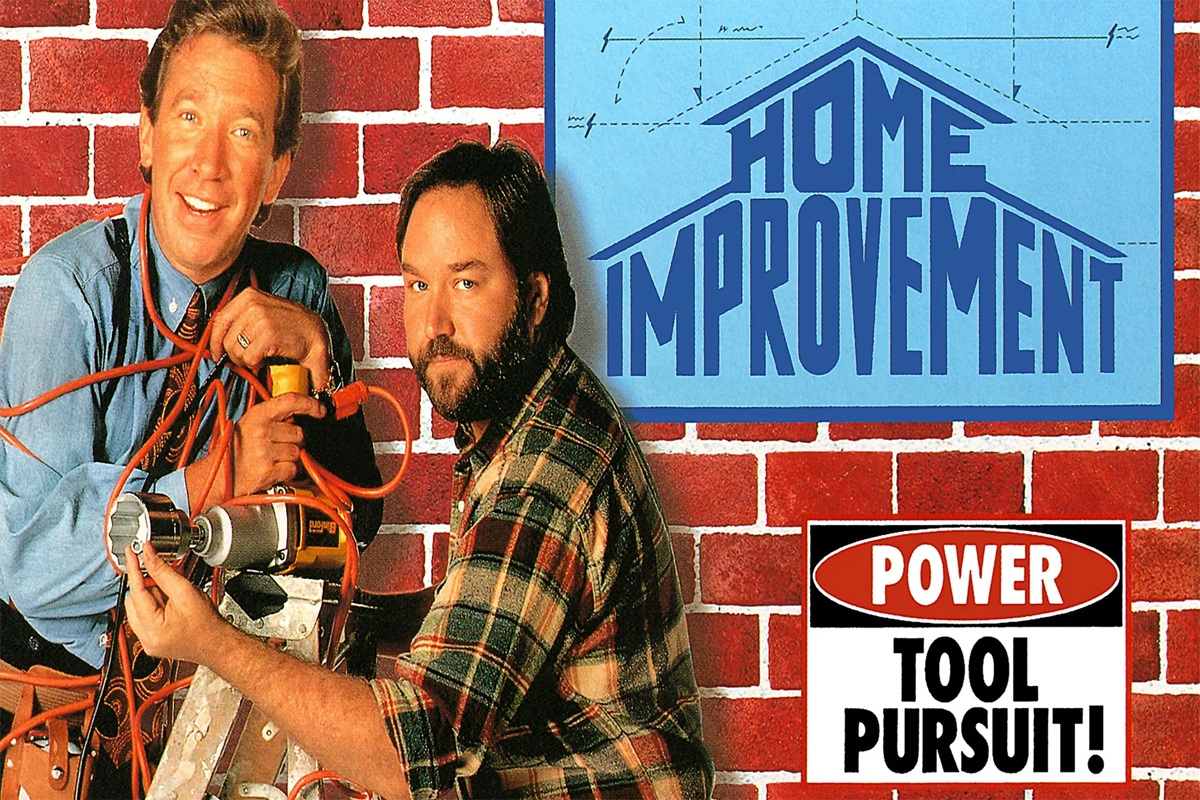
Home Improvement: Power Tool Pursuit! is one of those wonderfully strange licensed games that could only have emerged from the 1990s. Based on the enormously popular Home Improvement television sitcom, the game takes Tim "The Tool Man" Taylor away from household renovations and throws him into a side-scrolling action-platformer filled with dinosaurs, mummies, monsters, robots, and enough modified power tools to make even Tim question whether something has been given too much power. Released in 1994, the adventure turns the familiar Tool Time television set into the starting point for a journey across several increasingly ridiculous fictional studio productions. It may have an unusual premise, but underneath the television license is a surprisingly elaborate platformer focused on exploration, combat, and finding hidden objectives.
The story begins when Tim prepares to unveil the new Binford-Taylor Turbo Power Tool Line during a special episode of Tool Time. Unfortunately, the equipment disappears before the demonstration can begin, leaving behind a message directing Tim toward other television sets around the studio. Instead of calling security or simply replacing the tools, Tim naturally decides to investigate personally while carrying an arsenal of heavily modified hardware. His search takes him through Dinosaur Safari, the Temple of Tools, Monster Theater, and Lost on Mars, each filled with enemies and hazards that have somehow become very real.
Now playable online through Lemon Web Games, Home Improvement: Power Tool Pursuit! can be experienced directly in a modern web browser without needing the original console. Players can guide Tim through maze-like stages, hunt for missing tool crates, blast enemies with exaggerated power tools, break through walls and floors, and grapple toward hidden parts of each environment. The browser-based version provides a convenient way to revisit one of the more unusual television adaptations from the 16-bit era. Whether you remember Home Improvement from its original television run or simply enjoy strange licensed games from the 1990s, this is certainly an adventure that stands apart from more conventional platformers.
From Tool Time to an Unexpected Adventure
The game makes clever use of the Tool Time television setting to justify its bizarre collection of environments. Rather than claiming Tim has somehow travelled through time, visited Mars, and entered a monster-infested temple in reality, the adventure sends him through neighboring studio sets where other productions are supposedly being filmed. The concept allows the developers to place Tim inside almost any environment without worrying too much about logical continuity. Dinosaurs, ancient ruins, horror creatures, and futuristic machines can all exist within the same game because each world represents a different fictional television production.
Al Borland appears alongside Tim during the introductory sequences, maintaining the connection to the television series. However, once the actual platforming begins, Tim becomes an unlikely action hero who bears little resemblance to the accident-prone handyman viewers normally saw on television. He jumps across dangerous pits, operates destructive weapons, battles prehistoric creatures, and survives situations that would probably end Tool Time permanently. The exaggerated premise fits the show's running joke that Tim believes virtually every tool can be improved by adding "more power."
The storyline itself remains deliberately simple. Tim needs to recover the missing Binford equipment, and each world brings him closer to completing that objective. There are no complicated conversations or lengthy cinematic sequences interrupting the action. The game knows that its central attraction is the absurd idea of Tim Taylor fighting through dangerous television sets with weaponized tools, and it commits fully to that idea.
A Platformer Built Around Exploration
Although Home Improvement initially looks like a straightforward side-scrolling action game, its stages are significantly more exploratory than simply walking from left to right. Each level contains several crates holding pieces of the missing power tool equipment, and Tim must locate the required crates before completing the stage. These objectives can be scattered across large multi-level environments containing ladders, platforms, destructible surfaces, hidden pathways, and numerous dead ends. Finding the exit is only useful after the important equipment has been recovered.
This structure means players frequently need to explore upward, downward, and backward rather than continuously travelling toward the right side of the screen. Missing a route can result in substantial backtracking, particularly in later stages where the environments become larger and more complicated. The level layouts therefore feel closer to compact action mazes than conventional linear platforming courses. Players who pay attention to landmarks will generally have an easier time remembering which sections have already been searched.
The game does offer a useful navigation feature when players become stuck. Remaining stationary for a short period can provide an indication of where an undiscovered crate is located. It does not completely solve the maze-like nature of the environments, but it helps prevent the search from becoming entirely directionless. Knowing where the objective lies and actually figuring out how to reach it can still be two very different challenges.
A Tool Collection Designed for Maximum Power
The most entertaining part of the combat system is Tim's ridiculous collection of modified tools. Rather than using conventional firearms, swords, or magical attacks, he carries equipment inspired by the hardware associated with Tool Time. Some tools function as weapons, while others are essential for navigating the environment. The result gives the gameplay an identity directly connected to the television series.
Tim begins with a nail gun that fires rapidly toward enemies and serves as a reliable general-purpose weapon. Other offensive tools include a blowtorch that functions almost like a flamethrower and an arc welder capable of producing electrical attacks. The chainsaw takes the idea even further by sending destructive energy waves across the screen rather than simply cutting objects at close range. Dynamite provides another option when players need something considerably more explosive.
Tim can generally carry one primary collected weapon at a time, so finding another tool can change how he handles nearby enemies. Different weapons vary in range, attack pattern, and usefulness depending on the situation. Some can also be aimed diagonally, which becomes particularly valuable when enemies occupy elevated or lower platforms. Experimenting with each tool is part of learning how to survive the increasingly hostile studio sets.
Breaking Through Walls and Floors
Not every tool is designed primarily for combat. Tim also carries specialized equipment that allows him to interact with specific parts of the level design. A sledgehammer can smash through weakened walls, revealing passages that would otherwise remain inaccessible. The jackhammer performs a similar function downward, breaking through certain floor sections and allowing Tim to descend into lower areas.
These tools make exploration more involved because seemingly solid surfaces can hide alternative routes. Players need to identify which parts of the environment are breakable and remember where unexplored areas might exist. A missing crate may be located behind a wall or beneath a floor rather than somewhere along an obvious platforming route. This reinforces the game's emphasis on searching thoroughly rather than simply moving forward.
The interaction between utility tools and level design gives Home Improvement more personality than a platformer where every obstacle is solved through jumping. Tim is supposed to be obsessed with hardware, so using heavy tools to physically reshape parts of the environment feels appropriate. It also provides a satisfying moment whenever smashing through an apparently ordinary wall reveals exactly the route the player has been searching for.
The Grappling Hook Adds Vertical Exploration
The grappling hook is one of Tim's most useful navigation tools. It allows him to attach to suitable surfaces and move toward areas that cannot be reached through normal jumping. Stages frequently use vertical space, making the grappling mechanic essential when important crates are hidden above or across dangerous gaps. Players who forget to consider the grappling hook can easily overlook entire sections of a level.
Using the hook also changes the rhythm of movement. Instead of approaching every obstacle as a standard platforming jump, players need to look for places where Tim can attach and reposition himself. Certain areas involve raising or lowering him carefully, while others use the grappling mechanic to cross open space. Accurate positioning becomes increasingly important as hazards appear around the destination.
Combined with the sledgehammer and jackhammer, the grappling hook makes Tim feel more like an explorer equipped with a utility belt than a conventional platforming hero. His tools are not merely visual jokes based on the television series; several directly affect how the player moves through each environment. This integration is one of the game's more interesting design choices.
Dinosaur Safari Starts the Chaos
Dinosaur Safari provides the first major environment and immediately establishes that Home Improvement is not going to resemble a normal television sitcom adaptation. Tim moves through prehistoric scenery populated by dinosaurs, insects, and other hostile creatures that apparently have no interest in respecting studio safety regulations. Platforms, vegetation, rocky terrain, and dangerous gaps introduce players to the basic structure of the game. The setting also provides an amusing contrast with Tim's modern power-tool arsenal.
The early stages introduce the crate-hunting objective while gradually teaching players how to use Tim's movement and utility tools. Enemies are already aggressive enough to punish careless movement, but the layouts are more manageable than those encountered later. It is an effective environment for learning how the game's exploration works. Players quickly discover that searching above and below the obvious route is essential.
Dinosaur Safari also demonstrates the game's willingness to embrace complete absurdity. Nothing about Tim Taylor fighting dinosaurs with a nail gun needs to make sense, and the game never attempts to justify it beyond the television-set premise. That ridiculousness gives the adventure much of its charm. It feels like someone took one of Tim's exaggerated Tool Time fantasies and turned it into an entire video game.
The Temple of Tools Brings Ancient Dangers
The Temple of Tools changes the atmosphere significantly by moving Tim into an ancient environment filled with stone structures, traps, and supernatural enemies. Mummies and other creatures replace many of the prehistoric threats from the first world. Some enemies attack from awkward positions or use projectiles, making vertical awareness increasingly important. The environment also becomes more maze-like as hidden routes and destructible surfaces become more common.
This world places greater emphasis on recognizing how Tim's utility tools interact with the scenery. Weak walls and floors may conceal sections needed to locate the remaining crates. Players who simply follow visible platforms can easily reach a dead end without completing the objective. The sledgehammer, jackhammer, and grappling hook become increasingly important as the layouts grow more complicated.
The temple setting also fits surprisingly well with the treasure-hunting structure of the game. Searching through ancient corridors for missing equipment creates a strange mixture of archaeology and hardware repair. It is another example of the developers using the television studio concept to introduce a completely different visual theme without changing the fundamental objective. By this point, the adventure has clearly established that almost anything can appear behind the next studio door.
Monster Theater Turns Toward Horror
Monster Theater embraces classic horror imagery, filling its environments with ghosts, bats, monsters, and other supernatural threats. Darker backgrounds and more ominous scenery create a noticeable contrast with the brighter Dinosaur Safari stages. Tim's absurd power tools remain completely unchanged, producing the amusing sight of a sitcom handyman fighting supernatural creatures with construction equipment. The combination is strange enough to become memorable.
Enemy placement becomes increasingly demanding as the game progresses. Flying creatures can attack from above while ground-based enemies pressure Tim from below, requiring players to make better use of diagonal attacks and movement. Narrow platforms and complicated layouts make avoiding damage more difficult. Choosing a useful weapon becomes increasingly important when enemies approach from multiple directions.
The world also continues expanding the exploration mechanics. Hidden passages, destructible blocks, and vertically stacked areas encourage players to search thoroughly before assuming a section is complete. Because the number of objectives increases as the adventure progresses, later worlds naturally require more extensive exploration. Monster Theater therefore combines greater combat pressure with more complicated navigation.
Lost on Mars Takes Tim into the Future
Lost on Mars provides the final major environment and moves the adventure from supernatural horror into science fiction. Mechanical structures, futuristic hazards, and robot sentries replace the monsters and ancient creatures seen earlier. By this stage, players are expected to understand the full range of Tim's movement, weapons, and utility tools. The levels can therefore combine these mechanics more aggressively.
Robot enemies naturally fit the technological environment and can be dangerous when combined with moving platforms or narrow passages. Tim's ranged weapons become particularly useful when approaching threats positioned across difficult terrain. Meanwhile, destructible walls and floors continue hiding routes needed to recover the remaining equipment. Players must use everything they have learned throughout the previous worlds.
The science-fiction setting is perhaps the most absurd location of the entire game, which makes it an appropriate finale for Tim's increasingly ridiculous journey. The adventure has progressed from dinosaurs to ancient mummies, monsters, and eventually robots on Mars without ever leaving the general premise of television production sets. It is exactly the kind of escalating nonsense that makes the game memorable. By the final stages, Home Improvement has effectively transformed into a full action-adventure parody of its own source material.
Boss Battles Cap Each Major World
Each major world eventually leads to a larger boss encounter. These enemies are significantly tougher than the ordinary creatures scattered throughout the stages and usually require players to understand attack patterns rather than simply firing continuously. Movement becomes particularly important because the bosses can cover large portions of the available area. Choosing the right moments to attack is safer than standing still and relying on raw firepower.
The exaggerated bosses fit the unusual environments surrounding them. Dinosaur Safari naturally provides prehistoric threats, while later worlds introduce opponents appropriate to their supernatural or technological themes. Defeating them provides a clear sense of progression and signals that Tim is ready to move into another television set. These battles help break up the longer stretches of exploration.
Boss encounters also highlight the usefulness of Tim's offensive equipment. A weapon that feels unnecessary against ordinary enemies can become significantly more valuable when fighting something much larger. Understanding attack range and projectile behavior makes the encounters easier. The combat system is relatively straightforward, but the bosses provide satisfying opportunities to put Tim's oversized arsenal to work.
A Surprisingly Tough Licensed Platformer
Home Improvement: Power Tool Pursuit! can be more challenging than its sitcom origins might suggest. Enemies frequently appear near platforms and environmental hazards, creating situations where a single mistake can lead to several additional problems. Tim's movement has a certain weight to it, so players need to become familiar with the distance and timing of his jumps. Later levels demand increasingly precise navigation.
The crate-searching structure contributes another type of difficulty. Reaching what appears to be the end of a level does not matter if an objective has been missed somewhere behind. Players can spend considerable time retracing their route through large environments while searching for a crate or hidden passage. Learning the visual language of breakable walls and alternate routes becomes almost as important as mastering combat.
The game therefore rewards patience more than reckless speed. Moving carefully, checking suspicious surfaces, and remembering unexplored routes generally produces better results than rushing forward. This is especially true in later worlds where enemies and environmental hazards become more aggressive. Players expecting a simple children's platformer based on a television sitcom may be surprised by how much persistence some stages demand.
The Famous "Real Men Don't Need Instructions" Joke
One of the most remembered pieces of Home Improvement: Power Tool Pursuit! actually exists outside the main gameplay. The original packaging leaned heavily into Tim Taylor's exaggerated macho attitude toward tools and instructions. The manual famously presented the joke that "Real Men Don't Need Instructions," fitting perfectly with the television character's tendency to believe confidence and additional horsepower could solve almost anything. It became one of the game's most frequently remembered pieces of trivia.
The joke did not mean players were completely abandoned without help. The original package also included blueprint-style material containing useful gameplay information and hints. Still, the decision to turn the instruction manual itself into a Home Improvement gag was unusual enough to become part of the game's identity. It is a good example of a physical game package extending the humor of the television series beyond what appeared on the screen.
From a modern perspective, the joke is also amusing because Power Tool Pursuit! is exactly the kind of game where instructions would be useful. Tim has multiple weapons, utility tools, hidden objectives, destructible surfaces, and maze-like stages that are not immediately obvious to a new player. Figuring everything out through experimentation can take time. In a strange way, the packaging joke makes the learning curve even more memorable.
Colorful 16-Bit Graphics and Unusual Environments
Visually, Home Improvement uses detailed sprite artwork and large environments that make each television set feel noticeably different. Tim is immediately recognizable through his work clothes and exaggerated animations, while enemies are large enough to remain clear during combat. Backgrounds contain enough visual detail to reinforce the theme of each world without overwhelming the platforming elements. For a licensed platformer from 1994, the presentation is surprisingly ambitious.
Enemy design changes substantially between worlds. Dinosaurs dominate the prehistoric areas, mummies and ancient creatures appear within the temple, supernatural enemies populate Monster Theater, and machines take over once Tim reaches Mars. These changes help prevent the adventure from looking completely repetitive even when the underlying objective remains similar. Each television set creates a new excuse for increasingly bizarre opponents.
Weapon effects also contribute to the game's personality. Nails, flames, electricity, explosives, and energy waves make Tim look less like a handyman and more like someone who has accidentally constructed an arsenal. The exaggerated effects fit the humor of Home Improvement while giving combat clear visual feedback. There is something inherently amusing about seeing Tim Taylor defeat a dinosaur using an overpowered piece of hardware.
Why Power Tool Pursuit! Remains So Memorable
Home Improvement: Power Tool Pursuit! is memorable partly because it is such an unlikely adaptation. A family sitcom about home renovation and suburban life does not naturally suggest an action-platforming game filled with monsters and science-fiction environments. Instead of struggling to recreate ordinary episodes from the television show, the developers embraced Tim Taylor's obsession with power tools and built an absurd adventure around it. The result makes very little realistic sense but works surprisingly well as a video game premise.
The exploration mechanics also give it more substance than might be expected from a simple television license. Searching for crates, smashing through hidden walls, drilling through floors, grappling toward elevated platforms, and choosing between different weapons create a relatively broad set of mechanics. The maze-like stages can occasionally become frustrating, but they encourage players to engage with the entire environment rather than simply sprint toward an exit. This helps the game establish an identity beyond its Home Improvement branding.
Its peculiar combination of licensed humor and genuine platforming challenge has also helped it become a curiosity among retro gaming fans. Many licensed games from the 16-bit era have faded into obscurity, but Power Tool Pursuit! continues to attract attention precisely because its concept is so unusual. Tim Taylor fighting dinosaurs and robots with weaponized construction equipment is difficult to forget. Even players with no attachment to the television series can appreciate the sheer strangeness of the experience.
Playing Home Improvement: Power Tool Pursuit! Online Today
Through Lemon Web Games, Home Improvement: Power Tool Pursuit! can now be played directly in your web browser with no downloads or setup required. Features of the web-based version include:
Playing Power Tool Pursuit! through a browser makes it easy to experience one of the stranger licensed games from the 16-bit era without searching for the original cartridge. The controls initially take some adjustment because Tim has more abilities than a typical platforming character, particularly once utility tools are incorporated into exploration. However, learning how to break through walls, descend through floors, and grapple toward otherwise inaccessible routes makes the level design significantly easier to understand. The game becomes much more enjoyable once players recognize that exploration is just as important as combat.
For returning players, the browser-based version provides an opportunity to revisit a game that may be remembered as much for its bizarre concept as for its actual mechanics. Newcomers can meanwhile discover that there is more here than a joke based on a 1990s sitcom. The stages are surprisingly large, Tim's tools genuinely affect exploration, and the four worlds provide plenty of visual variety. It remains unconventional, occasionally frustrating, and undeniably memorable.
Who Should Play Home Improvement: Power Tool Pursuit!
Power Tool Pursuit! is particularly suitable for players who enjoy platformers that require more exploration than simply moving toward the right side of the screen. Locating every crate often means searching vertical routes, returning to earlier sections, and identifying walls or floors that can be destroyed with the correct tool. The grappling hook adds another layer by making some routes dependent on careful positioning rather than ordinary jumping. Players who enjoy discovering how a level fits together will likely appreciate this structure more than those who prefer completely linear stages.
It is also worth trying simply because there are very few games quite like it. Home Improvement was never an obvious candidate for an action-platformer, and the developers solved that problem by creating something almost completely disconnected from ordinary sitcom life. Tim becomes an armed adventurer travelling through prehistoric, supernatural, and futuristic television sets in pursuit of stolen power tools. As strange as that sounds, it gives the game a personality that many safer licensed adaptations lack.
Play Home Improvement: Power Tool Pursuit! Online Now
Home Improvement: Power Tool Pursuit! delivers considerably more gameplay variety than its unusual premise might initially suggest. Tim can fire modified tools at enemies, smash through walls, jackhammer through floors, grapple across difficult areas, and navigate large levels while searching for the missing Binford equipment. Each world introduces new enemies and environments while preserving the same exploration-focused structure. The mixture of platforming, combat, hidden routes, and specialized tools creates a surprisingly involved adventure.
Through Lemon Web Games, players can experience Tim Taylor's bizarre journey directly through a modern browser without requiring the original console hardware. Returning fans can revisit the strange combination of Home Improvement humor and action-platforming, while newcomers can discover one of the more unconventional licensed releases from the 1990s. The maze-like stages can demand patience, but understanding how Tim's tools interact with the environments makes progression increasingly rewarding. Few television adaptations offer anything quite as unusual as battling dinosaurs, mummies, monsters, and robots with an arsenal of heavily modified hardware.
Final Thoughts
Home Improvement: Power Tool Pursuit! is a perfect example of the unpredictable creativity that sometimes emerged from licensed gaming during the 16-bit era. Instead of trying to reproduce the everyday situations of the television series, it takes Tim Taylor's obsession with tools and "more power" and stretches that idea into an entire action adventure. Dinosaur Safari, Temple of Tools, Monster Theater, and Lost on Mars provide wildly different settings, while the missing Binford equipment gives Tim just enough reason to keep travelling through them. The result is ridiculous, but it is ridiculous in a way that gives the game a clear identity.
Underneath the television license is also a more ambitious platformer than many players might expect. Tim's grappling hook, sledgehammer, jackhammer, and collection of offensive power tools all contribute to exploration and combat, while the crate-based objectives encourage players to investigate each stage thoroughly. The levels can become confusing and challenging, particularly when an important route is hidden behind a destructible surface, but successfully understanding the layout provides a genuine sense of progress. It is not simply a game where Tim Taylor has been pasted onto a generic side-scroller.
More than three decades after its original release, Power Tool Pursuit! remains fascinating precisely because no one is likely to make anything quite like it again. It captures a period when popular television properties could unexpectedly become elaborate platforming games and when developers were willing to transform a sitcom handyman into an action hero armed with weaponized construction equipment. Through Lemon Web Games, players can revisit this wonderfully strange adventure directly in their browsers and discover why Tim Taylor's search for missing tools remains such an unforgettable piece of 1990s gaming. For retro platforming fans, Home Improvement enthusiasts, and anyone who appreciates unusual licensed games, Power Tool Pursuit! is still worth firing up.











Comments 0