

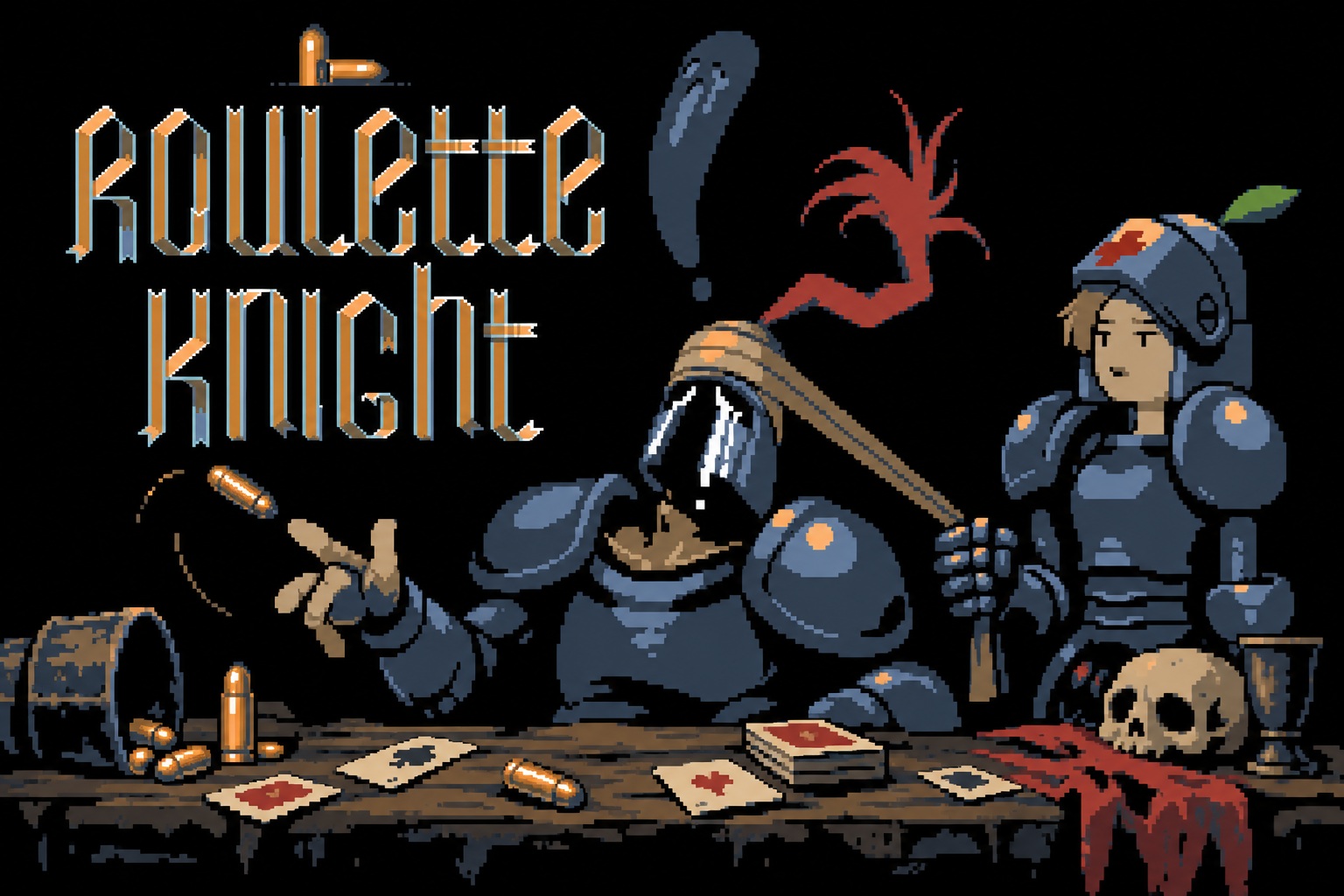
Roulette Knight takes two ideas that should barely belong in the same game and combines them into a strangely compelling roguelike RPG built around risk, luck, and survival. You play as a wandering knight travelling across a medieval kingdom, but instead of defeating every challenge through conventional sword combat, progress revolves around repeatedly facing a revolver and deciding how dangerous the next pull of the trigger should be. Bullets are loaded into the chamber, the cylinder is spun, and every successful empty shot can contribute toward the gold and experience needed to continue the journey. The more aggressively you gamble with the chamber, the greater the potential rewards—and the greater the chance that everything goes wrong.
Created by Four Quarters for Ludum Dare 41, Roulette Knight embraces the event's theme of combining two seemingly incompatible genres by merging role-playing progression with Russian roulette. Gold can be invested into better equipment, firearms and protective gear, while experience allows the knight to gain useful perks that improve survival. New regions introduce additional risks and modifiers, gradually transforming what initially looks like a simple game of chance into a surprisingly tactical question of how much danger the current character can realistically survive. Luck remains important, but preparation, upgrades and knowing when to stop taking unnecessary risks become equally significant.
Now playable online through Lemon Web Games, Roulette Knight brings this unusual risk-driven RPG directly into the web browser, allowing players to travel through the kingdom, build their knight, purchase equipment, unlock perks, and repeatedly confront the revolver without requiring a separate installation. Every run becomes a balancing act between greed and self-preservation because loading another bullet may improve the reward while also dramatically reducing the odds of walking away unharmed. Surviving long enough to acquire better gear can make later encounters more manageable, yet no amount of preparation completely removes the uncertainty. That mixture of RPG progression and uncontrollable chance gives Roulette Knight a personality unlike almost any conventional fantasy adventure.
A Knight Facing a Very Different Kind of Enemy
Roulette Knight immediately breaks expectations by presenting a medieval hero whose greatest threat is not a dragon, army, or dungeon boss. The central danger is probability itself. The knight repeatedly faces a revolver and must decide how many rounds to load before spinning the chamber and pulling the trigger. Every encounter becomes a calculation between potential reward and possible disaster.
This makes the game feel fundamentally different from most RPGs. Traditional role-playing games usually allow players to overcome danger through stronger statistics, better equipment, and mechanical skill. Roulette Knight includes those systems, but the result of a trigger pull can still depend on chance. Even a powerful character needs to respect the odds.
The knight therefore feels vulnerable throughout the journey. Progress makes survival more likely, but never completely safe. That persistent uncertainty gives even short encounters genuine tension.
The Revolver Is the Core of the Entire Adventure
The revolver acts as the central mechanic around which nearly every other system is built. Players choose how much risk to place inside the chamber before spinning it. A safer configuration reduces the chance of being hit but may also provide less attractive rewards. Loading more bullets creates a far more dangerous situation with stronger potential returns.
Once the cylinder is spun, control largely gives way to probability. The player has already made the important decision by choosing the level of risk. Pulling the trigger becomes the consequence of that choice. This gives Roulette Knight a very different kind of tension from an action game where reflexes can save the player at the last second.
The mechanic is simple enough to understand immediately yet flexible enough to support the entire progression system. Every new piece of equipment or character perk ultimately changes how comfortable the player feels taking another chance. The revolver remains dangerous from beginning to end.
Risk and Reward Are Constantly Connected
Roulette Knight makes greed mechanically tempting. Increasing the danger can generate better rewards, helping the knight earn money and progress more efficiently. A conservative player may survive longer but develop more slowly. Someone willing to take greater risks can become stronger much faster if luck cooperates.
This creates an interesting psychological cycle. Successful dangerous plays encourage confidence, which can lead the player toward even riskier choices. Several lucky outcomes in a row can make the chamber feel safer than it actually is. Roulette Knight quietly encourages overconfidence before probability eventually reminds the player that luck has no memory.
Knowing when to stop escalating is therefore one of the most important skills. The game constantly asks whether one more dangerous attempt is worth the potential reward. Sometimes the correct decision is simply to accept slower progress.
More Bullets Mean Greater Danger
Loading additional rounds into the revolver makes the mathematics increasingly unfavorable. The chance of surviving an individual trigger pull decreases, while the consequences of being hit remain severe. This is the simplest system in the game, yet it creates most of the strategic tension. Every extra bullet is a deliberate increase in danger.
That decision becomes more complicated once health and equipment are considered. A well-prepared knight may be able to survive a hit that would have ended an earlier run, making a riskier chamber more reasonable. Conversely, a wounded character may need to become extremely cautious even if the potential reward looks attractive. Context matters.
The game never completely removes this trade-off. Better equipment changes the acceptable level of danger, but probability continues to matter. Players need to constantly reassess rather than settling into one permanent strategy.
Health Turns Bad Luck Into a Manageable Problem
Taking a live round can remove a substantial amount of health, but it does not always mean immediate defeat. This gives Roulette Knight room to combine random outcomes with RPG-style survivability. A stronger character can absorb punishment that would have been disastrous earlier in the journey. Health effectively provides a buffer against bad probability.
That buffer should not be treated as permission to gamble recklessly. Several unlucky outcomes can quickly erase even a comfortable health reserve. Entering another high-risk encounter while already injured can turn a manageable setback into the end of the run. Health management therefore becomes part of probability management.
Players gradually learn to view health as another resource. Spending it through risky decisions may accelerate progression, but every point lost reduces future flexibility. Survival often depends on knowing when that resource is becoming too valuable to gamble.
Gold Gives Successful Risks a Purpose
Gold provides one of the main reasons to keep pushing forward. Surviving successful encounters can provide the money needed to purchase better equipment and strengthen the knight for future regions. This creates a clear connection between immediate danger and long-term progression. Risk produces resources, and resources create better survival chances.
The player therefore faces an interesting economic decision. Playing conservatively may generate money slowly but preserve health, while taking greater risks can accelerate purchasing power. The strongest strategy depends on the knight's current condition and available equipment. There is no universally correct level of aggression.
Gold also makes successful gambles feel more meaningful. The player is not risking health purely for an abstract score. Every reward potentially contributes toward something that changes the rest of the run.
Experience Adds Another Layer of Progression
Experience provides a second form of advancement alongside gold. Where money can improve equipment, experience contributes toward character development and perks. This gives players multiple reasons to continue surviving encounters. The knight becomes stronger not only through purchased gear but through accumulated progress.
The experience system also helps runs develop a sense of momentum. Early encounters feel extremely dangerous because the character has relatively few advantages. Later, useful perks can create additional defensive options or improve recovery. The knight gradually becomes better equipped to survive the kingdom.
Yet experience never completely replaces caution. A highly developed character can still suffer from a bad sequence of outcomes. The game preserves its tension by ensuring that progression improves the odds without guaranteeing safety.
Perks Can Change How Risk Is Managed
Useful perks provide permanent advantages during the current adventure and can influence how aggressively players approach future encounters. Some improve survivability directly, while others help the knight recover from previous damage. These abilities create meaningful strategic differences between an inexperienced character and one who has progressed significantly. The same chamber can feel very different depending on the build.
Health regeneration is particularly valuable because it can gradually restore some of the damage caused by an unlucky shot. This gives patient players a way to recover instead of immediately entering another dangerous encounter while weakened. Regeneration effectively rewards survival over time. It can also make a cautious strategy far more sustainable.
Improved evasion introduces another defensive possibility by giving the knight a better chance to avoid consequences. The exact value of such a perk depends heavily on how much risk the player normally takes. Defensive abilities become more valuable the more often the player challenges probability.
Equipment Makes Preparation Matter
Roulette Knight would feel almost entirely luck-driven if character preparation had no influence over survival. Equipment changes that by giving players practical ways to improve their situation before facing more dangerous encounters. Gold can be invested into tools that expand capabilities or reduce the consequences of failure. Preparation gives the player some control over an otherwise unpredictable journey.
This also creates meaningful choices about spending. Saving gold may provide access to stronger equipment later, but holding too much unused money offers no protection during the next dangerous encounter. Buying an upgrade immediately can improve survival but reduce financial flexibility. The right choice depends on current circumstances.
Good preparation does not eliminate bad luck, but it changes how damaging that luck can be. This is an important distinction. Roulette Knight remains a game about probability even when the RPG systems become stronger.
Protective Helmets Can Save a Run
Protective helmets provide one of the most intuitive forms of defense. When the central danger involves bullets, investing in head protection makes immediate sense. A good helmet can reduce the severity of certain outcomes and provide additional confidence during encounters. It effectively converts gold into survivability.
The psychological effect is almost as important as the mechanical one. Wearing better protection can tempt players to take greater risks because they feel safer. This can be useful when the character genuinely has enough durability to absorb failure, but it can also encourage reckless behaviour. Defensive upgrades do not change the mathematics of the chamber itself.
The strongest players therefore treat protection as insurance rather than invulnerability. The helmet provides another chance when luck goes badly. It should not become an excuse to ignore probability completely.
Larger Firearms Can Change the Stakes
Progression can also introduce larger or more capable firearms, changing the character of later roulette encounters. New equipment increases the sense that the knight is moving deeper into a world where the basic premise is becoming increasingly dangerous. What started as a bizarre roadside challenge gradually feels like a full RPG built around escalating risk. The equipment itself becomes part of that escalation.
More powerful firearms naturally make preparation more important. A mistake involving stronger equipment can have much greater consequences. Players who have relied on reckless luck during the early game may discover that the same behaviour becomes far less sustainable later. Progression raises both capability and danger.
This keeps the central mechanic from becoming stale. The basic act of loading, spinning and pulling remains familiar, but the context changes as equipment and modifiers develop. The player's relationship with risk evolves throughout the run.
The Kingdom Gives the Adventure a Sense of Journey
Roulette Knight does not present its roulette mechanic as an isolated mini-game. The knight travels through different parts of a kingdom, giving the experience a broader adventure structure. Progress feels like moving through a strange medieval quest rather than simply repeating the same challenge endlessly. The world provides context for the risk.
Different locations can introduce additional conditions and modifiers that alter how the player approaches encounters. The rules surrounding the revolver may become less comfortable as the journey progresses. This prevents the game from becoming mechanically static. New areas create new reasons to reconsider strategy.
The kingdom also contributes heavily to the game's humor. A heroic knight wandering through fantasy lands only to repeatedly resolve challenges through roulette is inherently absurd. The game embraces that contradiction.
Modifiers Keep Later Encounters Unpredictable
As the journey continues, additional modifiers can make the basic roulette system more complicated. These conditions force players to reconsider strategies that worked comfortably in earlier areas. A build designed around one type of encounter may suddenly need to adapt. The game becomes less predictable even before the cylinder is spun.
Modifiers are especially effective because the central mechanic is already based on uncertainty. Altering the surrounding rules changes how much risk is acceptable without needing to replace the basic gameplay. The player remains focused on probability, but the calculation keeps changing.
This creates genuine strategic progression. Later areas are not simply earlier encounters with larger numbers. They ask players to interpret risk under new conditions.
Luck Matters, but It Is Not the Only Skill
It would be easy to dismiss Roulette Knight as a game where outcomes are determined entirely by chance. Luck is undeniably central, but player decisions still influence how often dangerous situations occur and how well the character survives them. Choosing chamber risk, purchasing equipment, managing health and selecting upgrades all shape the journey. The player controls the conditions even when they cannot control the final outcome.
This distinction is important. A player who repeatedly chooses extremely dangerous configurations is statistically more likely to encounter serious problems than someone using a measured strategy. Luck can temporarily reward reckless behaviour, but probability eventually matters over enough attempts. Smart play is about managing exposure.
The game therefore rewards understanding risk rather than trying to predict random outcomes. You cannot know what the next chamber contains after the spin. You can decide whether entering that situation was sensible in the first place.
Greed Can Be More Dangerous Than the Revolver
The most dangerous moment often comes immediately after a successful risky play. Surviving can create a feeling that the same strategy should work again, particularly when the reward was substantial. Players may increase the danger further because the previous gamble succeeded. This is where greed begins replacing calculation.
Roulette Knight constantly tests that impulse. Another successful pull could provide enough gold for an important upgrade, but failure could wipe out much of the health that made the gamble possible. The game never needs to explicitly warn the player about greed because the mechanics demonstrate it naturally.
A disciplined player learns to separate previous luck from future probability. Surviving one dangerous chamber does not make the next chamber safer. Recognizing that principle is central to long-term success.
Conservative Play Has Its Own Risks
Playing extremely safely sounds like the obvious solution, but excessive caution can make progression slow. The knight still needs enough gold and experience to prepare for increasingly dangerous regions. Refusing almost every meaningful risk can leave the character underdeveloped. Safety now can create vulnerability later.
This prevents the game from having one trivial strategy. The player needs to take some risks to progress efficiently. The challenge is finding a level of danger that produces worthwhile rewards without repeatedly threatening the entire run. Risk cannot be eliminated; it needs to be managed.
This balancing act gives Roulette Knight much of its depth. The safest choice in one encounter may not be the safest choice for the entire journey. Short-term and long-term survival can conflict.
The Game Turns Probability Into Suspense
Very few mechanics create tension as efficiently as a spun chamber. Once the player has committed, there is a short period where the outcome is completely uncertain. No fast reflex or last-second button input can alter the result. The suspense comes entirely from waiting to discover what the earlier decision produced.
This makes even minimal animations or sound cues feel dramatic. The player knows exactly what could happen. The simplicity allows anticipation to do most of the work. Roulette Knight understands that probability can create suspense without elaborate action.
Repeated encounters do not completely remove that tension because the stakes continue changing. A trigger pull with full health and little money feels different from one taken while carrying valuable upgrades deep into a run. The same mechanic gains emotional weight through context.
Every Successful Empty Chamber Feels Like a Victory
When the trigger produces nothing, relief arrives immediately. The knight survives, the reward is secured, and the player's risky decision appears justified—at least temporarily. That moment can be surprisingly satisfying despite requiring almost no mechanical execution. The emotional reward comes from having survived uncertainty.
The danger is that repeated success can create false confidence. Empty chambers begin feeling normal until a live round suddenly reminds the player how severe the consequences can be. Roulette Knight deliberately alternates relief and punishment through probability. The player can never become completely comfortable.
This emotional cycle is one of the strongest reasons the game remains engaging. The mechanics are simple, but the player's reaction to them continually changes. Every pull carries a small story.
A Bad Shot Does Not Always End Everything
Because health and protection exist, taking a live round can become a setback rather than immediate defeat. This is important for maintaining the RPG structure. Players have opportunities to recover, change strategy, and continue the journey after bad luck. The run becomes a story of survival rather than a sequence of instant resets.
Recovery also creates difficult decisions. A wounded knight may still need resources, but taking additional risks becomes much more dangerous. The player must decide whether to slow down, seek regeneration, or continue gambling while vulnerable. A single bad outcome can therefore influence several future encounters.
This makes damage meaningful beyond the moment it occurs. Health loss changes strategy. Roulette Knight turns one random event into a longer-term tactical problem.
Regeneration Rewards Patience
A regeneration perk can transform how players think about recovery. Instead of treating every lost point of health as permanent, surviving long enough may gradually restore some durability. This gives cautious players a reason to slow down after an unlucky event. Patience becomes a defensive strategy.
Regeneration also changes the value of low-risk encounters. Even if the immediate reward is modest, surviving while allowing health to recover can improve the knight's overall position. Players begin considering time and health together. Not every encounter needs to maximize income.
The perk therefore supports a more sustainable style of play. It does not prevent bad luck, but it provides another way to recover from it. That can dramatically improve long-term survival.
Evasion Introduces Another Layer of Uncertainty
Evasion-related perks can provide the knight with another defensive advantage when dangerous outcomes occur. Mechanically, this adds probability on top of probability. The chamber may already produce an uncertain result, and the character may then have another chance to avoid the consequences. Defensive builds can therefore feel significantly more resilient.
This reinforces the roguelike quality of the game. Character progression can reshape the probabilities that define a run. The player is gradually constructing a knight better suited to surviving uncertainty. Different perk combinations can support different levels of aggression.
However, additional chances should not be mistaken for guaranteed protection. Probability remains probability. Even a favorable system can eventually produce an unfavorable result.
The RPG Systems Make Every Run Feel Like a Build
Gold, equipment, perks, health, and progression combine to create a character build rather than a simple sequence of roulette attempts. One run may develop into a highly defensive knight capable of absorbing mistakes, while another may emphasize stronger equipment and more aggressive resource generation. The route toward the later kingdom can therefore feel different each time. Character development matters.
These systems also provide reasons to replay after failure. A new run offers another opportunity to prioritize different upgrades or manage risk differently. The player can test whether a more cautious build produces better results. Learning persists even when the character does not.
This is where Roulette Knight most clearly resembles a roguelike. Death may end the current journey, but knowledge changes the next attempt. The player becomes better at understanding what a sustainable run looks like.
Failure Usually Begins Several Decisions Earlier
When a run ends, the final trigger pull may appear to be the obvious cause. However, the real mistake often happened earlier. Perhaps the player entered the encounter with too little health, failed to buy protection, or loaded more bullets than the potential reward justified. The final result simply exposed the accumulated risk.
This makes post-failure analysis surprisingly interesting. Players can ask whether the unlucky outcome was genuinely unavoidable or whether they created an unnecessarily dangerous situation. The chamber may have been random, but the decision to face it was not. Responsibility remains with the player.
Thinking this way makes later runs much stronger. Instead of blaming every defeat on bad luck, players begin identifying the choices that amplified that luck. Strategy emerges from probability.
The Ludum Dare 41 Theme Fits Perfectly
Roulette Knight was created for Ludum Dare 41, whose theme challenged developers to combine two incompatible genres. Few combinations sound more incompatible than a medieval RPG and Russian roulette. One genre traditionally revolves around long-term character development, while the other can theoretically end everything in a single unlucky moment. The tension between those ideas becomes the game's central identity.
The RPG systems encourage players to care about preserving the knight because progress accumulates over time. The roulette mechanic constantly threatens that investment. The longer the run continues, the more meaningful every risk becomes. The two genres strengthen one another precisely because they are so contradictory.
This makes Roulette Knight a particularly memorable game-jam concept. The combination is not merely a joke placed on top of unrelated mechanics. The genres actively interact. Character progression changes how roulette is approached, while roulette determines whether that progression survives.
Four Quarters Makes the Strange Concept Feel Coherent
Four Quarters is known for unusual mechanical ideas, and Roulette Knight demonstrates an ability to turn a seemingly ridiculous premise into a coherent game. The medieval presentation, RPG upgrades and risk-based mechanics all support the same central concept. Nothing needs an overly complicated explanation. The absurdity becomes internally logical.
The game's compact structure also reflects its game-jam origins. Rather than attempting to build an enormous fantasy world, the design concentrates on one unusual interaction and explores it thoroughly. This focus helps the experience remain memorable. Every system has a clear relationship with risk.
The result feels experimental without being confusing. Players understand what to do quickly. The deeper strategy emerges naturally from repeated attempts.
Simple Presentation Keeps Attention on the Decision
Roulette Knight does not need elaborate 3D environments to create tension. The presentation remains compact and readable, ensuring that health, resources, chamber risk and available upgrades are easy to understand. This matters because the player's decisions depend on knowing the current situation clearly. Visual complexity would only distract from the probabilities.
The medieval artwork also gives the game considerable charm. A tiny knight engaging with firearms in a fantasy world looks deliberately absurd. The contrast between heroic RPG imagery and grim roulette mechanics supports the dark humor.
That simplicity also makes the game easy to approach in short sessions. Players can understand the state of a run almost immediately. The mechanics remain the focus.
Dark Humor Runs Through the Entire Adventure
The concept itself is inherently darkly comedic. A noble knight progressing through a fantasy kingdom by repeatedly playing roulette with firearms is an absurd contradiction. The game embraces that ridiculous situation rather than treating it as realistic drama. Humor keeps the dangerous mechanic entertaining.
The RPG progression strengthens the joke. Buying a better helmet to survive a roulette challenge sounds like something no sensible fantasy hero should need to do, yet within Roulette Knight it becomes a completely logical upgrade. The game continually creates this kind of mechanical comedy. Systems that normally belong to one genre are reinterpreted through another.
That humor helps prevent the randomness from becoming overly grim. Even when a run ends badly, the premise remains bizarre enough to invite another attempt. Failure becomes part of the joke.
The Game Encourages Understanding Basic Probability
Players do not need formal mathematics to enjoy Roulette Knight, but understanding probability naturally improves decision-making. Loading additional bullets reduces the proportion of safe chambers. That relationship is obvious enough to understand intuitively. The player can immediately see why certain configurations are dangerous.
Repeated play also teaches that short-term outcomes can be misleading. A highly dangerous setup may succeed several times in a row, while a relatively safe one can still fail immediately. Neither result changes the underlying odds. Roulette Knight provides an entertaining demonstration of how randomness behaves.
This makes the game quietly educational without ever becoming a lesson. Players learn to distinguish between "unlikely" and "impossible." An unlikely event only needs to happen once to end a run.
Luck Streaks Can Create False Confidence
One of the most dangerous experiences is surviving several unlikely encounters consecutively. The player begins feeling unusually fortunate and may decide to increase the risk even further. Psychologically, the run starts feeling special. The next chamber then becomes even more dangerous because confidence has replaced caution.
The game is very effective at producing this behaviour because each successful pull rewards the player immediately. There is no visual indication that luck is about to run out because randomness does not work that way. Every new spin begins another independent situation. The player needs to remember this manually.
Learning not to chase a lucky streak is part of mastery. A good run is often the moment when caution should increase rather than disappear. Valuable progress deserves protection.
Bad Luck Can Happen Even With Good Strategy
Managing probability intelligently does not guarantee success. A player can choose a sensible low-risk setup and still encounter the live chamber immediately. This is fundamental to Roulette Knight's identity. Smart decisions improve expected survival but cannot remove uncertainty.
Accepting this makes losses less frustrating. The objective is not to create a perfectly safe strategy because none exists. The goal is to repeatedly choose situations where the expected risk is reasonable relative to the reward. Over many encounters, good decisions provide an advantage.
This is very similar to how roguelikes often operate more broadly. The player controls preparation and decision quality while randomness determines certain outcomes. Adaptation matters more than certainty.
Every Upgrade Changes the Meaning of Risk
A chamber configuration that is reckless early in the run may become more reasonable after the knight acquires better health, protection or defensive perks. This means players cannot memorize one universal rule such as always loading a specific number of bullets. Risk needs to be evaluated according to the character's current strength. Progress changes the calculation.
This dynamic is one of the strongest reasons the RPG systems matter. Upgrades are not merely numbers increasing in the background. They change which decisions make sense. A healthier and better-protected knight can afford situations that an inexperienced character should avoid.
The opposite is also true after taking damage. A previously acceptable risk can suddenly become reckless when health is low. Strategy needs to remain flexible.
The Journey Is About Managing Exposure
Long-term survival comes from controlling how often the knight is exposed to severe danger. One extremely risky decision may succeed, but repeating that decision constantly gives probability more opportunities to punish the player. Sustainable runs generally involve choosing danger selectively. Not every encounter needs to be maximized.
This idea makes Roulette Knight more strategic than it appears. The game is not only asking whether the next trigger pull will be safe. It is asking how many risky situations the player is creating across the entire run. Cumulative exposure matters.
Players who understand this often become more conservative as their progress becomes valuable. The cost of losing increases alongside the strength of the knight. Protecting a developed build becomes part of the strategy.
Short Sessions Can Become Surprisingly Intense
Roulette Knight works well in short sessions because individual encounters resolve quickly. Players can make meaningful progress without committing to a lengthy mission. Yet the emotional intensity can rise quickly when a valuable run begins depending on a few dangerous trigger pulls. A small game can create surprisingly large tension.
This compact format also makes restarting easier after failure. The player has learned something and can immediately approach the next run differently. There is little downtime between strategy and experimentation. The loop remains focused.
The browser format complements this perfectly. Players can begin another journey within moments. The game reaches its central mechanic almost immediately.
Replayability Comes From Different Risk Strategies
One run might focus on extreme caution, accepting slow income in exchange for better survival. Another might aggressively load bullets and attempt to build wealth quickly before luck turns. A third may prioritize defensive equipment or perks as early as possible. The basic mechanics remain the same, but player philosophy can change dramatically.
Trying different strategies also reveals how much of the game is genuinely controllable. Aggressive play may produce spectacular progress before ending suddenly, while conservative play can create longer but slower journeys. Neither experience feels identical. The player's tolerance for risk becomes part of the build.
This gives Roulette Knight replay value beyond simply reaching the end. Players can experiment with how much danger they personally consider acceptable. The game becomes a small test of decision-making style.
Winning Feels Like Surviving Your Own Decisions
Completing difficult sections of Roulette Knight feels satisfying because the player knows how many opportunities existed for the run to fail. Equipment and perks helped, but each major progression step still required confronting uncertainty. The final success feels like a combination of preparation, restraint, and luck. No single factor completely explains the victory.
This is very different from games where winning means mastering a fixed sequence of actions. Roulette Knight cannot be solved perfectly in the same way because randomness always remains. The player instead learns how to create favorable situations repeatedly. Success becomes probabilistic mastery.
That makes a strong run memorable. Players remember the dangerous chambers they survived and the moments where they decided not to push their luck. The story emerges directly from decisions.
Playing Roulette Knight Online Today
Through Lemon Web Games, Roulette Knight can now be played directly in your web browser with no downloads or setup required. Features of the web-based version include:
Playing Roulette Knight through a browser makes it easy to experience the game's strange mixture of medieval RPG progression and probability-driven danger. New players should avoid assuming that the most profitable chamber configuration is automatically the best choice. Preserving health and building a sustainable character often matters more than maximizing one immediate reward. Every successful gamble should be evaluated according to what the knight can afford to lose.
As equipment and perks improve, players can gradually reconsider which risks are reasonable. A stronger helmet, better health or regenerative ability may make an encounter more survivable, but no upgrade removes the uncertainty completely. Monitor the knight's condition, spend gold when an improvement meaningfully increases survival, and remember that one lucky streak does not guarantee another. The safest long-term strategy is usually the one that respects probability.
Who Should Play Roulette Knight
Roulette Knight is particularly suitable for players who enjoy making decisions under uncertainty. The game does not allow every outcome to be controlled, but it provides enough information to make sensible choices about exposure to danger. Players who understand the difference between a calculated risk and reckless gambling will generally create more sustainable runs. The challenge comes from resisting temptation when the game offers faster rewards.
It should also appeal to anyone interested in seeing two incompatible genres successfully merged into one coherent design. The RPG systems make survival valuable, while roulette constantly threatens everything the knight has built. Each genre strengthens the other. The result is funny, tense, and surprisingly strategic.
Play Roulette Knight Online Now
Roulette Knight takes the progression systems of a fantasy RPG and places them inside a game where one unlucky chamber can change everything. Players load bullets, spin the revolver, survive trigger pulls, earn gold and experience, purchase equipment, unlock perks, and gradually push deeper into a kingdom filled with new dangers and modifiers. Loading more bullets can increase potential rewards, but every additional risk makes the next encounter more threatening. The challenge is knowing when progress is worth gambling for and when survival should take priority.
Through Lemon Web Games, players can experience Roulette Knight directly in a modern browser and discover how much tension can emerge from a deceptively small set of mechanics. The revolver provides uncertainty, while equipment and character progression provide enough control to make decisions meaningful. A cautious player can build gradually, while an aggressive player can chase rapid rewards and hope luck remains favorable. Both approaches create memorable runs because every decision has consequences.
Final Thoughts
Roulette Knight works because the two genres at its core genuinely fight against one another. RPGs encourage players to become attached to progress, equipment and character development, while Russian roulette threatens to erase that investment through chance. The stronger the knight becomes, the more valuable survival feels, yet stronger equipment can also tempt the player toward increasingly dangerous decisions. That tension gives the game far more depth than its simple premise might suggest.
Gold, experience, protective equipment, larger firearms, health regeneration, evasion and other improvements gradually provide more ways to manage danger, but they never completely solve the central problem. Probability remains unpredictable. Players cannot guarantee the next pull will be safe; they can only decide whether taking that pull was reasonable. Learning to manage that uncertainty becomes the real progression system.
Through Lemon Web Games, Roulette Knight can be played directly in the browser as a compact roguelike where luck, preparation and self-control matter equally. It is funny, tense and occasionally brutal, especially when a promising run ends because one last gamble seemed too profitable to refuse. For players who enjoy unusual RPGs and games where every decision carries genuine risk, Roulette Knight turns one impossible genre combination into a remarkably memorable adventure.











Comments 0