

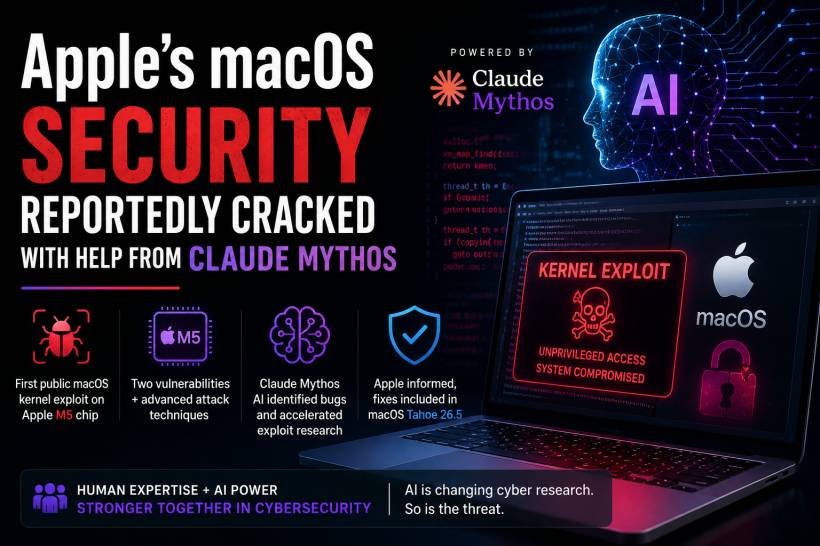
Apple's macOS security has reportedly faced a major research breakthrough, this time with help from Anthropic's advanced cybersecurity-focused AI model, Claude Mythos. According to reports, security researchers used the AI system to identify vulnerabilities in macOS and assist in building what is being described as the first public macOS kernel memory corruption exploit affecting Apple's M5 silicon.
The discovery is significant not only because it involves Apple's latest hardware platform, but also because it shows how quickly AI is becoming part of serious vulnerability research. Cybersecurity experts have always relied on deep technical knowledge, patience, and careful analysis to find flaws in complex systems. Now, tools like Claude Mythos appear capable of accelerating parts of that process, especially when the weaknesses fall into known vulnerability categories.
A Reported Breakthrough In macOS Kernel Research
The exploit was reportedly developed by researchers from Calif, a Palo Alto-based security firm. The team used Claude Mythos Preview to help identify vulnerabilities in macOS and assist in shaping an exploit path that could allow an unprivileged local user to gain full access to a device.
That kind of escalation is serious because it moves beyond a normal application-level issue. Kernel-level flaws sit much closer to the core of the operating system, where memory management, hardware interaction, permissions, and system-level protections are handled. If an attacker can successfully exploit this area, the impact can be much more severe than a typical app bug.
The researchers reportedly described the exploit as involving two vulnerabilities combined with several attack techniques. They have not released full technical details, which is the responsible approach while Apple works on closing the security gaps.
Why Claude Mythos Matters In This Case
What makes this case especially interesting is the role played by Claude Mythos. Calif reportedly said the model was able to recognise the bugs quickly because they belonged to known classes of vulnerabilities. In other words, once the AI had learned the pattern of a particular type of weakness, it could apply that knowledge to similar problems elsewhere.
That is where AI becomes powerful in cybersecurity. Many vulnerabilities are not completely new ideas. They often belong to categories that researchers already understand, such as memory corruption, privilege escalation, logic flaws, or unsafe handling of system resources. A capable AI model may be able to spot similarities faster than a human manually reviewing large amounts of code or behaviour.
However, this does not mean the AI simply did everything by itself. Calif emphasised that human expertise remained essential in designing and refining the exploit chain. The AI helped accelerate discovery and analysis, but the final outcome still depended on skilled researchers who understood how to connect the findings into a working exploit path.
Human Expertise Still Remains Critical
This is an important point because AI-assisted cybersecurity can easily be misunderstood. The headline may sound like an AI model "hacked macOS," but in practice, the more accurate picture is that researchers used AI as a powerful technical assistant.
Building a real exploit requires more than finding a suspicious bug. Researchers need to understand system architecture, memory behaviour, kernel protections, exploit reliability, mitigation bypasses, and how different weaknesses can be chained together. AI may help with analysis and pattern recognition, but experienced humans still need to guide the process, verify the findings, and avoid false assumptions.
That balance is likely to define the next phase of cybersecurity research. AI tools will not replace top researchers overnight, but they can help them move faster, test more ideas, and uncover paths that may have taken much longer using traditional methods alone.
Apple Has Been Informed
Calif reportedly met with Apple at Apple Park to discuss the issue, and the firm has chosen to withhold full technical details until Apple patches the vulnerabilities and closes the exploit path. That is the right move, especially for kernel-level security issues that could be dangerous if released publicly before fixes are available.
Reports also suggest that macOS Tahoe 26.5 release notes referenced fixes submitted by Calif in collaboration with Claude and Anthropic Research. Calif was also credited in additional vulnerability reports tied to the update.
Apple has acknowledged the research, stating that security is a top priority and that it takes reports of potential vulnerabilities seriously. This is standard language from a major platform vendor, but it also confirms that the findings were taken seriously enough to be addressed through Apple's security response process.
Claude Mythos Is Not Publicly Available
Claude Mythos is not available to the general public. Anthropic is currently limiting access through its Project Glasswing cybersecurity initiative, which provides selected organisations with access to advanced security-focused AI capabilities.
The list of participants reportedly includes major technology and cybersecurity names such as Amazon Web Services, Cisco, CrowdStrike, Google, Microsoft, NVIDIA, the Linux Foundation, and Apple. This limited-access approach makes sense because advanced cybersecurity AI models can be dual-use. They can help defenders find and fix vulnerabilities, but they could also help attackers if placed in the wrong hands.
That is the central tension around AI in cybersecurity. The same capability that helps a trusted research team discover a flaw responsibly could also help a malicious actor build exploit chains more quickly.
A Wider Pattern Of AI-Assisted Security Research
This report also fits into a broader trend. AI is increasingly being used in vulnerability research, exploit development, code analysis, and defensive security work. Earlier reports have already shown AI being used to assist with zero-day research attempts, while browser vendors and security teams are beginning to use similar tools to find and patch vulnerabilities at scale.
Mozilla, for example, reportedly identified and patched hundreds of Firefox vulnerabilities with help from Mythos. Google also recently said it blocked what it described as an AI-assisted zero-day cyberattack attempt, where the attacker allegedly used AI tools to support exploit development and vulnerability research.
Together, these cases show that AI is no longer just a side tool in cybersecurity. It is becoming part of both offensive and defensive workflows. The question is no longer whether AI will influence cybersecurity, but how quickly security teams, vendors, and attackers will adapt to it.
Why This Matters For Apple Users
For ordinary Mac users, this does not necessarily mean there is an immediate reason to panic. The exploit was reportedly discovered by researchers, the technical details are being withheld, and Apple has already been engaged through the responsible disclosure process.
However, it is still a reminder that even highly secure platforms are not immune to advanced research. Apple's hardware and software protections are strong, but no system is perfect. As AI tools become better at recognising vulnerability patterns, the speed at which flaws are discovered may increase.
This makes timely updates more important than ever. When Apple releases security patches, users should treat them seriously, especially when they address kernel-level vulnerabilities or privilege escalation risks.
Final Thoughts
The reported macOS exploit involving Claude Mythos is an important example of where cybersecurity is heading. AI is becoming capable enough to support advanced vulnerability research, recognise known bug patterns, and help researchers explore attack paths much faster than before.
At the same time, this case also shows that human expertise still matters. Claude Mythos may have helped identify and accelerate parts of the process, but skilled researchers were still needed to guide, validate, and refine the exploit chain.
For Apple, Anthropic, and the wider cybersecurity industry, this is a preview of a more complicated future. AI will help defenders find and fix weaknesses, but it may also help attackers move faster. The real challenge will be making sure these tools are used responsibly, access is controlled carefully, and software vendors respond quickly when AI-assisted research uncovers serious flaws.











Comments 0