

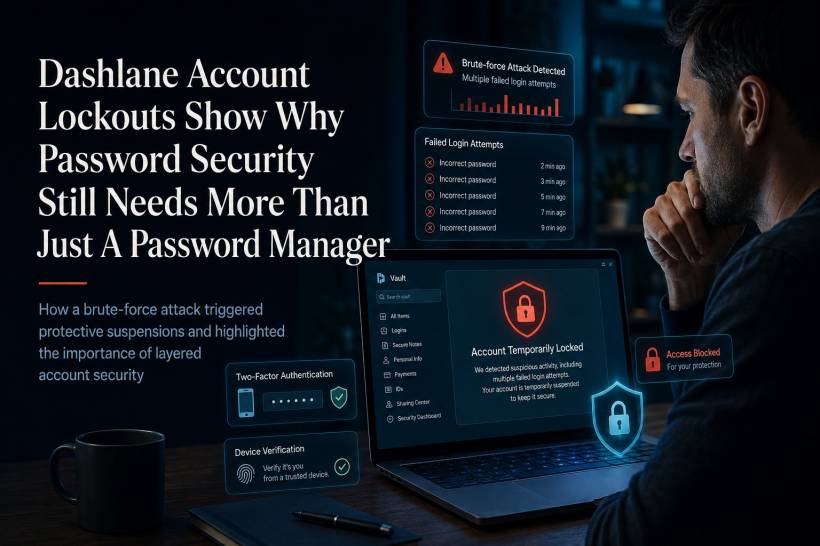
Some Dashlane users recently found themselves unexpectedly locked out of their accounts after the password manager detected suspicious login activity linked to a brute-force attack. For anyone who relies on a password manager every day, that kind of message can be worrying. After all, the whole point of using a password manager is to keep important accounts protected and accessible when needed.
But based on Dashlane's own status updates and current reporting, this appears to be a case where built-in security controls did what they were designed to do. Certain user accounts were targeted by an outside party, and Dashlane temporarily suspended those accounts after repeated failed attempts to register a new device or complete authentication.
That does not make the situation pleasant for affected users. Being locked out of a password vault can be disruptive, especially if the vault contains work credentials, banking logins, cloud services, email accounts and other essential records. Still, there is an important difference between a password manager suffering a breach and a password manager blocking suspicious access attempts.
So far, Dashlane has said there is no evidence that its systems were compromised. That distinction matters.
What Happened To Some Dashlane Users
The incident began when users reported receiving emails saying their accounts had been temporarily suspended for security reasons. The message explained that someone had attempted to register a new device but failed to enter the correct token after several tries.
In practical terms, this means Dashlane detected suspicious authentication activity and responded by locking down the affected accounts. That kind of response is designed to prevent attackers from repeatedly guessing or testing credentials until they get in.
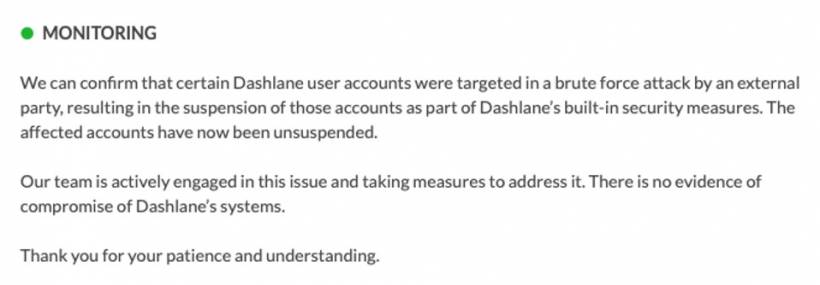
Dashlane later confirmed that certain user accounts had been targeted in a brute-force attack by an external party. The account suspensions were triggered by its security protections rather than by a confirmed compromise of Dashlane's internal systems.
For users, however, the experience still created confusion. Some were unsure whether the suspension email was real, whether their account had been hacked, or whether Dashlane itself had suffered a breach. That uncertainty is understandable, especially when the locked account is a password manager rather than an ordinary online service.
Why A Password Manager Lockout Feels More Serious
Getting locked out of a normal website is annoying. Getting locked out of a password manager can feel much worse because the password manager often holds the keys to everything else.
Many users depend on services like Dashlane to store unique passwords across email, banking, shopping, work systems, cloud platforms, streaming accounts and social media. If access is interrupted, even temporarily, it can feel like being locked out of your digital life.
This is why communication during password manager incidents is so important. Users need to know whether the issue is a platform breach, an external login campaign, a false alarm or a protective lockout. The technical difference may be clear to security teams, but for everyday users, the first reaction is usually worry.
In this case, the available information points toward a defensive response to suspicious activity. That is still inconvenient, but it is very different from attackers breaking into Dashlane's systems.
What A Brute-Force Attack Means
A brute-force attack is when an attacker repeatedly tries to gain access to an account by testing many possible login combinations. In modern attacks, this is often automated. Attackers may use lists of leaked usernames and passwords gathered from previous data breaches and try them against other services.
This is sometimes also discussed together with credential stuffing. The idea is simple: if someone reused the same password on multiple websites, a password exposed from one old breach may still work somewhere else.
That is why password reuse is so dangerous. An attacker does not always need to break into a company's systems directly. Sometimes they only need to find a leaked password from another service and try it elsewhere.
In Dashlane's case, the attack appears to have targeted user accounts from the outside. This does not necessarily mean Dashlane leaked passwords. It may mean attackers were attempting to use previously exposed credentials, repeated login attempts or device-registration attempts to gain access.
Why Two-Factor Authentication Still Matters
A password manager is a strong security tool, but it should not be treated as the only layer of protection. Two-factor authentication, or 2FA, adds another barrier between an attacker and the account.
With 2FA enabled, a password alone is not enough. The attacker also needs a second factor, such as a verification code, authenticator app approval or another supported security method. This makes brute-force and credential-stuffing attempts much harder to complete successfully.
Dashlane has advised users to enable two-factor authentication for extra protection. That advice is especially important for password manager accounts because they protect access to many other services.
If a password manager account is the front door to your digital identity, then 2FA is the extra lock behind that door.
Should Users Stop Using Password Managers?
This incident should not be seen as a reason to abandon password managers. In fact, it shows why password managers remain important.
A good password manager helps users create strong, unique passwords for every account. That reduces the risk of password reuse, which is one of the biggest reasons credential-stuffing attacks work in the first place.
The bigger lesson is not "password managers are unsafe." The better lesson is that password managers need to be used properly. That means using a strong master password, enabling 2FA, keeping recovery options updated and paying attention to security alerts.
No security tool removes all risk. A password manager is not magic. But compared with reusing weak passwords across many websites, it is still one of the most practical security improvements most people can make.
What Dashlane Users Should Do Now
Affected users should follow Dashlane's official account recovery or customer support instructions rather than clicking random links from emails or social media posts. During incidents like this, phishing attempts can appear quickly because attackers know users are worried and looking for answers.
Users should log in only through the official Dashlane app or website. If an email claims an account is suspended, it is better to manually visit Dashlane's official login page instead of trusting links inside the email.
It is also a good time to review the account's security settings. Users should enable 2FA if they have not already done so, check trusted devices, review recent security alerts and make sure their master password is strong and unique.
Anyone who has reused their Dashlane master password somewhere else should change it immediately. A master password should never be reused on any other website or service.
The Bigger Lesson For Everyone
The Dashlane account lockout incident is a reminder that attackers do not always need to breach a company directly to cause disruption. Sometimes they target users at scale and rely on password reuse, weak credentials or repeated authentication attempts.
This is why security has to be layered. A password manager helps. A strong master password helps. Two-factor authentication helps. Account monitoring helps. Lockout protections help too, even when they temporarily inconvenience legitimate users.
In this case, the lockouts were frustrating, but they may also have prevented unauthorised access. That is the awkward reality of security controls: when they work, they can still feel painful.
Final Thoughts
Dashlane users who were locked out have a fair reason to be frustrated, especially if they depend on the service every day. However, based on what has been reported so far, this incident appears to be an external brute-force campaign that triggered Dashlane's protective measures, not a confirmed breach of Dashlane's systems.
The situation is still a useful reminder for everyone who uses a password manager. Do not rely on a strong vault alone. Use a unique and strong master password, enable two-factor authentication, keep recovery options ready and stay cautious of phishing messages during security incidents.
Password managers remain one of the best tools for everyday digital security. But like any security tool, they work best when they are part of a wider habit of careful, layered protection.











Comments 0