

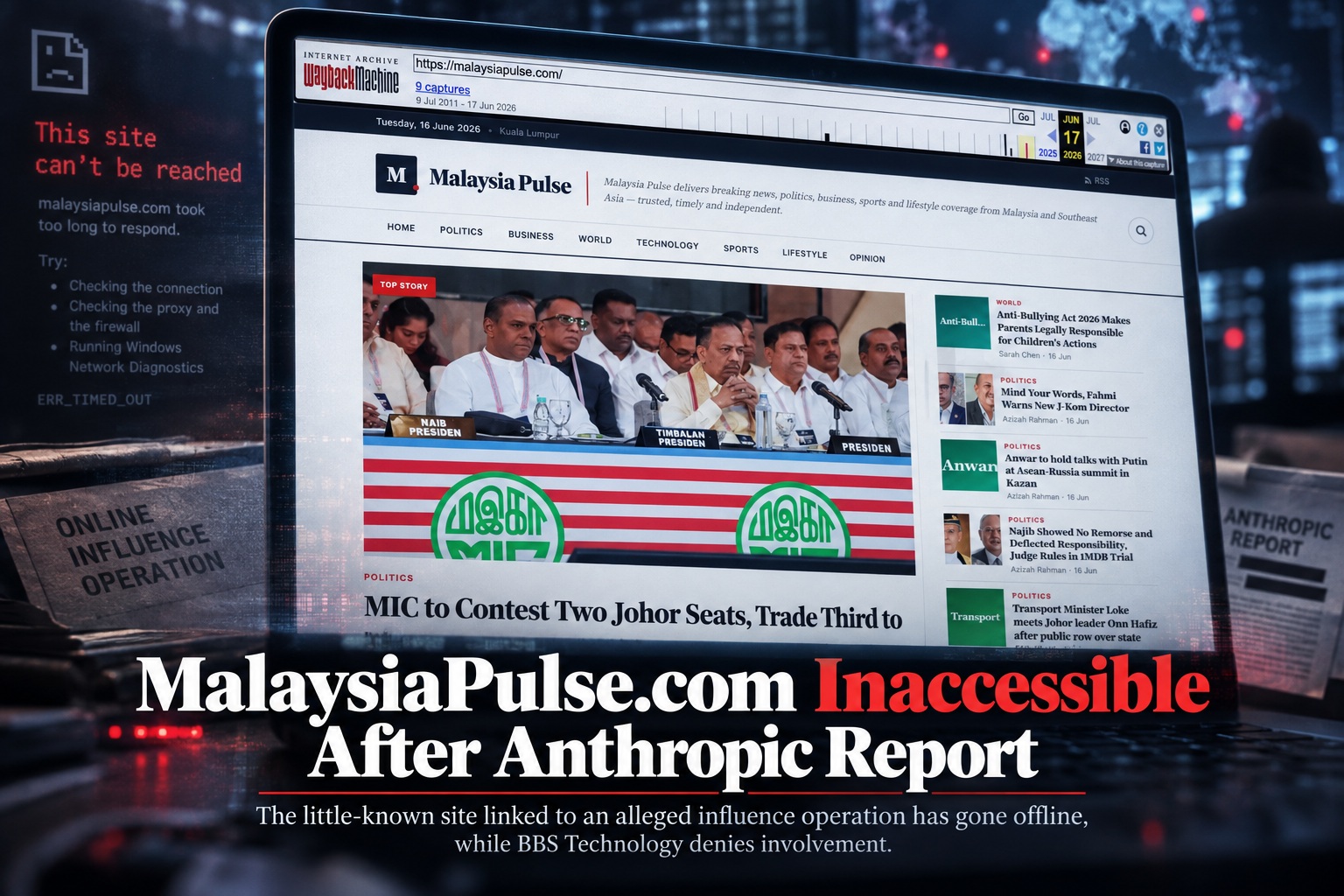
A little-known Malaysian news website has suddenly become the centre of a much larger conversation about artificial intelligence, online influence campaigns, and the difficulty of separating genuine digital media from synthetic operations. MalaysiaPulse.com was largely unknown to the wider public until Anthropic recently identified the site as part of an alleged commercial influence operation aimed at Malaysian voters. Shortly after the AI company published its findings, the website became inaccessible, while several accounts and online services reportedly associated with the operation also disappeared from public view.
The timing has naturally drawn attention to how quickly MalaysiaPulse.com appeared, what it published, and who may have been behind it. Available records suggest the website was created only months ago, yet it managed to present itself as a functioning local news publication with multiple sections, Malaysian bylines, and coverage spanning politics, business, technology, sport, and international affairs. Anthropic alleges that this apparent newsroom was actually one component of a larger AI-assisted influence infrastructure, although important questions about who commissioned the operation and who ultimately controlled it remain unanswered.
A Website Few People Had Heard of Until Anthropic's Report
Before the controversy, MalaysiaPulse.com does not appear to have had the profile of an established Malaysian news organisation. Its name only began attracting wider attention after Anthropic published a threat intelligence report describing what it believed to be a coordinated influence operation involving artificial intelligence, social media accounts, and fabricated media content.
According to Anthropic, MalaysiaPulse.com functioned as a synthetic news outlet within that operation. The company said the broader network included roughly 1,000 fake accounts on X, an associated YouTube channel, and supporting tools used to generate and distribute political material. Claude was allegedly used to assist with tasks such as rewriting legitimate news reports, producing political content, managing online identities, and creating material intended to resemble ordinary Malaysian news coverage.
The Malaysian Communications and Multimedia Commission has since said it is reviewing the claims contained in Anthropic's report. MCMC also firmly denied any involvement in the activities described and said it would seek additional information before determining whether further action was necessary. At this stage, therefore, Anthropic's findings remain allegations under examination rather than a final determination by Malaysian authorities.
MalaysiaPulse.com and MalaysiaPulse.my Are Two Different Websites
One point that can easily cause confusion is the existence of another website using a very similar name. MalaysiaPulse.com should not be confused with MalaysiaPulse.my, which appears to be a separate and unrelated publication.
MalaysiaPulse.my has existed independently and appears to have been inactive for some time, with its latest visible article dating back to 2024. The domain highlighted in Anthropic's report is specifically MalaysiaPulse.com, a much newer website whose appearance and publishing history begin in 2026.
That distinction matters because similar domain names can easily lead readers to assume they belong to the same organisation. There is currently no basis for treating MalaysiaPulse.my as part of the operation described by Anthropic simply because it shares a similar name.
MalaysiaPulse.com Appeared Remarkably Quickly
The timeline surrounding MalaysiaPulse.com is one of the more unusual aspects of the story. Anthropic said the domain was registered on 10 May 2026, while indexed search results indicate that articles began appearing on the site as early as 12 May, only two days later.
That suggests the publication was assembled and brought online at considerable speed. Rather than gradually developing from a blog or smaller publication into a broader news platform, MalaysiaPulse.com appears to have launched almost immediately with the look and structure of an established newsroom.
Its early content was not limited to politics. Indexed pages show coverage involving wealth management, cybersecurity, business developments, sport, international affairs, and general Malaysian news. Archived snapshots available through the Wayback Machine also show material published during June, giving some insight into how the website presented itself before it disappeared.
This broader editorial mix is significant because it helped make the publication resemble a conventional general-news website. A site publishing only political attacks or election messaging would immediately look suspicious, whereas mixing political articles with everyday business, lifestyle, technology, and international reporting can make the publication appear more legitimate.
The Site Used What Appeared to Be a Conventional Newsroom Structure
MalaysiaPulse.com also published articles under multiple reporter identities, complete with roles and editorial titles. Indexed pages credited names such as Azizah Rahman, Sarah Chen, Rajesh Kumar, Priya Suppiah, and Zarith Sofiah, with job descriptions including Senior Political Reporter, World Desk, and Lifestyle Editor.
On the surface, those details gave the impression of a functioning editorial team with specialised journalists covering different sections of the website. This is precisely the kind of presentation readers would expect from a genuine digital publication, especially one attempting to establish itself as a Malaysian news source.
Anthropic, however, said the synthetic newsroom involved fabricated bylines. Its public report does not establish whether every name appearing on MalaysiaPulse.com was fictitious, so it would be premature to assume that every listed identity has been proven fake. What the report does suggest is that invented journalistic identities were allegedly used as part of the wider operation to make generated or rewritten content appear more authentic.
That raises an increasingly important problem for online media. Generative AI makes it relatively easy to create not only articles, but also complete editorial personas, author profiles, professional biographies, and publishing histories. A website can therefore look convincingly like a traditional newsroom even when much of the organisation behind it may not exist in the form readers assume.
The Political Coverage Became More Extensive
Search engine records show that MalaysiaPulse.com eventually developed a substantial amount of Malaysian political coverage alongside its general-news content. Among the indexed material were candidate profiles, constituency information, and articles relating to the 16th Johor state election.
The website also published articles discussing Pakatan Harapan's campaign and political strategy. When placed alongside the broader collection of general-interest stories, this political content could easily appear to readers as the ordinary election coverage expected from a local news outlet.
Anthropic's allegation is that the publication was not simply reporting on politics independently but formed part of an operation designed to influence Malaysian voters. The company said AI was used to profile audiences and produce political content tailored to the campaign's objectives, while the synthetic newsroom provided a destination where that material could be presented as conventional news reporting.
Exactly how many readers encountered the content, how influential it was, and whether it meaningfully affected political opinion remain unclear. A sophisticated-looking influence operation does not automatically mean the campaign succeeded, and public information so far does not establish its actual impact on Malaysian voters.
MalaysiaPulse.com Disappeared Shortly After the Disclosure
At the time of writing, MalaysiaPulse.com is no longer accessible. Malaysiakini reported on 11 September that checks found both the website and accounts connected with the alleged operation were no longer reachable, roughly a day after Anthropic publicly released its findings.
The disappearance removes much of the material from direct public view, but it does not erase the site's previous activity entirely. Search engines continue to surface indexed references to articles, while archived copies preserve parts of the website as it appeared during its brief period online.
Those records are particularly useful because they show that MalaysiaPulse.com was not merely a landing page or a collection of political advertisements. It had the appearance of a functioning publication, complete with different news categories, reporter identities, ordinary news articles, and election-related coverage.
The rapid disappearance will inevitably invite speculation, but the timing alone does not establish who took the site offline or why. It could have been voluntarily disabled by whoever operated it, suspended by infrastructure providers, or removed for another reason that has not yet been publicly explained.
Anthropic Says It Found Links to BBS Technology
One of the most consequential parts of Anthropic's report concerns BBS Bilisim Teknolojileri, also known as BBS Technology, an Istanbul-based technology company. Anthropic said its investigation found infrastructure and other indicators that it believed connected the alleged influence operation to the company.
The AI firm described BBS Technology as the provider of a platform allegedly offered commercially as an influence service. If accurate, that would suggest the operation was not necessarily built entirely from scratch for Malaysia but may instead have relied on an existing technical platform capable of supporting coordinated campaigns.
That still does not identify the customer behind the Malaysia-focused activity. Anthropic has not publicly named a Malaysian political party, government department, candidate, campaign, or other organisation as the entity that allegedly commissioned the operation.
This distinction is important. Even if infrastructure could ultimately be linked to a particular technology provider, that does not by itself establish who paid for the campaign, who selected the Malaysian targets, or who directed its political objectives.
BBS Technology Categorically Denies the Claims
BBS Technology has strongly rejected Anthropic's allegations. In a public statement posted on LinkedIn, the company said it had no involvement in, knowledge of, or connection to the activities described in the report.
"BBS Technology has no involvement in, knowledge of, or connection to the activities cited in these allegations," the company said. "We categorically reject the allegations."
The company said it has begun an internal investigation into the matter. According to its statement, that review includes examining whether its name, digital infrastructure, corporate assets, or information relating to former employees may have been used without the company's knowledge or authorisation.
BBS Technology also said it would file a criminal complaint with the Turkish Public Prosecutor's Office and pursue legal action if its investigation produces concrete evidence identifying those responsible. The company has not publicly provided further details about the progress of that investigation.
Another Turkish Company Using the BBS Name Has Also Responded
The situation has been made slightly more confusing by the fact that another Turkish company also uses the BBS abbreviation. Bilgi Birikim Sistemleri, a separate enterprise IT company, has independently denied any involvement in the alleged operation.
That company works in areas such as enterprise hardware, software, networking, cloud integration, and technology consultancy. It is distinct from the BBS Technology named in Anthropic's report.
The similarity in company abbreviations makes careful attribution particularly important. When cybersecurity or threat intelligence reports identify infrastructure or organisations, similarly named companies can quickly become caught up in online speculation even when they have no connection to the activity being investigated.
Who Actually Commissioned the Operation Remains the Biggest Question
Despite the attention surrounding the website and BBS Technology, the most important question remains unanswered: who wanted the alleged operation carried out?
Anthropic has described the activity as a commercial influence operation, suggesting that a customer paid for the service rather than the campaign being conducted entirely for the technology provider's own purposes. Yet the company has not publicly identified that customer.
There is also no public evidence at this stage tying the alleged operation directly to any Malaysian political party, government agency, candidate, or election organisation. That absence matters because it prevents responsible attribution beyond what Anthropic has actually documented.
The nature of influence campaigns often makes attribution difficult. Infrastructure may be rented, contractors may work through intermediaries, domains can be registered privately, and AI tools can allow relatively small teams to generate enormous quantities of material. Even when investigators identify the technical infrastructure behind an operation, determining who ultimately ordered it can require a very different level of evidence.
AI Makes Synthetic Newsrooms Much Easier to Build
The MalaysiaPulse.com case is particularly interesting because it demonstrates how generative AI could change the economics of running an influence operation.
Building something that resembles a news organisation once required considerable effort. Writers had to produce articles, editors had to maintain publishing schedules, social media teams needed to manage accounts, and different stories had to be rewritten for different audiences.
AI can automate significant portions of that work. A small team could potentially rewrite existing news stories, generate headlines, produce summaries, maintain fictional author identities, develop constituency-specific political material, and schedule social posts at a scale that previously required far more people.
The result does not necessarily need to be perfect. It only needs to look credible enough that an ordinary reader encountering an article through search results or social media does not immediately question whether the publication is real.
This is why synthetic news outlets are likely to become an increasingly important challenge for media literacy and election integrity.
General News Can Help Political Content Look More Credible
One of the smarter aspects of a synthetic newsroom model is the use of non-political content.
If a website publishes nothing except election messaging, readers may immediately recognise it as a campaign platform. A publication that also covers cybersecurity incidents, investment trends, football matches, business developments, and international events looks much more like an independent news organisation.
Over time, that mixture can create the appearance of editorial history and legitimacy. Search engines index the pages, links appear in search results, and users encountering one political article may see dozens of unrelated stories surrounding it.
That does not prove MalaysiaPulse.com deliberately used general-news reporting for this purpose, but it illustrates why Anthropic's allegations deserve attention. If synthetic publications are being used for influence operations, the most convincing ones are unlikely to look like propaganda websites.
They will probably look like ordinary news sites.
The Site's Closure Does Not End the Investigation
Taking a website offline can stop new material from being published, but it does not answer the questions surrounding how it operated.
Investigators can still examine domain registration information, hosting records, archived webpages, social media activity, advertising infrastructure, analytics identifiers, payment records, and other technical evidence. Platforms may also retain internal records relating to accounts that are no longer publicly accessible.
MCMC's review will therefore be important in establishing whether Anthropic's findings can be independently verified from the Malaysian side. If the operation targeted Malaysian voters at scale, authorities will likely want to understand who funded it, what information was collected, how political content was distributed, and whether any Malaysian laws were breached.
Until those questions are answered, speculation about the identity of the customer should be treated with caution.
The Broader Issue Is Trust in Online News
MalaysiaPulse.com also highlights a problem that extends well beyond one website.
Readers are increasingly being asked to judge whether unfamiliar online publications are legitimate at a time when AI can generate professional-looking articles, author biographies, photographs, social media posts, and entire websites at very low cost.
Traditional signs of credibility are becoming easier to imitate. A clean website, Malaysian names, multiple editorial sections, polished writing, and regular publishing activity no longer guarantee that a genuine newsroom exists behind the content.
That does not mean readers should distrust every new publication. It does mean that verifying ownership, editorial history, contact information, author identities, sourcing, and established reputation is becoming more important.
The ability to manufacture the appearance of legitimacy is improving much faster than most people's habits for checking it.
Final Thoughts
The sudden disappearance of MalaysiaPulse.com after Anthropic's report has turned an obscure website into an important case study in how AI-assisted influence operations may evolve. According to Anthropic, the site formed part of a much larger system involving synthetic journalism, fake social media identities, political content generation, and automated audience targeting.
At the same time, several critical pieces of the story remain unresolved. Anthropic has not publicly identified the customer behind the alleged Malaysia-focused operation, no Malaysian political organisation has been established as responsible, and BBS Technology has categorically denied involvement while launching its own internal investigation.
Those uncertainties matter. The existence of technical indicators is not the same thing as proving who commissioned an operation, and responsible reporting should distinguish clearly between allegations, confirmed findings, and questions that are still being investigated.
Perhaps the most important lesson is how easily a convincing digital publication can now be assembled. MalaysiaPulse.com appears to have moved from domain registration to active publishing within days, while presenting readers with the familiar structure of a normal Malaysian newsroom. Whether or not every allegation surrounding the operation is ultimately confirmed, the episode shows how difficult distinguishing genuine journalism from AI-assisted influence infrastructure may become.
As authorities continue reviewing the claims, the disappearance of one website is unlikely to be the end of the discussion. The larger challenge will be developing better ways for platforms, regulators, journalists, and readers to recognise synthetic media operations before they have already established the appearance of trust.











Comments 0