

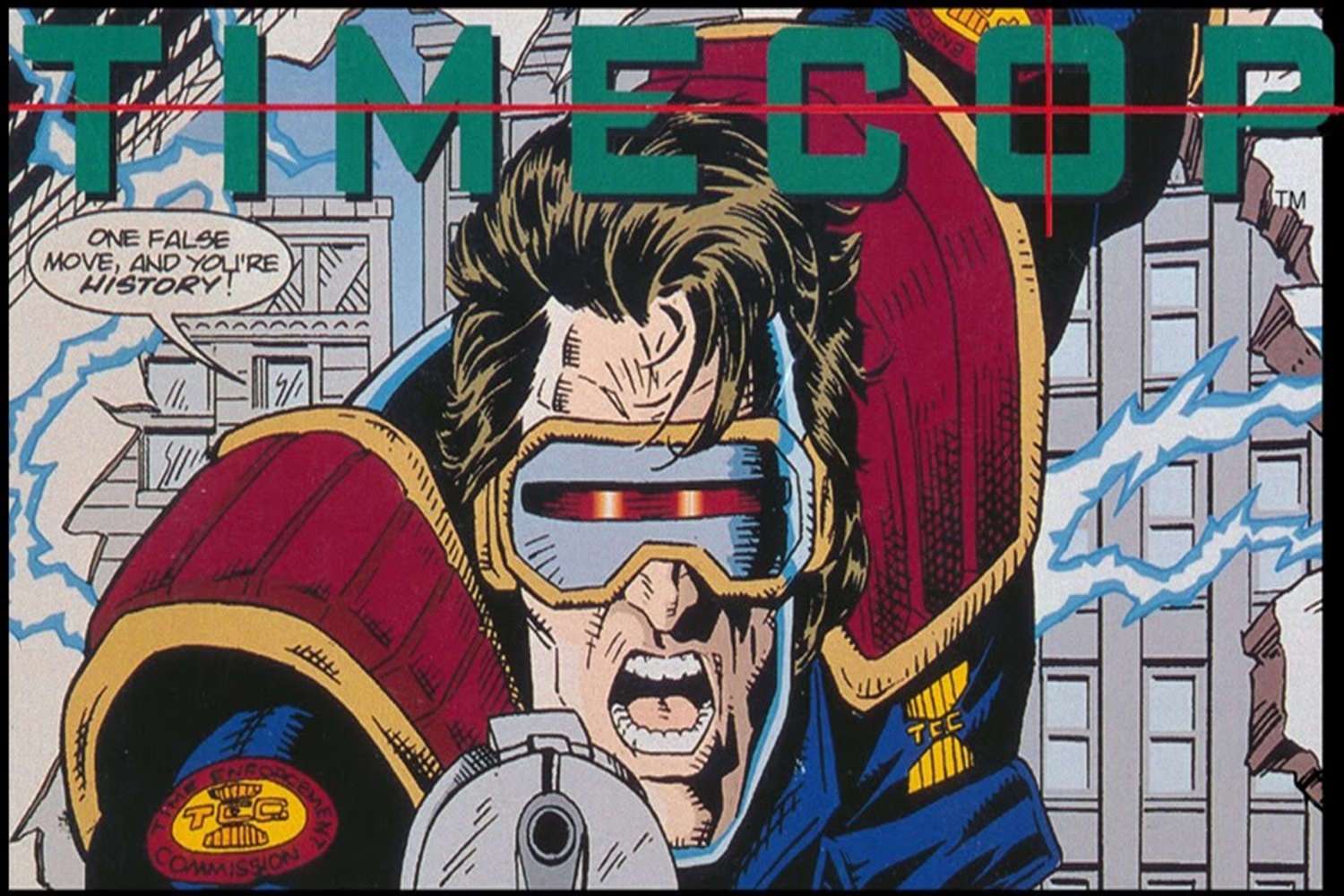
Timecop is a 1995 side-scrolling action game that transforms the science-fiction premise of the Jean-Claude Van Damme film into a lengthy 16-bit journey across multiple periods of history. Players take control of Time Enforcement Commission agent Max Walker, who travels through time pursuing criminals attempting to manipulate past events for their own benefit. Instead of remaining within a single city or era, the adventure moves between dramatically different historical settings, giving each group of stages its own atmosphere, enemies, and hazards. Martial arts combat, firearms, platforming, and occasional special gameplay sequences combine to create an action game that constantly changes its surroundings while keeping Max's mission moving forward.
Developed by Cryo Interactive, Timecop stands out visually because of its digitized characters. Actors were filmed performing punches, kicks, jumps, reactions, and other movements, then converted into detailed sprites that give Max and his enemies a more realistic appearance than the hand-drawn characters commonly seen in SNES games. The technique fits especially well with a title based on a live-action movie, making the game feel closer to its cinematic source material. Beneath that presentation is a traditional action-platforming structure where players need to defeat enemies, navigate dangerous environments, use weapons carefully, and reach the end of each mission.
Now playable online through Lemon Web Games, Timecop brings its time-travelling storyline, martial arts combat, digitized graphics, platforming, firearms, historical locations, and 15-stage adventure directly into the web browser. Players can guide Max Walker through different periods, battle criminals attempting to interfere with history, and adapt to stages that occasionally move beyond conventional side-scrolling action. The variety of locations gives the campaign a strong sense of progression, while increasingly dangerous enemies demand more careful use of Max's attacks and limited weapons. For fans of 1990s movie adaptations and unusual SNES action games, Timecop remains an interesting journey through both history and the experimental design trends of the 16-bit era.
Max Walker Returns to Protect the Timeline
Max Walker is an agent of the Time Enforcement Commission, an organization responsible for preventing criminals from using time travel to change history. The technology has enormous potential for abuse because someone who can access the past could influence money, political events, valuable resources, or entire future outcomes.
The game places Max directly into this ongoing struggle. Criminal interference has begun appearing across different eras, forcing him to travel through time and repair the damage before history is permanently altered.
This gives the game a convenient reason to constantly change its setting. A mission can begin in one decade and then suddenly send Max hundreds of years forward or backward. Time travel becomes both the story premise and the source of much of the level variety.
A New Threat Drives the Game's Story
Rather than simply recreating every event from the film exactly, the game continues the idea of Max fighting criminals who exploit temporal technology. The dangerous Dr. Hans Kleindast becomes one of the central threats connected to the disruption of history.
Max therefore spends much of the adventure pursuing enemies across different periods rather than remaining in his own time. Each mission represents another attempt to prevent history from being manipulated.
The plot remains straightforward enough that it never overwhelms the action. Timecop is primarily interested in providing reasons for Max to travel somewhere new, fight another group of enemies, and continue moving toward the people responsible for the temporal chaos.
Time Travel Gives Every Area a Different Identity
The most distinctive feature of Timecop is the way its stages jump between eras. Instead of repeatedly travelling through modern streets, Max can find himself in historical environments separated by decades.
These changes affect much more than the background artwork. Buildings, vehicles, clothing, scenery, and environmental hazards all reflect the period being visited. Enemies also fit the locations, helping each section feel different from the last.
The constant time shifts provide a strong sense of adventure. Players never know exactly what kind of environment will appear next, and reaching a new era feels like entering another chapter of the campaign.
1920s New York Creates an Early Historical Setting
One of the memorable periods visited during the game is 1920s New York. Streets, buildings, vehicles, and enemies adopt a style appropriate to the period, immediately separating these stages from futuristic locations.
The urban layout works naturally with Timecop's side-scrolling combat. Max moves through streets and buildings while dealing with criminals who stand between him and the next temporal objective.
The historical setting also reinforces the danger of altering the past. Even though Max possesses knowledge and equipment from the future, he needs to operate inside an earlier world without allowing criminals to reshape events.
World War II Provides a More Dangerous Battlefield
Another portion of the campaign moves into the World War II era, changing the atmosphere considerably. Military environments naturally introduce different kinds of enemies and hazards compared with ordinary city streets.
The setting allows Timecop to mix its science-fiction premise with wartime imagery. Max is effectively an outsider from the future moving through a conflict that already has enormous historical consequences.
This period also makes the idea of temporal interference particularly dramatic. Any major change could potentially alter decades of history, increasing the importance of stopping the criminals responsible.
Future Los Angeles Brings the Story Back Toward Science Fiction
Timecop eventually moves into more futuristic environments where the game's science-fiction identity becomes much more visible. Technology, architecture, and enemies increasingly reflect the world Max originally comes from.
These locations contrast sharply with historical stages. After travelling through streets belonging to earlier decades, futuristic Los Angeles reminds players that Max himself originates from a technologically advanced period where time travel has become possible.
The shift also makes the campaign feel like a complete journey rather than a simple historical tour. Timecop moves backward and forward as the story requires, continually changing what the player sees.
Fifteen Stages Create a Substantial Adventure
Timecop contains 15 stages, giving the campaign enough length to explore several settings and gameplay ideas. Each stage pushes Max toward another point in the temporal conspiracy.
The structure is generally linear, keeping the focus on combat and movement rather than exploration of a large interconnected world. Players progress through each environment until the current objective has been completed.
Because the locations change regularly, the level count feels more varied than it might in a game using only one visual theme. Historical shifts give the campaign natural milestones.
Martial Arts Form the Core of Combat
Max is capable of fighting enemies directly using punches and kicks. His attacks reflect the martial arts style associated with the film and Jean-Claude Van Damme's action persona.
Different attacks work best at different distances. Punches are useful when enemies are close, while kicks can provide additional reach and help keep opponents away from Max.
The combat is straightforward but benefits from timing. Attacking continuously without considering enemy position can leave Max exposed, particularly when several opponents approach from different directions.
Kicks Give Max Additional Reach
Kicking is one of Max's most useful tools because it allows him to strike enemies without standing directly beside them. Against slower opponents, keeping the correct distance can reduce the amount of damage taken.
The digitized animation gives these attacks additional visual personality. Max's martial arts movements resemble actions performed by a real actor rather than being constructed entirely from hand-drawn frames.
This reinforces the game's connection with its cinematic origins. Combat may remain relatively simple mechanically, but the animation helps make each attack visually recognizable.
Firearms Provide More Powerful Options
Max can also use guns during certain parts of the adventure. Firearms allow enemies to be attacked from a safer distance and can be extremely useful when several opponents occupy the path ahead.
Ammunition is not something players should waste carelessly. Unlike Max's punches and kicks, firearms depend on available supplies, making them more valuable during difficult encounters.
This creates a simple strategic choice. Weaker enemies may be better handled through martial arts, allowing ammunition to be preserved for situations where approaching closely would be much more dangerous.
Combat Becomes Harder Against Groups
Fighting one enemy is relatively manageable because Max can focus completely on that opponent. Problems begin when several enemies attack simultaneously.
An opponent approaching from behind can interrupt attacks directed forward, while ranged enemies can create additional pressure. Positioning therefore becomes increasingly important.
Players benefit from preventing enemies from surrounding Max. Moving to one side of a group can reduce the number of opponents able to attack at once and make the encounter easier to control.
Platforming Breaks Up the Fighting
Timecop is not purely a beat 'em up. Many stages contain jumping sections, elevated platforms, gaps, environmental hazards, and obstacles that require careful movement.
These sequences prevent combat from becoming the only activity. Players may defeat several enemies and then immediately need to navigate a dangerous platforming section.
The combination also suits the changing historical settings. Different environments can introduce obstacles appropriate to their locations while still using the same fundamental movement mechanics.
Jumping Requires More Precision Than It First Appears
Max's realistic digitized animation gives his movement a distinctive appearance, but players still need to understand exactly how far he can jump. Misjudging a platform can result in damage or having to repeat part of a stage.
Moving platforms and environmental hazards make timing increasingly important. Some jumps are safest when approached patiently rather than attempted immediately.
As the campaign progresses, platforming and combat often begin overlapping. An enemy placed near a dangerous gap can turn a simple fight into a much more complicated encounter.
Environmental Hazards Keep Players Moving Carefully
Not every danger is another human opponent. Different eras contain environmental threats that can damage Max or immediately disrupt progress.
Players therefore need to observe the surroundings rather than simply advancing while attacking. A seemingly clear route can still contain a hazard that requires careful timing.
These dangers become particularly effective during stages where enemies are positioned nearby. Dividing attention between combat and the environment creates some of the game's more demanding moments.
Special Sequences Change the Pace
Timecop occasionally moves away from conventional side-scrolling action and introduces special gameplay sequences. These moments help keep the 15-stage campaign from feeling like one continuous corridor of punching and jumping.
Vehicle-related action and other unusual sections provide temporary changes in mechanics. Players need to adapt quickly because skills developed during ordinary platforming may not apply in exactly the same way.
These stages also reinforce the cinematic character of the game. A movie-inspired action adventure benefits from occasional set pieces that feel larger or faster than normal exploration.
Underwater Action Adds Another Type of Challenge
Some portions of Timecop introduce underwater gameplay, changing both movement and environmental danger. Max behaves differently when moving through water, forcing players to adjust their usual timing.
The slower movement can make enemies and hazards more difficult to avoid. Actions that would be simple on land require greater planning underwater.
This variety prevents the game from relying exclusively on its martial arts mechanics. Each special sequence asks players to understand another small set of rules before returning to more familiar action.
Digitized Actors Give Timecop Its Distinctive Look
The visual presentation is one of the most interesting aspects of Timecop. Instead of relying entirely on traditional pixel artists to animate the characters, the development team recorded real performers and converted their movements into game graphics.
This technique had become increasingly popular during the 1990s, particularly after games such as Mortal Kombat demonstrated how striking digitized actors could look on contemporary hardware. Timecop applies the idea to a side-scrolling action adventure rather than a dedicated fighting game.
The result gives Max and his enemies proportions and movements that look noticeably different from ordinary SNES sprites. Even today, the unusual visual style is one of the first things that stands out.
The Animation Supports the Martial Arts Theme
Digitization works particularly well with Max's fighting moves. Punches, kicks, crouches, jumps, and reactions are based on physical performances, giving them a sense of natural movement.
The technique also reinforces the connection with the live-action film. Although the game does not simply reproduce Jean-Claude Van Damme as a photographic character in every detail, the realistic style clearly aims to capture the feeling of human performers.
For a mid-1990s console game, this approach was technically ambitious. Large character sprites and detailed animation consume valuable memory, making the presentation an important part of the game's identity.
The Film Provides the Foundation Without Limiting the Game
Timecop takes its central ideas from the movie: Max Walker, the Time Enforcement Commission, criminal misuse of time travel, and the danger of altering history. However, the game expands these ideas into its own sequence of missions.
This allows the designers to create stages that work as video game environments rather than attempting to reproduce every scene from the film exactly. New locations and situations can be introduced whenever they support the gameplay.
The approach makes the game feel connected to Timecop while still standing as its own adventure. Fans recognize the universe, but they are not simply watching a compressed version of the movie.
Health Management Becomes Important
Max can survive several attacks, but careless combat gradually drains his health. Entering every encounter aggressively can therefore create problems later in a stage.
Avoiding unnecessary damage is often more valuable than defeating enemies quickly. Maintaining distance, using kicks effectively, and preserving firearms for difficult situations can keep Max healthier.
This becomes increasingly important when stages combine combat with dangerous platforming. Losing too much health early leaves little margin for later mistakes.
Enemy Placement Encourages Caution
Many enemies are positioned specifically to interfere with movement. Some wait near platforms, while others approach shortly after Max enters a particular area.
Charging forward without checking what lies ahead can therefore trigger multiple threats simultaneously. Moving more carefully allows enemies to be dealt with individually.
Repeated attempts naturally make stages easier because players begin remembering where attacks occur. Knowledge becomes part of progression even though Max himself does not gain permanent levels or statistics.
Memorization Helps With Difficult Sections
Like many 16-bit action games, Timecop expects players to learn from failure. Enemy placements, dangerous jumps, hazards, and special sequences often become much easier after the first attempt.
Knowing that an enemy will appear from a particular direction allows the player to prepare before the attack begins. Similarly, remembering the timing of a moving hazard can turn a difficult platforming section into something predictable.
This gives the game an old-school learning curve. Success comes from improving execution and understanding the level rather than relying on permanent upgrades.
The Music Supports the Changing Eras
Timecop uses music to help distinguish its different environments and maintain the energy of the action. Historical locations and futuristic settings each benefit from their own atmosphere.
The soundtrack accompanies most of the gameplay without overwhelming the sound effects. Punches, gunshots, enemy hits, and environmental events remain easy to recognize.
Together with the digitized visuals, the audio contributes to the game's cinematic ambitions. Timecop clearly wants to feel like an action movie translated into a cartridge.
The Historical Variety Keeps the Campaign Fresh
One of the dangers of a lengthy side-scrolling action game is visual repetition. Timecop avoids much of this by using time travel to justify frequent environmental changes.
A stage set in 1920s New York naturally looks different from one taking place around World War II or in futuristic Los Angeles. Different scenery helps each section establish its own identity even when the basic combat remains familiar.
The changing eras also create anticipation. Completing a set of stages raises the question of where Max will be sent next.
Movie-Based Games Were Everywhere in the 16-Bit Era
The SNES generation saw countless films transformed into platformers, action games, and beat 'em ups. Some adaptations barely resembled their source material, while others attempted to recreate recognizable characters and scenes.
Timecop sits somewhere between those approaches. It uses the film's central premise and protagonist but expands the story into a wider time-travelling adventure designed around traditional game mechanics.
Its digitized presentation also separates it from many contemporary licensed games. The developers clearly wanted Timecop to retain some connection to live-action cinema rather than appearing like a completely cartoon-style adaptation.
Playing Timecop Online Today
Through Lemon Web Games, Timecop can now be played directly in your web browser with no downloads or setup required. Features of the web-based version include:
New players should become comfortable with Max's basic punches, kicks, and jump distance before trying to rush through stages. Kicks are especially useful for controlling distance, while firearms are better preserved for enemies that are dangerous to approach directly.
It is also worth moving carefully into unfamiliar areas. Enemy placement and environmental hazards frequently punish players who advance too quickly. Once a stage becomes familiar, progress can be considerably faster and safer.
Who Should Play Timecop
Timecop is particularly interesting for players who enjoy seeing how developers adapted live-action films during the 16-bit era. Its combination of digitized characters, historical environments, martial arts, gunplay, and time travel gives it an identity quite different from a conventional cartoon platformer.
It should also appeal to players who prefer games that regularly change their scenery and mechanics. The 15-stage campaign moves through several periods and includes enough special sequences to keep the adventure from relying solely on standard fighting.
Play Timecop Online Now
Timecop turns the movie's time-travel premise into a 16-bit action adventure where history itself becomes the battlefield. Guide Max Walker across multiple eras, defeat criminals interfering with the timeline, fight with punches and kicks, use firearms when necessary, navigate dangerous platforming sections, and survive special missions that push the action beyond conventional side-scrolling gameplay.
Through Lemon Web Games, players can experience Timecop directly in a modern browser and revisit one of the more unusual movie adaptations of the SNES era. From historical New York and wartime environments to futuristic Los Angeles, every time jump brings another opportunity to protect the past before the future is permanently changed.
Final Thoughts
Timecop remains interesting because it uses time travel to solve one of the biggest challenges facing a traditional side-scrolling action game: keeping a long campaign visually varied. Instead of spending every level inside similar streets and buildings, Max Walker travels between periods that can look and feel dramatically different. The premise of the movie naturally becomes a useful structure for the game.
Its digitized character graphics also give the adventure a distinctive identity. Martial arts attacks based on filmed performers fit the Jean-Claude Van Damme connection particularly well, while punches, kicks, gunplay, and platforming provide enough mechanical variety to support the 15-stage journey. Special sequences and unusual environments further prevent the experience from becoming completely predictable.
Through Lemon Web Games, Timecop can now be enjoyed directly in the browser as a fascinating piece of mid-1990s licensed-game history. It combines cinematic ambitions, live-action-inspired visuals, traditional 16-bit mechanics, and a time-travel story that continually sends players somewhere new. For fans of retro action games, movie adaptations, or simply the wonderfully experimental style of the SNES era, Max Walker's fight to protect history remains worth revisiting.











Comments 0