

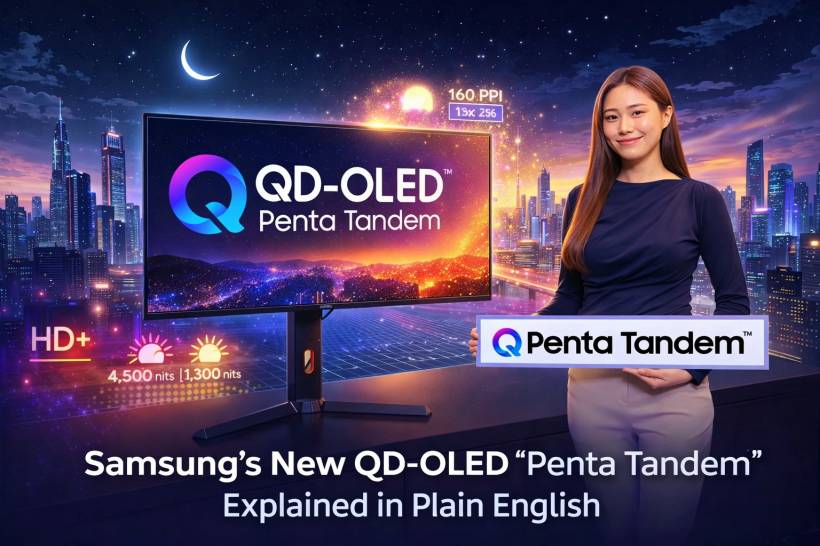
Samsung has just pulled the curtain back on a new twist to its QD-OLED lineup, called QD-OLED Penta Tandem. If that name sounds like a marketing bingo card, the idea behind it is actually pretty practical: it's a new way of stacking OLED light-emitting layers so the display can get brighter, more efficient, and sharper, without needing to increase the physical size of the panel.
This matters because the last few years of display upgrades haven't just been about resolution numbers. They've been about whether a screen can stay bright in real scenes (not just test patterns), keep colors looking accurate at high brightness, and hold up over time without wearing out too quickly. Penta Tandem is Samsung's attempt to push all three at once.
Quick refresher: What makes QD-OLED different?
QD-OLED is Samsung Display's approach to combining two things people already like.
First, OLED gives you pixel-level control. Each pixel creates its own light, so blacks look properly black, contrast is strong, and motion tends to look clean.
Second, quantum dots are used to produce color. Instead of relying only on traditional color filtering, quantum dots respond to light and help generate rich color output. In Samsung's approach, a blue-emitting layer acts as the main light source, and the quantum dots convert part of that blue light into other colors.
So in normal terms, the blue layer is doing a lot of heavy lifting. If you can improve that blue light source, you can usually improve the whole display.
What "Penta Tandem" actually means
The "Penta" part is the clue: Samsung Display has moved from stacking four blue-emitting OLED layers to stacking five. It's essentially a five-layer organic LED stack, using newer organic materials in that stack.
Why stack layers at all? Because you can get more light output (or the same light output with less power) by spreading the workload across more layers. That can improve efficiency and reduce stress on any single layer, which is one reason companies talk about longer lifespan when they improve the stack design.
In short, Penta Tandem is about getting more performance out of the same size panel by improving how the light is generated internally.
The sharpness angle: higher pixel density without changing the screen size
One of the biggest practical outcomes Samsung is highlighting is pixel density, especially on monitors. The example they point to is a 27-inch UHD (3840×2160) QD-OLED panel that hits 160 pixels per inch (PPI), which is extremely high for a self-emissive gaming monitor.
That number matters because 4K on 27 inches is the point where text, UI elements, and fine details start to look very crisp even up close. It's not just about games looking sharper; it's also about day-to-day use like reading, editing, and working with lots of small interface elements.
Samsung positions Penta Tandem as a core foundation that helps enable that kind of density in a self-emissive panel, and it also claims it's currently the only company mass-producing 27-inch UHD self-emissive displays at that 160 PPI level.
The brightness and efficiency angle: why "nits" is only part of the story
Samsung says Penta Tandem delivers 1.3x higher luminous efficiency than the previous generation, plus roughly double the lifespan. Efficiency is the less flashy number compared to brightness, but it's often the one that determines whether high brightness is actually usable for long periods.
Then there's the headline brightness claims:
Peak brightness figures like these are usually measured in small highlight windows rather than full-screen brightness, but they still matter for HDR. Bright highlights in HDR scenes (like sunlight reflections, sparks, neon signs, or specular highlights on metal) are what make HDR feel "real" when the panel can deliver them cleanly without washing out color.
If the efficiency improvement is doing what Samsung suggests, the more important win is that the panel can hit high highlights with less strain, and ideally maintain better consistency over time.
What's next: bigger and wider monitor formats
Samsung also says it plans to expand the QD-OLED Penta Tandem range this year, including a 49-inch Dual QHD (5120×1440) monitor format. That kind of panel size and resolution is usually aimed at people who want an ultra-wide desktop setup for multitasking, immersive gaming, or a cleaner "two monitors without the bezel" workflow.
If Penta Tandem's efficiency and lifespan claims hold up, formats like 49-inch ultra-wide could benefit a lot, because large bright panels are exactly where heat, power, and long-term durability start becoming real concerns.
Final thoughts
If you strip away the branding, Samsung's message is pretty straightforward: improve the blue light source by stacking more layers and using newer materials, and you unlock sharper panels, higher HDR punch, better efficiency, and longer life. Penta Tandem sounds like a small technical tweak, but in OLED land, the internal stack design often decides whether a panel feels like a minor refresh or a real step forward.











Comments 0