

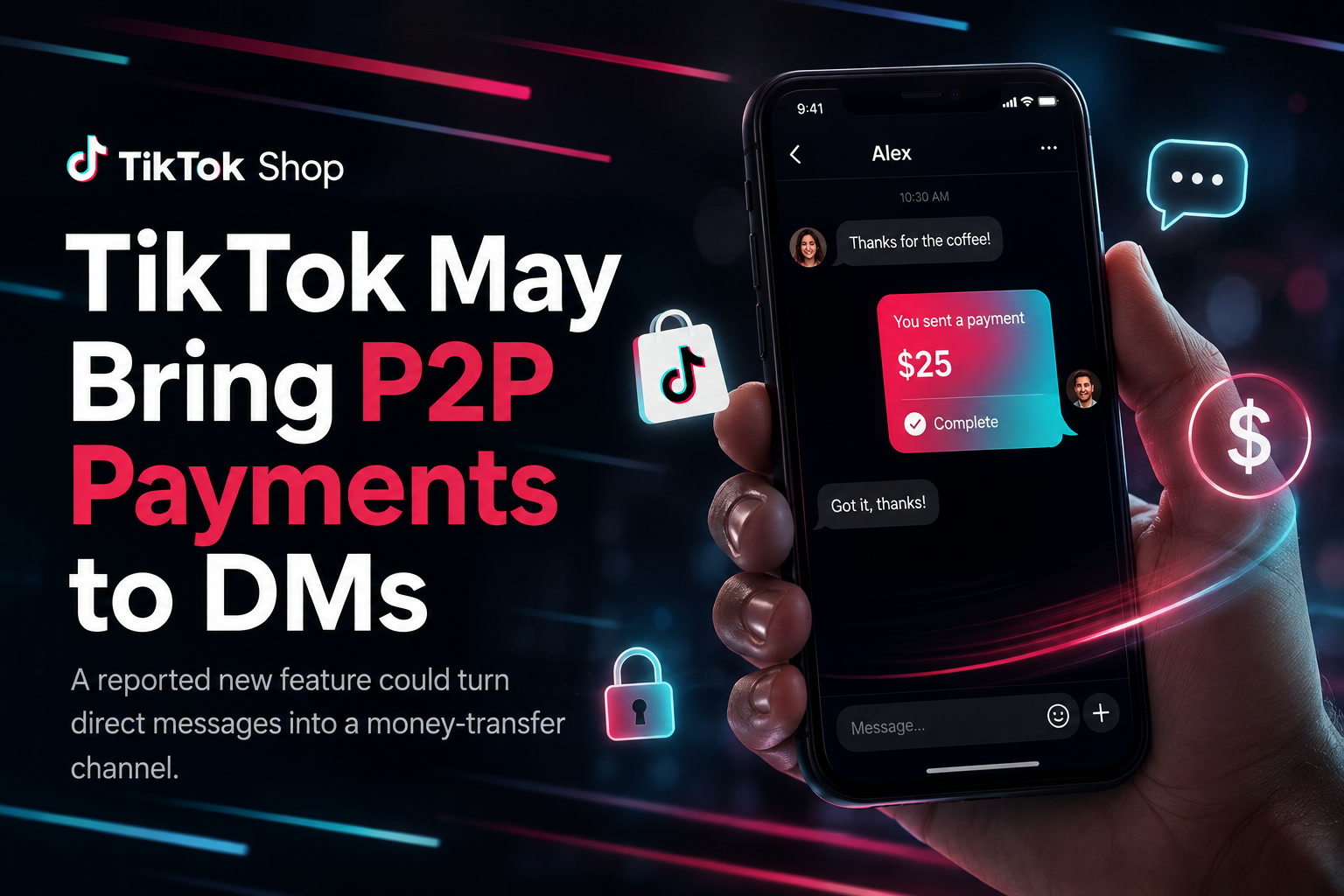
TikTok has spent the past few years transforming itself from a short-video app into something much bigger. Shopping, livestream commerce, virtual gifts and creator monetisation are already deeply integrated into the platform, and now TikTok may be preparing another major expansion: letting users send money directly to each other through private messages.
According to a recent report citing Bloomberg, hidden code discovered inside the current US version of TikTok's iPhone app contains references to peer-to-peer payments. The feature is reportedly still at an early stage of development and, importantly, TikTok says it is not currently being tested in any market.
So don't expect a "Send Money" button to suddenly appear in your inbox tomorrow. Still, the discovery provides an interesting glimpse at where TikTok could be heading next.
Your TikTok Inbox Could Eventually Become a Payment App
The concept appears surprisingly straightforward.
Instead of leaving TikTok, opening an e-wallet or banking application, entering someone's account information and transferring money separately, users could theoretically send money directly from an existing TikTok conversation.
Based on the code reportedly uncovered in the app, the system could include features such as:
That final feature would make TikTok payments feel somewhat similar to services such as Venmo, where users can include a short description explaining what a payment is for.
Imagine chatting with a friend about splitting dinner, concert tickets or a shared purchase and simply transferring their share without leaving the conversation.
Convenient? Absolutely.
But it also introduces some interesting questions.
TikTok Already Has the Payment Infrastructure
This idea isn't appearing out of nowhere.
TikTok already handles enormous amounts of money through its ecosystem. Users purchase products through TikTok Shop, buy virtual coins, send gifts during livestreams and interact with creators whose virtual gifts can ultimately translate into earnings.
In Malaysia, TikTok Pay is already a recognised payment product. Bank Negara Malaysia lists PIPO (MY) Sdn. Bhd., a ByteDance-related company, as both a registered merchant acquirer and non-bank e-money issuer, with TikTok Pay listed as its e-money product.
TikTok itself has also been actively promoting TikTok Pay locally. In June 2026, TikTok Shop Malaysia announced additional discounts for shoppers paying for selected groceries and daily necessities using TikTok Pay as part of its collaboration with Malaysia's Ministry of Domestic Trade and Cost of Living.
That makes Malaysia particularly interesting if TikTok eventually decides to expand into person-to-person payments.
The financial plumbing, at least to some extent, already exists.
From Buying Things to Sending Money
There is an important difference between today's TikTok Pay and what is reportedly being developed.
Currently, TikTok Pay primarily sits within TikTok's commercial ecosystem — you use it when buying something.
Peer-to-peer payments would turn it into something much closer to an everyday digital wallet.
Instead of:
TikTok could potentially support:
That seemingly small change would significantly broaden TikTok's role in someone's digital life.
TikTok would no longer just be where you discover the restaurant, watch the creator reviewing it and perhaps purchase something they recommend. It could eventually become the place where you also send your friend RM20 for lunch afterward.
And that fits neatly into ByteDance's broader strategy of keeping more activity inside its own ecosystem.
TikTok Is Becoming Much More Than a Video App
Social media platforms have increasingly realised that attention alone isn't necessarily the most valuable thing they own.
The real opportunity comes when users can discover something, talk about it, purchase it and complete the transaction without ever leaving the platform.
TikTok has already made significant progress towards that model.
Today, the app combines:
Adding direct money transfers would connect yet another piece of that ecosystem.
And TikTok certainly has the transaction volume to justify experimenting with financial services. The platform has repeatedly ranked among the world's biggest generators of consumer spending through mobile apps, driven heavily by virtual coins, gifts and commerce.
In other words, TikTok isn't starting from zero. Its users are already comfortable spending money inside the app.
The challenge is convincing them that sending money through TikTok should feel just as normal.
Convenient? Definitely. But This Could Also Get Messy
There's an obvious appeal to peer-to-peer payments.
If you're already talking to someone, why shouldn't you be able to send them money with a couple of taps?
Unfortunately, that same convenience could also become the feature's biggest weakness.
Social media scams work partly because conversations feel personal and immediate. A compromised account can convincingly pretend to be a friend, family member or creator — and suddenly having a payment button sitting inside that same conversation could make scams significantly easier to execute.
You can imagine messages such as:
Or:
Today, a victim would normally have to leave TikTok, open their banking app and consciously initiate a payment.
Every additional step creates friction — and occasionally gives someone enough time to realise something isn't right.
An integrated payment button removes some of that friction.
Scams Would Be One of TikTok's Biggest Challenges
If TikTok eventually launches peer-to-peer payments, strong safeguards would be absolutely essential.
At minimum, you would expect measures such as:
TikTok would also need to determine how aggressively it should intervene when its systems detect suspicious conversations immediately before a transfer.
That's considerably more complicated than simply building a money-transfer button.
Younger Users Make This Even More Sensitive
TikTok's popularity among younger audiences creates another layer of complexity.
Making payments as simple as sending a message could encourage impulse spending, especially when the payment request appears alongside content, influencers, livestreams or conversations engineered to create urgency.
That doesn't automatically make peer-to-peer payments dangerous, of course. Services such as PayPal, Venmo and numerous regional e-wallets already allow people to transfer money easily.
The difference is context.
A traditional banking application exists primarily to manage money.
TikTok exists primarily to keep you watching, interacting, discovering and engaging.
Combining those environments means financial decisions could increasingly happen while users are already being influenced by entertainment, creators, advertising and social interaction.
That's something regulators would almost certainly pay close attention to.
Malaysia Could Be an Interesting Market to Watch
For Malaysians, the story is particularly relevant because TikTok already has an established commerce ecosystem here.
TikTok Shop is widely available locally, while TikTok Pay is already being used for purchases and promotions. Malaysia also has an underlying regulated payment entity associated with the service.
That doesn't mean Malaysia will receive peer-to-peer payments — TikTok hasn't announced any launch markets at all.
But if the company eventually decides to expand the feature beyond experimentation, countries where TikTok commerce and payment infrastructure are already mature could logically be attractive candidates.
For now, however, that's speculation.
And There's Still a Good Chance This Never Launches
It's worth emphasising this point.
Finding code inside an application does not guarantee that the corresponding feature will ever reach users.
Technology companies routinely build prototypes, run internal experiments and prepare features that are eventually changed or cancelled altogether.
TikTok has explicitly said the peer-to-peer payment functionality isn't currently being tested publicly, and there is no confirmed launch date.
The safest interpretation right now is therefore:
That distinction matters.
Final Thoughts
A few years ago, the idea of sending money through TikTok would have sounded strangely out of place.
Today? Not so much.
TikTok has steadily evolved from an entertainment platform into a massive combination of social media, e-commerce, advertising, creator monetisation and digital payments. Peer-to-peer transfers would simply push that transformation one step further.
From a convenience standpoint, the idea makes perfect sense. If you're already messaging someone, being able to settle a small payment without jumping between apps could be genuinely useful.
But money changes the stakes.
Once direct payments become part of social conversations, TikTok would need extremely robust protections against scams, compromised accounts, financial manipulation and impulsive transactions — particularly considering the number of younger users on the platform.
So for now, it's an intriguing feature hidden inside some code rather than something you can actually use.
But if TikTok eventually switches it on, your TikTok inbox could become much more than a place for sharing videos — it could also become another digital wallet.











Comments 0