

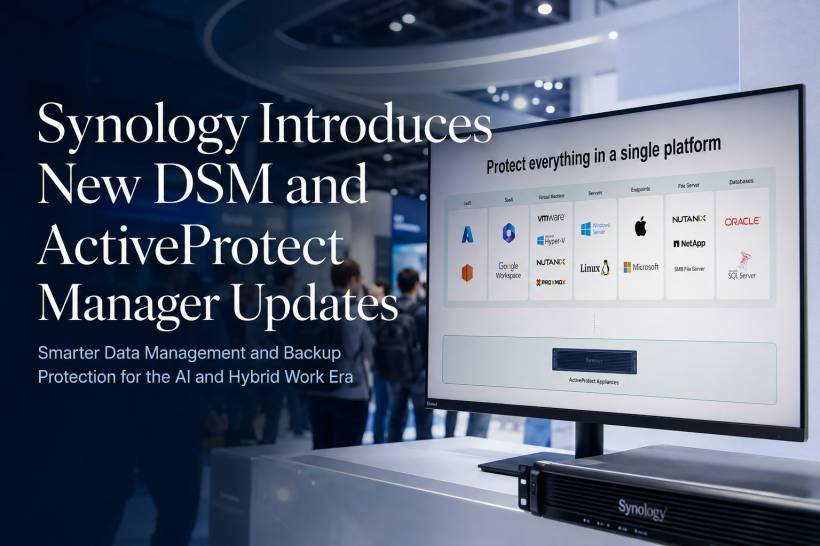
Synology has announced a new set of data management and protection updates as part of its Computex 2026 showcase, with the company focusing heavily on how businesses can manage their data more effectively in an AI-driven and hybrid working world.
The announcement includes the next generation of DiskStation Manager, better known as DSM, as well as ActiveProtect Manager 2.0. Together, these updates show where Synology is heading as NAS systems become more than just file storage boxes. For many organisations, NAS devices are now part of a wider data strategy involving backup, cybersecurity, collaboration, governance, monitoring, and increasingly, artificial intelligence.
In short, Synology seems to be positioning its ecosystem as a more complete business data platform, not just a place to store files.
DSM Is Moving Further Into the AI Era
DiskStation Manager has long been the core software experience behind Synology NAS systems. It is the interface that allows users and businesses to manage storage, users, permissions, applications, backups, surveillance, file sharing, and many other NAS functions.
With the next generation of DSM, Synology is clearly preparing for a future where AI becomes more closely tied to business data. One of the more notable changes is support for GPU-equipped NAS systems and dedicated AI appliances. This matters because AI workloads can be demanding, especially when businesses want to analyse, classify, search, or process large volumes of internal data.
Instead of relying fully on external cloud platforms, Synology's approach would allow more AI processing to happen locally. For businesses, this can be attractive because local processing may offer better control over sensitive data, lower dependency on third-party cloud services, and potentially better compliance with internal data policies.
Why Local AI Processing Matters
AI is becoming a bigger part of business operations, but it also raises important questions about privacy, access control, and data ownership. Many organisations want the benefits of AI, but they may not be comfortable sending sensitive internal files, customer data, financial records, legal documents, or operational information to external platforms.
This is where local AI processing becomes useful. If a business can run AI-powered tools on its own infrastructure, it gains more control over where the data stays and how it is handled. This is especially relevant for industries such as healthcare, finance, legal services, education, and government-linked organisations, where data governance is a serious concern.
Synology's plan to support GPU NAS systems and AI-focused appliances suggests that it wants to give organisations a way to bring AI closer to their own data environment.
Stronger Governance andAccess Control
Synology is also adding more governance-focused features into DSM. These include built-in guardrails, expanded Role-Based Access Control, and better visibility into how organisational data is accessed and used.
This is important because as data grows, managing access becomes more complicated. In a small office, it may be simple enough to know who has access to which folder. In a larger organisation, access rights can become messy very quickly. Employees change departments, external partners may need temporary access, and teams may create shared folders that outlive their original purpose.
Expanded Role-Based Access Control helps organisations manage permissions more systematically. Instead of giving access randomly or manually to every individual, businesses can define roles and apply access rights based on job function or responsibility.
Improved visibility into data access is also useful from a security and compliance perspective. If administrators can better understand who is accessing what, when, and how often, they can detect unusual behaviour earlier and maintain better accountability.
Better Tools for Larger Organisations
Beyond AI and governance, Synology is also introducing features that appear to target larger and more complex IT environments. These include enhanced system monitoring, centralised log management, Cluster Manager, and mass deployment capabilities.
These may sound less exciting than AI, but for IT teams, they are often the features that matter most day to day. Centralised monitoring allows administrators to keep track of system health across multiple devices. Centralised logs make troubleshooting and auditing easier. Cluster management can help organisations maintain availability and resilience. Mass deployment tools can reduce the time needed to roll out systems across many sites or departments.
For companies managing multiple NAS units, branch offices, remote teams, or hybrid infrastructure, these improvements could make DSM more practical at scale.
ActiveProtect Manager 2.0 Focuses on Smarter Backup Security
Alongside DSM, Synology also introduced ActiveProtect Manager 2.0, or APM 2.0. This update is focused on backup protection, which is becoming increasingly important as ransomware, malware, and data corruption remain serious business risks.
A backup is only useful if it is clean, available, and recoverable. If malware reaches backup data, or if compromised files are backed up without detection, organisations may find themselves in trouble when they need to restore systems.
To address this, APM 2.0 uses AI-powered threat detection to identify suspicious activity, anomalies, and malware that may affect backup data. The goal is to detect possible threats before they compromise the recovery process.
Auto Fallback Could Help During Recovery
One of the more interesting features in ActiveProtect Manager 2.0 is the Auto Fallback mechanism. When a threat is detected, the system can fall back to the last known clean backup version.
This is especially important in ransomware scenarios. If an organisation accidentally backs up encrypted or infected files, restoring from that backup may not solve the problem. A smarter system that can identify the last uncompromised backup gives IT teams a better chance of recovering safely.
Of course, this does not remove the need for proper cybersecurity practices, endpoint protection, network segmentation, and backup policies. However, it adds another layer of defence to the backup environment, which is exactly where many organisations need more protection.
Broader Support for Cloud and Virtualisation Platforms
ActiveProtect Manager 2.0 is also expanding its coverage across major cloud and virtualisation platforms. Synology says the new version will support Microsoft Azure Virtual Machines, Amazon EC2, Nutanix AHV, Proxmox VE, and Google Workspace.
This is a practical move because modern business data is rarely stored in only one place. A company may have local servers, cloud virtual machines, SaaS platforms, remote users, and on-premise NAS systems all operating together. Backup tools need to follow that reality.
By extending support to more platforms, Synology is making ActiveProtect Manager more relevant for hybrid environments. Businesses that use a mix of on-premise infrastructure and cloud services may find it easier to centralise backup visibility and protection.
Third-Party Antivirus Integration
Synology also says that ActiveProtect Manager 2.0 can integrate with third-party antivirus tools for malware scanning. This is another useful addition because many organisations already have existing security tools and policies in place.
Instead of forcing businesses into a completely separate ecosystem, antivirus integration can allow Synology's backup protection to work alongside existing security solutions. This can make adoption easier for IT teams that already depend on approved antivirus platforms or corporate security standards.
Not Everything Will Arrive Immediately
While the announcement is promising, not all of these features will be available at once. Synology says the new DSM features will be introduced progressively across future DSM releases.
This means users should not expect every announced capability to appear immediately after the next update. Some features may arrive earlier, while others may take longer depending on hardware support, software readiness, and regional rollout.
ActiveProtect Manager 2.0 is scheduled for release in the third quarter of 2026. Businesses interested in the new backup protection features will need to wait for Synology's official rollout and compatibility details.
Why This Announcement Matters
Synology's Computex 2026 announcement reflects a broader shift in the storage industry. NAS devices are no longer just about terabytes and drive bays. Businesses now need platforms that can help them manage data intelligently, protect backups from modern threats, support hybrid infrastructure, and prepare for AI-powered workflows.
For small businesses, this could mean easier backup management and better protection against data loss. For larger organisations, it could mean improved visibility, stronger access control, centralised monitoring, and better governance. For IT teams dealing with hybrid work and cloud workloads, broader platform support could make Synology's ecosystem more useful.
Final Thoughts
Synology's new DSM direction and ActiveProtect Manager 2.0 show that the company is trying to evolve beyond traditional NAS storage. The focus is now clearly on data intelligence, governance, AI readiness, cybersecurity, and hybrid infrastructure support.
The addition of local AI capabilities could be particularly important for organisations that want AI-powered tools without giving up control over sensitive data. Meanwhile, ActiveProtect Manager 2.0's AI-based threat detection and Auto Fallback feature could help strengthen backup resilience at a time when clean recovery points are more important than ever.
The main thing to watch now is timing. Since DSM features will arrive gradually and ActiveProtect Manager 2.0 is expected in Q3 2026, businesses will need to wait for more detailed rollout information. Still, the direction is clear: Synology wants its NAS and data protection ecosystem to play a bigger role in the modern business data environment.











Comments 0