

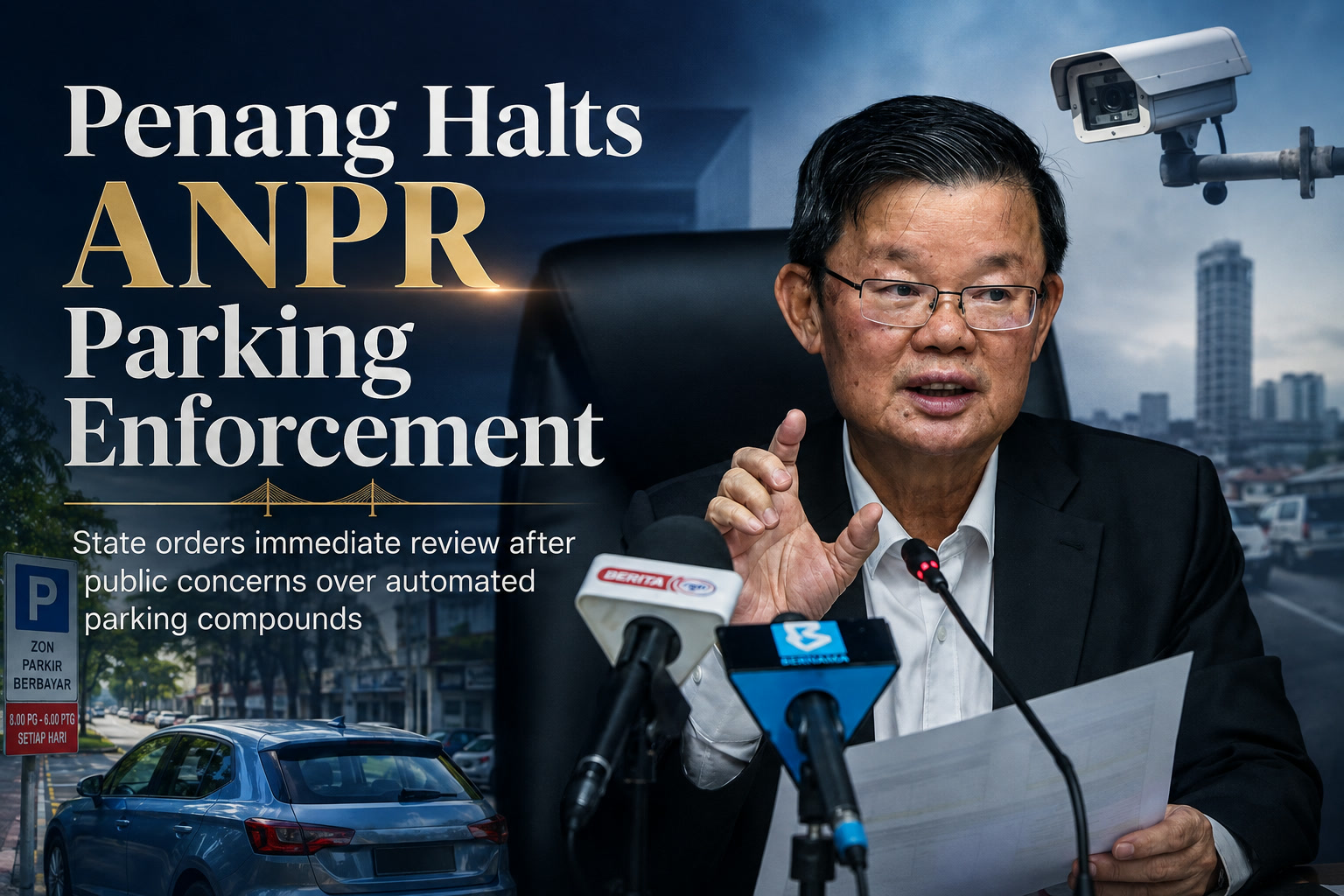
Penang has temporarily pulled the brakes on using Automatic Number Plate Recognition, or ANPR, for parking enforcement after growing public concern over how the system was being used to issue compounds.
Chief Minister Chow Kon Yeow said the state government has instructed both the Penang Island City Council (MBPP) and the Seberang Perai City Council (MBSP) to immediately suspend the implementation of ANPR for parking offences while the system is reviewed.
The decision follows feedback from residents who raised concerns about the technology, its enforcement approach and how quickly parking compounds could be issued through automated detection.
Penang Says Public Feedback Will Be Taken Into Account
According to Chow, the state government wants to reassess the system before deciding how it should move forward.
He stressed that public views must be considered when implementing policies that affect daily life, especially something as visible and widely used as public parking.
The issue was also discussed during a meeting involving Penang DAP chairman Steven Sim and deputy chairman Zairil Khir Johari following a Penang Pakatan Harapan leadership meeting.
For now, the main outcome is clear: ANPR-based parking enforcement is being paused while the state reviews its implementation details.
That does not necessarily mean the system is being abandoned completely. Instead, the suspension gives the state government and local councils an opportunity to examine what needs to be adjusted before automated enforcement potentially resumes.
ANPR Had Been Issuing Thousands Of Parking Compounds
The suspension is particularly notable because ANPR had already become a significant part of parking enforcement on Penang Island.
MBPP began operating its ANPR system on 24 April 2025, initially using two enforcement vehicles equipped with the technology.
According to MBPP Mayor Datuk A. Rajendran, the system had been generating an average of around 7,000 parking offence compounds every month.
That is a substantial number, especially considering MBPP manages close to 20,000 parking bays across the island.
From the council's perspective, the technology offered a much faster and more systematic way to monitor parking compliance than relying entirely on officers manually checking vehicles one by one.
How ANPR Parking Enforcement Works
ANPR technology uses cameras and software to automatically read vehicle registration numbers as an enforcement vehicle moves through parking areas.
The system can then compare those number plates against parking payment records or other enforcement information to determine whether a vehicle may be violating parking rules.
For local councils, this can dramatically increase coverage. A vehicle fitted with ANPR cameras can scan large numbers of parked cars in a relatively short period, potentially identifying offences much faster than traditional manual patrols.
That efficiency is also exactly why some residents became uneasy.
When enforcement becomes highly automated, motorists may feel there is less room for context, explanation or human discretion, especially when the system can detect and issue large numbers of compounds very quickly.
Efficiency Was One Of The Main Arguments For ANPR
There is little doubt that ANPR can make parking enforcement more efficient.
With thousands of parking bays under its management, MBPP has to monitor a very large area. Manual enforcement inevitably takes time, requires more personnel and may result in inconsistent coverage depending on where officers happen to be patrolling.
Automated number plate recognition changes that dramatically.
Instead of checking every vehicle physically, cameras can scan number plates continuously while software handles much of the matching process.
That can help councils identify unpaid parking more consistently and reduce the amount of repetitive manual work required from enforcement officers.
From an operational perspective, the attraction is obvious.
But Automated Enforcement Raises Different Questions
The controversy shows that efficiency alone is not enough to guarantee public acceptance.
Residents may want clearer answers about how ANPR data is collected, stored and used. They may also want to know whether every detected offence immediately results in a compound, how errors are handled and whether motorists have a practical way to challenge incorrect detections.
There are also broader questions about proportionality.
A system capable of scanning thousands of vehicles can potentially transform parking enforcement from occasional inspection into near-continuous monitoring. Even if the technology is accurate, people may still be uncomfortable with how aggressively it is deployed.
That does not automatically make ANPR a bad system, but it does mean transparency and clear safeguards become much more important once enforcement is automated.
The Technology Had Already Caused Unease
Concerns about Penang's ANPR implementation had already attracted public attention before the suspension.
Among those who reportedly raised questions was former Penang chief minister Lim Guan Eng, adding further political visibility to the issue.
The state government's response suggests officials recognise that the debate has moved beyond whether the technology technically works.
The issue now includes how it affects residents, whether the enforcement model feels fair and whether the public has enough information about how decisions are being made.
That is probably why the state has chosen to pause the programme rather than simply defend it based on efficiency figures.
A Review Could Lead To Changes Rather Than Cancellation
The next step will depend on what MBPP, MBSP and the state government find during the review.
Possible changes could involve how ANPR detections are verified, clearer notification procedures, stronger appeal mechanisms or more transparency about data handling.
The councils could also decide to use ANPR primarily as an enforcement aid rather than allowing the system to drive the entire process automatically.
For example, technology could identify potential offences while a human enforcement officer performs a final verification before a compound is issued.
Whether Penang chooses that approach remains to be seen, but the current pause creates an opportunity to reconsider the balance between automation and human oversight.
Parking Enforcement Still Needs To Continue
It is also worth remembering that suspending ANPR does not eliminate the underlying parking problem.
Penang still has thousands of public parking bays that need to be managed, and councils still need to deal with motorists who fail to pay or otherwise violate parking regulations.
If automated enforcement is reduced, the authorities may temporarily need to rely more heavily on traditional methods.
That could mean slower enforcement and more manpower requirements, which is precisely the challenge ANPR was introduced to address in the first place.
The real question is therefore not simply whether Penang should use technology for parking enforcement. It is how that technology should be deployed in a way that remains efficient without losing public trust.
The Issue Reflects A Wider Challenge With Smart-City Technology
Penang's experience is also a useful example of a broader challenge facing cities as they introduce more automated systems.
Cameras, AI, number plate recognition and digital enforcement can make municipal services significantly more efficient. They can monitor larger areas, process information faster and reduce repetitive work.
But once those systems begin making or influencing decisions that directly affect citizens, governance becomes just as important as technical capability.
People want to understand what data is being collected, who has access to it, how long it is retained and what happens when the technology gets something wrong.
A smart-city system that residents do not trust can quickly become politically difficult, regardless of how well it performs technically.
Final Thoughts
Penang's decision to suspend ANPR parking enforcement looks less like a rejection of technology and more like a recognition that automated enforcement needs public confidence as much as it needs technical accuracy.
The system clearly demonstrated that it could increase enforcement efficiency, with thousands of compounds being generated every month across a large parking network.
However, the public response shows that efficiency cannot be the only measurement of success.
If Penang eventually brings ANPR back, the review gives the state an opportunity to improve transparency, strengthen safeguards and make the enforcement process easier for residents to understand.
Technology can certainly help manage a growing city, but when that technology starts issuing penalties, people understandably want to know exactly how it works and whether the system is being used fairly.











Comments 0