

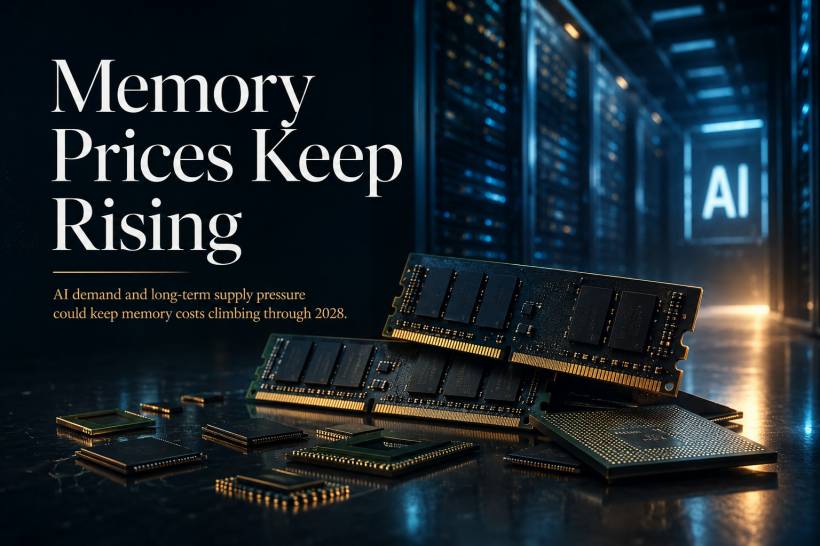
Buying PC memory, graphics cards, consoles, or other hardware could become more expensive for longer than many people expect. The global memory market is already under pressure from surging AI infrastructure demand, and new forecasts suggest the situation may not settle quickly. Rather than being a short-term supply issue, the shortage could continue to affect pricing well into 2028, with some analysts warning that demand may still outpace available supply even after manufacturers increase production.
For consumers, this could mean higher prices for everything from RAM upgrades and GPUs to gaming devices, laptops, servers, and future hardware launches.
The problem is not that memory manufacturers have stopped producing chips. The issue is that a growing share of the world's most advanced memory supply is being secured by AI companies and cloud providers before it reaches the wider market.
AI Is Taking Priority Over Consumer Hardware
Artificial intelligence has created a major shift in the semiconductor industry.
Large AI models require enormous amounts of memory to train, run, and serve users at scale. Data centres need high-capacity DRAM, high-bandwidth memory, enterprise storage, and increasingly advanced chip packaging to keep AI accelerators performing efficiently.
Companies building AI infrastructure are not buying a few memory modules at a time. They are committing to huge volumes over several years.
According to the market outlook referenced in the report, roughly half of global memory supply is already being allocated through long-term agreements with AI companies and cloud service providers. That share could rise as high as 70% as more organisations move to secure supply before shortages become even tighter.
This leaves less capacity available for consumer electronics, gaming hardware, smartphones, PCs, and smaller enterprise buyers.
In simple terms, AI data centres are becoming the biggest customer in the room.
Sharp Price Rises Could Continue Through 2027
The outlook for the next several quarters remains challenging.
The report suggests memory prices could rise by as much as 50% quarter-on-quarter in the third quarter of 2026, followed by a further increase of up to 40% in the fourth quarter. Even if the exact figures vary by memory type and supplier, the overall message is clear: buyers should not expect pricing pressure to ease quickly.
The forecast also points to potentially significant year-on-year price increases in 2027, with some memory categories expected to remain much more expensive than they were before the AI infrastructure boom accelerated.
There may be some improvement as manufacturing output grows. By 2027, supply could reportedly meet around 60% of demand, which would at least help slow the pace of price increases.
However, meeting 60% of demand still means the market remains undersupplied.
That is not enough to return pricing to normal. It simply means the situation may become slightly less severe than it would have been without additional production capacity.
Why More Factories Will Not Solve the Problem Overnight
It might seem obvious that memory makers should simply build more factories and increase output.
In reality, semiconductor manufacturing does not work that quickly.
A new fabrication plant takes years to plan, build, equip, validate, and bring into full production. Memory companies must also decide which types of chips to prioritise. With AI customers willing to pay more for advanced memory products, manufacturers naturally have strong incentives to focus on higher-margin enterprise and AI-focused components.
That can make consumer-grade memory less attractive from a production perspective.
There is also a technical challenge. Not all memory is interchangeable. High-bandwidth memory used for AI accelerators is more complex than standard PC RAM, and its production often involves advanced packaging capacity that is itself in short supply.
This means even companies that expand manufacturing may not immediately increase the supply of the memory products consumers need most.
Chinese Memory Makers May Take Time to Influence Global Supply
Chinese memory manufacturers are also expected to play a larger role in the global market eventually, but they may not be able to provide meaningful relief in the immediate future.
The report suggests that Chinese companies remain behind leading global suppliers in certain advanced memory technologies. Their contribution to the broader international supply picture may become more significant closer to 2028, once their technology and production capability catch up further.
Until then, the market will continue to rely heavily on established memory leaders such as Samsung, SK hynix, Micron, and other major suppliers.
That concentration of supply makes the market more vulnerable when demand rises sharply.
Consumers May Feel the Impact Across More Than PC Parts
Memory shortages do not only affect people building gaming PCs.
When memory prices rise, the impact can spread through the entire electronics industry. Graphics cards, laptops, smartphones, tablets, gaming consoles, handheld devices, servers, networking equipment, and storage products all rely on different forms of memory.
Manufacturers may absorb some of the increased cost at first. However, sustained shortages usually make their way into retail pricing eventually.
This could affect both existing products and new launches.
Companies developing future consoles, compact gaming PCs, AI-enabled laptops, or premium handheld hardware may face tougher decisions around specifications, pricing, and profit margins. A device that looked affordable during early planning may become much harder to launch at the intended price once memory costs rise.
For consumers, that may mean fewer discounts, slower hardware price drops, or higher launch prices for new devices.
The Market Is Being Rebuilt Around AI Infrastructure
The wider issue is that AI is changing the priorities of the semiconductor market.
For years, consumer electronics drove much of the memory industry. Smartphones, PCs, gaming consoles, and traditional data centres were the biggest sources of demand. AI has now added a much more aggressive and well-funded customer group.
Cloud providers and AI companies are competing to build larger training clusters, faster inference platforms, and more capable data centres. They are willing to lock in supply years ahead because waiting for memory availability could delay major AI projects.
That is why the shortage feels different from previous cycles.
This is not simply a temporary spike in PC demand or a short-lived supply disruption. It is part of a larger race to build the physical infrastructure behind artificial intelligence.
Final Thoughts
The memory market may remain difficult for consumers and hardware manufacturers until at least 2028, especially if AI companies continue securing large volumes through long-term supply agreements.
Forecasts can change as new factories come online, demand shifts, or technology evolves. However, the current direction suggests that memory will remain one of the most important pressure points in the global hardware industry for the next few years.
For anyone planning a major PC upgrade, a new gaming system, or a hardware purchase that depends heavily on RAM or high-performance memory, waiting for prices to fall may not be as simple as it was in previous market cycles.
AI may be making technology more capable, but it is also making the hardware behind it more competitive, more strategic, and potentially much more expensive.











Comments 0