

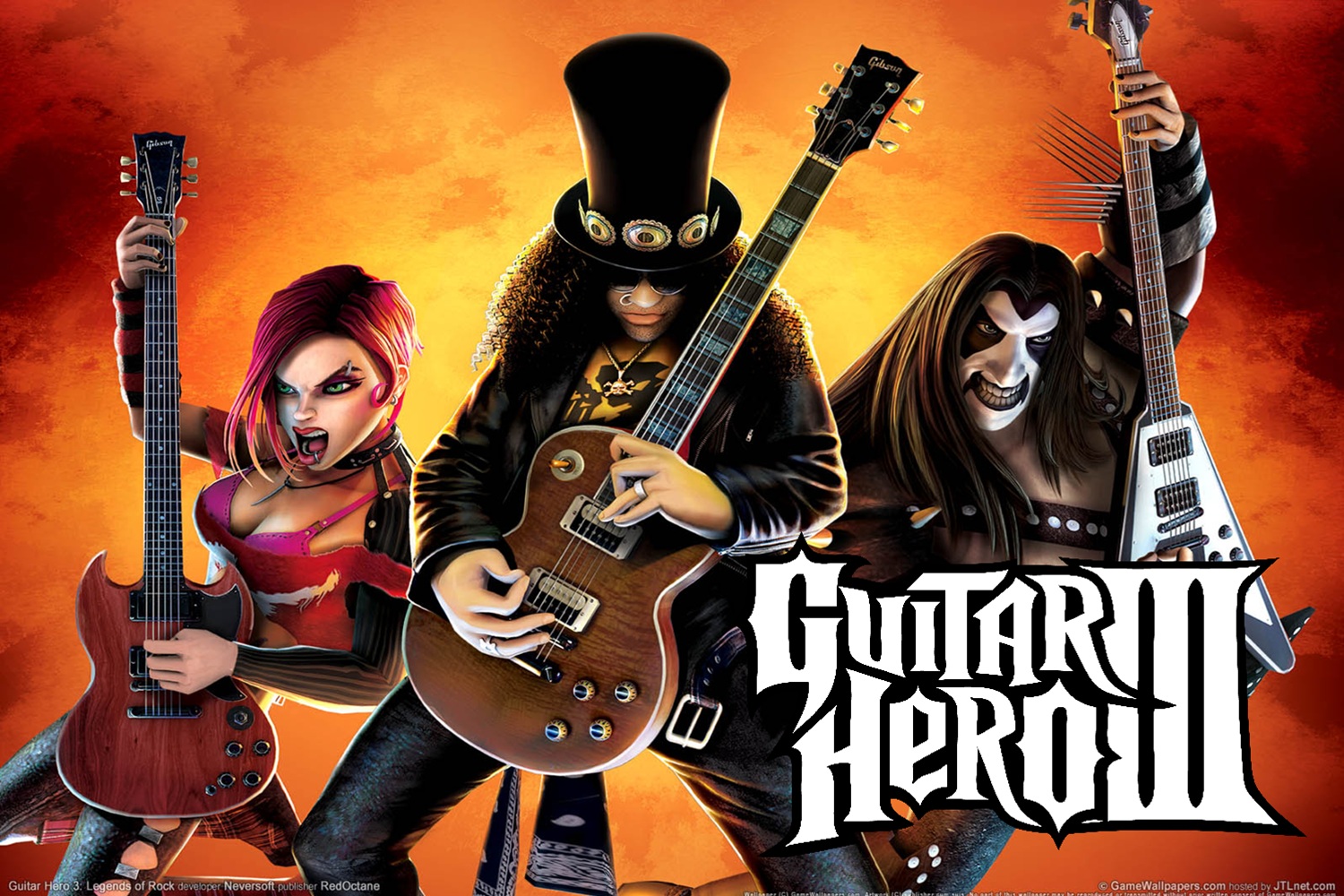
Guitar Hero III: Legends of Rock represents one of the defining moments of the rhythm-game era, combining instantly understandable mechanics with a soundtrack packed with famous rock and metal songs. Released in 2007, the game challenges players to follow streams of colored notes travelling down a virtual guitar fretboard, pressing the corresponding fret inputs while strumming at precisely the right moment. The concept is simple enough for a newcomer to understand within minutes, yet the hardest songs demand an extraordinary combination of rhythm, coordination, memorization, and endurance. That accessibility combined with an extremely high skill ceiling helped turn Guitar Hero III into one of the most recognizable music games ever created.
The Career mode takes players from smaller performances toward increasingly elaborate venues as the setlists become progressively more difficult. Along the way, players encounter famous guitarists Tom Morello and Slash in dedicated guitar battles before eventually facing the fictional demon guitarist Lou in one of the game's most memorable confrontations. Completing songs earns money that can be spent on guitars, finishes, characters, outfits, and other unlockable content, providing a sense of progression beyond simply clearing another track. The combination of escalating difficulty, huge songs, dramatic venues, and constant score chasing turns the campaign into a journey from beginner guitarist to virtual rock legend.
Now playable online through Lemon Web Games, Guitar Hero III: Legends of Rock brings its iconic rhythm gameplay directly into the web browser for players who want to revisit its legendary setlists and demanding note charts. Players can work through familiar songs, improve their note streaks, learn difficult hammer-on and pull-off sequences, build score multipliers, and activate Star Power at the right moments to push their scores even higher. The browser-playable format provides a convenient way to experience the game's progression without relying on the original console hardware. Whether you remember struggling through Expert difficulty years ago or are discovering the game for the first time, Guitar Hero III remains one of the most addictive tests of musical timing ever built around a virtual guitar.
Five Colored Frets Create a Surprisingly Deep Rhythm System
At the heart of Guitar Hero III is a five-lane note highway representing the familiar green, red, yellow, blue, and orange fret buttons. Notes travel toward the bottom of the screen in time with the music, and the player must press the appropriate fret while strumming as the note reaches the target line. Missing a note breaks the current streak and reduces performance, while accurate playing builds both score and momentum. The basic concept never changes, even when the songs become dramatically more complicated.
Single notes provide the foundation, but chords require multiple frets to be held simultaneously. Faster songs then combine chords, single notes, repeated strums, long sustains, and rapid transitions into patterns that demand increasing amounts of coordination. What looks manageable on Easy difficulty can become almost unrecognizable on Expert. The same piece of music is transformed according to the selected difficulty.
This design allows Guitar Hero III to support both casual and highly skilled players using the same songs. New players can concentrate on basic timing without dealing with every note in the recording, while experienced players attempt patterns designed to approximate complicated guitar passages. The game scales naturally rather than dividing beginners and experts into completely separate experiences. That flexibility is one of the reasons the formula became so popular.
Easy, Medium, Hard, and Expert Provide a Natural Learning Curve
The four main difficulty settings significantly change how every song is charted. Easy introduces a reduced selection of notes and usually limits the number of fret buttons the player must consider, creating a comfortable starting point for learning rhythm and strumming. Medium adds greater note density and additional fret movement while remaining relatively approachable. These modes allow players to understand the basic mechanics before tackling the real challenges.
Hard dramatically increases the complexity. More notes appear, fret transitions become faster, and players need to become comfortable using all five lanes. Songs that felt straightforward on Medium can suddenly contain sections that require much more deliberate hand movement and stronger rhythm awareness. The game begins demanding genuine technical improvement.
Expert attempts to provide the fullest and most demanding note charts. Rapid sequences, difficult chords, repeated strumming, fast solos, and long hammer-on and pull-off sections can appear within the same song. Certain tracks have become famous specifically because of how brutally difficult their Expert charts are. Completing them can feel like an achievement even before score optimization begins.
Hammer-Ons and Pull-Offs Make Fast Solos Possible
Hammer-ons and pull-offs, often shortened to HOPOs by rhythm-game players, are essential for surviving the faster portions of Guitar Hero III. Specially marked notes allow players to continue a sequence without strumming every individual note, provided the chain begins correctly and the fret inputs are timed accurately. This makes rapid solos much more manageable than attempting to strum every note manually. Understanding these mechanics becomes increasingly important on Hard and Expert.
Long HOPO sequences can initially feel overwhelming because one missed input may disrupt an entire run. Players need to recognize the pattern rather than simply watching individual notes in isolation. With practice, complicated solos begin to feel more like flowing movements across the fret buttons. Muscle memory gradually replaces conscious calculation.
Some of the game's most famous difficult sections depend heavily on this technique. Tracks such as "Through the Fire and Flames" include sequences that move across the fretboard at extraordinary speed. Learning to maintain control through these passages becomes a major part of high-level play. The difference between struggling and confidently clearing them can represent hours of practice.
Star Power Rewards Accuracy and Strategic Timing
Successful performance gradually fills the Star Power meter when players correctly complete specially marked note phrases. Once enough energy has accumulated, Star Power can be activated to temporarily multiply the player's score. This creates an additional strategic layer because the best moment to activate it is not necessarily the instant it becomes available. Strong players learn to save it for sections containing large numbers of notes.
Activating Star Power during dense chord sequences or long sections with a high multiplier can produce enormous score gains. Using it during a quiet portion wastes much of its potential. Players chasing high scores therefore need to learn the structure of each song rather than simply playing accurately. Timing becomes part of optimization.
Star Power can also provide a psychological boost during difficult songs. Seeing the visual effects activate while entering a demanding chorus or solo creates a sense of momentum. However, the score benefit only becomes meaningful when the player continues hitting notes. Star Power rewards consistency rather than replacing it.
Score Multipliers Make Long Note Streaks Extremely Valuable
Maintaining a streak increases the score multiplier, meaning sustained accuracy becomes much more valuable than occasional successful sections separated by mistakes. A player who consistently hits notes can therefore dramatically outperform someone who plays brilliantly for a few seconds but repeatedly breaks their streak. This makes consistency one of the most important skills in the game. Every missed note carries both an immediate and long-term scoring penalty.
The multiplier system creates tension during long successful runs. Once the player has maintained a perfect streak through several sections, even a simple note can suddenly feel dangerous because missing it would destroy the accumulated multiplier. This makes familiar songs exciting even after they have been completed many times. Score chasing transforms ordinary passages into meaningful challenges.
Players attempting Full Combos take this concept to its extreme. A Full Combo requires every note to be hit without breaking the streak anywhere in the song. Completing one on a difficult Expert track can require enormous familiarity and concentration. The game's scoring system naturally creates these self-imposed mastery goals.
The Rock Meter Keeps Every Performance Under Pressure
The Rock Meter provides immediate feedback on how well the performance is going. Accurate playing pushes the meter toward safety, while repeated mistakes move it toward failure. A few missed notes are usually recoverable, but struggling through an extended difficult section can quickly end the song. This gives even non-competitive play a constant sense of tension.
The system is particularly effective when a song contains one section much harder than everything around it. Players may perform confidently for several minutes only to approach a notorious solo knowing that survival depends on maintaining enough of the Rock Meter. Successfully emerging from that section can feel like winning a small battle. The meter turns difficulty spikes into dramatic moments.
Practice eventually changes how these sections feel. A passage that once caused immediate failure may later become something the player can survive comfortably. This visible improvement provides one of the game's strongest forms of progression. Players become better rather than simply acquiring stronger statistics.
Career Mode Turns Songs into a Journey
Career Mode organizes the soundtrack into tiers, gradually moving the player from smaller venues toward increasingly impressive performances. Completing enough songs in one section unlocks the next, creating a clear progression path through the campaign. The early tracks provide manageable introductions before later tiers begin introducing significantly more demanding material. This gives the soundtrack a deliberate difficulty curve.
Between performances, players earn money and unlock additional customization options. New guitars, finishes, characters, and outfits provide visual rewards alongside the mechanical challenge. While these items do not make difficult songs easier, they reinforce the feeling of building a virtual rock career. The player's stage presence becomes increasingly personalized.
The progression also encourages players to encounter songs they might not have chosen independently. Someone attracted primarily by heavy metal may discover a classic rock or alternative track they unexpectedly enjoy. Rhythm games have always been effective musical discovery tools, and Guitar Hero III is particularly strong in this regard. The campaign acts as both a game progression system and an interactive rock playlist.
The Soundtrack Is One of Guitar Hero III's Greatest Strengths
Guitar Hero III features an unusually memorable selection spanning classic rock, alternative, punk, metal, and modern guitar-driven music. Tracks such as "Slow Ride," "Barracuda," "Paint It Black," "Even Flow," "Welcome to the Jungle," "One," "Cliffs of Dover," "Raining Blood," "Cult of Personality," and "Knights of Cydonia" give the campaign enormous variety. Some are accessible rhythm-focused performances, while others become highly demanding technical challenges. The soundtrack rarely allows one musical style to dominate for too long.
The selection works particularly well because many tracks contain memorable guitar sections that translate naturally into gameplay. Solos become mechanical challenges, recognizable riffs create satisfying note patterns, and dramatic endings provide opportunities for huge score streaks. Playing along creates a different relationship with songs players may already know extremely well. Familiar music becomes interactive.
The soundtrack also exposes players to artists they may not otherwise have encountered. A teenager discovering classic rock through Guitar Hero III could suddenly become interested in bands from decades earlier. Likewise, older players might encounter newer metal or alternative artists through the same campaign. The game became part rhythm challenge and part musical introduction.
Through the Fire and Flames Became Legendary
DragonForce's "Through the Fire and Flames" became almost inseparable from Guitar Hero III because of its extraordinary difficulty. The track appears as a special challenge after completing the main Career path, immediately confronting players with an opening sequence famous for defeating unprepared Expert players within seconds. The song then continues for several intense minutes with rapid solos, repeated note streams, and demanding transitions. Simply reaching the ending can become a long-term goal.
The opening section in particular became one of the most recognizable challenges in rhythm-game history. Players developed techniques specifically for surviving its rapid hammer-on and pull-off patterns. Some practiced the intro repeatedly until muscle memory took over. Clearing it consistently represented a major improvement milestone.
Completing the entire song on Expert became a badge of honor for many players. Achieving a high score or Full Combo raises the challenge much further. Few bonus songs have become so closely associated with the identity of an entire game. Even people who never played Guitar Hero III may recognize the reputation of "Through the Fire and Flames."
Raining Blood Tests a Completely Different Skill Set
Slayer's "Raining Blood" is another track notorious for stopping players during Expert Career progression. Rather than relying on exactly the same type of technical difficulty as "Through the Fire and Flames," it introduces rapid strumming and extremely dense note patterns that can overwhelm players who have not developed the necessary control. The famous "Mosh" sections became particularly feared. Surviving them requires both speed and precision.
This demonstrates an important aspect of Guitar Hero III's difficulty: being excellent at one technical skill does not automatically make every hard song easy. Some charts reward fast fret movement, others demand consistent alternate strumming, and another may focus on awkward chords. Players gradually discover their personal strengths and weaknesses. Improvement therefore becomes multifaceted.
Returning to a previously impossible track after practicing elsewhere can be incredibly satisfying. A player may suddenly realize that a skill developed through another song has made the old obstacle manageable. This cross-song learning gives the soundtrack additional structure. Every difficult track can function as training for another.
Cliffs of Dover Rewards Fluid Fret Movement
Eric Johnson's "Cliffs of Dover" provides a different kind of Expert challenge. Its flowing guitar lines translate into long sequences that reward smooth movement across the fretboard. Instead of relying entirely on brute-force strumming, players need to become comfortable with rapid hammer-ons and pull-offs. The result can feel almost graceful once mastered.
The song is a good example of how Guitar Hero can make technical guitar playing visually understandable. Players may not know exactly how the real guitar part is performed, but the note chart communicates its speed and movement through the five colored lanes. Successfully maintaining the sequence creates a strong sense of musical flow. The rhythm mechanics and source material complement each other especially well.
Tracks like this also demonstrate that difficulty can be enjoyable without being purely punishing. A complicated section can become one of the most satisfying parts of the game once the pattern is understood. The challenge feels musical rather than arbitrary. That relationship is central to the best Guitar Hero charts.
One Builds Toward an Intense Final Challenge
Metallica's "One" begins much more gradually than some of the game's notorious tracks, allowing players to settle into the song before the difficulty increases dramatically. The later sections introduce rapid note patterns and intense guitar work that can quickly end an unprepared Expert run. This creates a memorable sense of escalation. Players know the hardest part is still approaching even while the early sections feel manageable.
The contrast makes the difficult sections particularly effective. A long successful streak can be destroyed very quickly once the guitar solo becomes aggressive. Surviving requires the player to switch from comfortable rhythm playing into fast technical execution. The song becomes almost a miniature campaign inside one track.
For players progressing through Expert Career, completing "One" can feel like another important milestone. It combines endurance with technical difficulty and demands concentration over several minutes. The track demonstrates why song structure matters so much in rhythm-game design. Difficulty becomes part of the musical journey.
Guitar Battles Introduce a Competitive Twist
Guitar Hero III replaces ordinary song progression at several points with dedicated guitar battles. Instead of simply attempting to achieve a passing score, players compete directly against another guitarist and collect Battle Power attacks that can disrupt their opponent. This changes the familiar rhythm mechanics into something more aggressive. The goal becomes surviving while making the rival struggle.
Battle Power can introduce effects that temporarily increase difficulty for the opponent. These disruptions may alter their fretboard, break strings, increase note complexity, or create other obstacles that make continued playing more difficult. Players need to decide when an attack will be most effective. Using it during a difficult section can cause much more damage than activating it randomly.
The system is intentionally less pure than standard score competition, but that is exactly what gives the battles personality. They are designed as dramatic Career milestones rather than serious demonstrations of musical accuracy. Each opponent becomes a character rather than simply another score target. The battles help break up the normal setlist structure.
Tom Morello Provides the First Major Guitar Battle
Tom Morello appears as one of Guitar Hero III's celebrity opponents, giving players an early introduction to the Battle Mode format. Known for his unusual guitar techniques and experimental sounds, he is a particularly fitting choice for a rhythm game built around exaggerated guitar performance. The confrontation combines recognizable musical style with the game's fictional battle mechanics. It immediately feels different from an ordinary Career song.
Players need to maintain their own performance while deploying attacks effectively against Morello. The battle introduces the strategic side of Battle Power without immediately reaching the intensity of later opponents. It serves as both spectacle and tutorial. Winning feels like a major step in the virtual career.
Morello's presence also helped reinforce Guitar Hero III's connection with real rock culture. The game was no longer merely licensing songs; recognizable musicians were appearing as characters inside the campaign. This made the Career progression feel larger and more theatrical. It blurred the line between fantasy rock performance and real-world music history.
Slash Becomes One of the Game's Most Recognizable Rivals
Slash's appearance as a guitar-battle opponent became one of Guitar Hero III's most memorable moments. His distinctive visual identity makes him immediately recognizable, and the battle provides another escalation in difficulty. Players who have become comfortable with standard Career tracks suddenly need to manage both the music and incoming Battle Power attacks. The confrontation feels appropriately dramatic.
Defeating Slash also provides access to additional content connected to his appearance. This turns the battle into more than a temporary story event. He becomes part of the broader collection of characters and musical material associated with the campaign. For Guns N' Roses fans, his inclusion was a major attraction.
The battle also reflects the exaggerated fantasy at the center of Guitar Hero. Players begin as unknown virtual musicians and eventually face one of rock's most recognizable guitarists. Realism is not the point. The campaign is building toward the fantasy of becoming a legend.
Lou Turns the Final Battle into Rock-and-Roll Fantasy
The final Career confrontation takes the concept to its most ridiculous extreme by placing the player against Lou, a demonic guitarist who effectively represents the ultimate supernatural opponent. The battle draws heavily on rock mythology and the classic idea of musicians making dangerous bargains for extraordinary talent. It fits perfectly with Guitar Hero III's increasingly theatrical presentation. By this stage, the career has moved far beyond ordinary venues.
The battle incorporates the Battle Power system at its most demanding. Players need to survive Lou's attacks while attempting to create enough pressure to defeat him. The encounter can be frustrating until the correct strategy and timing are understood. Victory provides a suitably dramatic conclusion to the main Career path.
The absurdity works because Guitar Hero III never treats its career as realistic musical management. The game is about exaggerated rock-star fantasy: huge crowds, flaming stages, celebrity guitar battles, and impossible songs. Fighting a demon guitarist feels like the logical destination. It gives the campaign a memorable finale.
Co-Op Career Lets Two Players Build a Band Together
Guitar Hero III includes cooperative play where two players can perform different parts of songs together. One player may handle lead guitar while the other performs bass or rhythm sections, depending on the track. This changes the experience significantly because success becomes dependent on both players maintaining their parts. A strong performance requires cooperation rather than competition.
The Co-Op Career includes its own progression and provides additional reasons to revisit familiar songs. Parts can differ substantially from the standard single-player charts, meaning even experienced players may need to learn new patterns. This extends the life of the soundtrack. Two players can experience the same music from different mechanical perspectives.
Cooperative play also captures more of the fantasy of performing as a band. Instead of one player representing the entire stage performance, both participants contribute simultaneously. Successful synchronization can be especially satisfying during difficult sections. The mode remains one of the most enjoyable ways to experience the game with another person.
Face-Off and Pro Face-Off Support Direct Competition
Competitive multiplayer allows two players to challenge each other on the same song. Face-Off can divide sections between players, while Pro Face-Off gives both participants complete note charts for a more direct test of skill. The latter becomes particularly interesting when both players are comfortable at the same difficulty. Scores and consistency determine the winner rather than Battle Power interference.
These modes reveal how differently two players can approach the same chart. One may excel during solos while another maintains stronger consistency through chord-heavy sections. A single broken streak can shift the lead dramatically. Familiar songs become competitive arenas.
Local competition was a huge part of Guitar Hero's cultural appeal. Passing a controller back and forth or challenging friends created memorable social experiences far beyond solitary Career progression. The simple concept made competition easy to understand. Whoever plays the song better wins.
Practice Mode Makes Impossible Sections Manageable
Practice Mode is essential for players attempting the hardest songs. Rather than replaying an entire track just to reach one difficult solo, players can isolate specific sections and repeat them. This dramatically improves the learning process. Difficult patterns can be studied without wasting several minutes between attempts.
The ability to slow sections down is especially useful. A pattern that looks like an unreadable wall of notes at full speed may become understandable once reduced. Players can learn the movement gradually and then increase the tempo as muscle memory develops. This transforms seemingly impossible challenges into manageable training exercises.
Practice Mode is one of the main reasons highly technical play becomes achievable. Expert songs are often too demanding to learn purely through repeated full performances. Isolating a problem section allows deliberate improvement. Serious players can treat difficult charts almost like musical exercises.
Unlockable Guitars and Outfits Add Visual Progression
Money earned during Career can be spent on a variety of cosmetic rewards. Different guitars, finishes, characters, outfits, and other visual options allow players to personalize their virtual performer. These unlockables do not improve note timing or make songs easier, preserving the skill-based nature of the game. Their purpose is expression and progression.
Unlocking another instrument can still feel surprisingly rewarding. Players spend a significant amount of time watching their chosen character perform, so visual changes provide noticeable variety. Some designs are relatively conventional, while others embrace the exaggerated rock aesthetic completely. The game encourages theatricality.
Characters can also change outfits as the career develops. This allows the virtual band to look increasingly elaborate as larger venues become available. The cosmetic progression complements the musical progression. Players look more like rock stars as they become better at the game.
The Animated Characters Give Every Performance Personality
Guitar Hero III includes a roster of fictional musicians representing different rock styles. Each character has their own visual identity, clothing, animations, and stage presence. Players can choose whichever personality fits their preferred image. This adds another layer of fantasy beyond simply matching notes.
Animations become particularly energetic during solos and Star Power sections. Characters move dramatically across the stage while audiences react in the background. Even though the player's attention remains focused on the note highway, the surrounding performance reinforces the sense of being part of a concert. The game creates spectacle around a relatively abstract rhythm mechanic.
Venues grow increasingly elaborate as Career progresses. Small performances eventually give way to huge stages filled with lighting, effects, and enormous crowds. The visual progression mirrors the player's growing reputation. Every new tier feels like another step toward rock superstardom.
The Note Highway Keeps Complex Music Readable
The scrolling note highway is one of the most elegant pieces of interface design in rhythm gaming. Even extremely complicated patterns remain represented through the same five colored lanes. Players always know where to look and what each incoming note means. Difficulty increases through speed and complexity rather than through constantly changing rules.
The perspective also provides enough advance information for skilled players to plan their movements. Notes appear further up the highway before reaching the strike line, allowing the player to recognize upcoming chords and sequences. Experienced players stop reading individual notes and begin seeing larger patterns. This transition is essential for high-level play.
Visual clarity becomes especially important on Expert. When dozens of notes arrive rapidly, even small confusion can destroy a streak. Guitar Hero III succeeds because the interface remains understandable even when the chart becomes extremely demanding. The same design supports both beginners and experts.
Timing Matters More Than Simply Knowing the Song
Knowing the music provides an advantage, but familiarity alone is not enough. The player still needs to match the game's chart accurately. A note may represent a specific guitar sound or rhythmic accent rather than every audible event in the recording. Players gradually learn how each song has been translated into gameplay.
Rhythmic awareness becomes especially useful during sections where notes repeat quickly. Listening to the music can help maintain a consistent strumming pattern without relying entirely on visual reaction. Strong players often combine audio and visual information. The song itself becomes part of the interface.
This relationship is one reason rhythm games can create such strong connections with their soundtracks. Players are not simply listening passively. They are concentrating intensely on individual riffs, rhythms, and transitions. Familiar songs can become even more memorable through repeated performance.
The Difficulty Curve Encourages Real Improvement
Guitar Hero III can initially feel incredibly forgiving on lower difficulties and nearly impossible on Expert. The important part is that the game provides a path between those extremes. Players learn basic strumming on Easy, expand fret movement on Medium, develop full-hand coordination on Hard, and eventually tackle dense Expert charts. Each stage develops skills needed for the next.
Progress is rarely completely smooth. A player may move comfortably through several songs before encountering one track that exposes a particular weakness. That obstacle becomes a training goal. Once it is conquered, the improvement often carries into other songs.
This makes advancement feel more meaningful than unlocking stronger equipment. The player themselves is becoming better. Fingers move faster, rhythms become easier to recognize, and previously intimidating note sequences begin looking understandable. Few games make mechanical improvement as visible.
Why Guitar Hero III Became a Cultural Phenomenon
Guitar Hero III arrived when rhythm games were expanding far beyond their traditional audience. The guitar-shaped controller was visually distinctive, the soundtrack contained recognizable music, and the basic concept was easy to demonstrate at parties or in stores. Someone could watch for a few seconds and immediately understand what the player was attempting. That accessibility helped the series become enormously popular.
The game also created memorable shared experiences. Friends challenged one another, families took turns attempting songs, and players discussed which Expert tracks they had managed to complete. Certain songs became famous specifically because of their difficulty within Guitar Hero rather than only their original musical reputation. The game influenced how an entire generation encountered rock music.
Its presentation embraced rock-star fantasy without embarrassment. Massive venues, dramatic characters, screaming crowds, guitar battles, and exaggerated animations made players feel like they were participating in something larger than a high-score challenge. Guitar Hero III was as much about performance fantasy as technical rhythm gameplay. That combination gave it enormous appeal.
The Skill Ceiling Remains Extremely High
Completing the Career is only one possible goal. Skilled players can continue chasing five-star ratings, higher scores, Full Combos, and perfect Expert performances. Songs that are merely survivable at first can eventually become optimization challenges. Star Power timing and note consistency become increasingly important. The game continues providing goals long after basic completion.
Some charts remain challenging even for highly experienced players. "Through the Fire and Flames," "Raining Blood," and other demanding songs can expose small weaknesses in technique immediately. Mastering them requires specific practice rather than general familiarity. This gives dedicated players long-term objectives.
Leaderboards and community competition historically pushed this even further, with elite players attempting near-perfect or perfect performances across the entire soundtrack. The difference between completing a song and mastering it can be enormous. Guitar Hero III accommodates both levels of ambition.
Playing Guitar Hero III: Legends of Rock Online Today
Through Lemon Web Games, Guitar Hero III: Legends of Rock can now be played directly in your web browser with no downloads or setup required. Features of the web-based version include:
Playing Guitar Hero III through a browser provides a convenient way to revisit its famous setlists and progressively demanding Career structure. Beginners can start on easier difficulties and concentrate on rhythm, while experienced players can move directly toward Hard or Expert and begin chasing higher scores. The short song-based structure also makes the game suitable for quick sessions. One track can easily become several when the player decides to improve a previous result.
Returning players can revisit songs that once seemed impossible and see how much of the old muscle memory remains, while newcomers can discover why tracks such as "Through the Fire and Flames" became legendary within rhythm-gaming culture. The basic note highway remains immediately understandable even years later. Its simplicity is exactly what allows the hardest charts to become so demanding.
Who Should Play Guitar Hero III: Legends of Rock
Guitar Hero III is particularly suitable for players who enjoy seeing their own mechanical improvement. Early sessions may involve missing simple fret transitions, while later attempts can involve surviving complex solos that once looked impossible. The game provides immediate feedback through score, streaks, multipliers, and the Rock Meter. Improvement is visible almost every time a difficult song is revisited.
It is equally enjoyable for players primarily interested in music. The large soundtrack covers several generations of guitar-driven rock and exposes players to artists they may not already know. Familiar songs become interactive challenges, while unfamiliar ones can become new favorites simply because their note charts are enjoyable. The relationship between music and gameplay remains the game's greatest attraction.
Play Guitar Hero III: Legends of Rock Online Now
Guitar Hero III: Legends of Rock takes the fantasy of performing famous guitar songs and translates it into one of gaming's most recognizable rhythm systems. Colored notes stream toward the player, chords demand simultaneous fret inputs, solos test rapid movement, and Star Power creates opportunities for enormous scores. The Career mode gradually raises the difficulty until players are facing celebrity guitarists, demonic rivals, and some of the hardest songs ever included in the series. Every successful performance feels like another step toward virtual rock stardom.
Through Lemon Web Games, players can experience this iconic rhythm adventure directly through a modern browser and work through its legendary soundtrack at their own pace. Newcomers can begin with simplified charts, while experienced players can immediately test themselves against the demanding Hard and Expert arrangements. High scores, five-star ratings, and Full Combos provide long-term challenges beyond simply completing each track. Even after the Career is finished, there is always another song that could be played more accurately.
Final Thoughts
Guitar Hero III: Legends of Rock remains one of the most memorable rhythm games because it makes complicated music interaction feel immediately understandable. Five colored fret lanes, a strum input, Star Power, and a simple score multiplier provide everything needed to begin, yet those mechanics support an extraordinary range of difficulty. The same system can entertain someone playing their first Easy song and challenge an expert attempting to Full Combo "Through the Fire and Flames." That scalability is a major reason the formula became so successful.
Its soundtrack and Career presentation elevate the experience further. Songs from multiple generations of rock and metal sit alongside celebrity appearances from Tom Morello and Slash, while the final battle against Lou embraces the exaggerated fantasy of becoming the ultimate guitar legend. Tracks such as "Raining Blood," "One," "Cliffs of Dover," and "Through the Fire and Flames" became mechanical milestones that players remembered long after completing the story. Music, difficulty, and progression all reinforce one another.
Years after the height of the rhythm-game boom, Guitar Hero III still captures the excitement of discovering a difficult song, failing repeatedly, practicing the troublesome section, and eventually performing it successfully. Through Lemon Web Games, players can return to that progression directly in their browser, rebuild old rhythm skills, discover the soundtrack for the first time, and chase another perfect streak. For fans of rock music, rhythm challenges, and games where genuine player improvement matters, Guitar Hero III: Legends of Rock remains an enduring classic.











Comments 0