

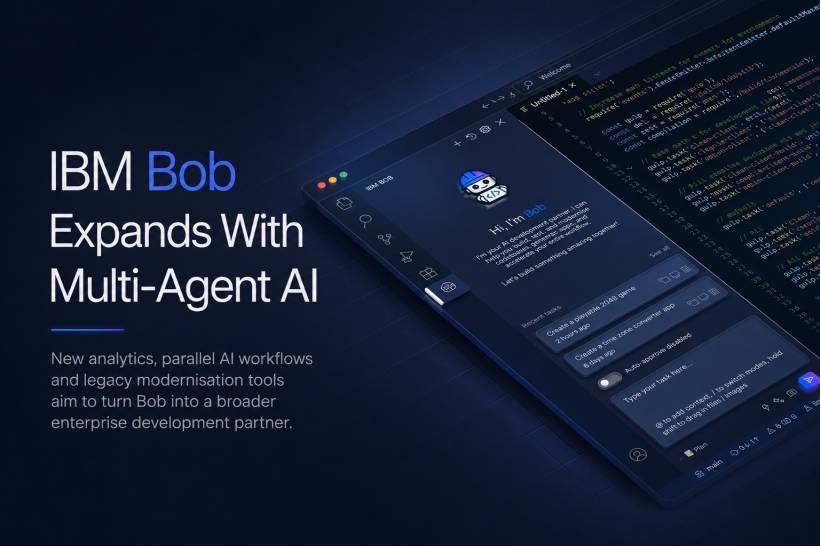
IBM is expanding its Bob software development platform with a stronger focus on multi-agent AI, cost visibility, and legacy system modernisation. The latest updates position Bob as more than a coding assistant. Instead, IBM is shaping it as an AI-supported development platform that can help engineering teams review code, validate outputs, modernise older applications, and manage large software transformation projects.
This reflects a bigger shift happening across software development. AI tools are already helping developers write code faster, but the new bottleneck is no longer just code creation. The harder part is now reviewing, validating, correcting, and safely integrating AI-generated work into real enterprise systems.
Software Development Is Moving From Writing to Verification
For many development teams, AI coding tools have already reduced the time spent writing boilerplate code or generating first drafts. But that does not mean software delivery has become effortless.
Instead, developers are spending more time checking whether AI-generated code is correct, secure, maintainable, and suitable for production. This creates a new kind of engineering workflow where humans are not simply writing every line manually, but supervising, validating, and refining what AI produces.
This is why IBM is positioning Bob to support the wider software development lifecycle. The platform is designed to help with code review, validation, performance tracking, quality monitoring, and task coordination, rather than only suggesting snippets of code.
In an enterprise environment, this distinction matters. A coding assistant may be useful for individual productivity, but organisations also need governance, consistency, cost control, and auditability across teams.
Multi-Agent AI for Different Development Tasks
One of the key updates is Bob's expanded multi-agent capability. Instead of relying on one AI model to handle everything, the platform can assign different models and agents to different tasks.
For example, one agent may analyse code quality, another may search through documentation, another may trace dependencies, and another may help refactor legacy code. This allows complex development work to be divided into smaller, more specialised tasks.
IBM says Bob can also match models to specific jobs, helping teams avoid the inconsistent results that may happen when developers manually choose models without considering cost, speed, or suitability.
This could become increasingly important as more organisations use multiple AI models at the same time. The best model for code explanation may not be the best model for security review, documentation, testing, or large-scale refactoring.
Bobalytics Adds Visibility Into AI Usage and Cost
IBM has also introduced Bobalytics, an analytics feature that helps teams understand how AI resources are being used.
This is a practical addition because AI development tools can create unpredictable spending if usage is not monitored properly. Developers may use different models for different tasks, some more expensive than others, and costs can rise quickly when large codebases, repeated prompts, and long context windows are involved.
Bobalytics gives organisations visibility into AI consumption, resource allocation, usage patterns, and spending. For enterprise technology leaders, this can help answer important questions such as which teams are using AI most heavily, which workflows are generating the most cost, and whether AI usage is improving productivity enough to justify the investment.
In other words, AI development is moving into the same governance space as cloud computing. It is not enough to enable the tool. Organisations also need to manage consumption, performance, quality, and cost.
Subagents Help Manage Complex Context
Another major improvement involves how Bob handles complex tasks. Long software engineering workflows can generate a lot of context. The AI may need to read files, search documentation, inspect dependencies, trace functions, compare outputs, and remember intermediate findings.
If all of that information sits inside one main context window, the process can become slow, expensive, and harder to manage.
Bob now uses subagents that work in isolated contexts. These subagents can handle specific tasks separately and then return their findings to the main workflow. This helps reduce context overload while improving speed and cost control.
IBM has also added parallel, model-native tool calling. This means a model can request multiple tools in one turn and run them at the same time, instead of waiting for each tool to complete one by one. For development workflows involving search, analysis, testing, and file inspection, that could make the process more efficient.
Legacy Modernisation Becomes a Bigger Focus
One of the most important parts of IBM's update is its push into legacy application modernisation. Many enterprises still depend on long-lived systems built over decades, especially in sectors such as banking, insurance, commerce, government, and large-scale operations.
These systems are not easy to modernise. The problem is not just old code. It is the accumulated business logic, dependencies, undocumented decisions, historical constraints, and operational knowledge built into the software over many years.
IBM is addressing this with premium modernisation packages for IBM Z, IBM i, and Java environments. These packages include pre-built workflows that organisations can customise for their own systems while keeping the process repeatable and auditable.
That is important because legacy modernisation projects can vary greatly depending on which engineer performs the work. A structured AI-assisted workflow can help reduce inconsistency, especially in large projects involving multiple teams and complex dependencies.
IBM Z, IBM i and Java Workflows
The IBM Z package focuses on mainframe modernisation, including COBOL, PL/I and Job Control Language analysis. Mainframes remain deeply embedded in industries that require high reliability and transaction processing, so modernising them must be done carefully.
The IBM i package includes tools and workflows designed around IBM i environments, including remote file system integration and operating modes suited to development and maintenance on that platform.
The Java Modernization package supports migration to Java 25, large-scale refactoring, and dependency analysis across Java application portfolios. This could be useful for organisations trying to keep older Java systems current without manually reviewing every dependency and compatibility issue.
Across all three packages, the goal is not simply to rewrite code quickly. It is to create a more controlled modernisation process that can be repeated, audited, and adapted to the organisation's environment.
Why Auditability Matters in AI-Assisted Modernisation
Enterprise software modernisation is not an area where organisations can afford black-box automation. If AI changes critical code, teams must be able to understand what changed, why it changed, and whether the result is correct.
This is especially important for regulated industries. Banks, insurers, healthcare organisations, and government-linked systems often require strong evidence of testing, change control, validation, and accountability.
By focusing on structured workflows and auditable outputs, IBM is trying to make Bob more suitable for enterprise environments where speed alone is not enough.
Early Customer Examples Show the Potential
IBM highlighted examples from companies using Bob in real-world development and modernisation work.
Financial technology provider Jack Henry has used the platform to support RPG development workflows and gain better insight into a long-standing codebase. This kind of use case is important because many older enterprise systems contain decades of knowledge that may not be fully documented.
Cloud services and consulting company Blue Pearl also reported a major acceleration in a legacy modernisation project after introducing IBM Bob. The broader point is that AI-assisted modernisation may help reduce time, cost, and complexity when used with the right governance and expert oversight.
However, as with any AI-driven development tool, results will depend heavily on the quality of the workflow, the complexity of the system, and how carefully human teams validate the output.
Final Thoughts
IBM's latest Bob updates show where enterprise AI development tools are heading. The market is moving beyond simple code generation and into supervised, multi-agent software engineering.
For large organisations, the real value of AI is not just producing code faster. It is helping teams review, validate, modernise, document, and manage complex systems more consistently. That is especially important for legacy platforms where years of business logic and operational history are buried inside older codebases.
The challenge now is trust. Enterprises will want AI tools that are not only fast, but also secure, explainable, auditable, and cost-controlled. IBM Bob's new multi-agent workflows, Bobalytics cost visibility, and structured modernisation packages are aimed directly at that need.











Comments 0