

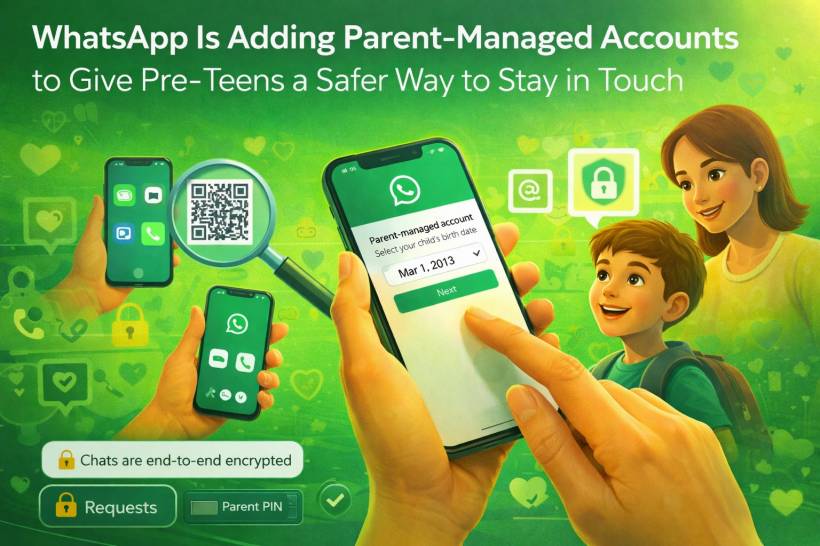
WhatsApp is introducing a new feature aimed at younger users, and it is clearly designed with one goal in mind: giving pre-teens a more controlled way to communicate while allowing parents to stay involved in how the account is used. The new system, called parent-managed accounts, creates a version of WhatsApp that focuses on the basics of messaging and calling, while removing several features that may be less suitable for younger children.
This move reflects a wider shift happening across major digital platforms. More tech companies are under pressure to create age-appropriate experiences rather than simply expecting families to figure everything out on their own. In WhatsApp's case, that means building a version of the app that still feels useful for family communication, but with stronger limits and more supervision built into the setup.
A Simpler WhatsApp Experience for Younger Users
The core idea behind parent-managed accounts is fairly straightforward. Pre-teens can use WhatsApp to stay in touch with family members and other trusted people, but they will not have access to the full range of features normally available in the standard app.
Under this setup, the account is restricted to messaging and voice or video calling. More open-ended features such as Channels, Status updates, live location sharing, and Meta AI are turned off. That may sound limiting, but that is exactly the point. Instead of exposing younger users to every social and discovery feature inside the app, WhatsApp is narrowing the experience down to communication only.
For many parents, that will probably be the most reassuring part of the update. A child can still use the platform for its most practical purpose, which is staying connected, without drifting into features that introduce a wider audience, more visibility, or added privacy concerns.
Parents Get More Control Over Who Can Reach Their Child
Another major part of the feature is parental control over contact and group access. WhatsApp is not just limiting features on the child's side. It is also giving parents more say over who is allowed into that communication circle in the first place.
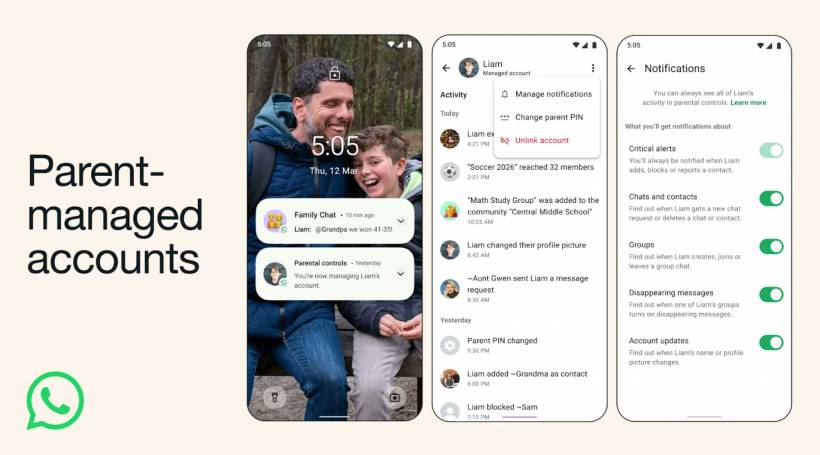
By default, only saved contacts can message a parent-managed account. If an unknown number tries to reach the child, that message does not simply land in the normal chat list. Instead, it goes into a separate message request area that parents can review. Access to that area is protected with a parent PIN, adding another layer of control.
The same thinking applies to groups. If someone sends a group invitation to the child's account, that invitation must be approved before the child can join. This is an important detail, because group chats can often become one of the most unpredictable parts of messaging apps. Even when a platform has privacy settings in place, being added to the wrong group can expose younger users to content or conversations that parents would rather avoid.
With this new setup, parents are not only managing the account after the fact. They are actively controlling the doors through which people can enter.
End-to-End Encryption Is Still Part of the Experience
Even with parental supervision added into the mix, WhatsApp says conversations on parent-managed accounts will still be protected by end-to-end encryption. That means messages and calls remain private between the people involved in the conversation, and even WhatsApp itself cannot read or listen to them.
This is an important balance for the platform to strike. On one hand, parents want more safety tools and more oversight. On the other hand, WhatsApp's identity has long been built around strong privacy protections. By keeping end-to-end encryption in place, the company is signaling that child safety controls do not automatically mean the removal of private messaging protections.
That said, the emphasis here is clearly on account-level supervision rather than message content monitoring. Parents can control who gets in, what requests are approved, and which settings can be changed, but the actual conversations remain encrypted. In other words, WhatsApp is trying to design a safer environment without completely abandoning the privacy framework that made the app popular in the first place.
Setting Up a Parent-Managed Account Requires Both Devices
WhatsApp says setting up one of these accounts requires access to both the parent's phone and the child's device. That is because the two accounts need to be linked during the setup process.
The process begins by installing and opening WhatsApp on the child's phone. During registration, the child's phone number and date of birth are entered as part of the setup. From there, the option to create a parent-managed account can be selected.
To connect the two accounts, the parent places their phone next to the child's device and scans a QR code. Once that is done, the parent confirms they are an adult and completes the account linking process. A parent PIN is then created, and this PIN becomes a key part of the management system. It is needed for changing privacy controls, approving requests, and handling access-related decisions later on.
Once the account is linked, the parent can manage who is allowed to contact the account, decide whether group invites are approved, and review incoming message requests from unknown numbers.
From a usability standpoint, the setup seems intentionally designed to ensure that parental involvement happens from the start rather than being added later as an optional extra.
Why This Update Matters
This feature is arriving at a time when online safety for children is getting much more attention from regulators, schools, and parents alike. Messaging apps are often seen as necessary tools for modern communication, especially for family coordination, school-related communication, and staying in touch during the day. But at the same time, they can also open the door to unwanted contact, inappropriate content, and privacy concerns if left unmanaged.
That is what makes WhatsApp's approach interesting. It is not banning younger users outright, nor is it simply handing them the full app with a few loose restrictions. Instead, it is creating a more closed and purpose-driven version of the service.
For families, that may make WhatsApp feel more practical as a first messaging platform. A child gets to use a familiar app for talking to parents, relatives, and other approved contacts, while the adults remain in control of the boundaries.
Part of a Bigger Push by Meta
This update is not happening in isolation. It also follows a broader set of safety measures introduced by Meta across its other platforms, including Facebook, Instagram, and Messenger. Those changes reportedly include tighter protections for teen accounts, stronger parental supervision tools, and more safeguards aimed at reducing unwanted interactions and limiting exposure to inappropriate material.
Seen in that broader context, parent-managed WhatsApp accounts look like part of Meta's larger effort to show that it is taking youth safety more seriously across its ecosystem. Whether that effort will satisfy critics is another question, but it is clear that the company wants to position itself as being more proactive rather than reactive.
Instead of waiting for problems to surface and then responding with patches or policy changes, Meta appears to be moving toward more structured safety frameworks from the beginning, especially for younger age groups.
Rollout Will Happen Gradually
WhatsApp says the feature will be rolled out gradually over the coming months, so availability will depend on region. That means not every market will see it at the same time, and some users may have to wait before the option appears in their version of the app.
Gradual rollouts like this are common for major messaging features, particularly when they involve privacy controls, age-related protections, and cross-device linking. They give the company room to monitor how the feature performs and adjust things if needed before expanding more widely.
Final Thoughts
WhatsApp's new parent-managed accounts feel like a practical attempt to meet families somewhere in the middle. Many parents want their children to have a safe way to communicate, but they do not necessarily want them dropped into the full social and discovery experience of a modern messaging platform. This update tries to solve that problem by narrowing WhatsApp down to its most essential functions and putting parents in charge of the guardrails.
The success of the feature will likely depend on how easy it is to set up, how intuitive the controls feel, and whether parents believe the restrictions are strong enough without being overly complicated. But as a concept, it makes a lot of sense.
For younger users, it offers a more limited and safer version of a familiar app. For parents, it provides a little more confidence that communication can happen without giving up all control in the process.











Comments 0