

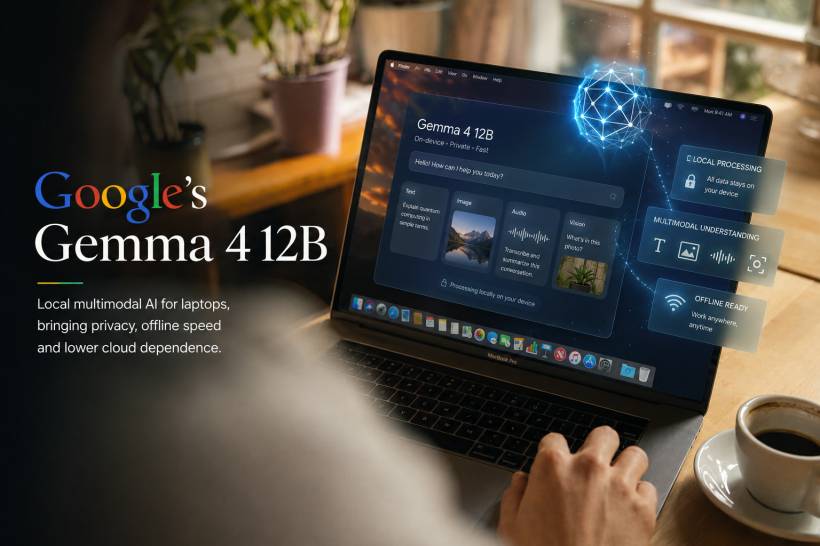
Google's new open model is designed to run advanced AI tasks locally, giving developers a way to work with text, images, audio and video without always relying on the cloud. For years, powerful AI tools have mainly lived in the cloud.
You upload a document, send a prompt, analyse an image or transcribe audio, then wait for a remote data centre to process the request. That approach has made advanced AI widely available, but it also creates concerns around privacy, network speed, recurring API costs and the handling of sensitive information.
Google's new Gemma 4 12B model is designed to offer another option.
Instead of depending entirely on remote AI services, Gemma 4 12B is built to run directly on compatible laptops. This gives developers the opportunity to process text, images, audio and video locally, while keeping data closer to the device where it is being used.
It is an important step for teams exploring private, responsive and more cost-controlled AI workflows.
A Local-First Approach to AI
Gemma 4 12B is part of Google's open-weights Gemma family. The model is aimed at developers who want advanced reasoning and multimodal capabilities without requiring a large data-centre setup.
The main idea is simple: some AI workloads do not need to leave the laptop.
A financial analyst could summarise confidential reports stored locally. A developer could use an AI assistant within an offline coding environment. A field engineer could analyse equipment photos and compare them against technical documents saved on a device.
In each case, local processing can reduce the need to send private material to a third-party cloud service.
It can also avoid the network round trip that comes with cloud-based requests, which may be useful when connectivity is weak, expensive or unavailable.
Designed for Everyday Laptop Hardware
Gemma 4 12B is intended to make local multimodal AI more practical on modern consumer hardware.
Google says the model can run on compatible systems with around 16GB of VRAM or unified memory. That means it may be accessible on a wider range of laptops than larger AI models that require high-end workstation GPUs or dedicated server infrastructure.
Of course, performance will still depend on the device, operating system, processor, memory configuration and model format being used. A newer laptop with unified memory or a capable dedicated GPU is likely to provide a smoother experience than an older system.
Still, the larger point is significant: advanced local AI is beginning to move beyond specialist hardware and into more everyday computing environments.
Why Its Multimodal Design Matters
Many multimodal AI systems use separate components to process images, audio or video before passing that information to the language model.
Gemma 4 12B takes a more unified approach.
Rather than relying on large standalone vision and audio encoders, the model feeds multimodal inputs more directly into its language-model architecture. This is intended to reduce memory overhead and simplify how different types of data are processed.
For users, that could mean one local AI model is able to work across several tasks, such as:
• Analysing documents and images together.
• Processing audio recordings and creating transcripts.
• Understanding short video clips.
• Assisting with code, text and structured data.
• Supporting multi-step local agent workflows.
This makes the model more flexible than a text-only assistant.
New Tools for Running AI Offline
Google has also introduced supporting tools intended to make local experimentation easier.
Google AI Edge Gallery is a local AI application for macOS that allows developers to test models such as Gemma 4 12B directly on their device. It can be used to explore local AI workflows, experiment with prompts and perform tasks such as data analysis and code generation.
Google has also expanded AI Edge Eloquent, a local dictation and text-editing application for macOS.
The app is designed to support offline voice dictation, transcription and voice-driven text editing. Rather than sending spoken content to a cloud transcription platform, the workflow can run directly on the device.
This could be useful for people who work with confidential meetings, private notes, internal reports or sensitive customer information.
Local AI Could Change the Cost Model
Cloud AI services usually charge based on usage.
The more prompts, tokens, files or requests an application sends to an API, the higher the running cost can become. This works well for occasional use, but it can become expensive when an AI tool is constantly analysing files, monitoring updates or supporting automated background tasks.
Running a model locally changes that equation.
There is still a cost: the user needs compatible hardware, electricity and enough computing resources. However, there may be no per-request cloud charge for each local inference task.
This could make certain AI workflows more practical, especially for developers building tools that run frequently.
For example, a local agent could help monitor a project folder, summarise new documents, assist with offline coding tasks or analyse images stored on a laptop without creating a growing API bill.
The Rise of Hybrid AI Applications
Local AI will not replace cloud AI for every situation.
Larger cloud-based models may still be better for highly complex reasoning, very large workloads, real-time web access or tasks that require the strongest available performance.
The likely future is a hybrid model.
A local AI system could handle private, routine or low-latency tasks directly on the device. More demanding requests could be sent to a cloud model when needed.
For example, an application may use Gemma 4 12B to process local files, generate first drafts or analyse private media. It could then use a cloud service only for tasks requiring broader knowledge, deeper reasoning or large-scale processing.
This approach gives developers more control over privacy, performance and cost.
Why This Matters for Businesses
For organisations, local AI has several potential advantages.
Sensitive files can remain inside the company environment. Teams may reduce dependency on external AI services for routine work. Developers can also create tools that continue functioning even when there is no stable internet connection.
This can be particularly valuable in industries that handle confidential information, including healthcare, finance, legal services, engineering and government-related work.
However, local AI also introduces responsibilities.
Companies still need to manage device security, access controls, model updates, software dependencies and data governance. Keeping data on-device can reduce cloud exposure, but it does not remove the need for strong endpoint protection.
Final Thoughts
Gemma 4 12B reflects a growing shift towards local-first AI.
Instead of treating the cloud as the only place where advanced AI can run, developers now have more options to bring capable models directly onto laptops and workstations.
For users, that could mean faster offline tools, better privacy and lower dependence on per-request AI services. For developers, it opens the door to a new generation of hybrid applications that balance local processing with cloud intelligence when needed.
The future of AI may not be entirely in the cloud. Increasingly, part of it may be running quietly on the device in front of you.











Comments 0