

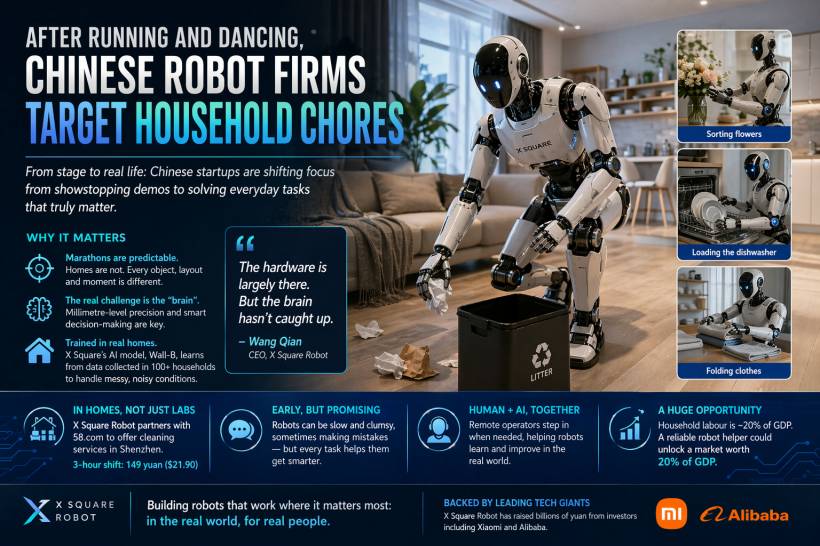
For years, humanoid robots have been stealing the spotlight with flashy demonstrations — running marathons, performing backflips, even dancing on stage. But now, a different kind of test is taking centre stage. Instead of impressing crowds, Chinese robotics companies are asking a tougher question: can robots handle everyday life?
At a recent demonstration in Beijing, machines were seen doing something far less glamorous but far more meaningful — picking up litter, sorting flowers, and handling small, delicate tasks. It may not look as exciting as a robot sprinting at high speed, but it signals a major shift in focus.
The Real Challenge Isn't Movement — It's Precision
According to executives from X Square Robot, the hardware side of humanoid robots is no longer the biggest hurdle. Robots today can move impressively well, thanks to years of engineering progress.
The real problem lies in intelligence — or more specifically, precision and adaptability.
Running, for example, is relatively predictable. A robot only needs to respond to consistent physical forces like gravity and motion. But something as simple as picking up an object or folding clothes requires incredibly fine control. A tiny miscalculation — even as small as a fraction of a millimetre — can cause the entire task to fail.
That is why tasks humans consider basic, like cleaning a room or loading a dishwasher, remain surprisingly difficult for robots.
Why Homes Are So Much Harder Than Labs
Another key challenge is the environment itself. Controlled demos are one thing. Real homes are something else entirely.
Every household is different. Furniture layouts vary, objects are constantly moved, lighting changes, and there are unpredictable elements like pets or clutter. Robots cannot rely on fixed patterns in these environments — they need to interpret and adapt in real time.
This is where the "brain" of the robot becomes critical. Instead of following pre-programmed instructions, machines need advanced AI models that allow them to perceive and react to the world more like humans do.
Training Robots in the Real World
To tackle this, X Square Robot has developed its own AI system, called Wall-B. What makes it interesting is how it has been trained — using data collected from over 100 real households.
The idea is simple: expose robots to messy, unpredictable conditions early on so they can learn how to handle them better. Unlike clean lab environments, real homes introduce noise, variability, and unexpected scenarios — exactly the kind of situations robots need to master.
The company plans to roll out this AI model into its home-cleaning robots soon, marking a step toward more practical, real-world deployment.
Robots Are Already Entering Homes — Slowly
This is not just a concept anymore. X Square Robot has already begun testing its machines in actual households through a partnership with 58.com.
In this setup, users can book a cleaning session that includes both a human cleaner and a robot. It is still early days, but the company says dozens of households have already tried the service.
Feedback so far has been mixed. Many users describe the robots as slow or awkward. Sometimes they make mistakes — placing items in the wrong location or pausing mid-task as if "thinking."
But instead of seeing this as a failure, the company views it as part of the learning process. Every mistake generates data, and that data helps improve future performance.
A Learning Curve That Requires Human Backup
At this stage, robots are not fully independent. When something goes wrong, human operators can step in remotely to guide or correct the machine.
This hybrid approach — combining automation with human oversight — is becoming a common strategy in early-stage robotics deployment. It allows companies to gather real-world experience without fully relying on still-maturing technology.
The Bigger Picture: A Massive Market Opportunity
Despite the current limitations, the long-term potential is enormous.
Household labour represents a significant portion of economic activity. If robots can eventually handle even a portion of daily chores, the impact could be massive — not just in terms of convenience, but also in economic value.
That is why companies and investors are paying close attention. Startups like X Square Robot have already attracted funding from major players, including Xiaomi and Alibaba, both of which are heavily investing in AI and automation.
Final Thoughts
The evolution of humanoid robots is entering a more grounded phase. The focus is shifting away from performance demos and toward practical usefulness — and that is where the real challenge begins.
Teaching a robot to run fast is impressive. Teaching it to clean a messy room without breaking something is much harder.
But that is also where the real value lies. If companies can solve the problem of everyday interaction — dealing with clutter, unpredictability, and fine motor control — robots could finally move from novelty to necessity.
For now, they may still be a bit clumsy. But they are learning — and this time, they are learning in the real world.











Comments 0