

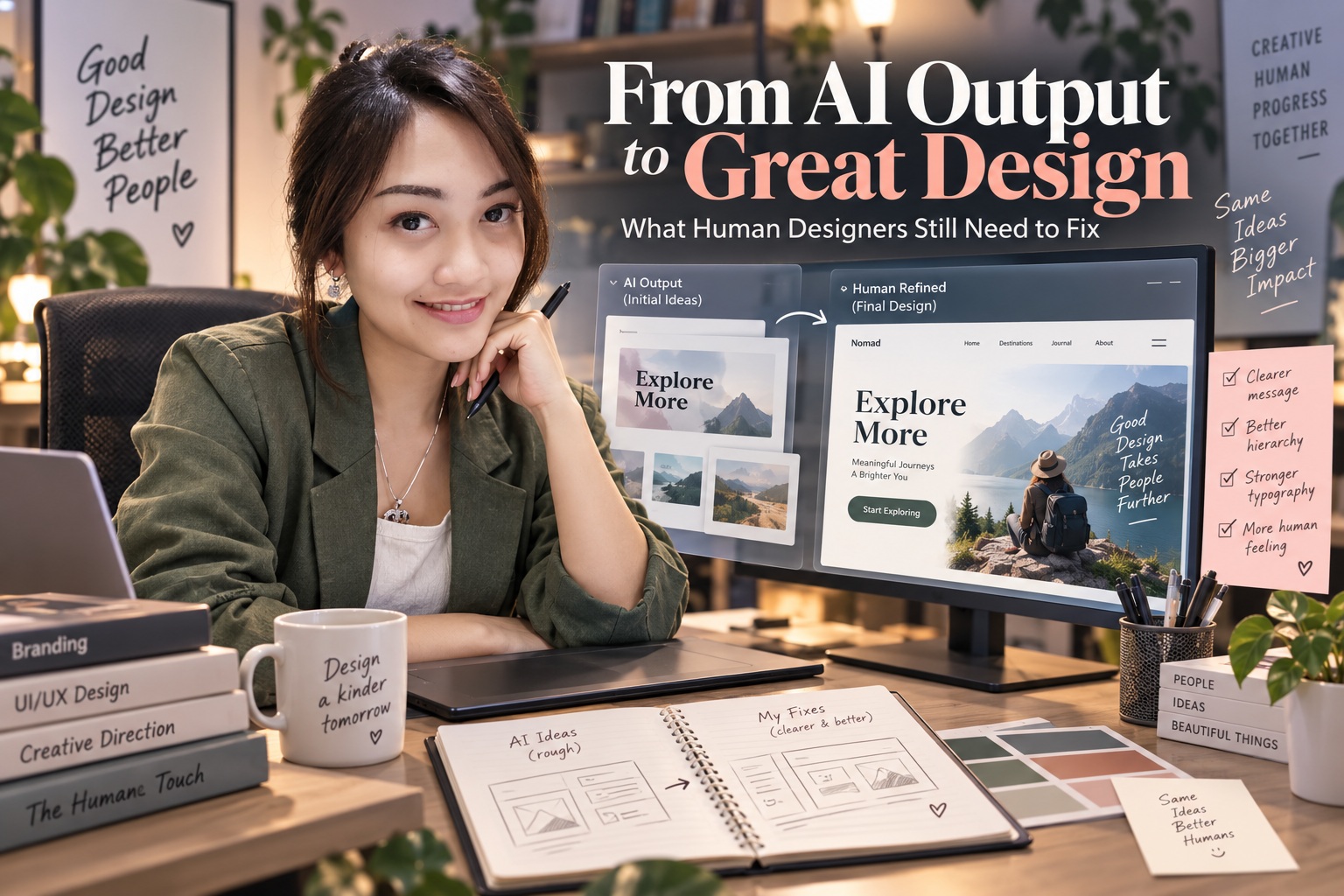
AI can produce a logo in seconds, generate dozens of layout directions, suggest colour combinations, draft interface copy, and turn a rough idea into something that looks surprisingly polished. For designers, that speed is both exciting and slightly unsettling because it changes how quickly a concept can move from blank canvas to something that feels almost finished. The important distinction, however, is that generating a design is not the same thing as designing something well.
AI is extremely effective at creating starting points, but those starting points still need interpretation, refinement, simplification, and testing. A visually convincing output can hide poor hierarchy, weak usability, awkward typography, or a complete misunderstanding of the audience. The most productive way to think about AI in design is therefore not as a replacement for designers, but as a tool that shifts where designers spend their time.
AI Is Excellent at Creating Possibilities
One of generative AI's greatest strengths is speed. A designer who might previously have explored three or four concepts can now generate dozens of visual directions within the same amount of time, experimenting with different compositions, moods, illustration styles, brand treatments, or interface structures. That makes AI particularly useful at the exploration stage, when the goal is not to perfect anything yet but to understand what directions are available.
This can be incredibly valuable when facing a blank canvas. An imperfect generated concept may reveal a better idea, while an unusual composition may suggest a visual approach that would not have emerged immediately through traditional sketching. Several variations can also help clarify what the designer does and does not want, which is often just as useful as finding the final direction.
The limitation is that more options do not automatically produce better decisions. AI can generate dozens of alternatives, but it does not inherently know which one best fits the brand, audience, product, or business objective. Choosing what deserves to move forward still requires judgement.
Context Is Where AI Still Struggles
Every design belongs to a larger situation. A landing page exists inside a brand system, a mobile interface belongs to a product, packaging has manufacturing constraints, and a campaign has a specific audience, message, and commercial objective. AI can work with the information included in a prompt, but a prompt rarely contains every piece of context surrounding the real problem.
Human designers naturally ask questions that go beyond surface appearance. Who is using this? What do they already understand? What action should they take next? What does the brand need to communicate? What happens outside the screen? Could something in the design confuse, exclude, frustrate, or offend the intended audience?
Those questions often matter more than visual polish. A design can look sophisticated and still be completely wrong for the people it is meant to serve. That is why context remains one of the strongest reasons human judgement is still essential.
Visual Polish Can Make Weak Design Look Finished
One of the biggest risks with AI-generated design is that it can look complete much earlier than it really is. A polished interface can contain confusing navigation, a beautiful layout can bury important information, and a stylish landing page can make the primary action surprisingly difficult to find. Because the output looks finished, it becomes easy to assume that the design thinking must also be finished.
That is a dangerous shortcut. Visual quality and design quality are related, but they are not the same thing. Design must solve a problem, communicate clearly, and support the user's intended task rather than simply looking attractive in a presentation.
This is where human designers need to look past the surface and ask whether the design actually works. Often, the most valuable improvement is not adding another visual element but removing one that is distracting, redundant, or confusing.
Typography Still Needs a Human Eye
Typography is a perfect example of where AI can get close without necessarily getting everything right. Generative tools can suggest font combinations, create attractive headline treatments, and produce layouts that look convincing at first glance. Yet typography depends on a large number of subtle decisions that are difficult to judge from appearance alone.
The designer still needs to consider whether the typeface suits the brand, whether the text remains comfortable to read at different sizes, whether hierarchy is obvious, and whether line lengths, spacing, and contrast work properly. Smaller screens can expose problems that are invisible in a large mock-up, and multilingual projects create another layer of complexity because the chosen typeface needs to support all required characters and scripts.
These are not minor details. Typography is one of the main ways users experience information, so getting it wrong affects both readability and tone. AI can propose typography, but the designer still needs to decide whether it belongs.
A Good Screen Is Not the Same as a Good System
AI can generate a beautiful individual screen fairly easily, but real products require consistency across hundreds of states, components, and interactions. Buttons need predictable behaviour, forms need clear validation states, colours need defined roles, spacing needs a logical system, and typography needs a coherent scale.
Without those rules, a collection of attractive screens quickly becomes a collection of unrelated screens. The product may look polished in isolated screenshots but feel inconsistent once someone starts moving through it.
This is where human designers still have an important role in turning isolated outputs into a design system. AI can assist with generating components and variations, but someone still needs to establish the underlying logic that connects everything together.
The difference is similar to writing individual sentences versus editing an entire book. Each sentence can sound good on its own, but the overall work still needs structure, continuity, and direction.
Critique Becomes More Important, Not Less
As AI improves at generating design material, the ability to critique that material becomes even more valuable. The important question is no longer simply, "Does this look good?" but rather, "What is not working, and why?"
A designer may notice that the hierarchy is weak, there are too many competing elements, the primary action is hidden, or the visual style is attractive but inappropriate for the audience. The workflow may contain unnecessary steps, or the supposedly original concept may actually feel like a collection of familiar trends generated from the same visual references everyone else is using.
AI can generate another version almost instantly, but the quality of the revision depends on the quality of the feedback. If the designer cannot explain what is wrong, the next version may simply be different rather than better.
That makes design judgement more important in an AI-assisted workflow. The faster machines generate options, the more valuable it becomes to know which options deserve to survive.
Accessibility Still Needs Deliberate Attention
Accessibility is another area where a polished AI-generated design can create false confidence. A layout may look excellent in a presentation while still having poor contrast, tiny text, inaccessible touch targets, unclear focus states, or interactions that cannot be completed with a keyboard.
Depending on the product, designers may also need to consider screen-reader structure, alternative text, motion sensitivity, colour dependence, and other accessibility requirements. These decisions should influence the design from the beginning rather than being treated as a final checklist after everything else is complete.
AI can assist with accessibility reviews, but responsibility still sits with the people building and approving the product. A generated design cannot simply be assumed to be inclusive because it looks professional.
Good accessibility requires deliberate trade-offs and an understanding of how different people actually experience the interface.
Originality Requires More Than Generating More Variations
Generative AI is extremely good at recognising patterns and reproducing visual conventions. That is useful during exploration, but it also creates a risk that design begins to look increasingly similar. When large numbers of designers use similar prompts, models, references, and workflows, the resulting visual language can quickly converge.
Human creativity provides an important counterweight to that tendency. Designers can draw from personal experience, cultural references, architecture, physical materials, historical movements, music, local environments, or unexpected combinations that do not begin inside the same AI prompt space.
The goal is not to make every project aggressively different for the sake of originality. It is to make deliberate choices rather than accepting the first aesthetically pleasing solution a model produces.
AI can generate variation very easily. Meaningful originality still depends on someone deciding what is worth saying differently.
Designers Are Becoming Editors and Creative Directors
As AI takes on more production work, the designer's role may gradually shift away from manually producing every asset from scratch. More time can instead go toward defining the problem, selecting directions, evaluating outputs, building systems, testing solutions, and improving the final result.
That does not necessarily reduce the value of design. In many ways, it places greater emphasis on the parts of the profession that are hardest to automate: judgement, context, empathy, taste, communication, and decision-making.
The designer becomes less of a production bottleneck and more of a creative director overseeing the process. AI can generate material at enormous speed, but the designer still determines whether that material deserves to exist, how it should be changed, and whether it actually solves the right problem.
This shift may ultimately make design more strategic rather than less important.
The Best AI Workflow Is Still Iterative
The weakest AI workflow looks like this:
It is fast, but it skips most of the work that turns an idea into a strong design.
A more useful process looks like:
AI accelerates the exploration and generation stages, but it does not remove the need for the others. A designer might generate ten concepts, reject most of them, combine pieces from the strongest two, rebuild the typography manually, simplify the layout, test it with users, and then revise the design again.
By the time the final product is complete, very little of the original AI output may remain. That is not a failure. The AI still did its job by helping the designer explore more possibilities and reach a stronger solution faster.
AI Can Save Time, but It Cannot Take Responsibility
One of the most important distinctions in AI-assisted design is responsibility. The tool can produce the starting material, but the final decision still belongs to the designer or team putting the work into the world.
If the hierarchy is confusing, the user does not blame the model. If the interface is inaccessible, the problem still belongs to the organisation that shipped it. If the visual style creates the wrong impression or the typography breaks in another language, someone still has to recognise and fix that before launch.
That is why human review is not simply a nice extra. It is the point where generated material becomes an intentional design.
AI can contribute ideas. It cannot own the consequences.
Final Thoughts
Generative AI has changed the pace of design dramatically. It can eliminate much of the blank-page anxiety, produce alternatives almost instantly, reduce repetitive production work, and help designers explore directions that would have taken far longer to develop manually.
What it has not removed is the need for judgement.
A generated interface can look polished without being usable. A generated identity can feel distinctive without fitting the brand. A generated layout can appear finished while hiding serious problems with hierarchy, typography, consistency, or accessibility.
The designer's job is to close that gap.
The strongest future workflow is therefore unlikely to be human versus AI. It will be designers using AI aggressively for speed and exploration while remaining fully responsible for context, critique, refinement, and the final decision.
AI can generate the first version.
Great design still begins when someone decides what needs to change.











Comments 0